“Stop Doing The Memes” — What Actually Works for Dealers on Social Media | Charlie Czerniawski, Car Sales Manager at Sansone Toyota
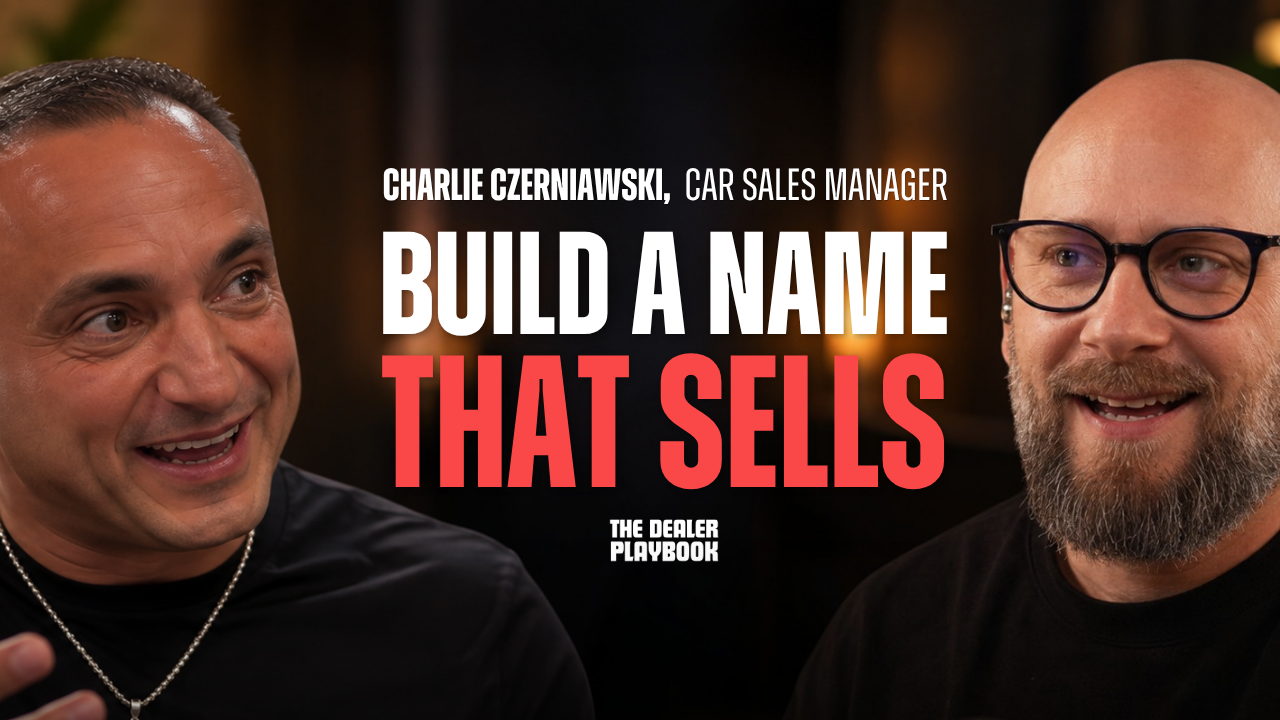
Charlie Czerniawski, better known as Emcee Charlie, has spent more than two decades in automotive retail and built a significant following across Instagram and TikTok.
But this conversation is much bigger than follower counts.
Charlie explains how salespeople can use social media to become known in their market before a customer ever walks into the dealership. That familiarity changes the interaction. Customers start asking for specific people. Trust begins earlier. And the salesperson starts building demand around their own name instead of depending entirely on random floor traffic.
Charlie shares some practical tips, including what he would do differently if he had to start all over again today.
You can find Charlie on Instagram and TikTok as Emcee Charlie.
Michael's takeaway: stop posting for attention and start posting proof. Your name is the thing that gets a customer through the door before price ever comes up.
Timestamps
(00:00) Why People Need To Know You
(00:35) Starting From Zero Online
(01:08) Quick Show Support Break
(02:35) How Charlie Got Into Car Sales
(06:36) Why He Reinvented His Content
(09:12) Sell Yourself Before The Car
(12:03) How To Build Repeat Customers
(18:00) Surviving The Chaos Of Retail
(20:19) What He’d Do Starting From Zero
(24:46) You Don’t Need 50K Views
(28:55) Become The Person Buyers Know
(32:53) Match The Buyer To The Person
(34:34) Connect With Emcee Charlie
(35:31) Final Takeaway
Episode Brought To You By FlexDealer
Need Better Quality Leads? FLX helps car dealers generate better quality leads through localized organic search and highly-targeted digital ads that convert. Not only that, they work tirelessly to ensure car dealers integrate marketing and operations for a robust and functional growth strategy.
Watch The Full Episode
Prefer to watch episodes? Be sure to subscribe to our YouTube Channel and turn on notifications to get full access to our content.
Episode Transcript
[0:00] Why People Need To Know You
Michael Cirillo: Do you think there's any value, even with social media, in the exercise of going and introducing yourself to people? Go introduce yourself to the restaurant owner?
Charlie Czerniawski: Of course. Everybody should know what you do for a living. No matter where you go, church, school, everywhere you go, you should introduce yourself. "Hi, my name is Charlie. I sell cars." Not just sell them a car. They have to know that you're going to be the guy that's going to help them. The mindset is different. The fear of walking into a dealership not knowing who you're going to deal with is the problem today. It's scary to the consumer. These kids are scared. The young adults are scared to talk to people. So if they don't know you, they don't want to talk to you.
[0:35] Starting From Zero Online
Michael Cirillo: Tell me if this tracks. Part of the fairy tale story is, "Oh my gosh, 300,000 subscribers or followers." But really, my guess is you started from the exact same place every beginner starts from, which is zero. What's your recommendation for someone who's afraid of that? They're afraid of the zero, because the fairy tale is everybody does this one thing and goes viral. Where do you start? If you're starting social media today, or restarting today, what do you have to do?
Charlie Czerniawski: If I was restarting today, right now, I wouldn't be doing the—
[Sponsor break]
Michael Cirillo: One of the things I enjoy most about producing The Dealer Playbook is hearing from you, the messages I get from people getting so much value out of the podcast, applying it to their day-to-day workflows, and finding a thriving career right here in the retail auto industry. It means the world to me. One of the ways we make doing this possible is through my agency, FlexDealer. Right now, if you go to flexdealer.com, you can get a full free PDF of my number one best-selling book, Don't Wait, Dominate. A lot of the topics in that book are more relevant today than ever, with the surge in AI and people wondering what they can do next to have a competitive advantage. I'd love to offer you a free copy if you go to flexdealer.com. It would mean the world to me, because that's how we continue to produce this show for you.
[2:35] How Charlie Got Into Car Sales
Michael Cirillo: The first question I'm curious about: did you do the backwards trust fall into the car business like all of us, and then just didn't find your way out? What was your journey into the business?
Charlie Czerniawski: I was working with my pops, and he sold his company. I was in between things. I owned a tanning salon, sold that. Opened up a furniture store, sold that. I didn't know what I wanted to do with my life. Then my buddy called me up and said, "What are you doing right now?" I said, "I don't know." He said, "Why don't you just come sell cars?" I said, "Sell cars?" He said, "You'd be good at it." He was the GSM of a Mitsubishi store. I went there, sold cars, and got hooked. Been there ever since. Can't get out of it now.
Michael Cirillo: What, 20-some odd years, 25 years or so?
Charlie Czerniawski: Yeah, it was back in '99. I got out in 2007, and then went back in 2010. I got out for a couple of years and then went back.
Michael Cirillo: In that time, had you observed any changes or updates to the business, or was it like getting back on the bike?
Charlie Czerniawski: It was getting back on the bike and riding. The business hasn't changed much, even from years ago to now. And that's an issue. The business should have evolved a little more, but it's evolving now with social media. Getting back into it years ago, it was so easy. It was just natural.
[4:07] Why He Reinvented His Content
Michael Cirillo: At what point in your journey are you like, "I've got to turn a camera on"?
Charlie Czerniawski: It wasn't until about three years ago, when I really started saying, "I need to get on social media and get more involved that way." I did it the old school way first. I made signs and put them at the end of people's blocks: "If you're looking to buy a car, no credit, bad credit, good credit, call me. I approve everybody." I stapled signs to telephone poles. People would pull up and say, "No credit, bad credit, got a job? Call me, you need a car?"
A couple years ago I was thinking, how can I get more people through the door? Everybody wants to know a guy. Everybody wants to know somebody. So I said, I've got to start getting on social media that way. I was already on social media because I have a DJ company, showing my parties and stuff. So I thought, how can I incorporate this into doing car business? And that's how I got on.
Michael Cirillo: You've got my mind moving so fast. You're approaching something that's really important for people tuning in to understand: this entrepreneurial mindset of "I am going to put myself out there." Even today, I think about the strategy. Yes, social media is a pillar. Content creation, video, all of it. But also, you're sitting there twiddling your thumbs. The average in the business is 10 cars a month, and you're sitting there twiddling your thumbs. The old idea was print a flyer, go to the mall or the outlets on a Saturday morning, drop it on a thousand cars.
Charlie Czerniawski: Guys don't do that anymore. Kids don't do that anymore. They don't have that mindset.
Michael Cirillo: What do you think that experience did to shape how you approach new and emerging technology?
Charlie Czerniawski: The work ethic is completely different today than it was years ago. Back then you actually had to get up and do it. Now these guys are doing it from their phones, sitting there doing nothing. Everybody's doing memes right now, and I did that three years ago too. That's how I started, and I thought it was funny. But then you realize people don't take you seriously when you're doing that. So I had to reinvent how I wanted to portray myself on social media, and I went back to the old school way: if you need a car, Charlie's your guy. I wanted people to realize that everybody wants to know somebody. The first thing people say is, "I need a car, do you know anybody?" Now everybody says, "Go see Charlie." Why? Charlie takes care of you. Charlie does the right thing. These kids today don't know how to do that.
Michael Cirillo: Do you think there's any value even with social media in the exercise of introducing yourself to people, to the restaurant owner? Because it's not one or the other, it can be both at the same time.
Charlie Czerniawski: Of course. Everybody should know what you do for a living. No matter where you go, church, school, the bowling alley, everywhere you go, you should introduce yourself. "Hi, my name is Charlie, I sell cars," and give them your card. Everybody in your neighborhood, your block, your community, everywhere, should know that you're the guy who sells cars when they need a car. You're there to help them, not just sell them a car. That's the biggest fear about people going into the car business, or people coming to a dealership: not knowing who they're going to deal with.
But it's so much easier when they already know you as a person. I'm not just talking as a car salesperson. As a person, I'm a family man, I'm a husband, I have daughters, I have a son. When they come in and know my life, the first thing they say is, "How's your daughter doing in school?" They already know me. That's where people have to start right now.
The mindset is different. The fear of walking into a dealership not knowing who you're going to deal with is the problem today. It's scary to the consumer. These kids, these young adults, are scared to talk to people. So if they don't know you, they don't want to talk to you. God forbid the doorbell rings, right? Your kids are like, "Yo Dad, there's somebody at the door."
Michael Cirillo: It takes my kids an hour to answer the door. I'm like, "What are you doing? Go answer the door."
Charlie Czerniawski: Exactly. You've got to sell yourself. It's all about people knowing who you are and who they're dealing with. That's what sales is. Sell yourself, you know what I mean? And people will come. If they like you, they're going to buy from you. That's it. It's that simple.
[9:12] Sell Yourself Before The Car
Charlie Czerniawski: I tell everybody, price is not always the best deal. I'd rather pay for service, and most people would rather pay for service. I ask people all the time, "You went down the road, right, and the guy was nasty but cheaper. So why didn't you buy from him?" "I ain't going to give that guy my money. He treated me like crap." I might be a little more, but I'm treating you much better, so you're going to buy from me. The best price is not always the best deal. People say it's the price, the price, the price. No, it's not. It's service. It's the connection, the feeling you're being taken care of, the understanding that you're having an intelligent conversation about the product people want to buy. That's what it's about today.
Michael Cirillo: You're saying something we haven't articulated well enough on past episodes of the show: when I pay for something, it's not just the thing, it's the experience around the thing that makes that price what it is. We talk so much in this business about hospitality and customer experience, but what you just said is the connector for me. Why aren't they buying down the street? Because they've associated the whole value of the transaction, whether knowingly or unknowingly, with more than just handing over money and getting a car. It's like an agency. You're not just paying for outputs, you're paying for the customer service, the mind power, the assembly of everything that goes into that price.
I love the value of what you said, that people have to know who you are. Sometimes I had a brief stint in the music business, and in school as a sound engineer they'd say the music business is a "who you know" business. Then one mentor flipped that on its head and said exactly what you just said: it's not about who you know, it's about who knows you.
Charlie Czerniawski: Who knows you. Exactly. This is what people don't understand. If I'd had social media years ago, forget it, I'd probably own a ton of dealerships myself, because I'm that guy who likes to put myself out there. I like to talk. I want to know everything about people.
[12:03] How To Build Repeat Customers
Charlie Czerniawski: The problem is, kids have to be able to have an intelligent conversation about the product, but also about life, about how to connect with people. If people tell you their future plans, "Hey, I'm here today, but I've got to hurry because Johnny's got a football game, my daughter's got a dance recital," that means they like you and trust you. Even if they don't buy, the first question you should ask when they come back is, "How was Johnny's football game? How was Samantha's dance recital?" These guys today don't get that. They think it's just about selling the car. It's not about selling the car. It's about building a relationship.
Michael Cirillo: Where did you acquire that? I know culturally we're probably cousins somewhere along the way, but I think a lot of those social cues came from your upbringing.
Charlie Czerniawski: Yeah, my father was a natural salesperson. He always just talked to people, and people would open up and tell him things. My father used to say, let people talk. They want to tell you. If you ask the right questions, they'll tell you what they want. Just listen. Then help them get what they want. It's their money they're spending, so you have to have their best interest at heart. If you have their best interests in mind and they feel good about what they're buying, they're going to buy from you. That's what sales is all about. Building that long-lasting relationship, where you buy, they buy, their kids buy, their grandkids buy, and it just keeps going. They tell their friends, "Go see my guy, go see Charlie."
The biggest problem in our industry is salespeople jumping around. They're never going to make a book of business. They're never going to last. People aren't going to follow them because it's a stability problem. Not only do they have to build a long-lasting relationship with the customer, they have to build a long-lasting relationship with the dealership they're at. That's where owners and managers forget: you're there to make sure your guys make money. Profit's not a dirty word. These guys have to be able to pay their bills. You have to teach your guys how to make money. If you teach them how to make money, they'll stay with you, and the longer they stay, the more everybody makes. Turnover is not good. That's the worst thing for a dealership.
Michael Cirillo: It's funny you say that, because I bet there's a correlation between turnover and how often people buy their next car. If salespeople switch dealerships every three to five years, and customers buy every three to five years, and nobody's loyal to a brand anymore, there's a sliver of a correlation there. But if you work at the same place consistently, and pay attention to the cues people are volunteering, and leverage that to serve them, they're going to come back and buy another car, service it more consistently, and so on. That's the unlock.
Charlie Czerniawski: And here's the thing. If the parents bought, when it's time for the kids to buy, they're going to listen to their parents, and it just keeps going that way. Then the friends, the referrals. But if I'm not there anymore, people say, "Where'd he go? What happened?" If you're only there for two years and then you're gone, it gives people a bad feeling about the dealership. Why aren't the same salespeople there? Where did everybody go? Why did people leave? Should I even buy a car here? And normally, when that salesperson leaves and the customer follows them, the salesperson tells them, "I left because that place was no good. I didn't make any money there, or the managers weren't good."
My GM now, and I've been with him a long time, I've been at the same dealership since 2012, he's the one who told me: make sure your guys, your troops on the line, are making money. Make sure they're happy. You've got to be their mother, their father, their uncle, their aunt, their brother, their therapist, whatever you've got to be. Because we rely on them to make us money and keep this business going. If they keep leaving on you, you're never going to build an environment people want to come and buy a car from. I never thought of it that way until now, being in the business this long. My group of guys have been with us, and now people just come.
That's how it's building the relationship. Dealers have to understand these guys need to make money, to take care of their families, to take vacations. And customers feel that. "How long have you been here?" "Eight years, nine years, ten years." "Wow, that's a long time. It's a great place." If the salesperson feels it's a great place, that comes off to the customer. The whole energy of the dealership changes. My managers are great, the service is great, the product is great, I'm great, and that helps the environment.
[18:00] Surviving The Chaos Of Retail
Michael Cirillo: I've got to ask you this. We hear the narrative from frontline salespeople all the time: "I've got to move, my managers are this or that." You've obviously experienced all of that. What keeps you going consistently, even for a place that could be better? How do you work in those environments and see it through?
Charlie Czerniawski: It's a mindset, first of all. Everybody can be negative about everything all the time. I can complain every single day about something if I want. I try to look at it the other way, at what's great about being here. I'm not going to focus on the negative, because I can, everybody can. Nothing's always amazing. It's not always sunshine and rainbows. Let's be honest, it's the car business. The hours are horrible. There are a lot of horrible things in it. But there are a lot of great things too. If you focus on the bad, that's what you're going to focus on. If you focus on the good, that's what you're going to focus on. It's a mindset, and you've got to get your troops to feel that way. The owners have to feel that way too.
Sometimes when your owner walks in and says, "You guys did a great job, just keep it going," that goes a long way. The yelling and screaming nonsense doesn't work. You've got to pat people on the back and make them feel they're doing a good job. It's not always about money. A thank you, a "great job today, guys," goes a long way with people.
People tend to watch social media all the time, and everything looks like a fairy tale. It looks so good, and you wonder why your life isn't like that. Because it's a fairy tale. But this is reality, right here, right now. Let's make the best of what's going on. That's why the social media thing works: you get your guys on social media, people get to know them, and it pulls customers in.
[20:19] What He'd Do Starting From Zero
Michael Cirillo: I want to ask about the social media thing, because you weren't always on it. You mentioned you started a few years ago, and my guess is you started from the exact same place every beginner starts from, which is zero. What's your recommendation for someone afraid of that, afraid of the zero, because the fairy tale is everybody does one thing and goes viral? If you were starting or restarting social media today, what would you do?
Charlie Czerniawski: If I was restarting today, I wouldn't be doing the memes, because people have left that behind. They think you're a joke, and you don't want to be taken as a joke.
Michael Cirillo: You're not doing "Drop It Like It's Hot" videos?
Charlie Czerniawski: Hell no. Even when I did dance videos three years ago, that's how I started, I was doing dance videos and meme videos, but I was never doing anything like that.
Michael Cirillo: You were doing the tarantella.
Charlie Czerniawski: Yeah, I was doing dance ones, but more like celebration. A customer just leaves, and I'd do the running man or something exciting to grab attention. But I'd do something real and relatable for today. So basically, a customer just bought a car and they're walking out: "Let's give Mr. and Mrs. Jones congratulations. I just want to welcome Mr. and Mrs. Jones to the family in a new 2026 RAV4." Tag them, make them smile, ask if they had a great experience. That's the social media people want to see: good experiences. Ask them to give you a review. That's the way I'd go if I was starting today. I wouldn't be saying, "Hi, my name is Charlie, come buy a car from me." No. You spotlight happy customers, tag them on Facebook and Instagram, collaborate with them, because now their friends and family see that you sold them that car, and it builds from there.
Michael Cirillo: What I love about that is, think about where things are going with AI, where it can fill in the context gaps for people doing searches and getting AI information. It's not just about the features of the car anymore. It's, "Mr. and Mrs. Jones actually had a good experience buying from Charlie."
Charlie Czerniawski: Right. I think people don't want to see the AI thing anymore. They want to see real people doing real things with real events. I could put myself into AI and make myself sound perfect, but I think people want to see who Charlie really is, the raw footage, the reality of what's going on.
Michael Cirillo: When you're starting out, and your first video probably takes the most time, and you get 123 views, what should your mindset be to keep you doing it tomorrow, and the day after, and the day after? A lot of people get discouraged by that.
Charlie Czerniawski: You have to be consistent. That's consistent in anything in life. Nothing works the first time, nothing. You have to be consistent no matter what. People used to say to me, "Oh my God, here he is again, doing another video." But I kept switching it up, kept trying to make it new, and I still do that today. I'm always trying to figure out something new. I try to show real experiences with real customers. Ask anybody who knows me: I don't do anything fake. I do everything real. It's a real scenario, but everything is real. I'm not going to do the running man anymore. It's evolved. People want to buy from people who are real and show who they are. So consistency is key. Keep doing it, keep doing it, keep doing it. And then it just becomes part of your daily routine. It's reality.
[24:45] You Don't Need 50K Views
Michael Cirillo: Tell me if this tracks. Part of the fairy tale story is "300,000 subscribers." But really, if I'm in a town with 20,000 people and I'm posting a video a day that averages 1,000 views, in the context of my market, I am viral.
Charlie Czerniawski: Of course you are. And here's the thing: you may reach that one person who didn't know you sold cars, and they come in and buy a car. You only have to reach that one person. Don't worry about reaching hundreds of thousands. Worry about reaching the one person who actually needs to buy a car from you, or whatever you're selling. That one person could make the sale, could make your day. Don't look at it as needing 50,000 views, or 10,000, or 3,000. Views are nothing, because most of the time people are just scrolling anyway. You want that one person who says, "I need a car," and comes to see you.
Michael Cirillo: That's where the consistency comes in.
Charlie Czerniawski: Right, because now they see you on a regular basis. They saw you once, watched a few more times, and now you're coming up on their screen all the time. That's what it is.
Michael Cirillo: Are you worried about the algorithm? I feel like that might skew the authenticity you're talking about.
Charlie Czerniawski: I don't care. I post whenever I feel like posting. Sometimes I'll post three stories early in the morning, sometimes at 12 o'clock at night, whenever my brain says to. I make content, edit it real quick, and post it. I don't worry about the algorithm. Just get yourself out there and post, because people want to know who you are. Post real stuff. Be authentic. Don't be fake, don't lie. Just do the natural stuff. Here's the one thing people don't get: don't say "come buy a car from me." People don't want to hear that. They want to see you in action. "I just want to congratulate Mr. and Mrs. Jones on their new 2026 RAV4," and let them drive off. That's all you have to say. Start with that.
Michael Cirillo: Something that comes to mind that validates everything you're saying: there's a creator on TikTok or Instagram, and when I'm scrolling, I have no interest in what this woman does at all. She makes handmade soap at home, and her videos start every time with her spraying her hands with something so she can take the soap out of the mold. She just says, "Hey y'all, hope you're having a good day." Why do I stop and watch this woman? Because my mind is asking, what is she all about? Something as simple as unpackaging handmade soap, and people watch. It's like you said: bring people into the world you're living in, because they're curious. It can be as simple as congratulating a customer. I love it because it shows what you do, it shows your environment, and it's a living, breathing case study every day that you're the guy selling cars to people, and you've got the proof. Meet the Joneses, meet the Johanssons, meet the Smiths.
[28:55] Become The Person Buyers Know
Charlie Czerniawski: That sends signals to people: he's the guy selling cars here, and people are having a good experience, I need to go see what he's all about. I've been trying to spotlight some of my guys, especially the new ones. I call one of my guys "Mr. 21." He sold 21 cars three months in a row, so I call him Mr. 21, and I get so many people asking, "How's Mr. 21 doing? I want to buy a car from Mr. 21." Then I hired another young kid, Kevin, and I call him "Mr. 7." He did seven cars in a week and four days with me, so by the end of the month I called him Mr. 7, and now I'm getting him to 12 cars, and people want an update on him. People want to know who these guys are and what they're doing. I want to teach them the right way to treat customers, to do the right thing.
It's about people. They want to know who they're buying from, and that they're buying from somebody they actually like. If they like you, it bridges the fear of pulling into a dealership and seeing 20 guys standing outside, thinking "Who am I going to get?" Or calling into the BDC, and they say, "Go into the dealership, ask for Bob." They don't know who Bob is. But they already know who Charlie is, because they saw me on social media. So they come in looking for me right away. "Ask for Charlie, my friend told me to ask for Charlie," because it's just a different feeling. You've got to be that person for them. People want to know you're going to take care of them, that you have their best interest in your hands and you really care about them. That's what makes a phenomenal salesperson. You've got to make sure people know you're not there to hurt them, that you'll listen to their needs and take care of them. Not just sell the car, but if a problem occurs, you're there. "Here's my cell phone number, call me anytime, I'll make the appointment for you." That makes a difference.
[30:57] Michael's Playbook Recap
Michael Cirillo: As we wind down, here's the playbook I'm hearing. Number one: the job is taking care of people, placing their interests ahead of your own. That's the famed Zig Ziglar line: "Help as many other people achieve success and you'll be successful." That's the job. Number two: your social media is a tool of the job. So in closing, because your job isn't social media, it's an aspect of your job, how do you do it when you're having a heavier day, feeling uninspired, you had to help a customer with something, you're trying to take care of your team, and it becomes a chore? What inspires you to keep doing it even when it's a chore?
Charlie Czerniawski: For me, I actually still enjoy doing it, and I like helping my salesmen grow with it too. It only benefits my dealership, my family, and other families by doing it. I've just got to keep doing it. It's the way of the future, and you've got to do it the right way, not the wrong way. Stop doing the memes, stop doing all that nonsense, and do more of what's actually going on in your dealership. And dealers need to stop spending money on characters they're never going to buy from, like hiring a celebrity to speak. No offense to them, but customers are never going to actually know that celebrity. Spend the money on your guys and girls who are selling the cars. Imagine your website showing all your salespeople the right way, letting customers get to know them. Dealers have to spend money the right way, so people know who your salespeople are, and people will come. Advertise your salespeople.
[32:39] Match The Buyer To The Person
Charlie Czerniawski: Let me rewind. People are searching for a salesperson for a car. They already know the car they're buying. Now they're finding the right person to sell them that car. It's almost like Match, like match.com. Who's going to be the right person? At least I need somebody who speaks Spanish, or Italian, or whatever it is.
Michael Cirillo: I've never thought of it like that. We're not matching people to cars. We're matching people to people.
Charlie Czerniawski: A hundred percent. You're connecting people to people. And if you connect the right people, listen, I'm not for everybody. Sometimes I'm too much, I get it. I might be too much high energy, but the difference between me and someone younger, I'm 52 years old, is I know when to turn it on and turn it off. I can bring the energy up or down, where a young kid might not be able to do that yet. He'll learn how to do that. Tony Robbins once said you've got to be able to mirror people. If somebody's sitting relaxed, you sit more relaxed. If they're sitting straight up, you sit that way too, so you feel like you're mirroring them. That works. But you've got to match the right salespeople to the right people. Sometimes people go there to buy a car, and it's the wrong salesperson, so they leave. What happened? Then I get involved, and it's just the wrong salesperson who showed them that car. Dealers have to spend money connecting their salespeople with the consumers, because it's Match.
Michael Cirillo: It's match.com.
Charlie Czerniawski: It's exactly what it is.
Michael Cirillo: I love it, man. This has been so much fun. Thank you for coming on the show and sharing your wisdom with us. How can those listening and watching connect with you?
[34:37] Connect With eMCee Charlie
Charlie Czerniawski: MC Charlie on Instagram and TikTok. That's E-M-C-E-E Charlie. Message me, I try to respond to everybody. It's not that easy now that I'm growing, but I really try. And I'm not just there to sell. If people have questions, I try to answer them and steer people in the right direction. Car guys are known as the bad guys, but we're not all bad. I'm a father, I'm a husband. I'm a DJ, I'm an MC. It's that simple. We're not bad. I just sell cars, that's it. Everybody's entitled to make a dollar, and consumers understand that. Nobody works for free.
Michael Cirillo: I love it, man. Thanks so much for joining me on The Dealer Playbook Podcast.
Charlie Czerniawski: My brother, it was an absolute pleasure.
[35:31] Final Takeaway
Michael Cirillo: Hey, thanks for listening to The Dealer Playbook Podcast. If you enjoyed tuning in, please subscribe, share, and hit that like button. You can also join us and the DPB community on social media. Check back next week for a new Dealer Playbook episode. Thanks so much for joining.