“I Didn’t Have to Chase Ups” — Car Sales Systems Behind 64 Cars in 15 Days | Kevin Rudolph, Sales Team Leader at Royal Buick GMC
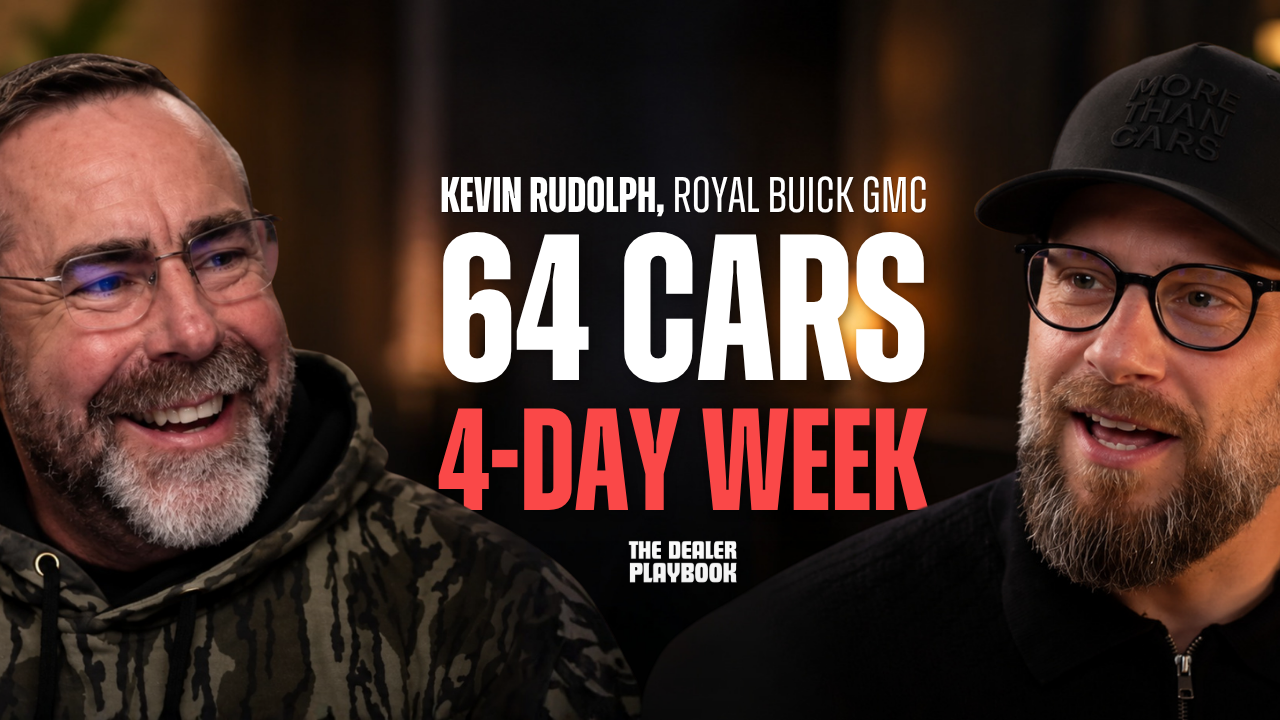
Kevin Rudolph sold 64 cars in a month and worked 14 or 15 days to do it. He didn't chase ups, and he didn't wait on the BDC.
Kevin is a top-producing salesperson at a single-point Buick GMC store in rural northwest New Jersey. Before sales, he spent 13 years as a master tech and shop owner, and he only stepped onto the sales floor because his wife pushed him. He had one condition. His kids were going to know him.
That condition forced him to build something most reps never do. In this conversation, Kevin walks Michael through the request he made to his bosses once his numbers backed it up. He shares how two full-time assistants became part of his deals, and why his customers are fine buying from his team when he's home with his family. He also talks about a mentor's line that became his reason for going to work every day, and why he won't sponsor anything he can't personally show up to.
And Kevin explains what happened when his store took notice.
Connect with Kevin on Facebook by searching #ridewithrudolph, or find Kevin Rudolph on LinkedIn.
Michael's takeaway: "Kevin earned the help before he asked for it, and that help bought his family time back. Build the process, prove the units, then go get your people."
Timestamps
(00:00) 60 Cars Four Days
(00:53) Sponsor Message FlexDealer
(02:17) From Repair Shop To Sales
(05:47) Family First Mindset
(11:47) Building A Sales Team
(16:41) Community Giveback That Works
(20:38) First Three Career Moves
(24:21) Culture Training And Small Markets
(28:25) Key Takeaways And Mindset
(32:22) Connect And Closing
Episode Brought To You By FlexDealer
Need Better Quality Leads? FLX helps car dealers generate better quality leads through localized organic search and highly-targeted digital ads that convert. Not only that, they work tirelessly to ensure car dealers integrate marketing and operations for a robust and functional growth strategy.
Watch The Full Episode
Prefer to watch episodes? Be sure to subscribe to our YouTube Channel and turn on notifications to get full access to our content.
Episode Transcript
[00:00] Michael Cirillo: You sold upwards of 60 cars in a month, working four days a week.
[00:04] Kevin Rudolph: That is correct. Best month ever was 64 cars, and I think I worked a total of 14 or 15 days that month.
[00:09] Michael Cirillo: It's worth emphasizing, you earned that right. This is not some individual selling eight cars a month who says, "I think I can get to 15 if I had people working exclusively with me." You put the proof in. You built the infrastructure and the systems, and I think that's worth noting.
[00:27] Kevin Rudolph: Right. So I never looked at it as, I need to be there 90 hours a week to do this job. I need to find a way to do the job from a high-value position and not be here 90 hours. How do I do that?
[00:38] Michael Cirillo: I know that doesn't just happen by happenstance. If you look back over your years of experience now, the lived experience, what would you say are those first three moves? What started really moving the needle for you coming into the business?
[00:51] Kevin Rudolph: That's a good question.
---
Sponsor Message
[00:53] Michael Cirillo: One of the things I enjoy most about producing The Dealer Playbook is hearing from you. I get messages from people who are getting so much value out of the podcast, applying it to their day-to-day workflows, and finding a thriving career right here in the retail auto industry. It means the world to me.
And one of the ways we make doing this possible is through my agency, FlexDealer. In the spirit of providing value, I think this is a perfect time to head over to www.flexdealer.com. To show even further support for you, my beloved DPB gang, if you go to flexdealer.com right now, you can get a full free PDF of my number one bestselling book, Don't Wait, Dominate.
The reason I think it's so special is that a lot of the topics in this book are even more relevant today than ever, with this surge in popularized AI and people wondering, "Well, what can I do next? How can I have a competitive advantage?" That's all here in this book. So I'd love to offer you a free copy if you go to flexdealer.com. It would mean the world to me, because that's how we continue to produce this show for you.
---
From Repair Shop to the Sales Floor
[02:17] Michael Cirillo: Okay, this is kind of the first place I like to start with people. Did you grow up saying, "Man, I want to work in the car business," or did you do the backwards trust fall like all of us did?
[02:30] Kevin Rudolph: It's kind of a hybrid for me. I grew up in a family retail business, so I always enjoyed the interaction, people to people, and just getting to know my customers. My family had a deep-rooted business where our customers knew us and we knew them.
In my mid-teen years, I said, "You know, I really have a passion for cars." So I got into the auto repair side. I did two years of business school at a community college, then went to automotive trade school and became a master tech. And I ended up buying a business, an auto repair shop I had originally worked at.
I spent the better part of just under 13 years doing that. Along the way, I was also a State of New Jersey humane police officer, so I got a lot of interaction and some different people skills from that job as well.
Then, because of family circumstances, my wife tragically lost her parents. We had a young son. So I decided to pull back from automotive, because as we all know, no matter what side you're in, it takes a lot of time. And we had a newborn. So I sold the repair business and took a year off. My family and I traveled a little bit, and ultimately we decided to come back home to New Jersey and plant our roots.
At that point my wife's like, "Listen, you love cars, you love people. Why don't you sell cars?" So I credit her with a little bit of the push to come back into automotive. At the same time, I had this stigma of the slimy, sleazy underbelly of the automotive side, and at first I was very hesitant to get into sales. But she gave me a little push and I said, "You know what? I'm going to try it. It can be a lucrative career if you do it right, and when it's properly structured, it can be a way to be a little more present, a little closer to home."
And I think for a lot of our viewers here, being present was always my goal in this industry. I needed to be a family man first. So I ended up settling at a local mom-and-pop store. It's Buick and GMC, a single location, so it's not corporate-owned, and it had a much better feel to it. I've been there just under 10 years now.
[04:46] Michael Cirillo: Can we pause for a minute to double-click on what you just said? You might be the first guest in 12 years of podcasting who said, "My wife encouraged me to go sell cars." Kevin, I have never heard anybody say that.
[05:03] Kevin Rudolph: So listen, Mike, we have to give credit where credit is due. I was like, "I don't want to be a car salesman. Maybe I can be management, maybe a service advisor." So I actually started looking at service advisor roles, and she goes, "Yeah, but you're burnt out from fixing cars. The passion is lost on the repair side."
I ultimately gave in to her advice. I said, "All right, I'm going to go interview at a couple of places," and I did. And the feel was off for me. Like I said, what mattered most to me was knowing I'd be at a place that allowed me to prioritize my family as the reason I go to work every day.
---
Family First From Day One
[05:46] Michael Cirillo: This is cool. There's something here that deeply resonates with me, and it's this concept of work-life, or life integration. Years ago I interviewed Grant Cardone when he had released his book, Be Obsessed or Be Average. The reason I'm going there for a second is that it ties back to what I'm picking up from you.
He said most people get this wrong. They get fully obsessed about work, and then their family suffers. Or, and it sounds weird, they get so into their family that they can't actually provide for them because they don't work enough. And he said the trick is being obsessed about all the facets of your life, not just one.
You're saying something about work, dare I call it work-life balance, that I think our industry has a hard time reconciling, because we have the hustle heroes and the bell-to-bell guys and the cradle-to-grave and this and that. Coming into the business with family first in your mind is really interesting. How were you able, from the hop, to reconcile that and still go on to accomplish what we're going to talk about?
[06:56] Kevin Rudolph: There was a part of me that said, "You know what? There's no good in any job where I'm going to lose my family in the process." Initially, I had a plan to kind of do what you said: be the bell-to-bell guy and work my tail off while the kids were little, when maybe they wouldn't miss me and wouldn't notice the lack of presence so much.
My wife and I had that understanding: "Okay, you're going to hustle, you're going to grind, you're going to be that guy." But we fully recognized the pattern of automotive. Once you build your book of business, and then build on that book, it dynamically changes how this industry needs to be.
So I never looked at it as, I need to be there 90 hours a week to do this job. I need to find a way to do the job from a high-value position and not be here 90 hours. How do I do that?
Early on, before I had any mentorship or anything else, I knew there was a way to model this business so that people came in and asked for me. I didn't have to chase ups on the lot. I didn't have to rely on the BDC department, which meant I didn't have to hang out for appointments that were set when I should be home with my wife and kids. And from day one, that changed the scope of how it looks, not only for me, but for my whole store.
[08:15] Michael Cirillo: What is it about you that makes this non-negotiable? Because I think a lot of men feel the same way but just can't pull the trigger on family first. Is it how you were raised? Is it a faith tradition? What feeds into this ecosystem you operate in?
[08:35] Kevin Rudolph: I'll jokingly say fear of loss. One of my mentors, and I know you're familiar with him, as a lot of the industry is, is Jonathan Dawson. He very candidly said to me early in the business, "What good is your kingdom if you lose your queen in the process?"
I've watched guys over 10 years of doing this, and from what I knew of the business beforehand. Listen, if you work 90 hours, six days a week, and you're taking phone calls on your one day off, you're not able to be present when you're not in the office. I'll call it divorce club.
So early on I said, "I want a structured family life where my kids know me, I know my kids, I know my wife, and we stay best friends." That was non-negotiable from day one. If it couldn't be that way, I wouldn't be doing what I do.
[09:25] Michael Cirillo: I love it. It fits with the show. When we first started the pod, back in 2012 or whenever it was, it was so much about sales tactics and marketing tactics and this and that. As the years have gone on, what you're talking about has become the much more interesting conversation: how do I thrive as a whole while working in this industry? And that requires the other facets of life being healthy.
[09:47] Kevin Rudolph: Absolutely.
[09:48] Michael Cirillo: I'm going to butcher it now, but what's the point in having a kingdom if you lose your queen in the process? I see that becoming a real motivator in how you operate, and in how you condense productivity into the time you've allocated to the workplace. So I want to talk to you a little bit about that.
I know there's going to be a lot of curiosity about coming into the business selling cars. And you say something I think is so important, which is the concept of being the figurative mayor of your town. So you come into the business as a salesperson. Do you feel like your experience as an entrepreneur, working in service-related businesses on the fixed ops side, gave you a leg up?
[10:46] Kevin Rudolph: Without a doubt, the answer is yes. Knowing how cars work means being able to explain things with integrity, instead of just saying, "Oh yeah, the diesel's better than the gas." You can explain things to your customer 12 different ways. You can take an experienced former mechanic as a customer, or a single mom buying a camper for her and her kid, and walk through the mechanical differences in a way they understand. That's absolutely a leg up. Having a foundation in how the machines we sell actually work means a lot.
---
Building Team Ride with Rudolph
[11:26] Michael Cirillo: I might get the number wrong, so you'll have to correct me, but I want to say you sold upwards of 60 cars in a month working four days a week.
[11:36] Kevin Rudolph: That is correct. My best month ever was 64 cars, and I think I worked a total of 14 or 15 days that month.
[11:47] Michael Cirillo: I know that doesn't just happen by happenstance.
[11:51] Kevin Rudolph: Absolutely not.
[11:52] Michael Cirillo: What moves are you making to build that kind of momentum?
[11:56] Kevin Rudolph: First and foremost, I now have two full-time assistants who only work for me. So we're Team Ride with Rudolph instead of just Ride with Rudolph, as I've branded myself. And again, I grew into that. When I was at 20 cars, hitting 30 cars, it wasn't a necessity. It just meant I had to work more, work harder, and work more efficiently. So building my own personal process within the dealership platform was huge.
What I've done over the years is not only have a process, but have systems for those processes. When I sell a car, my team knows exactly what to do. They move it through, from the handshake I do to the handshake I give the customer when they're leaving. In the middle, sometimes I'm only actually interacting with my customer for 30 to 45 minutes total. My assistant is prepping the deal jacket. My assistant is bringing the car to prep. She's making sure it's full of fuel. She's onboarding them with their insurance company and our mobile app.
The ability to do that was earned. I had to hustle and grind to get to a level where I could say to my bosses, "Look, I can sell 30 cars and nobody's going to be upset, but I can do more. And I know you've never heard of something like this," because at the time, nobody in our area really had. I said, "But I need help, and I need the help to only be my help. I can't have it be a floater. I need to know this person is trained by me, in my system and my process."
And I've been super blessed with two young ladies who have been with me for six years and, I think, going on three years now. They know what I do. When I go left, they go right, and we meet at the back end of it with a happy customer.
[13:48] Michael Cirillo: Okay, there are a couple of things I want to unpack, because it's worth emphasizing: you earned that right. This is not some individual selling eight cars a month who says, "I think I can get to 15 if I had people working exclusively with me." You put the proof in. You built the infrastructure and the systems, and that's worth noting for anyone curious how Kevin has done this.
So the next question: are these individuals paid by the dealership, or are you paying out of your own pocket to have them work specifically for you, or is it a mix?
[14:27] Kevin Rudolph: It's a mix. I pay a certain portion and the store pays a certain portion. It leans a little heavier on my side with one of them, and the other is a direct split. I know that if I can sell and deliver an extra 20 to 30 units, it's more than worth it, and it preserves what we talked about earlier. If I'm not there today, my assistant is. So if I get a phone call, it goes to her. I don't have to take time away from my wife and kids on a day off. My customers know my team is there.
That came from teaching my customers: "Hey, if I'm not here and Jessica's here, or if I'm not here and Carla's here, they can step right in." They can take a deal from front to back, and it stays with my team, because these are all repeat and referral customers. They're only walking in asking for me. At my store, we operate as a unit. My store knows that if they're my customers, they always have help.
[15:23] Michael Cirillo: This is interesting. We see this model a lot in real estate, right? You might work for a firm, Keller Williams or whatever it is. Hashtag not sponsored. Do we even say that anymore?
[15:34] Kevin Rudolph: We do now.
[15:37] Michael Cirillo: And they'll have assistants who work with the licensed realtor to do all of these sorts of things. You actually answered the follow-up question I was curious about, which is: what is it about your customer in particular that says, "Yeah, we want to work with Kevin," even knowing he might not be there the day they buy, instead of a salesperson who is there? And I think you answered it. You've built a book of business. These are mostly repeats and referrals.
[16:09] Kevin Rudolph: Yeah, and it's important to note, because we all know there are referrals, and then there are fans. One thing I've worked very hard at is making sure my people not only want to work with me, but want to work with me for a reason. It's one thing to say, "Hey, Michael's a good guy, go see Michael." But if Michael's not there, the person who took the time to come into the building probably isn't going to reschedule. They're going to talk to Joe next door, because they're already here and they came in to get information or make a purchase.
---
Community Giveback That Works
[16:41] Kevin Rudolph: So my customers know, and this will probably segue into another part of our conversation, that working with my team produces something for their community. There's a giveback associated with it. We've become known as community champions and community sponsors in several areas.
That's why people will wait for me, or work with my assistant instead of me, even though she might not know as much about the vehicle. And mine are very good, but maybe they don't have all the technical answers, or maybe the customer has to wait until tomorrow to get their final numbers from me. But they know that by working with us, they're giving back, and they're part of that community.
[17:25] Michael Cirillo: Why does it work for you? One of the things I love about our industry is how generous it is, and in some ways we're still struggling to publicize that ethically, so it doesn't feel scummy or like an ulterior motive. Why do you think community giveback lands for you, when some dealerships that are legitimately donating millions of dollars and helping at soup kitchens aren't hitting the same way?
[17:56] Kevin Rudolph: I think a big reason, and this goes back to entry-level marketing for me, is presence. If you're not present at whatever you're sponsoring, you don't become part of that community. If you sponsor a pet shelter but you never go to the pet shelter and you're not an animal person, people see through that. They don't make the same connection when you're not present in the area you're trying to support.
We both know anybody can put a billboard up. Anybody can sponsor a youth sports team. Anybody can sponsor a pet shelter. But if you're not there on adoption day, and you're not there to hand out the trophies or bring the kids water bottles or pizza, nobody really knows who you are. In our industry it comes across far too often as a gimmick. "I'm going to donate $100,000 to this charity." Okay, that was very, very generous of you. But did you show up? Were you there for the people? Did you shake hands with the people? So I try not to sponsor or get involved in anything I can't also show up to.
[19:03] Michael Cirillo: Yeah. It's the genuine touch point that makes the difference. You're right. We expect our money to do the talking for us.
[19:15] Kevin Rudolph: Yeah. People recognize it's easy to cut a check. And a lot of people think, "Well, they're getting a tax break by donating to this not-for-profit." But if they're not putting in time with that not-for-profit and they're not showing up, it's just another face on the wall. It's just another banner. It's just another billboard.
[19:32] Michael Cirillo: Doing it the way you do builds a genuine affinity program with other people who are emotionally bought into that organization too. It's in our nature. We want to support others who support the same things we believe in.
[19:51] Kevin Rudolph: Yeah, and that's a huge point. You surround yourself with this. You stock the pond with the fish you want to catch. So it's not a slimy thing to say, "I'm very passionate about first responders. I'm very passionate about addiction and mental health in this area. I'm passionate about several different things." When I show up, people understand, because I'm walking the walk with them. I'm part of that community. I support first responders, and I'm also a first responder. You can't fake that, and people do see through it.
If you just decide, "I'm going to go show up to the kids' sporting event," it's hard when you don't have a kid on the team. It's hard when you're not part of that community.
[20:36] Michael Cirillo: I love it.
---
The First Three Moves
[20:38] Michael Cirillo: Looking back over your career in automotive, we get a lot of people who are new to the business. We see comments from them like, "What were Kevin's first two or three moves that picked up the momentum for him?" If you look back over your years of experience, the lived experience, what would you say those first three moves were? What started really moving the needle for you coming into the business?
[21:10] Kevin Rudolph: That's a good question. Thinking of it off the cuff, I'd say the first thing, without a doubt, is work ethic. Showing up to work to work. Avoiding the water cooler talk. Avoiding the huddle. Avoiding the downtime stuck on your phone watching YouTube because you have nothing to do. So work ethic is number one. If you don't show up to do the job you're paid to do, all bets are off. That just puts numbers two and three out the window.
Number two would be education in your business. Just learning, learning, learning. Learning the art of the deal, finding out what options you can present to people.
And number three, genuinely, is something I've studied with Jonathan and others in the industry: the psychology behind selling cars, behind what you're doing. Understanding people's motivations, understanding what people are telling you, and being able to listen to that and come up with what we said in number two, an actual option that fits this customer.
So: work ethic, educating yourself on how to do your job and on the industry, and then understanding people. That's absolutely huge.
[22:32] Michael Cirillo: Did you enjoy it in the beginning?
[22:35] Kevin Rudolph: I did. There's the addictive nature of sales. Every time you put that sold tag on a car, you get to high-five yourself. You get to say, "All right, I did it. I made some money. I took care of this customer. They're leaving happy." That part is very addictive in the automotive industry.
But if you can't see past that, it just becomes a series of extreme highs and extreme lows. Because the other eight hours of the day you didn't sell a car, what were you doing? Moping, cold calling, following up with orphaned leads. It can beat you up a little bit. But in the beginning I really enjoyed it, because I loved the thrill of meeting people, solving problems, and making those customers into my customers.
[23:23] Michael Cirillo: And this isn't me looking for dirt, because that's not my style. But I'm thinking about the day-to-day things we hear a lot about in the industry: leadership styles, culture, the 30-day cycle, all these sorts of things. What is it about you that lets you separate from that and stay hyper-focused? I think sometimes the water cooler habit or the YouTube habit starts because people are looking for comfort throughout the day. And by the way, I'm not advocating for that at all. I'm like, "Get your butt to work."
[24:05] Kevin Rudolph: Yeah. Go to work.
[24:06] Michael Cirillo: But some people get trapped in this. They easily get trapped in "My leader never lets me do anything," or "My this, my that." I don't want to say victim mindset, but I guess I kind of did. How did you separate from that?
---
Training, Support, and Small Markets
[24:21] Kevin Rudolph: Again, I'm super blessed to work for a store that from day one has had a very supportive culture of production. Our dealer owner and our general manager are very focused on process, but they're also very customer-focused. Their core values are very strong. It's something we all need to know, and they'll support the people who show up to do the work.
Early in my career, I watched a little bit of turnover happen. Part of it was, "Kevin's selling 25 cars. I've been here five years and I'm selling 12. This is BS. I'm not doing this." And all the while my manager's going, "Yeah, but look at what he's doing." So honestly, it wasn't as big an issue at my store as I've seen with some of my colleagues.
I'm so fortunate. Like I said, I call myself blessed every day, because if I go to a manager with a question, or say, "Hey, I have an idea about how to become more productive or get to that next level," they not only support it, they've now emulated it with all of our salespeople. Our whole store averages over 22 cars a month with six salespeople.
[25:39] Michael Cirillo: Wow.
[25:40] Kevin Rudolph: And just for the record, we're in a rural town in northwest New Jersey. We're an hour and a half from the New York metro market, and we sell Buick and GMC. So we're not selling Hondas in a metropolitan area, not that there's anything wrong with that. I think you can build it anywhere you are. But the store is so supportive of community involvement, of personal branding, and of pouring into their people, and most stores don't take the time. Some stores you go to and they're like, "What is training? What is personal branding?" That blows my mind.
[26:16] Michael Cirillo: It does blow my mind, and it came into clearer view for me during the World Cup. My business partner Emer calls me up and says, "I need an answer right now." I'm like, "What's up?" He goes, "I came into Portugal versus Spain tickets." And I'm like, "Yo, I'm half Portuguese. I've got to see Portugal play in real life."
And of course, there's the crème de la crème, Ronaldo, at the top of his game, making $300 million a year, and he shows up and practices and trains harder than anybody. And we sit here in the professional world going, "What's training? I sell eight cars a month." It's so backwards.
[27:03] Kevin Rudolph: Why aren't people showing up?
[27:04] Michael Cirillo: Why aren't people showing up? And I love the excuse you're dispelling. A lot of people will say, "I'm only in a town of 5,000 people and there are three other stores here. There's not enough room." What I'm picking up from you, Kevin, is that's actually the perfect climate. In some ways a small market is more compelling, because you can actually dominate it.
[27:29] Kevin Rudolph: Absolutely. You can go beyond being known of and actually become known. People know exactly who I am. They know my wife and kids when she walks into a restaurant. And like you just said, in a big metropolitan market that's a harder thing to accomplish, because you're serving a massive marketplace and it's harder for people to know you.
And you said it: he doesn't skip practice because he's the best in the world. Michael Jordan didn't stop practicing basketball because he was Michael Jordan. No matter who you are, the Ali Redas, the Frank Kranites, Cody, all these guys who sell 1,300 or 1,400 cars a year, they don't go to work and say, "Well, I'm the best there is, so I don't need to work any harder today."
[28:17] Michael Cirillo: Right.
[28:18] Kevin Rudolph: You hit it, man. You can't give up on practice and working your craft.
[28:24] Michael Cirillo: Amazing.
---
Takeaways From the Playbook
[28:25] Michael Cirillo: Here's what I'm picking up from the playbook today. Number one, you started with a bigger purpose than just selling cars. I think we rush to the selling-cars part. You're like, "I have a family. They're number one." And you said fear of loss. It's this idea that my purpose, my family, improving our lives and giving them the best, is what moves me to show up to the office and stay so focused while I'm there. That's the first thing I heard.
The second thing I heard is go to work to work. What are you doing watching YouTube at the office, bro? What's that going to do for you? It's like you came to the office to clean your desk. Hey, do that some other time.
[29:16] Kevin Rudolph: Yeah. Clean it up when you're done working, you know what I mean?
[29:20] Michael Cirillo: Entrepreneurial mindset. The opposite is what I call employee-itis: "Well, I don't get paid to do the extra." And it's like, what are you talking about? We actually had Jonathan Dawson on the show, and he said people come to him and say, "I think I need a raise." And it's like, "Why?" "Well, because I've been doing a really good job." Well, isn't doing a really good job the baseline standard of employment?
[29:42] Kevin Rudolph: It's funny. Yesterday I met with a high-end executive from a $300 billion company who runs their New York office. He's an acting general manager with seven managers under him, serving 10% of the US market and probably 5% of the global market for a monster company. And he said, "Kevin, you know the most common question my interviewees have asked me lately? How much time do I get off?" And he goes, "Do you want to start with maybe doing your job well first?"
[30:22] Michael Cirillo: Yeah, right.
[30:24] Kevin Rudolph: Oh my gosh.
[30:26] Michael Cirillo: That's a whole other episode we've got to unpack when you come back, Kevin.
[30:31] Kevin Rudolph: For sure.
[30:32] Michael Cirillo: The third thing I heard is focus, putting yourself out there, and building community, which I don't think we can emphasize enough. Get involved in the things you're passionate about. There's a community group out there. There are other people who share that interest. Getting involved with that genuine presence is a real standout action item for the playbook.
And it all comes full circle into not forgetting the hustle. You've got to hustle and prove yourself every single day, not to somebody else, but to yourself. That's what I heard coming through your sentiment a lot: "I'm proving this for me, because this is my life."
[31:14] Kevin Rudolph: Exactly. Who are you doing it for? Yes, I know I need to do my job for my bosses or I won't have a job, but I need to do it for me first. You have to go in with that mindset all the time: the reason I'm doing this every single day is to support my family. End of story.
And if I sit around for two hours... I quote him a lot, because he's been an absolute mentor in the industry, but just do me a favor: go home and give your wife all the reasons it's better that you sold fewer cars today.
And if you're on the management side, I implore all the managers out there listening: listen to your people. If you have hardworking people, try something different. Give them training. Give them a little bit of leash to run out there and say, "Okay, I want to get involved with something." Because we all know the referral customer, the repeat customer, is worth 10 times the internet lead that isn't going to tell anybody how happy they are with your services.
[32:19] Michael Cirillo: Right. Incredible.
---
Connect and Closing
[32:22] Michael Cirillo: I can't thank you enough for joining me on the show. How can those listening or watching connect with you?
[32:27] Kevin Rudolph: I'm very easy to find. Facebook is my number one. You can look up #RideWithRudolph, and there's more than enough out there to see. My full name is Kevin Rudolph. I'm also on LinkedIn, and I'm happy to connect with anybody. I really enjoy making the industry better, the way my mentors, trainers, and staff have done for me, so whatever I can do to help. And thank you so much for having me on, Mike. I appreciate it.
[32:52] Michael Cirillo: Kevin, thanks so much for joining me on The Dealer Playbook Podcast.
[32:55] Kevin Rudolph: All right. Be well, guys.
[32:56] Michael Cirillo: Hey, thanks for listening to The Dealer Playbook Podcast. If you enjoyed tuning in, please subscribe, share, and hit that like button. You can also join us and the DPB community on social media. Check back next week for a new Dealer Playbook episode. Thanks so much for joining.