"There is money to be made" — Unlocking Profit in the Used EV Market — Ryan Osten, Co-Founder & CEO at Lyteflo
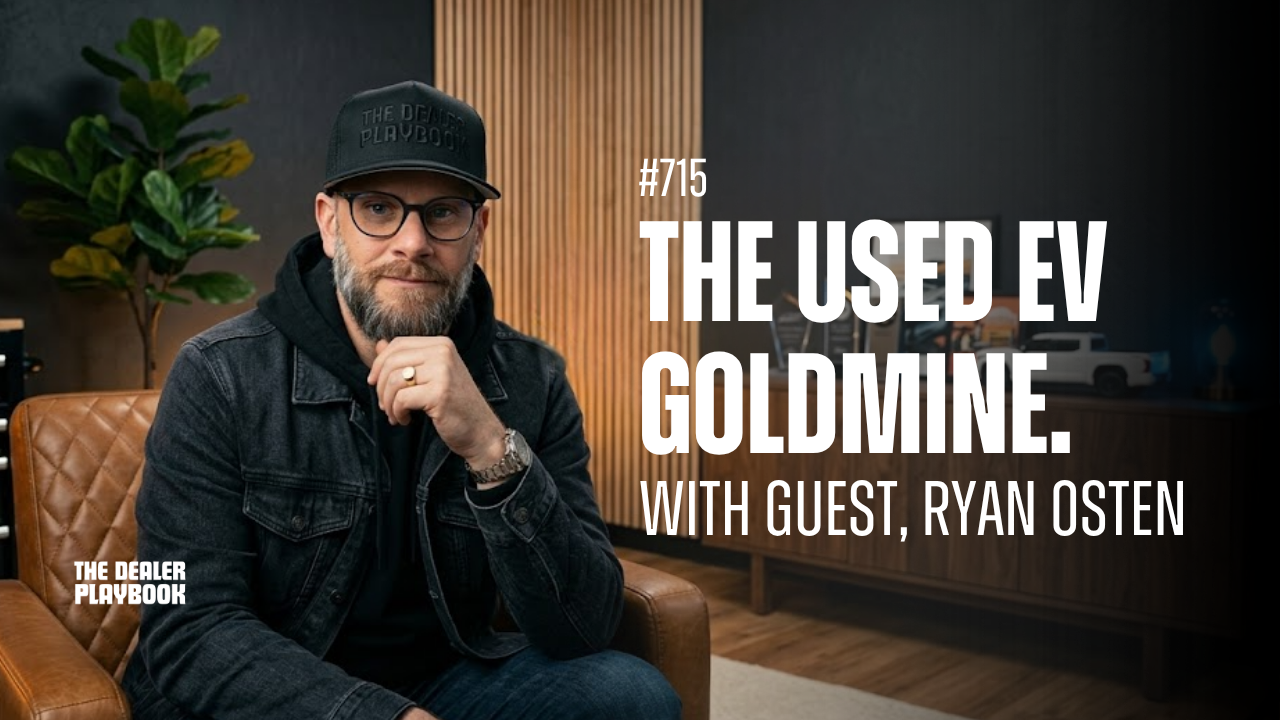
Is your dealership struggling to move used EVs while your competitors are banking big? It's time to stop letting inventory sit and start capitalizing on the massive opportunity in the pre-owned electric vehicle market.
In this episode with Lyteflo Co-Founder and CEO Ryan Osten, you'll discover:
Why used EVs are consistently delivering up to $5,000 in total gross profit per unit.
The critical operational changes needed to stop inventory from aging out.
How to leverage battery health reports to build trust, boost sales, and drive fixed ops revenue.
The specific questions modern EV buyers are asking and how to equip your team to answer them confidently.
Actionable strategies to gain a significant competitive edge in automotive retail for the next 12-24 months.
Ryan Osten, Co-Founder and CEO of Lyteflo, provides EV sales and merchandising tools to help car dealerships confidently sell more electric vehicles.
Follow The Dealer Playbook so you never miss an episode.
Timestamps
00:00 Used EV Gross Opportunity
03:05 EVs Sitting on Lots Costs
05:01 Why Dealers Struggle With EVs
07:28 EV Test Drive Done Right
09:58 Battery Health and Buyer Questions
14:02 Service Retention Without Oil Changes
17:15 How Battery Checks Work OBD
19:39 Used EV Market Boom and Margins
23:05 Connect With Ryan and Wrap Up
23:36 Podcast Outro and Subscribe
Episode Brought To You By FlexDealer
Need Better Quality Leads? FLX helps car dealers generate better quality leads through localized organic search and highly-targeted digital ads that convert. Not only that, they work tirelessly to ensure car dealers integrate marketing and operations for a robust and functional growth strategy.
Watch The Full Episode
Prefer to watch episodes? Be sure to subscribe to our YouTube Channel and turn on notifications to get full access to our content.
Episode Transcript
[0:00] — Used EV Gross Opportunity
Ryan Osten: I've been living in this space for a while. Dealers are making three to four thousand dollars front end gross, and then another fifteen hundred on the back end. They can go five thousand dollars total gross on these vehicles. And so that's why they should care — because there is money to be made.
I know dealers that are VW dealers, and they're running them as just fronts for used EVs. Like, they're selling a few VWs and they're selling sixty Teslas a month.
Michael Cirillo: It kind of seems like what I'm hearing, if I'm listening between the lines, is that the used EV market is something that we really need to be paying attention to.
Ryan Osten: One hundred percent.
[0:40] — Welcome and Sponsor Message
Michael Cirillo: One of the things that I enjoy most about producing The Dealer Playbook is hearing from you. The messages that I get of people who are getting so much value out of the podcast, applying it to their day-to-day workflows, and finding a thriving career right here in the retail auto industry — it means the world to me.
One of the ways that we make doing this possible is through my agency, FlexDealer. In the spirit of providing value, head over to flexdealer.com. Right now you can get a full free PDF of my number one best-selling book, Don't Wait, Dominate. A lot of the topics discussed in this book are even more relevant today than ever with the surge in popularized AI and people wondering, "What can I do next? How can I have a competitive advantage?" That's all in this book. Go to flexdealer.com — it would mean the world to me, because that is how we continue to produce this show for you.
[2:02] — Guest Introduction
Michael Cirillo: Here we are. We got to see each other for about twelve and a half seconds at ASOTU Con, but I'm so happy every time I get to see you and hang out with you. Welcome back to The Dealer Playbook.
Ryan Osten: Thank you, Michael. Is it Mike or Michael?
Michael Cirillo: Whatever. I respond to both.
Ryan Osten: So thank you, Mike. It's great to be back. We had a great time at ASOTU Con. It's a banger conference. Everyone should go. If they don't already go.
Michael Cirillo: It's a lot of fun. You got me thinking — here's a little bit of Canadiana for our audience. You said Mike, and I immediately thought of Mike from Canmore. Royal Canadian Air Farce was a TV show big in the nineties, and they had a character, Mike from Canmore. People are going to look it up. I thought it was funnier than SNL.
Ryan Osten: They should look up Canmore. Canmore is beautiful.
Michael Cirillo: Beautiful old stomping grounds.
[3:06] — The Real Cost of EVs Sitting on Your Lot
Michael Cirillo: I want to get into this with you. I'll kick it off this way. I was recently at a dealership — a Chevy store — and the dealer had a lineup of EVs that he lamented he couldn't sell. I thought, when and if I ever get a chance to talk to somebody who is living, breathing, eating, thinking, learning, and building around EVs, I'm going to ask this question.
Dealers have EVs sitting on their lots right now, ninety-plus days. They don't know what to do with them. From an operational perspective, from your vantage point, what are some of the costs that are just eating away at that dealer that he may not even be aware of?
Ryan Osten: One thing is just opportunity cost. You've got space taken up on your lot. Forget about floor plan — it's taking up space on your lot and mind share for your team. If your team is not trained on them, there are morale and soul costs. They've got these vehicles, they're not trained on how to sell them, they're not bought in on them. So there's an energy drain on them any time a customer asks about EVs.
There are other costs too. If you don't have a plan for F&I or service retention, when you sell those vehicles, you're basically going to lose that customer for life. And you might have low CSI scores on those deals because the customer knew more than you — which is something we hear often. Shoppers know more than dealers about EVs. And that's not a good thing.
[5:01] — Why the Industry Wasn't Built for EVs
Ryan Osten: From where we sit at Lyteflo, the reason we started the company was because we could see that the industry was built for gas vehicles. The websites are built for gas vehicles. Training is built for gas vehicles. Marketing is built for gas vehicles. And now there are plug-in hybrids, EVs, and soon-to-be extended range EVs. I bet most dealers won't even know what extended range EVs are. Bringing in those electrified vehicles breaks all the rails of your website, marketing, appraisal, and service retention. It's created big challenges for dealers.
Michael Cirillo: I love that you bring in the human element right away. If our teams are better equipped to answer questions appropriately, morale goes up. What's the opportunity of morale going up? They're going to feel more confident. They're going to take a harder swing at the ball and have a greater chance to knock it out of the park. And the more often they do that, morale goes up again. They follow process. They want to show up to work.
Years ago, when I interviewed Cardone for the first time, he said, "You know why salespeople hate their jobs?" I said, "Why?" He said, "Because they suck at it. And typically anything we suck at, we hate." But then you see salespeople who love their jobs — and it's because they are the most equipped. They're well-trained.
[6:39] — What an EV Test Drive Should Actually Look Like
Michael Cirillo: You brought up the customer experience. A customer goes on a test drive. What are you seeing from the information side? What are some of the common questions dealership teams are fumbling over?
Ryan Osten: First of all, I love the Cardone thing. That's so true. When you figure something out, you get dopamine. It's all dopamine. You play guitar, right? When you figure out some new pattern, you get a warm feeling over your whole body. You just won. You just succeeded at something.
To answer your question — the test drive is interesting. The test drive for a gas vehicle hasn't changed in a long time. But the test drive for an EV is fundamentally different. This is brand new technology. It's a computer on wheels. It's like if you had a BlackBerry and then someone handed you an iPhone. You have to show them how to swipe, how to use gestures — it's fundamentally different.
A few examples. First, you're going to want to show how to plan a trip in the EV. That's something you don't have to do in a gas vehicle. If you're planning a four-hour trip, you might have a charging stop. Show how the car identifies where you need to stop, the best place to stop, and how it preheats the battery to make charging faster.
Another thing to cover is regenerative braking — also known as single-pedal driving. A lot of people, and probably many dealers, don't even know that single-pedal driving can be turned on, turned off, and has settings in between. It essentially uses the motor to slow the vehicle down so you don't have to use the brakes. Some people find it jarring at first, but it can extend your range. That's something to demonstrate on a test drive.
And then demonstrate charging. Maybe this person has never charged before. Go to a public charger near the dealership, show how you plug it in, show how it charges, and explain that in fifteen to twenty minutes you can get a nice charge up to eighty percent. You can grab some food or hit the bathroom in that time.
[9:58] — What Used EV Buyers Are Asking About
Ryan Osten: If it's a used EV, more and more customers are asking about battery health because batteries degrade and consumers are getting more educated about that. We're already seeing cases where customers won't buy a car without a battery health report. They're good with the payment, good with the car — they just need to see a battery certificate. That's one.
Other questions include: where are chargers near me, how much am I saving on fuel, and what are the maintenance savings? Fuel savings is a big deal for some customers right now, especially with everything happening around the Strait of Hormuz. People didn't even know what the Strait of Hormuz was — including myself. Now we'll know that name for the rest of our lives.
Michael Cirillo: I think it's so interesting. Everything you're talking about, I'm thinking about my own experience with an EV. My wife and I had a Model 3 for a little over a year. Had somebody actually gone through those things with us — now, I get it, I'm no victim, I could have figured things out — but it's weird. Being somebody who researches so much before buying, I felt like I didn't do enough research.
The whole Tesla model was to streamline how quickly you get the vehicle and drive away. How to map trips, the fact that you can drive until zero miles and it will guide you — these were things I did not know. Range anxiety was something I really struggled with, which was so annoying to me because I can look at nineteen miles of gas in my car right now and feel zero anxiety.
Ryan Osten: Because you know you'll find a gas station.
Michael Cirillo: Exactly. Had I known these things, I probably would not have traded out of that vehicle. My wife would still be driving it. She still talks about how much she loved the driving experience.
Ryan Osten: Why did you switch?
Michael Cirillo: All of these things combined. We live in the growth path in DFW. At the time, my wife was putting a hundred miles on the car before nine in the morning — getting the kids to school eleven miles away, then driving twenty miles to work. A year in, I looked at the mileage and it was thirty-two thousand miles in a year.
Ryan Osten: Imagine how much you were saving in gas.
Michael Cirillo: I know. I know all the things I regret. I think I'm right in the middle of what a typical customer doesn't know that they don't know — and they're making decisions based on that ignorance. Had somebody shown me how to map a trip and explained that it's actually a better experience than Waze — where you don't know what gas station you're pulling into or what side of town you're in — that whole infrastructure of the relationship changes.
[14:02] — Service Retention Without the Oil Change
Michael Cirillo: You brought up fixed ops. Everything is still built around gas. We talk about the oil change — but there's an avenue here with battery checks. What's your vantage point on that?
Ryan Osten: At a high level, EVs don't need oil changes. And I often say the oil change was the greatest invention in the history of customer retention. You had to come back every six months or every three months. That drove so much business — it created an engine for dealerships around lease pull-aheads, vehicle acquisition, and selling new vehicles to returning customers. That's going away.
We still have tires and some coolants. But even brakes are less frequent on EVs because of regenerative braking.
Battery health checks, we believe, will be a key retention tool for dealerships going forward. Whether they charge for it or not, it's a way to bring the customer back in. Some dealers will use it as a loyalty tool — "whenever you buy an EV from us, you get a free battery health check every year." Some dealers will use it as a repair order line item. We're already seeing independent service shops offer battery reports for sixty-nine, seventy-nine, eighty-nine dollars — using tools like Lyteflo or others. Customers are requesting them on pre-purchase inspections. If a customer is buying a used EV, they may take it to their independent shop to get the battery checked out first.
We're already seeing this show up in the service lane. When a customer comes in for tires, dealers are saying, "By the way, we can check your battery — make sure the cell voltages are good, check cell health, and give you an independent assessment of degradation."
[17:04] — How Battery Health Reports Actually Work
Michael Cirillo: For the dealer who's thinking, "I should be the first in my market to offer battery checks" — what do they need infrastructure-wise? Is it a heavy install?
Ryan Osten: Firstly, there's an opportunity right now — and I think it'll exist for the next twelve to twenty-four months — where not a lot of dealers are offering transparency around battery health. The used EV market is having a huge moment. In the new vehicle market, EVs are about ten thousand dollars more than an equivalent gas vehicle. In the used market, they've come down to near parity. You can get a Tesla Model 3 for the same price as a Camry.
I was literally on a call with a large used EV dealer this morning. They said most of the Teslas they sell — the customer came in for a Camry, saw they could get a Model 3 for the same price, and went with the Model 3.
So back to your question — that's why battery health reports matter. There's a window where you can be the only dealer offering that transparency to customers, both in sales and in service.
On the infrastructure side, we primarily use the OBD port to read data from the battery management system. You plug an OBD device into the port on the EV, and within two minutes it reads cell health, individual cell voltages, and degradation. It shows whether the battery is at ninety-five or ninety percent, and what the actual range of the vehicle is. Within two minutes you have a full report that you can print, give to the customer, post to your website, or email on lead follow-up — and use as a key merchandising piece for your used EV inventory.
[19:39] — The Used EV Market Opportunity
Michael Cirillo: You brought up used EVs. We've gone through these weird roller coasters — "we're all in on EVs," "actually, we're not." From a franchise perspective — do I need the new lineup, do I care about allocation? It kind of seems like what I'm hearing, if I'm listening between the lines, is that the used EV market is something we really need to be paying attention to.
Ryan Osten: One hundred percent. First, what I say to dealers is: you shouldn't do this if you're not all in. You can't just dabble. You've got to train your team. You need to figure out how to acquire these vehicles. You need to understand how to appraise them. You need to be comfortable taking some risk to open up a new line of business. You've got to be fully bought in.
Second, the used EV market is set to grow very differently from the new market. The new market — you're getting force-fed allocation. Some of those vehicles weren't compelling products at compelling prices. A Hummer is a cool vehicle at a certain price point — maybe seventy thousand dollars. Not at a hundred and ten thousand.
The used EV market is set to grow twenty-six percent per year. We're going to have one point one million EVs coming off lease over the next three years. The finance companies that held them at too-high residuals — the vehicles aren't going to be priced where those residuals were. Someone's going to hold that bag, but it's not going to be the consumer. What's going to happen is the consumer gets a really compelling product at a really compelling price. Off-lease volume combined with pricing parity — it's a strong setup.
And then the final point — gross is very good on these cars. Dealers are making three to four thousand dollars front end gross, and another fifteen hundred on the back. They can go five thousand dollars total gross on these vehicles. That's why they should care. I know dealers — VW dealers — who are running their stores essentially as fronts for used EVs. They're selling a few VWs and sixty Teslas a month. More used Teslas than new cars at their franchise.
Michael Cirillo: What a wild time.
Ryan Osten: It's crazy. This opportunity will be around for another twelve to twenty-four months for dealers who are motivated and adventurous.
Michael Cirillo: What I selfishly heard is there's a second chance for me in the next couple of years to get back in.
[23:08] — Connect With Ryan Osten
Michael Cirillo: As we wind down — how can those listening and watching connect with you?
Ryan Osten: Follow me and connect with me on LinkedIn — I'm pretty active on there. Go to lyteflo.com and fill out a form. But the best thing to do is connect with me on LinkedIn. I'd love to chat EVs. Or reach out directly at ryan@lyteflo.com.
Michael Cirillo: Ryan, my pal — Co-Founder and CEO of Lyteflo. You've got to check him out. Thanks so much for joining me on The Dealer Playbook.
Ryan Osten: Thank you, Mike. Have a great day.
[23:36] — Outro
Michael Cirillo: Hey, thanks for listening to The Dealer Playbook Podcast. If you enjoyed tuning in, please subscribe, share, and hit that like button. You can also join us and the DPB community on social media. Check back next week for a new episode. Thanks so much for joining.