“My Team Will Adapt at the Drop of a Dime” — The GM Playbook for Leading When You Don’t Have All the Answers | Charlie Spradlin, GM Art Moehn Auto Group
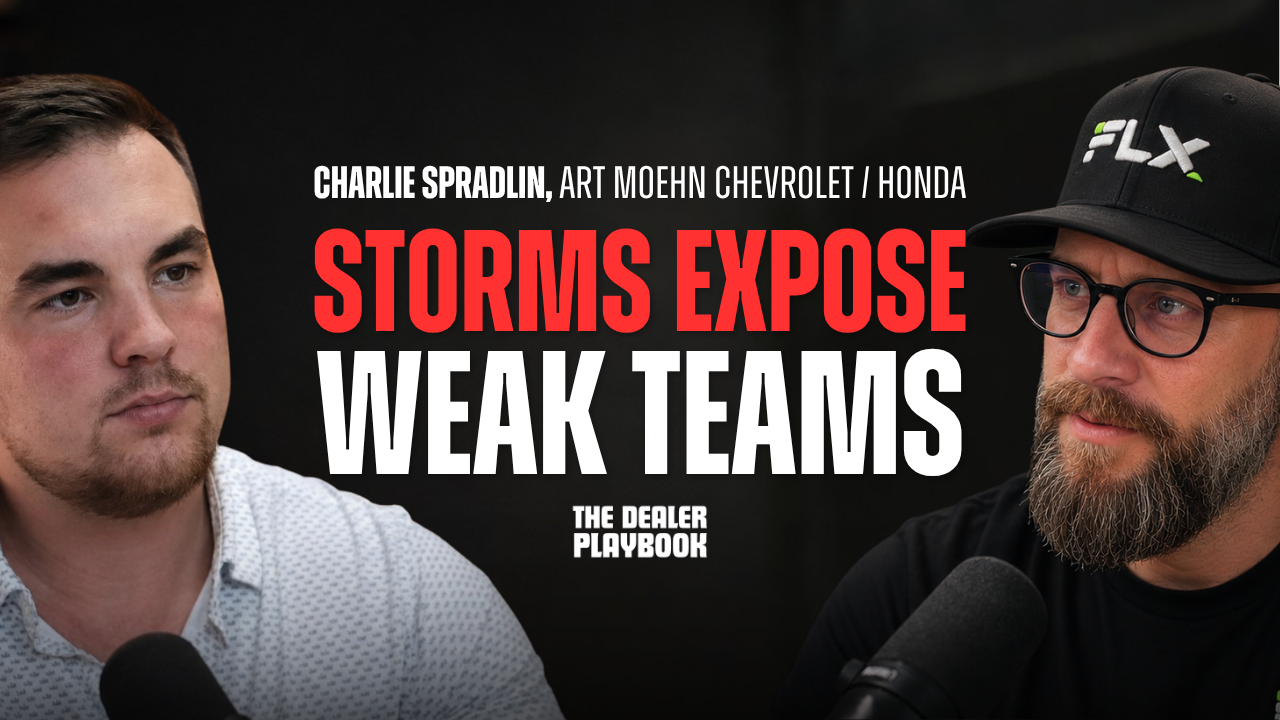
There's a moment in this conversation where Charlie Spradlin says something most GMs would never admit out loud, and it's the reason his multi-rooftop dealer group keeps adapting faster than everyone else around him. He's not running things the way you'd expect for someone breaking records the way he is. This episode gets into how he actually leads his team through constant market shifts, what's really going on with his pay plan, and the one thing he had to let go of to get his store to where it is now.
What you'll get from this episode:
The mindset shift that changed how fast Charlie's team responds to a changing market
What's actually behind his pay plan, and why it's not what most dealers expect
The one thing Charlie had to give up to grow past where he was stuck
A different take on what real trust looks like between a GM and their team
Charlie Spradlin is GM at Art Moehn Chevrolet Honda, where he's grown a multi-rooftop dealer group while protecting net profit through constant market shifts.
Follow The Dealer Playbook so you never miss an episode.
Timestamps
00:00 What’s Coming
00:51 Sponsor Message Flex Dealer
02:22 Origin Story Into Auto
05:37 Climbing To General Manager
06:38 Mentors And Proximity
08:38 Discomfort And Humility
12:34 Post COVID Challenges
14:19 Vulnerable Leadership
17:32 Big Picture Perspective
25:50 Pay Plans And Culture
29:22 Running Into Storms
31:59 Used Car Inventory Fix
34:53 Architect Not Operator
40:52 Closing And Connect
41:51 Final Outro
Episode Brought To You By FlexDealer
Need Better Quality Leads? FLX helps car dealers generate better quality leads through localized organic search and highly-targeted digital ads that convert. Not only that, they work tirelessly to ensure car dealers integrate marketing and operations for a robust and functional growth strategy.
Watch The Full Episode
Prefer to watch episodes? Be sure to subscribe to our YouTube Channel and turn on notifications to get full access to our content.
Episode Transcript
[0:00] Welcome to the Show
Michael Cirillo: Your stores are breaking records and you have put in a tremendous amount of work. But I think a lot of people in our industry are too afraid to acknowledge a problem. I try and make the connection, especially on the show, that without being willing to acknowledge the problem, you can never actually get to the success that happens on the backside of it.
Charlie Spradlin: I've never met a perfect car dealership. I've seen a lot of different places, and I've seen a lot of different people operate in different ways. I've never seen a perfect one. I don't know if you have.
Michael Cirillo: And here we are. We're seeing you. You have put in a tremendous amount of work. There have been problems along the way, and now here you are. I mean, we see the posts, you're breaking records, you're seeing incremental growth, you're pulling your teams together, you're unifying this dealer group. For those listening, what's a challenge you're thinking about right now and some possible ways that you're going to maneuver through it?
Charlie Spradlin: The most glaring issue that we're facing right now, as I stare off into my lot that's nice and full, is—
[1:00] Sponsor Message
Michael Cirillo: One of the things that I enjoy most about producing The Dealer Playbook is hearing from you, the messages that I get of people who are getting so much value out of the podcast, applying it to their day-to-day workflows, and finding a thriving career right here in the retail auto industry. It means the world to me.
One of the ways that we make doing this possible is through my agency, FlexDealer. And of course, in the spirit of providing value, I think this is a perfect time to head over to www.flexdealer.com to show even further support for you, my beloved DPB gang.
Right now, if you go to my website, flexdealer.com, you can get a full free PDF of my number one best-selling book, Don't Wait, Dominate. The reason I think it's so special is that a lot of the topics discussed in this book are even more relevant today than ever, with this surge in popularized AI and people wondering, "What can I do next? How can I have a competitive advantage?" Well, that's all here in this book, and I'd love to be able to offer you a free copy if you go to flexdealer.com. It would mean the world to me, because that is how we continue to produce this show for you.
[2:22] From Survival to Success: An Unexpected Start in the Car Business
Michael Cirillo: Okay, this has been like a little bit in the making — like, maybe 14 years in the making. Where were you 14 years ago?
Charlie Spradlin: God, am I 33? I don't... I have no idea. High school, probably.
Michael Cirillo: Dang. How did you get into the car business?
Charlie Spradlin: I had these big aspirations to go to law school and all that after I graduated college. Huge fight with my parents, got kicked out, had nowhere to go. Ended up asking my wife's brother-in-law for a job. He ran a car dealership, and I haven't been anywhere else since.
Michael Cirillo: You got sucked into the vortex like all of us.
Charlie Spradlin: I needed a job immediately.
Michael Cirillo: Tell me where you're at now. So you got into the car business out of desperation, out of survival — what do you think that did for your journey, in lessons learned or the outlook you have on the industry?
Charlie Spradlin: I think by being so forcefully pushed in, I really didn't have a choice. Not that I want to paint a picture of a starving child needing to feed himself, but I really didn't have any other options. So that idea of "I'm doing this, I've got to figure something else out" — this was my only opportunity for something. I think it just made me commit immediately to my level of greatness, whatever that was going to be. I drank from a fire hose of Joe Verde videos for like the first six months. I just wasn't going to fail, you know?
Michael Cirillo: This resonates with me because I think about my journey — this is going to be year 24 in and around car dealers. And a lot of people go, "Well, what do you feel has attributed to your success?" Similar story, it kind of starts from survival mode. At this point, this is what I know, this is my thing. It fits with every marketing discipline where people say, "Niche down till it hurts." It fits with every successful business coach who says, "Get good at the one thing." I look at some of my buddies who've done laps around different careers — real estate to paramedic to physician's assistant back to real estate — jumping around because they weren't sure what they wanted. I picked up a hammer and I kept hammering that nail.
Charlie Spradlin: Yeah, for sure.
Michael Cirillo: And it sucked at times, and it was good at times. When I zoom out and look at it, I think, "What an awesome career." I'm hearing that in you. Now, fast forward to today — where are you at? What's your stewardship?
[5:45] Climbing the Ranks: The Power of Proximity and Mentorship
Charlie Spradlin: As of this month, I'm officially taking on the mantle of General Manager at our store, which is great. It's been a work in progress for me for a long time. Prior to that, I was our sales director for the group, over the three-ish rooftops we've got. I'm currently reaching that initial pinnacle of what I started aspiring to all those years ago.
Michael Cirillo: I love it. What kept you moving all that time? I know you started from survival mode, but for those listening — I think a lot of people come into the industry this way. I've been participating in a lot of TikTok Lives with Gen Z, and we all have the same story: falling backwards into the industry. But what kept you in, in an industry with a notorious churn rate?
Charlie Spradlin: I think two things. One, sales and my work ethic have always appealed to me — I don't know if that's an inherited trait from my dad, but if I was going to work for it, I wanted to be paid for it. That resonates with me at my core. The other part, which I actually came to realize not that long ago, is that at every phase of my career, I've been introduced to either a new mentor or a circle of people doing way better than I was — which came from sticking my nose in places it didn't belong.
I met Jonathan Dawson as a brand-new sales manager, and being around him, seeing the income potential he talked about, left this little nugget in me. He took me to a Tony Robbins event. Then after COVID, I met Glenn and was introduced to all these incredibly successful car dealerships making all this money. It seems like every time I was at a peak, I saw a bigger one — someone else introduced me to a bigger one. There's nothing more motivating than seeing what you could achieve. I guess that's the thing that keeps me going.
Michael Cirillo: I love it, and what you're saying rings true — this law of proximity. So many people are wondering, "How do I achieve the next thing?" What I heard you say is twofold: number one, proximity to those doing the thing you desire to achieve, because that rubbing of shoulders changes the dynamic. But also, it's proximity to the next hill you're going to climb — meeting those people reveals to you, blows the ceiling off, right?
I'm hearing it, and I've felt it myself. There's a lot of discomfort in that. I'm driven by my ambition, but I'm also sometimes freaked out by my ambition, because not knowing something and admitting I don't know something as I'm climbing the hill is extremely uncomfortable. But I've also come to love that in a way.
[9:11] The Superpower of Vulnerability: Leading with Humility and Trust
Charlie Spradlin: Yeah, I think I've been naturally blessed with the idea that I love being told what I don't know. It started with Joe Verde — my schooling background was in philosophy, and I really loved it. I might have a major in philosophy. I think I would have been a great lawyer. But this idea that there's so much out there that other people can teach you, people who are better than you — there's always going to be somebody who has done more, accomplished more, earned more. And if you just ask them for help, so many of those people are willing to pour into you with no benefit to themselves. Not everybody, but I've been blessed to find people like that. Sometimes that turns into a relationship where my company pays them to teach me something. But I love the idea that I don't know what I'm doing and I can learn from somebody else. I've never had the "you can't teach me" mentality. I want to learn from you. I'm absolutely willing to humble myself, because if you're better than me, I want to know why.
Michael Cirillo: So much power in that. Before I ask you the next thing — I just have to say how proud I am of you. I'm proud to know you, and I'm proud to see how you operate. What you're talking about here, I've seen firsthand that this is a real person doing real things. Sometimes, with media and AI, it's really easy to bolster yourself up and embellish a little. But you're speaking the truth I've observed, and I think it's refreshing, especially with the way things are going in the world, to connect and hear from other people doing a real thing.
Your stores are breaking records, and you've put in a tremendous amount of work — probably at times the philosopher in you came out asking, "Why am I here, or where am I going?"
Charlie Spradlin: Or my paycheck did, you know?
Michael Cirillo: And you've experienced the discomfort and run through it — you thrive on it. It's rocket fuel, is how I'm hearing you use it. But I think a lot of people in our industry, and in life in general, are too afraid to acknowledge a problem. I try to make the connection, especially on the show, that without being willing to acknowledge the problem, you can never actually get to the success that happens on the backside of it. What are some challenges you've faced, and what did you do to overcome them?
[12:35] Navigating Change: Replicating Success in Shifting Markets
Charlie Spradlin: There's been so many challenges since COVID — it feels like there's one every six months. Whether it's an inventory shortage, a parts issue, pricing issues, affordability — there's just a constant issue right now. I think this idea that if you just barricade yourself inside your dealership and wait out the storm doing what's worked in the past, you fall behind so quickly from all these rapidly moving things. The alternative, which is the stance I take, is that I'm going to change something immediately and fast. While it doesn't always work the way I want it to, what it's done is create a team around me of people who will adapt to change. Sometimes that change isn't for the better, and we have to unwind what we did before — but they're willing to try something new and give it their all the next day. They know that might change in three months, six months, nine months, because I've let them know this is something I don't know. I don't know how things are going to look. I'm going to do my absolute best. They believe I'm going to do my best to prepare them for whatever challenge is coming, to set them up for success. At the drop of a dime, my team will adapt to a new thing very quickly. That adaptability has made all the difference these last three to four years, while maintaining a good net profit level and a good relationship with our community. A lot of people lost sight of that throughout COVID and the years since — you couldn't do both, but you can.
Michael Cirillo: How do you maintain that vulnerability as a leader — to pull your team together and say, "There's stuff I know, there's things I don't know, and there's things I don't know that I don't know," and still have them trust your leadership? I think that's something that worries new leaders, and maybe some veteran leaders too — vulnerability perceived as weakness. You're showing it's actually a superpower. How do you balance that, and make sure it's delivered with the right intention so your team is willing to follow you through it?
Charlie Spradlin: I think the big thing is it can't just be all talk. You have to deliver on what you're promising — or maybe not promising, but implying a place you're going to get to. It's like a politician promising things and never delivering — you just don't trust them anymore. I think by being vulnerable with your team, you're humanizing yourself. I've never met a perfect car dealership. I've never seen one. This idea that GMs or owners or anybody in a dealership is infallible is crazy, but I think we talk about ourselves that way a lot of times. How much does that cheapen the message when you're acting like you know it all, and you know what's coming, but then you have three bad months in a row and your team is struggling to pay their bills, and your finance manager's relationship with the sales floor is getting worse because nobody's making money?
It's like, "I know I'm not perfect. I am trying my best to take all of you to a place of financial success while having a good environment to work in." Some months, that means we just have fun and we don't break a record. Maybe we have a bad month, but we're going to enjoy ourselves while we do it. That hot pot of "I'm doing my best, I'm trying to work for you" just makes you want to work for me. And then sprinkle in the fact that we are having success — don't sprinkle it, dump a bucket on it. It just becomes a really great place to work while everybody's still making money.
Michael Cirillo: What I love about this is it's an incredibly honest take. This is the message — these are the kind of conversations, Charlie, that keep me wanting to do this show, because the whole point of the playbook is to uncover what it really takes to enjoy a thriving career in retail auto. We have this kind of addiction where we go to a conference or a 20 group and hear the highlight reel of somebody else's thing, and then we go back to our store thinking we're incredibly deficient. You're sharing an honest inside look — hey, some months are not going to be great, some are going to be amazing. But do you feel sometimes that might be a little myopic? Because if I zoomed out at your group over the last 10 years, I'd probably see a line that goes up and to the right.
Charlie Spradlin: Yeah, 100%.
Michael Cirillo: How do you maintain that perspective? We get trapped in these 30-day cycles — we know why, but it's also the reason we're not able to look at the bigger picture a lot of the time. How do you balance that?
Charlie Spradlin: So, how do I balance the day-to-day perspective with the fact that we've had a decade-plus of constant success? I think your pay is a great reflection of whether you're paid correctly and held accountable to the right standards inside your dealership. This is going to be a weird conversation, but —
Michael Cirillo: Just pour it out, man. I can see you holding yourself back.
Charlie Spradlin: Well, I am, because it could be taken out of context. But COVID allowed us as dealers to have an incredible paycheck without incredible work. On paper, in a lot of ways our store has gone backwards, and in a lot of ways it's gone forwards. But COVID showed an income potential inside the business that most people think will never happen again — that you'll never achieve that level of net profit success again. But for me, especially since COVID, it moved the goalposts in a way that says it can be done. It doesn't mean it's going to happen overnight, but it means at one point in time we made this much money. If I could recreate that level of success under new market conditions, what does that mean for everybody around me? I'm going to lose sometimes, but I'm going to keep pushing whatever formula I think is going to take us to that level. It allows me to keep driving, because I saw that bottom line and thought, "This is the holy grail of what running a business looks like." And to have that taken away from you — well, I'm going to do everything it takes to get there. We're damn near there at this point. It's just this idea of being told what isn't possible anymore, but I saw it happen, and then it got taken away. So yeah, we might go backwards, but the goal is still there, and the goal will be even higher. I think COVID, if you looked at it from the right perspective, showed you what could be — even though you didn't deserve it.
Michael Cirillo: This doesn't sound weird at all. What I'm hearing is you got a taste of what's possible. Some people might call this myopic — "yeah, but it took a global pandemic" — but no. There was a condition that created a market situation, which means the condition is replaceable. It doesn't have to be a pandemic; that just happened to be the case during the pandemic. What I'm hearing you say is, there was a condition that caused a market scenario, which means maybe there could be other conditions, and maybe I could actually create those conditions. What does demand generation even mean in marketing? It's "I generate demand." I walked into a store the other day called Learning Express — not sponsored — and it was packed with 12, 13, 14-year-old girls buying squishy toys. They can't keep them in stock, and there are moms taking their kids out of school to stand in line. Somebody created that demand — someone saw how to create a condition that changes a market scenario, not just for the store but for whoever's making these squishies. That's what I'm hearing you say — this didn't necessarily get ripped away from you. The condition stopped, and we weren't paying attention to the condition; we were paying attention to what happened in the market. We should have been studying the condition — what about it created so much demand, and how do we replicate what caused the condition?
Charlie Spradlin: Yeah, it was one of those peak moments in my life where I was like, "This is possible." It was very eye-opening that we were opening our doors every day and making X amount of dollars — again, we weren't prepared for it. One, I don't think we capitalized on it enough, and two, we weren't the reason it happened, so replicating it has to come through trial and error, and that comes with failing in different ways. But at the end of the day, if I can get my volume to a certain place, make this much money on the back of each car and this much on the front, and generate that much more income in service and parts — at the end of the day, I can, through volume, replicate the net profit of COVID. I know that I can. It's just been this constant squiggly line all the way up — sometimes we drop, and we squiggly wind our way back. It's seeing what's possible and knowing it's there, coupled with every 20-group moderator I've ever seen saying, "That's never going to happen again." And it's like, yes, it will. We'll get there.
[25:57] Dynamic Pay Plans: Leading Like a Bison into the Storm
Michael Cirillo: I don't want to linger too long on culture, because I think people know it's important and it's a driver and a foundation. But I want to dig into this piece — there's always conversations about pay. How have you found the appropriate balance in pay plans so people are incentivized to do their best work, and also show up when times are tough?
Charlie Spradlin: I think it comes with being flexible on pay. A pay plan exists and works well as long as market conditions are steady and your goals are steady. But if either of those things change, I think as someone who cares about their people, you'll go farther caring about your people and their financial situation in the long run than you will protecting your bottom line in a short period of turmoil. Being flexible and making sure your pay plan aligns with your store's goals seems obvious, but it doesn't always work on a 30-day or even a three-month window. It's, "What am I trying to achieve in the next year?" and my pay plan needs to line up with that goal. Sometimes I'll win as an operator, sometimes I'll lose, but I'll win ultimately because it will match up with where I'm going. For salespeople, it's a mix between volume and gross. I want to grow the store through volume, but I can't lose sight of the fact that I don't want to do more work for less money — I'm commission through and through. Those two things have to line up, but they will change, and my team knows they might change every single year. We've been lucky they haven't in the last couple, but if my goals shift, their pay plan shifts too. I'll make sure it's a fair pay plan for them to achieve what they need in their life.
Michael Cirillo: I love it, because they know what to expect, but it's also flexible. Are you committed to at least keeping it in place for a year at a time?
Charlie Spradlin: Always. I don't want the fear of an unknown paycheck or pay plan to limit them, or affect whether they feel comfortable working for me. If I'm giving you a pay plan, I'm going to see it out for that period of time. But I reserve the right — Brian Benstock said this at NADA, and I've used it a thousand times since — I reserve the right to manage my business. If my goals change, your pay plan is going to change too. That's just how things work.
Michael Cirillo: Do you think it's that your goals change, or that your understanding of how to get to the macro shifts — you're pivoting, being flexible for yourself along the way?
Charlie Spradlin: That's a more eloquent way of saying it, yes. How I'm going to get to my goals could shift based on market conditions, what's available in front of me, what resources I have to pull from. My goals never change — how I get there will change.
Michael Cirillo: I have to say this, and I don't mean it as an insult — your spirit animal might be a bison. People think bears, people think lions, but I learned this recently and it fascinates me: bison, when they see a storm coming, run towards it instead of away from it, like most animals. The reason is that if they run into the storm, their time in the storm will be less than if they ran away from it — because the storm will catch up to you and move with you. Everything you've talked about — this dude runs into storms.
Charlie Spradlin: Yeah, I probably do. That's fair.
Michael Cirillo: Not only are you stacked, guys — I've been with Charlie in real life, he's built like Mr. Incredible.
Charlie Spradlin: You're blushing.
Michael Cirillo: I'm going to get a little red on camera. Not only are you stacked like a bison, you behave like one by running directly into the storm — and that creates something I believe so deeply in, which is fierce, passionate leadership that is worth following. People are struggling so often in our industry with "how do I get people to follow me?" And what I'm hearing you say, what resonates deeply with me, is: behave in a way that is worth following. Like you said, all of this is great, but you have to have action to back it up.
Charlie Spradlin: Yes, 1,000%.
Michael Cirillo: I find that inspiring, and that is the secret. I've done 700-plus interviews with people from every profession, so many in the auto industry, and here we have this episode with Charlie Spradlin, General Manager at Art Moehn Chevrolet Honda, tying a bow on so many threads.
[31:59] From Operator to Architect: Empowering Teams and Letting Go
Michael Cirillo: What's a challenge you're thinking about right now, and some possible ways you're going to maneuver through it?
Charlie Spradlin: The most glaring issue we're facing right now, as I stare off into my lot that's nice and full, is a used car inventory issue. People warned about it for years — all the big data guys and fancy tools telling us, "Heads up, not enough new cars coming into the market, you're going to have a used car shortage." The demand outweighs the supply, coupled with the fact that people can't afford it. So this weird demand of not having enough cars, having to pay more for them theoretically, while making them affordable for customers, all while feeding your service department — it's this big ecosystem. My big solution is to reach out to people who know more than me, who can educate me, because most of the things I try to tackle, I know nothing about — I've never experienced them. I've been doing this for 12 years, but there's lots of stuff I haven't been exposed to. So I reached out to Frank Knox to help me build a department inside our dealership that acquires cars in a way that's profitable, turns efficiently, and moves through my service department so everybody's fed. My goals haven't changed, but how I get there will — we're creating a standalone department inside the dealership, focused entirely on this, with its own metrics and pay plans, everything separate from what we do standardly in the sales department.
Michael Cirillo: From an operational perspective — we're not just talking about onboarding software, we're talking about building a whole department. How much time do you give yourself to get that done, and how do you make sure other priorities keep moving while you allocate a good chunk of focus to it?
Charlie Spradlin: My short answer for time is "as long as it takes," but realistically, I think it's going to take us eight months to a year to have a well-oiled acquisition department. I've dabbled in different ways before — service lane buying, private party — like a lot of other dealerships have, but never sat down, charted out a path, and committed to making something happen as far as acquisition goes. I think it'll take a year, if I'm being realistic, to get it to a standard I feel comfortable with.
The other part of that is learning how to let go of the superhero cape — being involved in everything across the board all the time, investing tons of time and energy into trying to touch everything in the dealership, which is exhausting. While it can be endearing to your team, it can also make it look like you don't care enough about any individual thing, because you're shooting all over the place and not really giving things their attention. By creating champions for each thing we're focused on, and empowering that champion to make decisions, make mistakes, and call me to help bail them out — creating champions means the things I'm focused on that are doing well and propelling us forward aren't losing steam. I'm constantly getting better at handing off that responsibility while I focus on something else. That's been a huge thing for me this year — taking on more responsibilities, a lot of the same responsibilities but in different ways, and having champions to do each one and trusting them to do their job.
Michael Cirillo: I feel like we could have an episode just on this piece, because what I'm hearing is something I've fundamentally struggled with in my career. You use the word "champion," and I take that as — you look at your career and you go from operator, doing the things, to no longer being an operator, you're an architect. I've struggled with the identity crisis of what an architect does differently than an operator, while feeling the gravitational pull towards operation. But to your point, you've built a team to do the operating now, and you're the architect. I think that resonates with so many people — even as I build my team, I think, "I've spent the last 20 years building a team that knows how to operate, and I'm the architect," but sometimes I measure myself against operator-as-architect and feel like I need to go build something tonight.
Charlie Spradlin: Can I share how I came to the conclusion that I needed to be better at that?
Michael Cirillo: Yeah, tell me.
Charlie Spradlin: Danielle Delgado — another person in my life who's given me tons of her own time for free — she's a mentor to me now. She posed all these different questions, and then she challenged us to use an AI tool to learn more about ourselves, to ask it questions, ask for help, create different things, and then challenge ChatGPT to come up with the one thing it registers from all the information we'd been pouring into it that we need to work on. My big, bold thing was to take off the superhero cape. It was so obvious who I am as a person that even AI, which knows nothing about me outside of what I put into it, said, "You need to step back, and you'll never achieve the goals you're trying to achieve by doing it on your own."
Michael Cirillo: How long did you have to sit with that for it to ring true to you?
Charlie Spradlin: The moment I read it, I was like, "That's my biggest problem."
Michael Cirillo: How long did it take you to accept it? You know it, but —
Charlie Spradlin: I still haven't accepted it. Danielle pushes me every week that we talk, to let go — let go and allow your team. It takes a lot, because I've been working on this store, building this team and this culture for so long. It's my baby. It was very successful before I ever got involved, but I'm very proud of where we've brought it. So it's really hard to let go and trust that other people are going to do it — and also know that once you get those people really good, they might leave you, and you have to start again. That's hard for anybody, but I'm getting a lot better, and I'm seeing how valuable it is as a personality trait to be able to trust people to do their job.
Michael Cirillo: The unlock there is — you'll never be able to get to the things you really want to get to if you don't pull the cape off. And because other people have to operate and they may leave, all the more reason you're sitting in the architect's chair, the vision's chair — so when the next person comes in, you're the consistent person conveying the vision and pulling the team in that direction, versus somebody who isn't bought in and doesn't have the vision. That's probably the clearest articulation of why the architect role is needed in a business. If you're listening and this hits you, you're part of a club — we all feel it from time to time. I also love that you brought up a practical use for AI — you're not saying, "I did this and pulled all these things out of it," you used it to interview yourself, essentially.
Charlie Spradlin: Yeah — share with me the weaknesses I'm not picking up on.
[40:52] Final Thoughts: Connecting with Charlie Spradlin
Michael Cirillo: I want to keep talking to you for the rest of the day, but the big boss called — we heard the phone. We're probably going to snip that piece out and make it a reel and share it specifically with him, that you ignored his call.
Charlie Spradlin: I do appreciate that.
Michael Cirillo: I can't tell you how much I love getting to share time with you. Thank you for pouring into us. How can those listening or watching connect with you?
Charlie Spradlin: I don't really have a personal brand or anything like that. I'm always happy to help or give advice, so I guess someone could find me on LinkedIn — I have it, I don't really use it, but I do check my messages. I'm probably most active on Facebook. One of my challenges from Danielle this year is to be more active and share more of myself on social media, so I'm working on that. If anybody sees some of my posts and has feedback for me, I'd love to hear it.
Michael Cirillo: You got it. You can be like, "Bro, smash that—" I'm not a personal brand, smash that like button, hit subscribe.
Charlie Spradlin: Smash the like button, dude.
Michael Cirillo: I love it, man. Thanks so much for joining me on the Dealer Playbook Podcast.
Charlie Spradlin: Yeah, thanks, Michael. Good seeing you, man.
Michael Cirillo: Hey, thanks for listening to the Dealer Playbook Podcast. If you enjoyed tuning in, please subscribe, share, and hit that like button. You can also join us and the DPB community on social media. Check back next week for a new Dealer Playbook episode. Thanks so much for joining.