"175 to 400 Cars a Month" — The Used Car Reframe That Changed Every Department | Rob Dell, VP at at Bob Ruth Ford
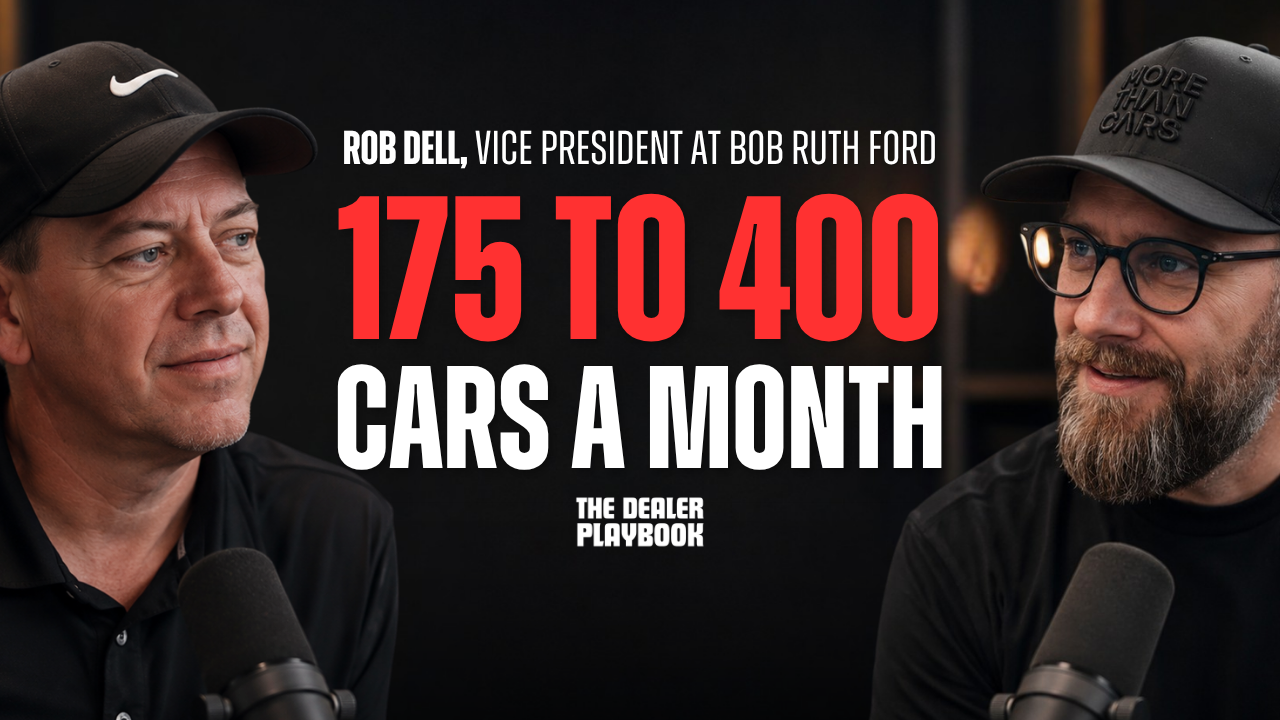
Rob Dell runs a Ford store in a town of just 2,700 people, boxed in by a competing Ford dealer every seven miles. Instead of fighting for new car volume he could never win, he rebuilt his store around used cars, taking monthly volume from around 175 to close to 400.
Rob Dell is the Vice President at Bob Ruth Ford, and he's spent almost 30 years figuring out what actually makes a dealership work.
In this episode, Rob breaks down the shift in thinking that made that growth possible. He explains why he stopped chasing a flat front-end profit number on every deal and started valuing every trade at a baseline of $3,500 once service, parts, and finance are factored in. He also gets into the historical data his buyers use to price a used car before it ever hits the lot, the five-thousand-dollar rule that keeps his team taking smart risks, and the six-person pod structure that keeps every manager focused without being stretched too thin.
You can connect with Rob on LinkedIn, where he posts regularly about the real numbers at his store, wins and losses included.
Michael's takeaway: the number that matters isn't how many cars you sell. It's understanding what one deal is actually worth once every department gets its share.
Follow The Dealer Playbook so you never miss an episode.
00:00 Championship Mindset
00:53 Sponsor Message FlexDealer
03:58 Choosing The Right Mentors
06:49 Building Teams In Pods
12:21 Leadership View And AI
14:56 Quality Service Wins
19:31 Used Cars Strategy Shift
22:24 Buying Used Cars With Data
25:49 Variable Vs Fixed Alignment
33:38 No Excuses Who Said
37:30 Learning From Mistakes
40:47 Bison Mentality Closing
41:57 Connect And Wrap Up
Episode Brought To You By FlexDealer
Need Better Quality Leads? FLX helps car dealers generate better quality leads through localized organic search and highly-targeted digital ads that convert. Not only that, they work tirelessly to ensure car dealers integrate marketing and operations for a robust and functional growth strategy.
Watch The Full Episode
Prefer to watch episodes? Be sure to subscribe to our YouTube Channel and turn on notifications to get full access to our content.
Episode Transcript
[00:00] Episode Introduction and Sponsor Message (FlexDealer)
Michael Cirillo: The team at Bob Ruth Ford that you've built are champions. How much of that experience are you able to now convey to them, and what does that look like in day-to-day operations?
Rob Dell: You know, I always say "who said," because people will tell me, "Well, you can't do that." Who said? Who said you can't sell 40 cars a month as a salesperson? Who said you can't be a technician and make X amount of dollars a year?
Michael Cirillo: There's so much to be inspired by in the way you guys operate. I feel proud to know you and to have been able to witness it, because it's the application of destroying every excuse and just not being willing to accept it. And what's so inspiring to me is, people who aren't confident in what they're looking for don't make comments like that. So I'm like, ever since I knew I wanted to have you on the show, I've been asking myself, what is Rob Dell's baseline criteria for feeling confident buying the right used car?
Rob Dell: Well, let's start with —
[Sponsor break: FlexDealer]
Michael Cirillo: One of the things I enjoy most about producing The Dealer Playbook is hearing from you, the messages I get from people getting so much value out of this podcast and applying it to their day-to-day workflows, finding a thriving career right here in the retail auto industry. It means the world to me. One of the ways we make this possible is through my agency, FlexDealer. Right now, if you go to flexdealer.com, you can get a full free PDF of my #1 best-selling book, Don't Wait, Dominate. A lot of the topics in that book are even more relevant today than ever, with AI surging in popularity and people wondering what they can do next to gain a competitive advantage. I'd love to offer you a free copy at flexdealer.com. It would mean the world to me, because that's how we continue producing this show for you.
---
[02:19] Rob's Accidental Start and Mentor Selection
Michael Cirillo: Okay, I've got to ask you this, because I'm genuinely curious anytime I sit down with an industry operator, somebody in the trenches. This is one I actually don't know the answer to. How did you get into the car business?
Rob Dell: By mistake.
Michael Cirillo: That makes 786 people I've asked that question who've given the same answer.
Rob Dell: No, it was... So I got in when I was 18. I worked for an engineering firm in high school, and I thought I wanted to be an engineer. I was always good at math and I loved cars, so I was kind of in the engineering world. Great opportunity. I didn't like school, full disclosure, and I passed on going to college because I didn't feel like I wanted to go. My employer was going to send me to college for the next level of my career, and I was like, "Man, this just isn't for me. I can't sit still." So I bought a car, and I thought, "I think I could do that." My sales guy, who's still in the business to this day, said, "Man, I'm going to get you in here." I thought, "This is going to be great, I'm going to deal with cars." Thankfully, I figured out it doesn't really have a whole lot to do with cars — it has a whole lot to do with people. And the rest was history. I just learned who to listen to and who not to listen to. I thankfully had a couple of good mentors along the way, stuck with them, and went from there. So, almost 30 years later, 29 years later, here we are.
Michael Cirillo: You've said something that... So years ago, when I was a young pup — hair, no beard, no gray hair — I attended this seminar, and one of the lessons they wanted to sink in was, success breeds success. The proximity effect of getting in the room with people doing the thing, and knowing who to listen to. And you, out of 700-plus episodes we've done, are the first person to say those exact words in that sequence: "I knew who to listen to." So I want to ask, now, at this phase of your career, with the lived experience you have, how do you know who to listen to?
Rob Dell: It depends on the setting, but I remember they told me how much I could expect to make, and I thought, "I'm going to be rich," because I was very shortsighted at the time. I figured out one of my managers took the responsibility seriously for my career path, if that makes sense. I thought, "If I just listen to what he tells me to do, I'm going to be successful." It was a bigger organization, and I had other managers who I watched do things I didn't agree with, and I watched them burn out in a short period of time. So I think I could identify with who treated people the way I wanted to be treated, and it seemed like the success path followed that. Maybe it wasn't instant, immediate-gratification success. Maybe I could've made more money going a different way, but it was going to be the long-term path. It's like meeting a good human — sometimes you meet somebody and you just know. It was more of a gut feeling of who I went with. But once I saw that pattern repeat itself across multiple stores and companies, I realized: you've got to find somebody you can trust, who trusts you, who's going to give you opportunity and not hold you back.
---
[06:14] Structuring Teams with Six-Person Pods
Michael Cirillo: That's one of the most difficult things for me being a dad now — I've been a dad for almost 18 years — but it's that lived experience of meeting enough people, finding out which ones are the con men and which ones are legit, and then watching your kids, or your newest employees, go through the same thing, where they're like, "No, they seem like such a great individual," and you're thinking, "You're reading them all wrong," and you so desperately want to warn them. Which makes it so difficult. But from that experience, now in your seat growing your organization — and by the way, for those listening, I've been in the store, I've seen how this team interacts when Rob isn't in the room, and the team at Bob Ruth Ford that you've built are champions.
Rob Dell: Agreed.
Michael Cirillo: How much of that experience are you able to convey to them, and what does that look like day-to-day?
Rob Dell: I think that's a huge part of it. We have about 180 employees total when you count part-time right now. Whether it's somebody I worked with in the past who came here, or somebody brand new, it's a relationship. Just like you and I — we didn't meet in person until probably within the last year, and our relationship has grown through that. It's the same thing on the manager level. You've got to be clear on expectations. And just because you're clear doesn't mean it happens — I could say, "Hey, we want to sell 500 cars this month," but that doesn't mean we can do it. We have to realize where we're at and where we're going, and over time, with every department, that communication comes to life. I'll use an example: I have one manager who didn't know anything about a franchise dealership — he came from the independent world. He would always ask me questions, and some people might think that's annoying, honestly, but it's my responsibility to educate him on what's going to help him grow and become a better leader. He was terrible at holding people accountable, at having a hard conversation — and there's no such thing as a hard conversation unless you tell yourself that. We've been together three years now, and I told him the other day, "I'm so proud of how far you've come." That's how you've got to do it. In this organization, we believe you can only effectively manage six people. So there are teams the whole way down. I only have six people who report to me directly. Obviously I'm available for everybody when they need me, but the people I work with every day, that's the group. It's about building a relationship, and you've got to be able to listen to feedback whether you want to hear it or not, because as a leader, sometimes the feedback isn't great. You've got to own it and figure out what to do with it. But if you're doing it for the right reasons, it all works out, and everybody grows together.
---
[09:25] Leadership Perspective and AI as a Tool
Michael Cirillo: I want to break this apart operationally, because I think it's brilliant, and it's something most people would gloss over because we're always chasing the shiniest thing. What you didn't say, Rob, is, "We developed this AI thing internally, a whole department for AI that helps us optimize our people." You said, "We break our team into six-person pods," and you work specifically with six people, who then work with six people, and so on. That's such a powerful, tangible principle of delegation for anyone listening. What led you to that structure?
Rob Dell: A lot of smarter people than myself. In life, you go through it and — I still think I'm 26 years old, I'm not, as you've told me — you see what worked and what didn't. Especially today, with technology, everybody's a showman. Let's be real. But how many of those people have you watched who are now gone? You don't even know where they went, they just vaporized, in my opinion. But there are a select few people you've watched for a long time who've been consistent and successful. Success doesn't mean they tripled their sales or profitability — those are the people to pay attention to, because they're building something. There have been a lot of people I've looked to and asked, "How did they do it?" I don't want to partner with somebody who says they're going to take me to the moon tomorrow. I'm looking for somebody who's built something proven over time, that's going to put us on a long-term trajectory where everybody grows. In this organization, we want to treat everybody as though they're learning how to run a dealership, because we'll get there faster.
Michael Cirillo: It's this reconciliation I've been thinking about — there's so much hype around AI, and everybody's answer seems to be AI, but yours is very practical, real-world experience. AI can give you an answer about something, but it can't give you the experience of that something.
Rob Dell: Right.
Michael Cirillo: I'm hearing you say your experience informs how you operate, not just getting a quick answer. Think about the encyclopedia — you could read it until you were blue in the face and know everything in it, but if you didn't have the experience of the thing, there was a ceiling on that. I'm seeing that so much with AI now. But sitting in your seat, directing the organization, how does what you look at differ from what somebody on one of those six-person pod teams looks at? What's the biggest concern for you, versus the biggest concern for them, in making sure everything's on the right trajectory?
---
[12:47] Leveraging Technology for Customer Engagement
Rob Dell: I think they're looking at their department specifically — as you called them, pods, I love that word — and they know what their department needs to do. From my vantage point, I'm looking at how all those other departments feed each other. I spend 25% of my week with the acquisition team, because I believe that feeds sales, finance, and parts. We know this. A lot of times they're reporting from this crazy spreadsheet we built, that anybody could build, and everybody's like, "Who inputs all this?" It's overwhelming if I showed it to you and said, "Go run a dealership successfully with this." That's not how it works. Every manager of every department is responsible for making sure it gets filled in daily. Then all that information feeds up into what we call the 30,000-foot view. So what I'm looking at is, what's coming next, usually three to six months down the road. And going back to AI — I know it's a tool, but you can't just plug it in and expect it to do something magical in a people business. Remember, this all started as a people business. So I took the time to invest effort and money into an MIT class, which was a good base understanding, even though I probably knew most of it already. I went through the motions. We use some AI — everybody does, in some form. If you go to a red light, technically that's AI if you want to be real about it. But what I envision is: AI can create engagement, and then a team of superhumans can actually transact and offer the service. So what I'm looking at is how we engage customers with technology — it doesn't have to be an AI bot, it can be other things — and how we make sure the team is prepared to give the best experience and be different from everybody else, because at the end of the day, everybody wants excellent service.
---
[14:55] Prioritizing Quality for Exceptional Customer Service
Michael Cirillo: Oh, this — I didn't know we were going to go in this direction, but I'm so glad we did, because it's like we're running in parallel. I posted a video yesterday about quality over quantity, and everything you've shared leads to a quality interaction, a quality experience, a quality customer or work experience. It's the downstream impact of quality on an organization versus quantity alone. Of course, our nature is to want quantity, but quality being the guiding principle — championship, to me, is quality, not quantity. Part of my post was: if we're so focused on quantity and never on quality inputs, we're never actually going to get to the customer experience we all want, because we won't have the time. We'll be so busy with perpetual busy work that we won't have the bandwidth to ask, "What does a great customer experience actually look like, and do I even have the energy to care about it?" It's like my wife after a full day of cutting hair and teaching two fitness classes — she's like, "The last thing I care about tonight is the experience my kids are having." It's the same in the car business. We're so busy chasing paperwork and data that we can't focus on the customer experience. But you guys are in a position where you can focus on it, because of everything you've built. Focus on the quality of your inputs.
Rob Dell: 100%. Think about your personal life — I use this analogy with my team all the time. I have somebody in my phone for every problem that could arise: a contractor, a plumber, a pool guy, a car guy, a watch guy, whatever it is. How do you get into my phone? Because you made my life better somehow. And 99% of the time, that's not about price — it's about time, and just doing the right thing. That's the big differentiator. The customer has more information than ever, and in the next three months, they'll have even more than at any point in the history of man. So how do you stand out? Through customer service and standing behind what you do. Are we perfect? No, nobody's perfect. But do we do better than most? Yes. Do repeat business and referrals happen in every department within a dealership? 10,000%. People think referrals only matter in sales, but the parts department gets referrals too. I think quality is longevity, really — people come back, time and time again. If I did business with you and you took care of me, I'm probably not going to question you on price unless you try to gouge me the second time around. I know you're going to come through, and I expect you to earn a living doing it. It's that simple, and that difficult, all at once.
Michael Cirillo: That's been our experience being a partner with you. It's also my philosophy, and probably why we run at the same speed — if you ask for something and it's a genuine need, I'm going to do everything I can to make it happen, even if we don't necessarily need that service anymore. So many people in the world hang on to things because it's transactional. I think the greatest tell between a dealer and their market, or between vendors and their dealer partner, is: do you genuinely care about the other party's experience before your own, knowing it will inform the quality of experience you have in that partnership too?
---
[19:31] The Strategic Shift to Used Car Dominance
Michael Cirillo: You guys have been so bullish on used cars. I heard from a marketing professional at ASOTU CON who described the typical 20-group mentality: new car, new car, new car — "we need to sell more new cars because that's how we're scored." My response was, new car dealers are used car dealers, and the sooner they get that, the better off we'll all be. You guys are so bullish on used cars, and you said you spend 25% of your week in acquisition. What informed that? Where did you get comfortable saying, "We're a used car dealership with a Ford logo"?
Rob Dell: It's funny — I've been here at Bob Ruth Ford eight years. Rob Ruth and I knew of each other but had never really met. Out of the blue, I contacted him and said, "Here's the deal, I'm looking for a new home." We met, and he was a used car operator — he grew up in that world, and always had that vision. I was a new car guy. In several roles, I could go in and become the number one new car dealer in the state, because to me that was just math — we all pay the same for the cars, and if I marketed aggressively and had the best experience, we'd win, which would also generate more trades and more used cars to sell. When I came here, I was a new car guy, and they were struggling on new cars, so I came in and took new cars up. Then COVID happened, and shortages happened, and working with Rob, we realized used cars gave us more control instead of dealing with shortages and mandates. At the time, we were selling maybe 175 to 200 used cars a month. Now we're closer to 375 to 400. But you have to understand the data to be a used car operator, because anybody can go buy 300 cars at auction or wherever — if you buy them wrong, you'll go out of business just like that. It just worked in our market. Everybody knows the story: a town of 2,700 people, with a Ford dealer every seven miles in every direction. We can't sell 300 new cars, but we can sell 300 used cars, and that grows every other department. Every department eats off of used cars. New cars don't feed the other departments the same way, at least not in the short term.
---
[22:24] Buying Used Cars with Data and Profit
Michael Cirillo: I want to ask about the mindset behind all this in a second, especially piggybacking on the idea that you're in a small market but have figured out how to blow the lid off your own thinking. But first — in all your experience acquiring cars, being bullish on used cars, what's the baseline criteria you're looking at? We were together in Scottsdale, and you mentioned buying used cars while we were there. People who aren't confident in what they're looking for don't make comments like that. So, what is Rob Dell's baseline criteria for feeling confident buying the right used car?
Rob Dell: Well, first off, if you tell me something's not possible, that's the first motivator right there.
Michael Cirillo: We just covered the mindset question I was going to ask.
Rob Dell: That's it. I was literally on the plane to Scottsdale thinking, "How cool would it be if I just bought a car out here?" I couldn't come up with a reason we couldn't do it. I might have to jump through some hoops, but we could transact. I think the biggest criteria when buying a car — and I don't care if it's $1,000 or $300,000, though I don't prefer to play in the $300,000 space because there's more risk — is: where do I believe, based on our data, that we're going to transact? We have a lot of historical data. If I know that in the last 30 or 60 days, a certain vehicle with certain mileage is transacting at a certain dollar amount, at a certain percentage of the market, it's a simple math equation. I just need to figure out how far behind that number I need to be in order to move the car and be profitable. Profitability isn't just front-end margin — every department eats off of it. About two years ago, I made a big shift: I started believing every trade is worth $3,500 of profit, worst case scenario. Think about it — it's going through the service department, the parts department. Assume we make no money on the front end of the deal, then it goes to finance, and about 47% of the time you'll get another trade out of it, and I'm probably low on that estimate. I grew up in a world where you had to make $2,500 or $3,000 on the front of every deal. But it's simple math: if you sell 100 cars there, that's $250,000 to $300,000. Take it down to $500 on the front, times 400 cars, and start adding in all the other departments — that's where the scaling and huge profitability come from. That said, there's a lot of personnel and expense that comes with it. It's just looking at the thing differently. I can sit there and drown everybody in a spreadsheet, and that's been one of my hardest challenges — I can't train somebody off the way my brain operates. But what I can do is go back and show them: "Hey, this worked, how do we get more of them? These didn't work, how do we eliminate them?" It's elementary, but it takes discipline.
Michael Cirillo: It's brilliant, because it's the economy of scale at play, very practically, at a dealership level. I think too many people get so stuck on variable operations that they never think about how the whole loop feeds itself.
Rob Dell: You're 100% right.
---
[26:20] Aligning Variable and Fixed Operations for Growth
Michael Cirillo: What I hear you saying is that it feeds every other department, and you're getting profit out of every one of them — there are multiple touchpoints for profit. What do you think keeps an operator so focused on variable?
Rob Dell: Honestly, it's the way the industry's always been. Most people aren't open-minded. We have key people in every department who don't just get paid on their department — they get paid based on all of them, because it's the whole machine. If I just pay you on variable and pay myself on fixed, and you're the sales manager and I'm the service manager, we basically get paid to work against each other. Like, "He put $2,500 as a reconditioning estimate, so I'm going to make it $2,505." But when you open it up — look, they call variable "variable" for a reason, and fixed "fixed" for a reason. So this is what we talk about all the time: when you blend the two together, you create gentle waves, and you make sure those waves grow. I think it's just the industry. Every dealership in America, on average, sells 80 to 100 cars, new and used. It's like buying a shirt — when I grew up, in the '90s, once I had a little money, I could go to the mall and there were all kinds of choices. Now there aren't — there are big conglomerates that have all the inventory, or you buy online, which irritates me to death, because it doesn't fit, or it's the wrong color, and I have to return it. When you tie it all together, having a large inventory means people can shop with us, and I can't tell you how many people come in thinking they want X and end up buying Y. But when you tie the team together with the mindset of, "We're going to take care of you and find a solution," everybody wins together.
Michael Cirillo: I've never thought about it this way until just now — you're solving the original problem. Online outlets created a new problem they now have to solve. When you order something online and it doesn't fit, that introduces a new problem: how do I return this thing? Now I have to drive somewhere to ship it back. I have a motorcycle battery sitting in my garage right now that doesn't even fit my motorcycle, because returning it was more of a hassle than it was worth. So they invent a "solution" — print a label, put it on your door, and someone picks it up — but that's still a hassle, and the problem never needed to exist in the first place. What you're doing is solving the original problem: come here, have a great selection, meet a human being you're going to want to have in your phone, and be done with it. Need something serviced? We'll pick it up. That's the original problem — everybody wants to feel like kings and queens, with concierge-level service, even on a used car purchase. I remember buying my first car with my own cash, a Saturn SC2 coupe, for about $7,500 Canadian. It was dirty because storms had come through, and I remember the detailer asking the sales manager if they should clean it up before I picked it up, and the manager said, "He only paid $7,500 for this thing, it's not worth it." You guys give people a king-and-queen experience even on a used car. How do you reconcile that?
---
[31:30] Embracing the "Who Said You Can't" Mentality
Rob Dell: Look, I have a car problem, first off. I'll tell this story — I bought a car at the end of last year from another dealership. I didn't have to buy it, but I went through the customer experience myself. I submitted a lead, and within three minutes they called me, which in this industry is amazing. We started talking, I wanted to negotiate, they were upfront with me, I was upfront with them. They were 500 miles away, and I said, "I want the car delivered here tomorrow," and they said, "Wire us the down payment." I told them, "I think wires are dirty, I don't know why," and long story short, they overcame all my objections and had the car here the next day. I'm no different than anybody else buying a car, no matter the price. That's the big thing — we have a lot of layers of communication, but if we get a review that's not exceptional, our team will flag it to leadership immediately. Sometimes the internal response is, "This guy wanted another five grand off, and the price was already great, below market value." And I have to interject: "So what? Call the customer and figure out what we need to do." Just let them be heard. A lot of times you don't uncover the real objection because you never asked the right question. Sometimes it's as simple as saying, "It sounds like you think we dropped the ball — how can we do better next time?" You've got to look at everything and communicate it, and that communication within the team is the biggest thing. The team knows we're going to do the right thing, and that's what builds more and more over time. You saw the facility — we're out of space, so we have to be as efficient as possible. There are cars on top of cars, but it comes down to communication.
Michael Cirillo: That ties into the whole mindset thing I want to talk about, and how you guys have blown the lid off your own mindsets. Approaching your store — and I don't mean this in a disparaging way, more endearing — we thought it looked like a roadside motel at first, and then we walked in and it was packed, deals flying, the gong being banged, excitement, cars in and out of service, golf carts zipping around the lot. And it was rainy that day. Most dealers would say, "I don't have the brand-new flagship facility, therefore I can't," or "We're in a town of 2,000 people, therefore I can't." You guys take all of that and say, "Therefore, I can." Why? How is that such a mold-break for our industry?
Rob Dell: Go back to Amazon. I order a $7 thing and ship it to the wrong address, and I get mad at myself, but it's only $7. With technology, how much do you really touch and buy in person anymore? It's no different with a car. Give the customer all the information — that's where it starts. Not, "Come in and then we'll make a deal," or "Then I'll tell you what your trade's worth." They're calling to eliminate you, essentially. I hate calling anybody — how many times have we talked on the phone? Once. If I am calling, it's to eliminate something, or I'm in desperation — those are really the only two reasons. With the internet, you can reach everybody, and people will travel. If you're in Dallas and you want the truck I have, I can ship it to you — why not? There are avenues for that. It goes back to what I always say: who said? People will tell me, "Well, you can't do that." Who said? And their answer is usually, "I don't know, somebody." Well, until you introduce me to that somebody, it's not true. You have to have that mindset about everything. Who said you can't sell 40 cars a month as a salesperson? Who said you can't be a technician and make X amount of dollars a year? Nobody.
Michael Cirillo: It's a full-circle moment, because we started this conversation with "knowing who to listen to," and you're coming all the way back around to, "Who said? Who, exactly, should I be listening to right now?" "Oh, they." "Who's they?" "Someone." "Someone who?" "I don't know." So, nobody. There's so much to be inspired by in the way you guys operate, and I feel proud to know you and to have witnessed it — it's the application of destroying every excuse and refusing to accept it. What's so inspiring is, this is available to anyone listening. It's just about being willing to try something and test it.
---
[37:30] The $5,000 Rule for Learning From Mistakes
Michael Cirillo: I'm sure in all of this you've experienced your fair share of failures. People go to 20 groups and only want the highlight reel, and when we come on stage, we want to be inspired by the highlight reel. But I'm sure there are moments where you've thought, "Holy crap." How do you make sure those micro moments stay micro and don't bleed into the macro?
Rob Dell: Sticking to the sales world, where you can relate it to data — the one thing I communicate to every manager here is, I view every mistake as a $5,000 mistake. It's simple: I tell them, "We can make a $5,000 mistake, but we can't make it again. As we grow, we can afford to make more $5,000 mistakes, but we can't duplicate them." That gives people the understanding that we have to take risks, and if we make a mistake, we'll do the right thing and correct it, but we won't do it again. We've made plenty of mistakes, and there's been plenty of heartache along the way, in different areas. But if you hit a wall, are you going to stop and retreat, or keep finding a way around it and move forward? It's that simple. Every day, somebody comes to me and says, "Hey, I hate to tell you this," and I say, "Okay, well, we'll figure it out." That has to be the mindset every time. The only time I won't say "we'll figure it out" is if the building's literally burning down right now — then we're all going to run. Otherwise, it's: how did it happen, who was involved, how do we correct it, how do we prevent it, how do we move forward?
Michael Cirillo: What I know about you guys is, even if the building did burn down, you'd have 35 guys downstairs grabbing keys and moving cars away from the building right now, saying, "We're selling from the trailer over there." You'd figure it out. What I love about it is this sense of, what's really a catastrophe? We tend to think in absolutes about everything, which causes us to not be able to be absolute about anything that matters. I love the $5,000 mistake framing because it grounds it — "We can afford to make one, we can't afford to make two" — it makes the message so practical for whoever's receiving it. It reminds me of the story in How to Win Friends and Influence People, about the test pilot who crashes the plane, and he's ashamed and afraid to face the owner of the company, and the owner just says, "Well, you probably won't do that again, huh?" That was it. I guess, at scale, that was the $5,000 mistake — very grounded, very much, "You probably won't make that same mistake again," and forward we go.
---
[40:47] Bison Mentality and Connecting with Rob Dell
Michael Cirillo: I was talking to our friend Charlie Spradlin over at Art Moehn, and I'm hearing this same thing from you, which is why I want to share it. The spirit animal of automotive — we always think lions, or bears. Dude, the auto industry is a bison. Not a buffalo, those are in Africa — I'm talking bison, big and beefy. Bison are a rare species that, when a storm is approaching, herd together and run into the storm, because they know that by intersecting with it, they'll actually spend less time in the storm than other animals who run away from it. Everything you've said — this idea that everything is figureoutable, that there's no ceiling, that a pandemic or a building burning down doesn't matter — it's like you're a bison. We run into the storm. We thrive on it. We ask, "Is that all you've got?" I think it's so inspiring. Listen, you've shared a lot of wisdom with us today, which I deeply appreciate. We talked used cars, your method for analyzing a used car at a high level, and we learned about this secret, cryptic spreadsheet that I secretly wish I could get devoid of data and make available to Dealer Playbook listeners. It's incredibly insightful. I appreciate not only our friendship, but who you are in this industry and what you're doing — I think it's incredibly inspiring. Thank you for joining me on The Dealer Playbook. How can those listening or watching connect with you?
Rob Dell: Best way is to connect with me on LinkedIn. I try to post relatively consistently, and I share wins and losses — the real numbers. Last month, we were down a little bit, about 20 cars year-over-year. That's not like us, and we're not happy about it, but it's real. Don't be afraid to reach out. I'm glad to offer advice, help, meet up, whatever.
Michael Cirillo: Let's go. Thanks so much for joining me on the pod.
Rob Dell: You got it, man.
Michael Cirillo: Hey, thanks for listening to The Dealer Playbook Podcast. If you enjoyed tuning in, please subscribe, share, and hit that like button. You can also join us and the DPB community on social media. Check back next week for a new Dealer Playbook episode. Thanks so much for joining.