“39 Cars To 62” - How A Store Fixed A Decade-long Sales Plateau In 60 Days | Jonathan Dawson, Dealer Principal at Cherokee Mitsubishi
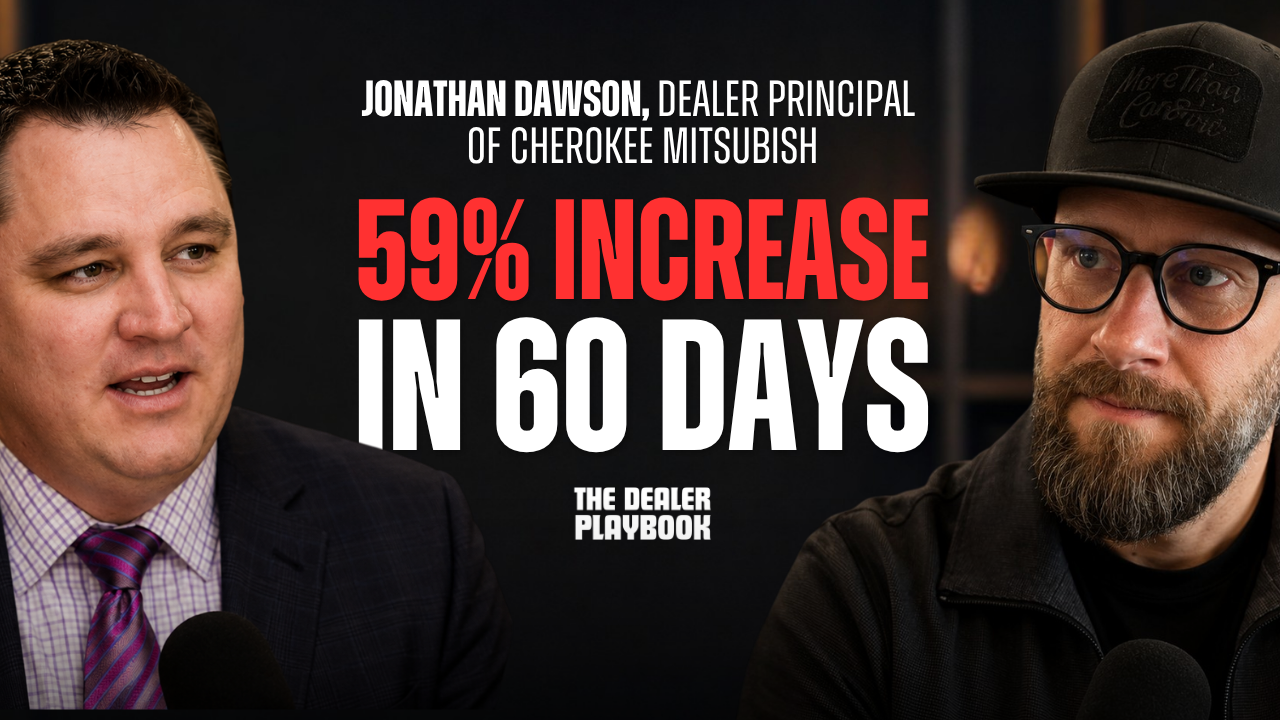
Jonathan Dawson has spent over 20 years training dealerships as the president and founder of Sellcology and co-founder of the Pinnacle Society. A year ago, he became an owner and operator himself at Cherokee Mitsubishi.
This episode centers on one story: a 10 year veteran salesperson who'd been chasing 40 cars a month for a decade, topping out at 39, and told Jonathan flatly that the only way to get there was to fire five coworkers and add more staff and inventory. Jonathan walked him through a simple math exercise instead, built entirely off the salesperson's own best single day. Two months later, he sold 62 cars. No new hires, no new inventory.
Jonathan also gets specific about the moment he had to write up his own top performer twice in two days, why he didn't let it slide even though it stung more than he expected, and the principle he now runs his store by: you either raise your people to your standard, or you eventually lower your standard to your people.
Michael's takeaway: the ceiling most salespeople hit isn't a real ceiling, it's a number they made peace with a long time ago, and the fastest way to break it is math, not motivation.
Timestamps
00:00 Culture Standards Dilemma
00:45 Show Support And Free Book
02:11 TikTok Prodigy And Stewardship
04:08 Stewardship Defined With Examples
08:24 Self Accountability And Value
11:56 Building Owners In Business
14:50 Dealer Principal Hard Lessons
19:01 Non Negotiables And Accountability
21:58 Vision And Personal Branding
30:45 Unlocking Bigger Potential
36:12 Motivation And Kingdom Impact
39:25 Connect And Closing Remarks
Episode Brought To You By FlexDealer
Need Better Quality Leads? FLX helps car dealers generate better quality leads through localized organic search and highly-targeted digital ads that convert. Not only that, they work tirelessly to ensure car dealers integrate marketing and operations for a robust and functional growth strategy.
Watch The Full Episode
Prefer to watch episodes? Be sure to subscribe to our YouTube Channel and turn on notifications to get full access to our content.
Episode Transcript
[0:00] Standards Dilemma
Michael Cirillo: Can I ask you this? You've had a very successful career training, helping others build their dealerships. Now you're an owner of a dealership. In all of the experience you had leading up to this, what are maybe some things to this regard, about what we're talking about here, that you found some deeper nuance to from your training to actually, like, lived experience now being a dealer principal?
Jonathan Dawson: Either you have two options, really. You either raise your people to your standards, or inevitably you will lower your standards to your people. And those are, in fact, the only two options in culture.
Michael Cirillo: You are the only other person in the industry that I have heard use this word, and it was a word you've attributed all of your success to. Can you bring me into that? How do you come to that conclusion, that that's the thing that's going to make you the most successful?
[0:45] Show Support and Free Book
Michael Cirillo: One of the things that I enjoy most about producing The Dealer Playbook is hearing from you. The messages that I get, of people who are getting so much value out of the podcast, applying it to their day-to-day workflows, and finding a thriving career right here in the retail auto industry. It means the world to me.
And one of the ways that we make doing this possible is through my agency, FlexDealer. And of course, in the spirit of providing value, I think this is a perfect time to head over to flexdealer.com to show even further support for you, my beloved DPB gang.
Right now, if you go to my website, flexdealer.com, you can get a full free PDF of my number one best-selling book, Don't Wait, Dominate. And the reason I think it's so special is that a lot of the topics discussed in this book are even more relevant today than ever, with this surge in popularized AI and people wondering, "Well, what can I do next? How can I have a competitive advantage?" Well, that's all here in this book, and I'd love to be able to offer you a free copy if you go to flexdealer.com. It would mean the world to me, because that is how we continue to produce this show for you.
[2:10] TikTok Prodigy and Stewardship
Michael Cirillo: Perhaps the longest episode-guest in the making — only about 14 years in the making. We have crossed paths so many times. It was like, "We've got to do this," and then it never materialized, and I own that. But I am so glad that you're here, because I probably have 20 questions that I just want to get answered, as I've thought about this.
And I want to start here. The kids tell me I've got to be on TikTok. So I go on TikTok last night, and I see a live, and there you are. And there's a 14-year-old child prodigy, a car... what does he call himself? A car sales prodigy?
Jonathan Dawson: He's a self-proclaimed car automotive prodigy. I don't know the kid from Adam, but he seems like a sharp kid, and he seems like he's got some personality.
Michael Cirillo: Yeah, he was articulate. He had some charisma. Anyways, everybody prods you to say, "Hey, give this kid some advice." And the reason I want to start here with you is, you are the only other person in the industry that I have heard use this word, and it was a word you've attributed all of your success to. And the word is stewardship.
Everyone talks about leadership. Everyone talks about management. Everyone talks about discipline. But you go to stewardship. And I thought it was so timely, because I'd written a post on LinkedIn — it might have even been Sunday morning — because I was talking about how I'm a Sunday school pastor in my congregation, and that stewardship has been such a gift to me. And then here you are, a couple of days later, and I'm hearing you attribute so much of your success to this concept, this principle of stewardship. Can you bring me into that? How do you come to that conclusion, that that's the thing that's going to make you the most successful?
[4:08] Stewardship Defined With Examples
Jonathan Dawson: Well, thank you first of all for that question, because this topic is literally near and dear to my heart. It's the thing I attribute my success to, in relative degrees of success. What I attribute what I have to is the combination of my stewardship and God's grace. Combining those two things, I give credit to those two things for what I've achieved.
I did youth ministry for over 20 years, and one of the things, of course, teaching young 12- and 13-year-olds about life, is I would try to talk to them about this idea of stewardship — this idea that every season that you're in, whether that season lasts a couple of weeks, or months, or years, you have a responsibility to act as if you are responsible for that season.
For those who aren't familiar with the word stewardship — and this is not a dictionary definition, it's just my working definition — it's the idea that you act as if you own something, even when you don't. An illustration that really drives it home: how many people have washed and vacuumed a rental car that they had for a weekend? You don't treat a rental car as your own, because you know it's temporary. Your care and concern for it is minimal, because it's not your property. You don't want to get in an accident in it, but you also don't really care if you turn it in dirty. It doesn't matter to you — it's not your car.
Whereas your own car, you will detail, you will wash, you will vacuum, you will clean. Why? Because it's your car. So this idea of stewardship is acting as if the season you're in matters — that the season you're in may, in fact, unlikely as it seems, be a season of preparation. There's a really good chance that whatever you're doing today, there are skills, relationships, and opportunities being developed in this current season that will be potentially necessary, or even exclusionary, depending on what happens in your next season.
For example — and I'll go back to youth ministry just to illustrate the point — if I'm talking to young men and I say, "You want the woman that you believe God has prepared for you," well, that future woman also has a man of her dreams. And this is a line I actually heard from a pastor that I think really communicates the idea: if you want the woman of your dreams, become the man that the woman of your dreams is dreaming about. Then when she sees you, she'll recognize you. But if you're out there playing the field, flirting with all the ladies, the woman of your dreams — the real, godly character woman, the right woman — who sees you being careless and frivolous, that's not attractive to her. So the woman of your dreams could be missed, because you're out being goofy with women who aren't the woman of your dreams.
So this idea is: while you're in the season you're in — whether you're a porter, a salesperson, a sales manager, a janitor, whatever you're doing — the way you steward that season matters, because there's somebody who would promote you that's watching you. There's somebody who has the potential to recruit you that's watching you. So, jokingly, when I talk to salespeople about this, I say, "Hey, constantly be recruitable. Act as if you want to be recruitable." That means doing your task at such a level that somebody thinks you're underpaid and needs to work for them.
Stewardship is just operating at a high level of responsibility. And that's the advice I gave this 14-year-old. He said, "One day I'd like to be a dealer. What would your advice be?" And my advice was, just steward the season that you're in. Act like everything matters. The decisions you make on who you befriend matter. Who you spend your time with matters. What you watch matters. Who you talk to, what you read — it all accumulates, and it eventually becomes a door opener or a door closer, because time eventually will either promote you or expose you, given enough time.
[8:27] Self-Accountability and Value
Michael Cirillo: As you're saying this, and I'm feeling it, and it's resonating with me — where my heart yearns is that more people would understand that what you just taught is the make-or-break of whatever you do in your life. In this context, we're talking about the auto industry, car dealers, car sales, marketing, and all the things we consider. But everything you just taught, John, dispels this idea of, "Oh, well, I can't, because my leader will never..." — you're completely removing that from the table. You're like, "What does that have to do with anything?"
Jonathan Dawson: Self-responsibility, self-accountability — these are words that sound good, might make a good meme or a good Facebook post, but when it comes to preparing yourself for whatever your heart's desire is... I actually genuinely believe that God will give you the desires of your heart, meaning two possible things. Number one, that He will seed them within you, so that you have the right, God-given desires. And as He gives them to you, He equips you with sufficient grace, sufficient faith, and sufficient capacity to do what you can with what you have, until He equips you for the next thing.
So it really comes down to: what do I have control over right now? What can I influence now? What value can I add now? I was recently talking to somebody about getting a raise, and they said, "I feel like I do a really good job in my role — I'm just looking for that raise." And I said, "Can I push back a little bit? The job you're doing a good job at — isn't that just the expectation of the job? You want a raise for doing what you're expected to do? If I pay you this many dollars to do this task, and you do the task really well, isn't that just the standard you're being compensated for?"
You can't say, "I want more money because I do what I'm being paid to do." You need to say, "I'm going to do above and beyond, more than expected, beyond the scope of what I'm currently compensated for, until the marketplace — in this case, either your employer or another employer — recognizes how much value I bring," and says, "That person's underpaid, or underutilized." That's how you become promotable. That's how you become recruitable. That's how you become more valuable to the marketplace — by adding more value than what is expected, not just doing a great job at your job.
Michael Cirillo: In your observation, why do you think — I've always called it "employee mindset" — we kind of expect to be paid more for doing what was expected of us? What has contributed to that mindset, and how do you, in your organization, extract people out of that mindset so they can really get it? You even said last night, something about how anybody who's developed wealth or any measure of success has understood this concept — that you go above and beyond. How do you extract that out of people?
[11:56] Building Owners in Business
Jonathan Dawson: I think obviously it comes with recognizing that the default setting of the average person is average. Their brainwaves are average, their thought process is average, their habits are average, their reading is average, their TV watching is average. So, first of all, with grace, you say: a leader is supposed to see beyond where people are now and be able to take them there. That's the nature of being a leader — you can see a person's potential better than they can, and that's why you can lead them there.
So with grace, I say, "Look, I don't expect them to have an entrepreneurial mindset. If they all had an entrepreneurial mindset, they'd all be trying to run their own businesses." So as I'm developing businesses within the business, it's about partnering with them in the things that help them become owners of their business.
What does that look like? The mantra for forever has been managers saying, "I don't understand — I tell these guys, 'You're a businessman in the business.'" Okay — are they a businessman in the business, so they can set their own hours? No. So they can have their own business cards, instead of the company card? No. So they have a marketing budget? No. So they have a branding strategy? No. So in what way exactly are they actually a business within the business? How does that look in real life? The reality is, most management has no plan around how to actually create a "businessman in the business."
Now, at my dealership, we actually do. We equip them with marketing budgets. We equip them with branding strategies. We want them to build a portfolio. I tell my salespeople, "I want you to become recruitable, and I want you to have enough leverage to renegotiate your pay plan with me. Here is the pathway to opening up your schedule. Here's the pathway to setting your own schedule." And I tell them, "I want you to have enough leverage to sit across from me and say, 'John, for me to stay here, I need this, this, this, and this.' And the day you do, you should have the leverage when you do" — because whoever has the most leverage will win that conversation.
I've even told my team, "If you're not sure if you have leverage, talk to me about it. I'll tell you what you can do to increase your leverage" — because I want people at their maximum optimal performance, even if that means I'm only going to keep them for two or three years on my team. If I can get somebody to sell 50 cars a month for three years, and then they move on to become a real estate agent or whatever — okay, I'll start over with somebody else, and I'll probably have a pretty good pipeline of people like that.
So I'm trying to develop that with the new store I just bought. I want to, from the beginning, tell them, "Here are some business models, here are some pathways — which pathway is attractive to you? Which model is attractive to you? What kind of support do you need to build that kind of model?" That's what we're trying to do at our store, because we have to train people to take ownership — because unfortunately, the average person is not wired to do that on their own.
[14:50] Dealer Principal Hard Lessons
Michael Cirillo: Can I ask you this — and I feel genuine about this question, and I think you'll receive it in the right way. You've had a very successful career training, helping others build their dealerships. Now you're an owner of a dealership. In all of the experience you had leading up to this, what are maybe some things to this regard that you found some deeper nuance to, from your training to actually, like, lived experience, now being a dealer principal?
Jonathan Dawson: That's fair. And just for a little bit of context — for over two decades now, I've been in the training and consulting space. I've physically walked into over 3,000 dealerships. I've now trained in nine different countries, and I'm a 26-time NADA speaker. So most people who know that, with a significant client base of really high-performing stores, would say, "What were you thinking, getting into retail operations, you crazy person?" Because, as we know, the industry has shown us — it is hard to take a store and grow it from scratch, or take a very broken store and grow it. Many people have tried and failed at that. It's difficult to do.
Yesterday was our one-year anniversary for our dealership.
Michael Cirillo: Congratulations.
Jonathan Dawson: So the things I've, I guess, found nuance in — it's easier, I think, as a consultant or trainer, to say, "Just write them up. Just fire them. If they won't do what you tell them, change the people," as one friend of mine often screams from the podium. To me, the nuance of that is — especially in a smaller operation, and I don't mean this as a slight against any other dealership — because of how much value we put on relationship, community, and core values, when I have to write up an employee, it stings at a level I didn't think it would. I used to be more objective about it and just say, "It's a necessary part of the business."
But recently at my store, I had to write up my top salesperson — salesperson of the month for four months in a row. I had to write them up on the last day of one month, then literally on the first day of the next month, for two completely unrelated things they violated in our policies. They were process things — they didn't follow an understood part of our process, on the very last day of the month, and then on the first day of the next month, they didn't follow a different one.
To have to write up your top person, who's been number one for four months in a row, and start the month with that, was like, "Oh, God." I wanted to just let it slide. I thought, "I don't want to ruin their mojo — it's the last day of the month. I don't want to ruin their mojo — it's the first day of the month." And then I thought, "Yeah, but that's the compromise. That's the little leaven that leavens the whole lump. That's the little fox that ruins the vineyard. That's the little slip that creates the slippery slope." So I did it anyway, and it was hard to do.
I also had another team member — one of my management team members — who had to be written up, for a different thing. Now, we have a process for this, and it's not something that hits people entirely by surprise. There's a sequence — there's a verbal, there's a clear definition of what needs to be done, then there's the expectation with the write-up. There's a verbal right before the write-up, where I say, "Look, because of our last conversation, you knew the next step would be this if it happened again. I need to inform you now — you will be having a formal write-up. It's going to be painful. It's going to suck. Here's what it's going to say. You're going to get it soon. I just want you to know."
But I actually lost a management member because they didn't like being written up for something, and they disagreed with it. Instead of talking it through, they got upset and heated in the moment, said some things that I think crossed the line of what I could tolerate, and it was time to part ways. It was unfortunate, because two days later they were like, "What did I do?" But at the same time, from a standards perspective, I cannot allow — and here's the reality, Michael, this is my philosophy, and I tell my clients this all the time, and I'm living it daily now.
[19:02] Non-Negotiables and Accountability
Jonathan Dawson: Either you have two options, really. You either raise your people to your standards, or inevitably you will lower your standards to your people. And those are, in fact, the only two options in culture.
Over time, little by little, you and I have seen this in the market — a store that used to sell 200 cars, and then they had a month where they sold 190, then 193, then 182, then 180, then 187, then 174 — and all of a sudden, creep, creep, creep, creep, and now they're a 120-car-a-month store instead of what used to be a 220-car-a-month store. And they're going, "What happened?" Well, I can tell you what happened: a bunch of little compromises, where you didn't hold people accountable, where there wasn't clarity — which is a form of kindness — where there wasn't accountability done with kindness and firmness.
So there are things we built into my store, processes that, having been in 3,000 stores looking for best practices everywhere I go, I say, "This is a non-negotiable for me. This will be really hard, but it's a non-negotiable." That's the nuance of the humanity of our business — it's been the hardest thing for me to navigate, because these are relationships. They have families. It's painful. That would be one of the top ones, for sure.
Michael Cirillo: I love hearing you walk through your thought process, and how many steps it took. You started by talking about grace at the beginning of the conversation, and here we see an example of how you deploy grace to your team. It's like, "No, we have a mission to accomplish here. We have a standard." I love that visual — I was just talking to my pastor before we hopped on this call, about an individual that our hearts yearn for, and we realized we can't dive into the depths of where they are; we actually have to throw them the line. You make me think of that again, Jonathan. It's, "I have a standard, and I've created the why around these non-negotiables." I love the visual too, of the fox in the vineyard, because you're right — I even think about my own journey building my business, how much longer than I should have I held on to toxic people, or thought I could change them without them taking responsibility in that change.
I think that means a lot, especially in this environment — you're now a dealer principal, you have an ambitious brand, and you're trying to rally your people. I learned a little bit about your story acquiring the store at ASOTU CON, and you said so many things that fascinate me.
[22:19] Vision and Personal Branding
Michael Cirillo: Touching on something you said earlier, to quantify building a business within the business — it sounds like what you're doing with your people is almost like a hard reset, a "Thanos snap," saying, "However it was then, it's not going to be that way now. Here's what it actually means to build a business within the business." You talked about doing fun stuff like personal brands, and the way they do their staff photos. Why is that an important place to start for you?
Jonathan Dawson: Because it goes back to a general understanding of basic psychology, of motivation or activation. Here's the broad strokes of how brains work: the thing we own, or the thing we create, we care about differently than the things we don't own and didn't participate in creating. If I give you business cards, you don't care if they get thrown away, because I just gave them to you. It's like a 15-year-old — you give them a car, they're going to wrap it around a mailbox. But if, from the time they're 12, they're mowing lawns, stacking up $20 bills so they can one day afford a $2,000 car, and they buy that car with three years of sweat, they will wax and wash that car daily, and make sure there's not a bug smudge on it — because they earned it through work, and it's theirs. They own it.
So what I want to do with any sales team — whether I'm coaching them as a client from a training-company perspective, or in this case my own store — is bring them in as co-collaborators and co-creators of what they want their business to look like. I usually start with a simple framework, and these are all real examples from my students and friends.
I say, "Imagine, Michael, if it were possible that you could have a business where you sell 20 to 25 cars a month, and you only work two weeks out of every month — two weeks on, two weeks off. Or, you work three days every week, but you sell 30 to 35 cars a month. Or, you work four days a week, and you sell 40 to 45 cars. Or you work five days a week, and you sell 50-plus cars a month." If you heard those different models, and two or three years from today, one of those was your actual life — do you have a preference right now? Everybody does. I've done this with a survey of 100 salespeople in a room, and it's never a uniform answer — everybody has one they'd prefer.
Then I say, "Okay, let's pretend that's going to be true of you. In order for that to become true, let's reverse-engineer it." As the Scriptures tell us, God is a God who sees the end from the beginning — He's outside of time, so He can see the whole scope of it. If you can imagine the end result and work yourself backward — "In order for that to be true, what would have to be true now? What kinds of things would we have to put in place?"
For example, if you're working three days a week and having a "hat trick" every time you walk in, what kind of clients would that require? Total strangers? Good ups on the lot? Good internet leads? What customer type would most likely honor that business model? And they say, "Gosh, it would have to be repeats and referrals." Okay — so if, two and a half years from now, your business is primarily repeats and referrals, what would have to be true today to ensure you have enough of them then? And they start going, "I'd have to be really good at follow-up." Okay, what else? "I'd have to give a great experience." Okay, what would that look like?
By helping them co-create a possible future they want to be true, it becomes about small, specific things — techniques, actions — but the vision is there first. Scripture teaches that people perish for lack of vision. They don't have clarity of vision, they don't know where they're going. So you have to give people a vision. Otherwise, what they end up doing is sitting on the lot all day, watching cars drive by, hoping someone comes in and buys — that's the mantra of the salesperson stuck in mediocrity, because they have a management team so focused on managing tasks that they've forgotten the role of developing people.
That's the philosophy I want to instill, both in my clients and my team — if they co-create the idea, if it's theirs, they protect it differently. They care about it differently.
I'll tell you one quick story about that. I had a salesperson I got on a call with, and we talked about his business. About a week or two later, the general manager calls me and says, "John, I've been talking to this guy about follow-up for years. He's been on our team for 10 years and follows up with nobody. But for the last week, he's sending out 20 pieces of mail a day, sending emails every day, leaving voicemails like crazy. What did you tell him about follow-up that I didn't?" And I said, "That's funny — because we didn't talk about follow-up. Not one sentence. We didn't spend 10 seconds on it." He said, "Then what did you talk about?"
I said, "I talked about the importance of building a personal brand, being outstanding and memorable, having customers be truly loyal to you, so you can build a business that will one day work as hard for you as you work for it — so you get a real return on the 10 years you've invested, with a raving-fan advocacy network driving you traffic. We talked about the importance of building a business you're proud of." I never told him to send an email, a text, or a piece of mail to anybody.
He said, "Wow, that's fascinating." I said, "It's not really fascinating — it's interesting, but not shocking to me — because he took ownership of his business. In his mind, one of the actions an owner would take is making sure their customer base remembers them." I didn't have to tell him to do follow-up. I had to give him a vision of what his business could look like if his customers loved him and never forgot him.
Michael Cirillo: It's like you're making the vision real for them, so they take it and get clarity about the possibilities for themselves. Sometimes it's like kids — you ask, "What do you see for your future?" and they say, "I don't know." But you're not letting them go to an "I don't know" position. You're saying, "No — here are the options. Which one resonates with you?" I think that's so powerful.
Jonathan Dawson: Or give me your own — it doesn't have to be one of the ones I gave you. Tell me what it looks like to you. But give us clarity. What are we working on? When you show up, and you've been eight or ten hours away from your family that day, what is the reason you're going to suffer at a car dealership? Because — again, this is a scriptural principle — it was for the joy set before Him that Christ endured the cross. There's a principle there: when given enough joy or hope, people can endure incredible suffering, pain, or stress. The challenge is, you have sales floors with everybody suffering and no clear reason why. They don't know what they're doing there — they're wandering around aimlessly, like zombies. Give people vision, whether it's corporate vision toward what we're building together, or individual vision, as to what we're going to create for their personal family and future.
[30:45] Unlocking Bigger Potential
Michael Cirillo: Let me ask you this. Because we're notoriously "grow, grow, grow" — for the person who's being honest with you and says, "I'm at 18 cars a month, and that creates a version of me that's bigger and bolder and better than I've ever wanted" — what do you say to that? How do you reconcile it, as an operator or a principal, when you've coached them to where they want to go, they're achieving it, they're happy — but now we've got to go the extra mile, we've got to go to the next step?
Jonathan Dawson: Yeah, there are a couple of ways I've helped unlock some people. One of my favorite stories is about a gentleman named Jeff. He was the number one salesperson at his dealership, and had been for north of 10 years. He was in a classroom — I happened to be there, speaking to the entire store in a training session. As I was talking about the potential of what's possible at a store — hitting bigger numbers, 50, 60 cars a month, since some of the people in my Pinnacle Society, which I co-founded with Ali and Frank, sell 60, 80, 100-plus cars a month — I'm telling this story, and he raises his hand.
He says, "John, that's all well and good, and I mean no disrespect" — and I'm thinking, "Great, here we go." His owner is in the room, everybody's in the room, and this is the veteran number-one salesman. He says, "But I think I know better than you what's possible in my store. I've been through three owners since I've been here, and let me tell you what it will take. I've been trying to hit 40 cars for over a decade — I've hit 35, 36, 38, all the way up to 39. Let me tell you what it will take: fire five of these other guys, put 50 more used cars out there, and hire me two more F&I managers. Then I can get past 40 cars." That's what he said, boldly, in front of everybody, with the owner right there — "Fire five of these guys."
I said, "Jeff, I'm going to ask you a question back, and then I'm going to take you to a place. Is it fair to say — am I being fair when I say, based on everything you know, that everything you said is true?" He said, "Absolutely." I said, "Is it accurate to say, then, that based on everything you know, everything you said is 100% true?" He said, "100%." I said, "So — based on everything you know, Jeff, the only way it wouldn't be true is if there was something you didn't know that could make it not true. Now, you've been at this store for almost 20 years, but I've been in 3,000 stores. Is it possible — just possible — that I know something you don't know?" He said, "Well, of course."
I said, "Is it possible, then, that if I gave you the thing I know that you don't, you wouldn't need to fire five guys, or hire two more, or add 50 cars?" He said, "Well, I guess." I said, "Then let me show you what I know that you don't." I walked him through an exercise I do on potential — it's called the mathematical potential of your business. I won't do the whole exercise, but here's the 30-second version.
I asked, "What's the most cars you've ever personally sold in a single day?" He said, "Six." I said, "Great — you're scheduled 22 days a month. Six times 22 — is that 132?" He said, "Yes." I said, "So if you only replicated what you've already done — a six-car day — consistently, 22 days a month, that'd be 132 cars. May I ask you, Jeff — what was your goal this month, relative to that 132 actual potential?" He said, "My goal was 30."
I said, "So, Jeff, let me ask you something else. Didn't you just tell me that for 10 years, your goal has been to get to 40?" He said, "Yeah." I said, "And didn't you just tell me this month's goal was 30?" He said, "Well, yeah." I said, "So how does a man who's trying to get to 40 for 10 years have a goal this month of 30? How is that possible, Jeff?" And he said, "Well, it's just a number I know I can hit."
I said, "Yeah — and here, Jeff, is the rub. Your goals have nothing to do with your actual potential. Your goals are based on your past, designed to protect your pride, and have nothing to do with your potential. And that, my friend, is how we unlock you."
I have the video — happy to share it with anyone who'd like to see the receipts. Two months later, he hit 62. We did not fire five people. We did not hire two more F&I managers. We did not add 50 cars. And I have the video where he politely concedes and says, "John, it was me the whole time. It took someone like you helping me see that I had just normalized my standard. I wasn't really trying to get to the next level — not really. I was telling myself a story."
So when I look at an example like Jeff — and he's one of many stories I could share like this — how do you unlock it? It depends.
[36:12] Motivation and Kingdom Impact
Jonathan Dawson: I'll illustrate this back to biblical principles, because I try to both live my life by that and lead by that. How did Jesus interact with and heal people? Some He touched. Some He spoke a word to. Some He made mud and applied it to their eyes. There isn't — and I think every manager wishes there was — a cookie-cutter approach where you just do one thing and everybody falls in line. That's not how human beings are wired.
So when you're trying to motivate a staff — I asked a room recently at a convention, "How many of you relate to the pain of throwing a $500 spiff at a room of salespeople, only to have half of them duck so it doesn't hit them?" The whole room said, "We feel you, Jonathan." Because there's a part of you that goes, "Back in the day when I sold cars, I'd have crawled over somebody for that spiff." I get that — but that's misunderstanding what leadership is. Leadership isn't about what you'd care about — it's about what they'd care about.
So when I'm trying to motivate somebody who's already near the top, sometimes it's about naming a relative degree of selfishness they've settled into. For example, if a salesman says, "John, I don't really need much — I'm taking care of what I need to take care of," I'd say, "I'm going to push back on you a little bit. You don't strike me as an egotistical or selfish person, but what you just said is highly egotistical and highly selfish — because what you've implied is, 'I've covered my own,' as though you don't live in a world where you could impact others. How many wells in Africa are you funding? How many orphanages? How many missionaries are you sending? Yes, you take care of yours — but if you don't need more than the fifteen grand you're already making a month, what you're telling me is that if you had an excess five grand, you could deploy it for something meaningful — kingdom work, a cause you care about, a family member you could support. There are things you could do if you had excess. But you don't, because you've convinced yourself that taking care of your own little silo of the world is all there is. That's a selfish, egotistical position."
I'd challenge someone to unlock that, and say — this is my conviction — one day you'll have to give an account, not just for what you did with what you had, but for what you could have done with what you could have had. That matters, especially to someone with an eternal perspective. That question starts to make someone ask, "What am I actually doing? Will I have to give an account? How will I justify that I only took care of my little world, in a world that was suffering and broken?"
Michael Cirillo: Yeah — it's like the parable of the talents, isn't it?
Jonathan Dawson: It is. Yeah, it's another great principle of leadership.
Michael Cirillo: Wow. Okay — I wish my cup wasn't overflowing right now, but it is, which ties into the whole point, because I'm thinking, "What could he tell me that would make me get a bigger cup?" This is tremendous stuff. I'm so glad you were able to join me today and share your time and your wisdom with us.
[39:25] Connect and Closing Remarks
Michael Cirillo: How can those listening and watching connect with you?
Jonathan Dawson: I like to jokingly say I'm all over the web like Spider-Man — you can't miss me. You can throw "Jonathan Dawson" into the interwebs, or you can Google Sellcology, which is my primary training company. Pinnacle Society is my mastermind for high performers. Pinnacle Training Center is my physical training center here in Atlanta. And of course, Cherokee and Cherokee Mitsubishi are all over social, to see what we're doing at our dealership.
But if you're a dealer exploring resources, and you'd like to have a conversation about what we do — we just built an AI tool that I'm really proud of, spent a year building it — it absolutely equips what I do on the ground. It makes the difference. One of the biggest challenges forever, Michael, has been: you tell a salesperson what you want them to do, and as soon as they walk out the door, you're wondering if they're going to do it, or do it anywhere close to what you asked. I've asked managers, "What's your personal level of confidence that the version of events the salesman just told you is actually true?" And it's basically zero, across the board.
My AI tool has a complete scoring metric built in. It listens to the entire customer conversation, pulls the transcript, runs it through the AI metric, and tells management what's working, what's not working, what reps are doing and not doing. It's a wonderful coaching tool, and a wonderful save-a-deal tool. So if a dealer wants to talk to me about that, I'd love to do that.
If you want to send people to our live classes at the Pinnacle Training Center in Atlanta, go to pinnacleworkshops.com. If you want to find out about Sellcology, go to sellcology.com or SellcologyUniversity.com for the online platform, and pinnaclesociety.com for the mastermind. If you're looking for me, you'll find me — I'm out there. Otherwise, find me on social media, send me a DM if I can add value. I'm on a mission to save the world one salesperson at a time, and opportunities like this — the opportunities dealer clients give me — are a way for me to live out my mission statement. So I appreciate this introduction to your audience.
Michael Cirillo: Yeah, it's been almost a decade, I think, since we first talked about doing this. We kind of slow-rolled this one — I'd call us the chief procrastinators when it came to this particular conversation.
Jonathan Dawson: Procrastinate on purpose, as they say — because now look how much we had to talk about.
Michael Cirillo: Jonathan, thank you so much for sharing your time with me on The Dealer Playbook.
Jonathan Dawson: My pleasure, my friend. Thank you so much for the invitation.
Michael Cirillo: Hey, thanks for listening to The Dealer Playbook Podcast. If you enjoyed tuning in, please subscribe, share, and hit that like button. You can also join us and the DPB community on social media. Check back next week for a new Dealer Playbook episode. Thanks so much for joining.