"The middle ground" — How Smart Dealers Use AI Beyond Hype or Fear | Michael Cirillo, CEO AT FLEXDEALER
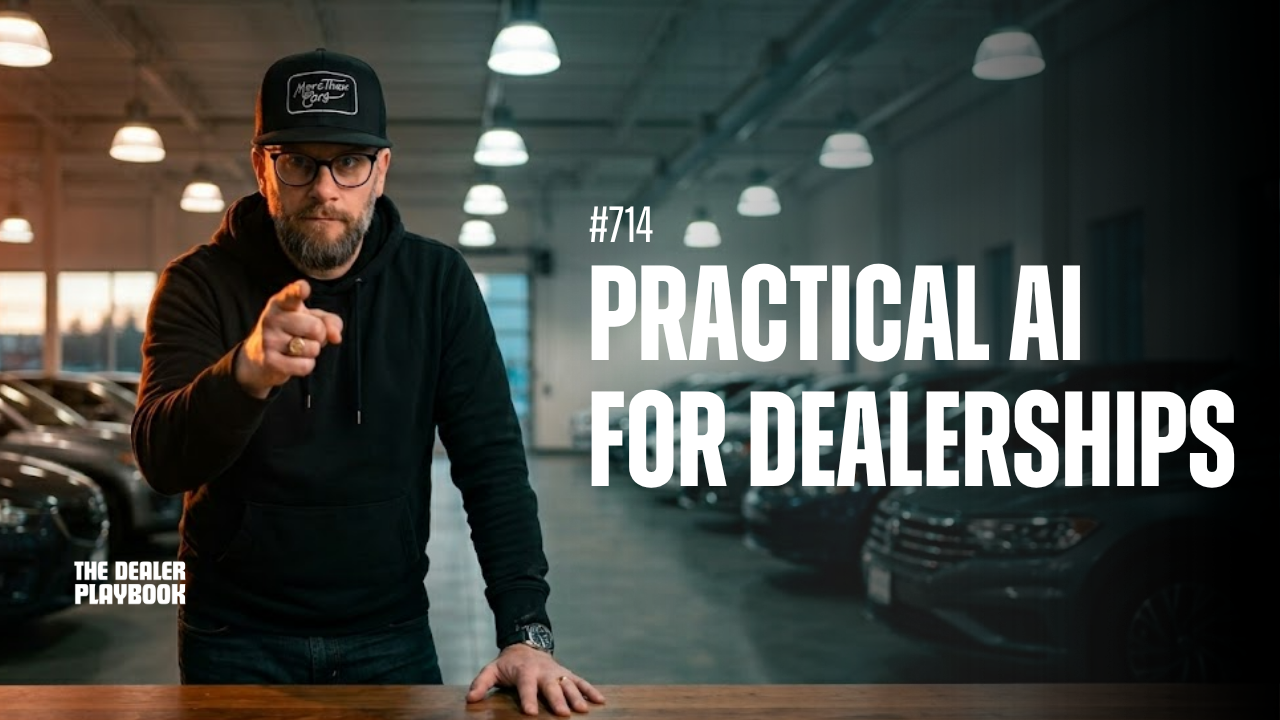
Are the "AI zealots" and "AI doomsayers" clouding your judgment about what artificial intelligence actually means for your automotive retail business? It’s time to move beyond the hype and fear and discover the practical, actionable ways AI can elevate your dealership and refocus your team on what truly matters: human connection.
What you will get from this episode:
Understand how AI can free up time from monotonous tasks, allowing your team to focus on meaningful customer interactions.
Learn how top performers are using AI to analyze CRM data, identify customer trends, and enhance sales strategies.
Discover practical applications for departmental leaders to transition from "operator" to "architect," empowering their teams.
Gain clarity on how to utilize AI to build a more effective, human-centric dealership culture.
Join Michael Cirillo, Host of The Dealer Playbook, as he shares tangible examples and strategies from his own experience and from leading automotive professionals on leveraging AI to scale the human element in your business.
Follow The Dealer Playbook so you never miss an episode.
Timestamps
00:00 Intro
02:10 Hype vs Zealots
02:51 Internet Disruption Story
10:32 Finding the Middle Ground
13:03 Watching Claude Ad
15:05 Ad Breakdown and Narrative
20:35 AI Scales the Human
24:25 Dealer AI Morning Brief
28:43 CRM Data Sales Insights
31:44 GM Delegation with AI
32:56 Three Practical Use Cases
34:24 Final Takeaways and Outro
Episode Brought To You By FlexDealer
Need Better Quality Leads? FLX helps car dealers generate better quality leads through localized organic search and highly-targeted digital ads that convert. Not only that, they work tirelessly to ensure car dealers integrate marketing and operations for a robust and functional growth strategy.
Watch The Full Episode
Prefer to watch episodes? Be sure to subscribe to our YouTube Channel and turn on notifications to get full access to our content.
Episode Transcript
[0:00] — Introduction
Michael Cirillo: Hey, what's up? Welcome to this episode of the Dealer Playbook podcast. This is the episode where we are going to stop talking about AI like it's this thing that's going to just kill everything that we know. This is the episode where we are going to talk about practical applications for automotive industry professionals when it comes to AI.
We're going to look at some videos — the latest viral video from Claude, Anthropic's Claude. We're also going to talk about some of the things that AI experts out in the world are talking about as far as the implications of this on our society. Most importantly, I want to give you some clear examples about what you can utilize AI for in your dealership to help you move forward.
[0:47] — A Note From Michael
Michael Cirillo: One of the things that I enjoy most about producing the Dealer Playbook is hearing from you. The messages that I get of people who are getting so much value out of the podcast, applying it to their day-to-day workflows, and finding a thriving career right here in the retail auto industry — it means the world to me.
One of the ways that we make doing this possible is through my agency, Flex Dealer. And of course, in the spirit of providing value, I think this is a perfect time to head over to flexdealer.com. Right now, if you go to my website, you can get a full free PDF of my number one best-selling book, Don't Wait, Dominate. A lot of the topics discussed in this book are even more relevant today than ever with this surge in popularized AI and people wondering, "What can I do next? How can I have a competitive advantage?" It's all in this book, and I'd love to offer you a free copy. It would mean the world to me because that is how we continue to produce this show for you.
[2:09] — The Hype vs. The Zealots
Michael Cirillo: I want to start here. As I've thought about AI and everything that's going on and all of the conversations that are happening, I seem to observe that there is the hype crowd and there are the zealots.
The hype crowd says, "Oh my gosh, you won't be able to live without this. It's the best thing. Here are the three things that are going to help you change everything about the way that you live life. And if you don't do these things, you're not going to be living the way you should."
And then there are the zealots who say, "This is going to replace you. Millions of jobs are going to be gone." They just talk through the lens of pretty much no hope.
I think there's a middle ground, as there is with anything. And for me, it starts in my own lived experience.
[2:51] — The Phone Book Story
Michael Cirillo: I remember back in the early '90s, my family business — we published phone books. So go with me here for a minute.
Somewhere around 1991, my dad called us into his home office. He had us gather around his desk. He was sitting in his chair, and he loaded up the internet. You remember that sound — connecting to the satellites. And he loaded up the Encyclopedia Britannica website, which was one of maybe ten websites at the time.
I remember sitting there enamored. I was like, "What is happening right now?" My dad said, "We've connected to the World Wide Web."
Once the Encyclopedia Britannica website was done loading — pixel by pixel on a slow 28 kilobyte per second connection — I remember my dad turning around in his chair, looking me square in the eyes, and exclaiming: "This is going to kill the encyclopedia salesperson."
At the time, for all of you who may not know, encyclopedia salespeople would go door to door once or twice a year selling the updated volume of the Encyclopedia Britannica, A through Z. My dad's declaration was kind of prophetic. He saw the potential of the internet in that moment, and he wasn't being a zealot. He was making a realization in real time that this wasn't just going to change the way commerce happened — the internet was fundamentally going to change everything. Most importantly, it was going to change his job as a publisher of a phone book.
Looking back now as a 40-year-old man, I think what my dad was really saying was not that the encyclopedia industry was going to die — he was saying, "This is going to put phone books into oblivion. We become obsolete." And about five years later, my dad got us out of the phone book business.
[5:37] — Wrestling With What Comes Next
Michael Cirillo: During that transition, he probably wrestled with much of what I'm seeing people wrestle with today. There are people living in fear, saying, "AI is going to replace me." You hear people online pointing out that software engineering was the most coveted job out there — and that was the first thing AI was able to do. So if that's the most coveted, most sophisticated job and AI tackled it first, what does that mean for everyone else?
I think a lot of people in our industry are genuinely concerned about the implications of artificial intelligence. They know they kind of have to lean into it, but they're living with an uncertainty that clouds the way they lean in.
That's why I share the phone book story. My dad went through every position you could possibly take when trying to grapple with what's going to happen next. For him it was the internet. For you it might be AI.
He went through a defensive posture first: "No, no, no. This is a community phone book. People are going to want to look up postal codes. They're going to want to advertise and support a local business." Then he moved through acceptance: "I see the writing on the wall. The internet is going to make things more efficient. I'm not going to have the publishing cost anymore." But in that period of acceptance, he was still grappling with, "What do I do next?"
I watched him go through all of those thought processes. What I didn't realize at the time was that the evolution out of phone books was actually our entrance into the automotive industry. We started publishing a car magazine — the only competition to Auto Trader at the time in Canada. It was lucrative, profitable, and amazing.
When I eventually took the helm of that business and dealers started saying, "Hey, I don't know if I need to do print anymore — I've got this website thing," I took a defensive posture too. I spent so much energy defending my position. I understand now why I did. It was a real proposition — this is going to put me out of work, it's going to cause discomfort, and I don't know what's around the corner.
But as I showed up every day and went through those motions, clarity came. Maybe we could do the digital thing too. Maybe there was a bridge. That eventually led us to developing our own inventory platform and building a portal website that for years ranked in the top three portal websites in Canada. That was our foray into digital — uncomfortable, stressful, and ultimately transformational.
[10:32] — Finding the Middle Ground
Michael Cirillo: I'm sharing all of that because I think a lot of people today are wrestling with AI on both sides of the coin. There are those taking a defensive posture: "Humans are always going to be needed for the things that I do." And then there are those saying, "Without AI, you are going to die." And we're having trouble finding the middle ground.
Because of my lived experience going through all of those motions before, I think I've been able to navigate the AI conversation a little better prepared. I saw it early, became very bullish on it, and said, "I've got to lean into this." I have a marketing agency. I have a software company. And you're telling me AI is going to fundamentally change marketing and software development — the very things I hang my hat on. Yet this time around I'm not feeling defensive. I'm feeling excited. I'm enamored with the possibilities.
The purpose of this episode is to pull both sides closer to the middle. The best way I know how to do that is to bring it up, call out both sides, and then walk through some clear, practical use cases — so that if you're defensive, you can start to see how AI speeds you up, and if you're a doom and gloomer, you can begin to understand it in context.
[13:03] — Breaking Down the Viral Claude Ad
Michael Cirillo: Before we do that, I want to share the most viral Claude advertisement — Anthropic's latest ad for Claude. I think it's really well done, and I want to give you my commentary after we watch it. If you're listening only, this is where I'd encourage you to come over to Spotify or YouTube and watch the clip. Follow us on socials at @thedealerplaybook or @dealer_playbook on Instagram, where we'll slice this out so you can get the full effect.
[Ad plays]
[15:05] — Ad Breakdown and Commentary
Michael Cirillo: A couple of things here right out of the gates.
Number one — we have a guy who is going to enjoy his life. He's out the door in a rush, says goodbye to his wife and kids, gets in the SUV, goes and does boxing. On his way to training, he's telling Claude everything that needs to be accomplished. This highlights some of the capabilities of where AI agents are today, especially Claude Computer, which can access your computer and perform actions. Really cool stuff.
Then he comes home, brief exchange with his wife who's holding the baby, sun going down, and he sits at his computer to review the work.
Now let's break apart the message — because there is very real indoctrination happening here, and I don't mean that negatively. A very powerful principle in marketing is indoctrination: bringing your target audience up to speed on capabilities so they know what to expect. There's definitely indoctrination happening in this ad. The idea of a busy business owner who, because of AI, can go and do whatever he'd rather do with his day.
This coincides with the narrative from people like Mo Gawdat, who talks about AI moving us toward a state where it does everything, replaces gazillions of jobs, and puts us into a new economic state of euphoria. I don't love that narrative because it leaves unprepared people asking, "Then what is my purpose on this planet?" I get what he's saying, but the euphoria framing is a stretch.
Here's what also drives me a little bit crazy about this ad: this guy doesn't share any time with his family. We watch him go do whatever he wants with the day, barely say good morning to his wife and kids, go get beat up in the ring, come home, and immediately sit down in front of a computer. I get the point they're trying to convey. I just find it ironic given that one of the reasons I became an entrepreneur in the first place was to build systems that could operate the business so I could have more time with my family. That hasn't proven to be quite as straightforward as advertised.
There's something else worth highlighting though. We recently did an episode with my good friend and business partner at Flex and LiftKit, Dan Collingridge. As a software developer who has built hundreds of things, Dan said: "AI is now helping me do those things — but I still need to skill up. I still need to be on top of things. There is still a place for the human in this mix. Without it, we basically have minions doing actions with no human to cross-reference against. And if I'm going to be that human, I need to constantly skill up. I can't just hand it off to Claude Code, or Cursor, or Lovable and walk away."
That's the subtle thing I pull from the Claude ad too. Listen to how the guy directs the AI — he's very specific, based on his own knowledge of what a viable output looks like. That matters.
[20:35] — AI Scales the Human
Michael Cirillo: This brings me to the point I really hope lands with the right intention: AI is going to speed us up, but what is it going to speed up? What is it going to scale?
My encouragement is this — AI scales the human. AI speeds up human connection.
AI can absolutely take away work that the human didn't need to do or shouldn't have had to do to begin with. In the ad, we see the demonstration of finding files, analyzing them, building a scope, producing a report. When you really think about it — that wasn't human work to begin with. It shouldn't have been.
With AI pulling both parties toward the center, it's a very real possibility that agents can handle all of that routine, monotonous work and deliver me a brief. And then with my human nature — my empathy, my nuance, my capacity for genuine human-to-human connection — I can spend that freed-up energy doing more meaningful work at a human level.
We've talked about customer experience until we're blue in the face in this industry. We keep talking about it and keep struggling to actually do it. What I would suggest is that AI actually gives us the most probable path to deliver it. If it frees up my time, energy, and talents by handling what I shouldn't have had to do to begin with, I can then reallocate all of that toward what is going to matter more than anything else: meaningful, positive human connection. Building a relationship of trust. Pouring real value into another person. Unlocking the law of reciprocity.
That might be the thing that excites me most about AI — it's opening up the very real possibility to remove from me the things I never should have had to do in the first place.
So when you hear me say, "AI is going to replace jobs," what I'm really saying is not the job as a whole — but aspects of the job that you didn't need to do to begin with.
[24:25] — Real-World Example: The AI Morning Brief
Michael Cirillo: We interviewed John Osborne, AVP at Carter Myers Automotive, on Auto Collabs — one of our other shows at More Than Cars. As an operator and director, he gave us some really practical insight into how he's using AI.
What he's done is connect Claude to his email and his calendar. Every day, the agent skims his emails, finds attachments from OEMs with scorecards, reports, and analysis, and summarizes all of it into a morning brief. When he sits down, he spends ten minutes at the beginning of his day getting all the operational insight he needs — where the OEM is going, where his stores are going — so that he can invest the rest of his day pouring into his people.
He moves himself from an operator role to an architect role. The architect is the person who moves through the floor freely, pouring vision, values, quality, and standards into the people who are operating — so that every move they make maps back to the bigger picture.
Without that morning brief, going through all of those emails and reports meticulously, cross-referencing data points, making assumptions, and then acting on them? That's half a day of work. Here we have a real, practical example of AI freeing up time so an operator can move to architect and invest their energy in scaling the human.
I do want to be honest about something though: my prediction is that most people will use AI like glorified Google. All these decades later, most people barely scratch the surface of Google Search, let alone AI. Most will use it to find dinner recommendations, ask what car to buy, or generate a fun image. That's fine — but that's not where the value lives.
[28:43] — Practical Application: CRM Data for Sales Professionals
Michael Cirillo: Here's a practical application for car sales professionals.
If you have access to your CRM, download your sold data from the last 90 to 180 days. Drop that report into Claude, ChatGPT, Gemini — it honestly doesn't matter much at this stage, though for more advanced users the differences become relevant. Start asking your model about what it can see in that data.
What are the commonalities? What are the most popular vehicles? What are the common challenges those customers had, and how were they overcome?
By using AI that way, you're moving into a practical usage that most people will never actually reach.
At a recent ASOTU CON — just a few weeks before we recorded this — Kyle, our COO at More Than Cars, stood on stage at our Auto Industry AI Summit and showed a room full of people how to open their laptops and use AI to actually build something. The feedback by and large was: "We didn't even know we could say these types of things to AI."
So here's the exercise. Grab your CRM data. Drop it into your model. Ask it to find the common themes, the common vehicles, the common objections, the common demographic patterns. Then start with a simple but powerful question:
"As a car sales professional in [your market] who sells [your vehicle types], what can I do to improve every interaction I have with a customer so they have the best test drive experience, I'm saying the right things, and I'm giving off the right energy? And before you give me that analysis, ask me questions to learn more about me."
That exercise could realistically take two hours. But that's the differentiator. It's not about using AI in a mediocre fashion. It's about thinking about an elevated way to use it to improve yourself. Those who take action are the ones who separate from the pack. You cannot stand out and fit in at the same time.
[31:44] — Real-World Example: The GM Transition
Michael Cirillo: I recently interviewed a good friend and client partner of mine, Charlie Spradlin. He's the GM at Art Moe's Chevrolet and Honda, and he dropped a great nugget about how he's using AI.
It was to help him transition from operator to architect — from the person doing every role in the dealership to the general manager, the visionary, the direction-giver. What AI helped him identify was a way to take off the champion cape and step into that new role with clarity.
He simply had his model ask him questions to get to know him and what he wants to achieve. And it instantly identified the thing he needed to do in order to be okay being the architect. It's something we all struggle with as we progress in our careers. Our nervous systems get attached to the work we've always done, and it makes it hard to feel satisfied doing the new kind of work. That was a simple, practical way Charlie used AI to move forward.
[33:05] — The Three Practical Use Cases
Michael Cirillo: To summarize — the three practical ways to utilize AI right now:
One: Scan your emails and calendar. Have AI brief you on your meetings, OEM scorecards, attachments, and key messages so you can spend ten minutes in the morning — your morning cup of coffee — set up and ready to go. Then invest the rest of your day in meaningful interactions with your team.
Two: Use it as a car sales professional to understand the through line of the people most commonly buying cars from you. The most common objections, how they were overcome, the patterns in your best deals — so you can move on to delivering the customer experience this industry keeps talking about and so few actually do something about.
Three: Use it like Charlie — to help you progress in your career. Delegate more effectively. Take off the champion cape. Step into your next role with clarity about what you need to be doing and why.
Those are three very simple, very practical things you can start doing today before the overwhelm and overthinking sets in.
[34:31] — Final Thoughts
Michael Cirillo: Here's how I'd like to summarize everything we've covered.
You don't have to be defensive. This is a once-in-thirty-years gift where the playing field is completely level. All of us, at the same time, don't know what we don't know. We are all just starting to explore — and that provides you the greatest opportunity to dig in and start with these little practical moves.
As you start with simple, practical maneuvers inside of AI, you'll get clarity and curiosity about the next thing you can do. You'll build your knowledge base and your experience line upon line, precept upon precept — and you'll become one of those power users. The most important thing then is to use it in a way that helps you take more calculated, more measured, more responsible, and more impactful action.
I hope you found value in this episode. If you did, please subscribe if you haven't already. And if you're on Apple or Spotify, leave a comment or a review — it means the world to me and it helps us reach more people we can have a positive impact on in retail automotive.
Until next time — keep that playbook open and dominate.
Thank you for listening to the Dealer Playbook Podcast. If you enjoyed tuning in, please subscribe, share, and hit that like button. Join us and the DPB community on social media, and check back next week for a new episode.