Your sales department works hard to earn the first purchase. But how much thought goes into making sure that customer returns for their first oil change, their next repair, and eventually their next vehicle?
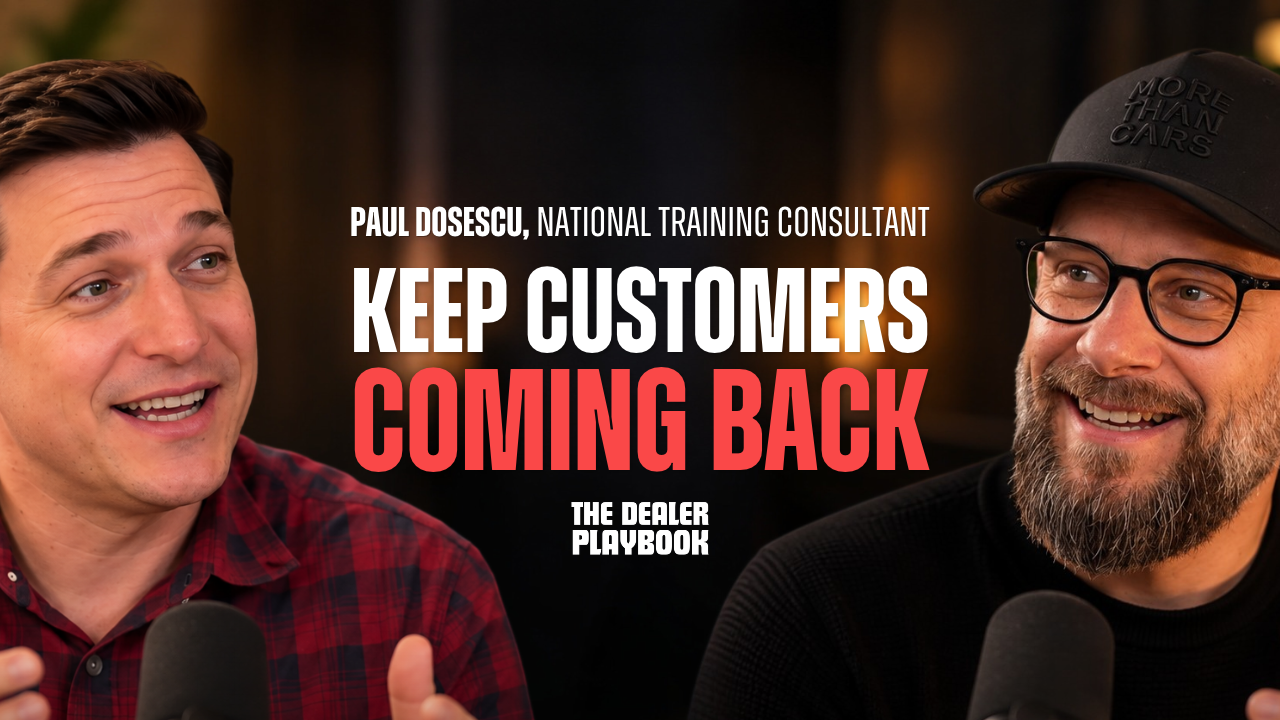
Michael Cirillo sits down with Paul Dosescu to unpack an overlooked dealership operating problem: the disconnect between selling a vehicle and keeping the customer throughout the ownership experience.
Paul works with dealerships on service advisor training, customer communication, and fixed operations performance. And with independent repair shops competing aggressively for dealership service customers, he believes the way stores handle everyday interactions deserves far more attention.
One of Paul's most useful observations is that service advisors cannot control every delay in the shop, but they can control how well they keep customers informed.
The conversation also examines why sales and fixed operations need to take shared responsibility for the same customer, especially when their next purchase may still be years away.
Michael's takeaway: The first sale gets a customer into your dealership. What happens after delivery determines how many more opportunities you get to earn their business.
Timestamps
00:00 Educate Not Sell
00:58 Sponsor Break E
01:51 Service Boom Outlook
03:36 Break Down Silos
07:45 Advisors Influence Ethically
11:53 Quick Service Touchpoints
15:27 Tour And Handoff To Service
20:37 Culture And What We Tolerate
22:39 Mobile Service Future
25:49 Five Year Winning Formula
26:12 Connect And Wrap Up
26:41 Podcast Outro
Episode Brought To You By FlexDealer
Need Better Quality Leads? FLX helps car dealers generate better quality leads through localized organic search and highly-targeted digital ads that convert. Not only that, they work tirelessly to ensure car dealers integrate marketing and operations for a robust and functional growth strategy.
Watch The Full Episode
Prefer to watch episodes? Be sure to subscribe to our YouTube Channel and turn on notifications to get full access to our content.
Episode Transcript
[00:00] Paul Dosescu: We have to really understand that we're not in the business of selling things to people, but we're in the business of educating our customers on being better car owners. The only way we're going to do that is if we're able to hold their attention long enough to share things with them. And the only way we do that is if we're interesting enough, and enough of a conversationalist, to engage with them. And that starts from the moment they engage with us.
[00:20] Michael Cirillo: As you work with dealers, for those who are tuning in, what are some of the first moves you think they need to make? Maybe it's a mindset shift or an actual behavioral shift, where you're like, "Hey, this is the most common mistake that we need to reframe."
[00:33] Paul Dosescu: We have to dive past the transactional tendencies of these interactions, at least the way they've been historically, and really focus on taking care of the customer first. The car is the byproduct of taking care of them.
[00:45] Michael Cirillo: To your point about a mindset shift, where can we help people who are already in the business, who have been operating a certain way, start to make those positive shifts in the right direction?
[00:55] Paul Dosescu: Yeah, that's a solid question.
Sponsor Message
[00:58] Michael Cirillo: Hey, before we hop into this episode, I need your help. Tell me if you've noticed this, because I see this problem all over the place. The vehicle sells on Tuesday, but it's still being advertised on Friday. Your website, your DMS and your IMS all tell different stories. Well, allow me to introduce you to the solution.
It's ÆTHR. ÆTHR checks all three sources independently, then builds one clean record for every vehicle and streams that standard data feed everywhere it goes downstream. ÆTHR: trust what moves downstream. You can check it out at theaethr.ai. That's T-H-E-A-E-T-H-R dot A-I. Go check it out.
Where the Service Business Is Headed
[01:54] Michael Cirillo: Okay, I'm thinking it was about episode 170. Arnold's going to have to fact-check me on this in post-production. But it was somewhere around episode 170 that my guest and I made this prediction, Paul: that variable operations and floor plans might shrink, and service departments might grow in the future. We're starting to see some commentary around this. But for someone who's in the figurative trenches, so to speak, I have to kick this off with your opinion. Where do you think things are headed?
[02:26] Paul Dosescu: Oh boy, that's a good one. The service business is booming. We cannot afford to lose a single customer today. There's a lot of competition for the service business. We've got independents dumping a lot of money into buying equipment, into buying technology, into getting ready to service vehicles as soon as they hit the ground. So on the service side, we absolutely have to put a big focus on that.
At least from my perspective, the focus I'm seeing from the dealer principals reaching out to me is, "Hey, we need you in. We need to focus on training. We need to focus on the customer experience." We can't just have processes that are, "Hey, you've got an appointment, come on in." We have to actually make that service experience absolute top tier. With the price tags on cars nowadays, even customers buying in the non-luxury segment are expecting a very high level of customer service.
So we have to pay a lot of attention to what's happening on the fixed ops side of our dealerships: on our service lanes, in our collision centers, in the parts department, how we handle the phone calls, all of it. It's absolutely a huge focus, at least from my perspective.
Breaking Down the Silo Between Sales and Service
[03:34] Michael Cirillo: Yeah, interesting. I think about this conversation we usually have from a marketing and sales perspective, where there's a silo between marketing teams and sales teams. I've advocated for revenue departments. And you're on the record in various places, when you speak or when you consult, talking about the silos that exist between variable operations and fixed operations, and you've advocated for them to start thinking more cohesively.
So as you work with dealers, for those who are tuning in and leaning in, what are some of the first moves you think they need to make? Maybe it's a mindset shift or an actual behavioral shift, where you're like, "Hey, this is the most common mistake we need to reframe."
[04:22] Paul Dosescu: Yeah, that's a solid question. A lot of times we look at sales as the finish line. We've gotten the car over the curb. There's all kinds of terminology around that: busting bugs, over the curb, all that stuff. But that's really just the first day of the customer's ownership experience. That's when we've earned that commission, but now the customer can really see, "Hey, did I get exactly what I was promised?"
So this isn't, "Hey, it's been a week, it's over to service now, they can figure it out." Or, "Hey, this customer called me, go solve it." It's a collaborative effort. When we look at how we create a customer who wants to come back and do business with us, yes, sales might sell that first car, but it's everything that happens afterward that either strengthens that customer's perception of, "Yeah, I made the right decision," or erodes it. And they go, "Well, I got my car from here, but do I really need to go back to them?"
I want the service team and the sales team to look at it like this: we want the customer to experience such a high level of customer service, attention to detail, attention to their needs and respect for their time that they're afraid to go try somewhere else. They know exactly what they get from us. They've gotten the same level of attention on the sales side and on the service side, and they don't need to go try anybody else.
I think it's a mindset we have to adopt. The customer doesn't really look at us as, "Well, that's the sales department, that's the F&I department." They see us. A lot of times, on the service end, we may be the face of that dealer, because they'll come see us multiple times a year, and they'll see their salesperson every few years, three to five years or whatever that trade cycle is. On the service end, we often become the face of that dealership to that customer. That's who they know. That's who builds that relationship.
So it isn't an us-versus-them kind of thing. We collectively work together to take care of the same customer, so there's never a reason for them to go anywhere else.
[06:14] Michael Cirillo: You're bringing up something that resonates deeply with me. I feel like I've been having this conversation a lot lately. Historically in the business, the comedic factor of the service department has always been that they just yell at you. You roll in and they're like, "Be right with you, sir." And you're like, "Why?" "I'm going to put you on a brief hold." It's always been kind of like that.
However, lately, probably in the last couple of years, especially where I service my vehicle, it seems like the hospitality conversation has spilled over. And I've been thinking a lot about what you just said. What I'm hearing, Paul, is that it's incumbent upon us, not this department versus that department, but us as the brand and as its faces, to really develop soft skills, emotional intelligence, hospitality behavior and so on.
So, to your point about a mindset shift, where can we help people who are already in the business, who have been operating a certain way, start to make those positive shifts in the right direction?
[07:32] Paul Dosescu: That's a really great point. I'm so happy to hear, first and foremost, that you're seeing that personally when you take your vehicle in. That means people like me are having some kind of impact on the customer's experience.
How Service Advisors Should Influence Customers
[07:45] Paul Dosescu: One of the things I try so hard to help service advisors understand is the true impact of their presence. What are they really there to do? Are they there to take the customer's order and do exactly what the customer says, with absolutely no insight and no subject matter expertise? If the customer says it, do we just do it? No, that's not really true. We do have to have a certain level of influence over what the customer asks us to do for them. We have the responsibility and the expertise to share things with them that they may not be aware of.
We're also not there to just upsell, blurt things out and sell people things they don't need. That's never a good scenario. We live in a money-back-guarantee kind of world. Say I pin you in a corner and tell you, "You really have to get this service done. I can't guarantee anything, but you have to do it today. It's only $200." And you do it, you drive away, and you go, "Wow, that Paul guy. I can't believe that. I've never had an experience like that."
Then you call my service director, you get him or her on the phone, and you explain your position: "I've never had that experience before. I want my money back." What are they going to do? They're going to give you your money back and then come have a conversation with me. Because we live in a money-back-guarantee kind of world, where a $200 service isn't worth a one-star Google review.
So we have to really understand that we're not in the business of selling things to people, but we're in the business of educating our customers on being better car owners. The only way we're going to do that is if we can hold their attention long enough to share things with them. And the only way we do that is if we're interesting enough, and enough of a conversationalist, to engage with them.
That starts from the moment they engage with us, whether it's on our website to schedule a service appointment or they just drive in and walk up. If we greet them with, "Do you have an appointment?" that's not a very welcoming first impression. Compare that to, "Welcome in, Michael. How can I assist you today? What brings you by? Are you waiting with us, or do you have transportation set up?"
If we can engage at a deeper level and get past the pleasantries of "How are you?" "Good," into something a little more... I'm not saying we're going to make a best friend in a 13-minute conversation on the service lane. But we have to dive past the transactional tendencies of these interactions, at least the way they've been historically, and really focus on taking care of the customer first. The car is the byproduct of taking care of them.
[10:20] Michael Cirillo: It's so funny you're saying all this. It resonates deeply with me. I hope those listening and watching are leaning into their computer screen or their phone right now, because we've spent the better part of the last decade trying to bypass the human experience. When really, I think the pain point is this: it's not that I'm trying to bypass you. I'm just trying to save myself from a bad experience, or an experience that feels like a waste of time.
But to challenge that at an extreme: do we really not want to come to a dealership? People go, "Well, in its current iteration, no. I'm just going to sit there. I'm going to be bored. The popcorn's going to be stale. They limit my soft drink allocation," all those sorts of things. But what if we flipped that on its head, and all of a sudden you felt a Ritz-Carlton experience? What if there was a shuffleboard table, a pool table, an arcade? I've even seen this: a diner.
Now, I know people are going to hate me for saying this. I'm not saying go out and build a diner in your store, necessarily. But I am challenging the idea with an extreme. Is it that you didn't want to come to the dealership and waste your time there? Or is it that it just didn't give you the experience you were hoping for? And if it did, would you be okay hanging out there?
[11:49] Paul Dosescu: Yeah. You make a really solid point. One of the things a lot of my dealers have asked me to help devise lately is a reasonable customer experience for quick service.
Communication Milestones for Quick Service
[12:02] Paul Dosescu: Some of the most basic needs most internal combustion engine cars will have are oil changes, tire rotations, filters, wipers and little things like that, which customers often don't mind waiting for. A lot of research suggests the sweet spot for how long they're willing to wait is about an hour.
An hour is a significant amount of time, and it doesn't stop there. If I take you in as my customer, plop you down in my lounge and don't talk to you for 59 minutes, that's a very long time for you to just sit there and wonder, "I wonder what's going on with my car."
But I have a few touchpoints I make sure to hit along the way. I call these communication milestones. "Mr. Cirillo, I just want to let you know your vehicle is in the shop. Our technician has started working on it. We've drained your oil. In just a few moments, you're going to get a video of your multi-point inspection. It's going to come straight to your cell phone. If you don't mind, please watch that for me. It's really cool. You'll get to see what the technician sees underneath the car. If you have any questions, I'll stop back by in a few minutes and we can talk about it."
Just one little touchpoint to make you feel acknowledged and help you understand you haven't been forgotten. That's one of the customer's biggest fears, from my perspective: "I've been forgotten about." And as a service advisor, it's one of the parts of the process I have complete control over. I don't have control over how well my technician diagnoses a car. I can influence it. I don't have control over how fast they move or whether the parts arrive. I can influence it, but I can't control it. But how well I update you, and whether you feel forgotten or not, is within my control.
So as a service advisor, if I'm aware of that during the time you're waiting on me, I can make an hour fly by just like that, and you go, "Wow, you guys did so much." But if I just leave you there for an hour and then go, "Hey, here's your key. Sorry, we're about 15 minutes over. I tried to get you in and out as fast as possible," you don't know what happened. You just think you were waiting like everybody else.
That's one of the things I spend a lot of time helping service advisors understand. There are small things they can do that have a monumental impact on how the customer perceives their service experience, especially for waiters.
[14:23] Michael Cirillo: That's kind of the premise of the book Unreasonable Hospitality: going above and beyond, paying attention. In the vein of this conversation, I really think the people who can develop emotional intelligence and soft skills, and who know how to be conversational, as you brought up earlier, are going to be the winners in a world that's moving faster and faster into technology.
We come into the world desiring meaningful human connection and experience. And I can't help but think that those who develop those skills are investing in something that's going to increase in value more and more. It's going to be the differentiator. It won't be the dealership that could book your service appointment faster. It's going to be the one that made you feel something, right?
[15:26] Paul Dosescu: Yes, absolutely.
The Sales-to-Service Tour and Handoff
[15:27] Paul Dosescu: And it starts even before the customer signs on the DocuSign pad, or whatever it might be, for their vehicle. I'm a huge proponent of a dealership tour during the sales presentation, maybe right after the test drive, or at some point during the sales experience. The salesperson walks that person back to service and introduces them to the service manager or the service director, or points out some of the service advisors.
One of the things that does for the customer is show them who they'll be seeing if there's a need on that vehicle outside the realm of normal maintenance. It also familiarizes them with what to do. I think back to my days as a salesperson. I sold for a short period before I moved over to the fixed ops side. I can't say I've had 10 years of sales experience. It was just under a year or so. But one of the requirements my organization had was that I introduce all of my sales customers to someone on the service end.
I would share a little about the number of loaner cars we had in service, to further build the value of doing business with us as opposed to competitors. I would share the number of bays we had available in our shop and how many millions of dollars in parts we had in inventory. What that meant for the customer was that when their car had an issue, we had the capability to fix it, and they could have confidence leaving their new baby with us. We would resolve the issue and get it back on the road.
Furthermore, once the customer agreed to purchase the vehicle, we'd introduce them to a service advisor and talk about what that first service experience was going to be like and what they should expect. We'd set that customer up to understand, "When I service my vehicle with this dealership, this repair facility, this entity, here's what I should expect. Here's what this is going to look like." Because then, on the service end, if we have a process designed to fulfill that, we've made promises to the customer right off the bat that we delivered on from their very first service experience.
Chances are their first multi-point is going to be all green, where they don't need anything. We can share that with them, and we can further break the narrative that every time we talk to a customer, we're just trying to sell them something. We're not. Every time we talk to a customer, we want to make them a better driver and educate them on how to better take care of the car they have. For us to do that, they need to know how things are today.
So the way I look at it, it's not just an after-sales thing. It starts even before that, with some introductions. I've seen some really successful sales and service departments work together when they embrace a model like that. And it starts at the very top: from ownership, to senior leadership, to the GMs and everybody else.
[18:41] Michael Cirillo: I'm also thinking about small details. For example, and I mean this in no judgmental way, it's strictly optics: don't bring a new customer who's just experienced the showroom to some weird, greasy section of the service department where your techs are wearing blue overalls covered in grease, with unhappy looks on their faces and sweat dripping down. We've all seen this. The service director is clearly wearing the polo, and behind him the door keeps opening and closing, and some unhappy-looking bloke walks in going, "Where's the keys? Where's the..."
I know I'm opening a can of worms. This is like cancel culture for the automotive industry. But I get passionate about it, because, guys, if Disney can take high school dropouts and make them the most hospitable, smiley, know-when-to-hug kind of people, then surely, for what you're making in comparison, we can smile more and greet a little warmer.
And I just think about the impact of that small maneuver on the handoff you're talking about. I know you advocate for a strong handoff and that first impression, but it's taking that handoff seriously that I feel gets missed.
[20:35] Paul Dosescu: Absolutely, yes.
Culture and What We Tolerate
[20:37] Paul Dosescu: One of my favorite quotes on culture, and I don't know if I came up with this or if I've just been saying it long enough to feel like I came up with it: culture can be defined by the very least of what we tolerate. If you and I work side by side and, golly, we just cuss each other out all day in front of customers, and somebody next to us doesn't say, "Hey, guys, we don't do that here," then that defines our culture. But if we get stopped, and they go, "Hey, I'm not sure what you guys have going on, but that's not how we act here in front of customers," that doesn't define our culture.
The thing about culture is it often dilutes as companies grow. You get a satellite point that's 150 miles away, and the boss isn't always around, so it's easy to be a little more relaxed. But company culture starts at the very top, and a lot of times it comes down to what we tolerate. When we see that real grumpy-looking individual, do we just not approach them, because it's better not to say anything? What impact does that truly have?
There are a lot of things I talk about that work in a perfect world. If we didn't have a person like that, a sales-to-service handoff and introduction would be magical. But imagine if that happens one time to Salesperson A. Is Salesperson A ever going to do that again? Well, no. The customer's sitting there looking at that guy going, "Whoa."
So you're absolutely right. Before we put these things into motion, we really have to ask ourselves, "Yeah, that's our desired goal, but are we okay with the customer actually seeing this?" And if the answer is no, we have a choice to make. Are we going to still do it, but fix it? We address the attitudes. We address the greasy door we keep walking through every single day and don't do anything about. Or do we shift and stop doing the thing? We have some hard decisions to make there. But that's a fantastic point. Good callout.
The Future of Mobile Service
[22:39] Michael Cirillo: I want to wind us down on this thought process and get your opinions and ideas around it. You brought up culture, and you brought up the satellite point. Another new dynamic is this growing narrative around mobile service. So talk to me about your thoughts, feelings and impressions about where we're headed with mobile service. What are some of the must-dos, and what are some of the don't-dos?
[23:07] Paul Dosescu: Oh, I love this. Mobile service, in my opinion, is one of those things that gives us one additional avenue to engage with the customer. I think of it as a wonderful opportunity to bring more flexibility, especially to people who don't have the ability to come to us.
I think it's a great way to regain some lost sales. Say somebody comes in, we make some recommendations on light maintenance items or filters, and they don't have time for it, or maybe they say, "Not today, I need to budget for it a little bit." We can come out to them and do that service, so they don't have to come back to us. It's a little less friction. So I think it's great from a lot of different perspectives.
However, we still live in 2026, currently. That means when a vehicle has a true issue that requires true repairs, it still needs to come to a repair facility. I don't think mobile service is quite at the point yet where it can really solve everything. We can't replace an engine in someone's driveway. We can't rebuild a transmission. We can't replace a steering rack in their driveway. But if we use it wisely, meaning we market it the right way, advertise it the right way and truly make it a benefit to the customer, I think that's a really valuable way to use mobile service.
Now, it still has a significant cost. Each truck or van costs quite a bit to outfit with all the tools. And you have a technician who's significantly less effective, because they're driving between jobs instead of just getting the parts and pulling the next car in. So I don't know that it's a profit center in a lot of organizations. I know there are some really big stores in the country that have invested heavily in it, and even if they're not making money, it's all about, "This is what we're known for."
More than anything, I think it's about meeting the customer where they are, and simply saying, "Look, we want to earn your business, and there's a variety of ways you can do that with us. Whether you come to us, we come to you, we pick it up from you or you drop it off, we just want to earn your business, and we want to make it easy for you to take advantage of the services we have to offer." I think that's the big thing at this point.
The companies using it really well are also using social media to market it. They're doing ride-alongs with technicians and making different content to share, which is just another form of advertising: "Look what we have." I think it's the wave of the future in a lot of ways.
The Five-Year Winning Formula
[25:48] Michael Cirillo: Okay, finish this sentence for me as we wind down.
[25:52] Paul Dosescu: Okay.
[25:53] Michael Cirillo: The stores that win in the next five years will be the ones where sales and service...
[26:02] Paul Dosescu: ...learn to work together to maximize the customer's ownership experience. People over profits.
How to Connect with Paul
[26:11] Michael Cirillo: I love it. How can those listening and watching connect with you?
[26:14] Paul Dosescu: The best way is either on social media or LinkedIn. It's just my first and last name, Paul Dosescu. There are no funny handles or anything like that. It's just my name. Look me up on Google.
[26:25] Michael Cirillo: You're so lucky. I was the only Michael Cirillo before the internet, you know? So the fact that you're still the only one, mazel tov to you.
Paul Dosescu: That's right.
Michael Cirillo: Thanks so much for joining me on The Dealer Playbook.
[26:38] Paul Dosescu: Thank you for having me. It's an honor. Thank you.
Outro
[26:41] Michael Cirillo: Hey, thanks for listening to The Dealer Playbook podcast. If you enjoyed tuning in, please subscribe, share and hit that like button. You can also join us and the DPB community on social media. Check back next week for a new Dealer Playbook episode. Thanks so much for joining.