“Anyone Can Do This” - Social Media for Car Sales Pros Who Overthink It | Raffi Mouchmouchian, CEO RM Content Media
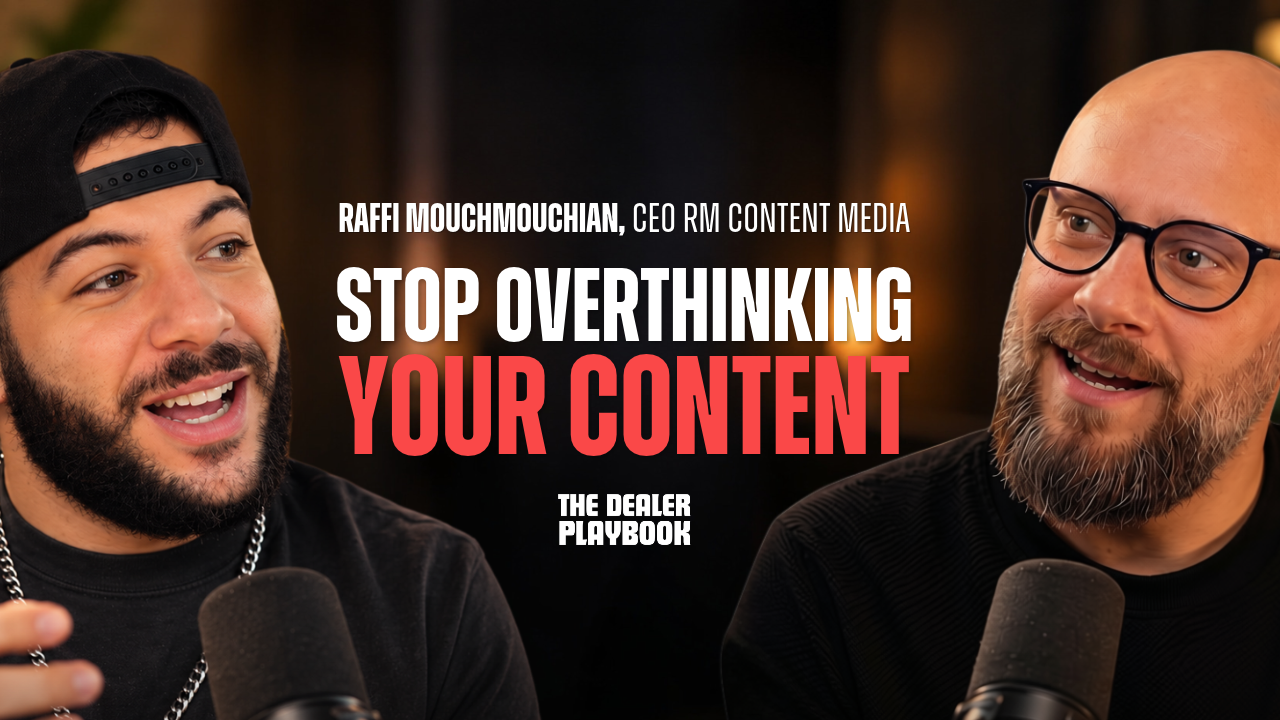
How many salespeople at your dealership know they should be creating content but keep finding reasons to put it off?
They don't know what to post. They don't like being on camera. They're worried about looking stupid. Or they spend so much time trying to make the perfect video that nothing ever gets published.
Raffi Moosh (Raffi Mouchmouchian) knows that hesitation firsthand. A former Dodge dealership salesperson turned social media creator, Rafi built an Instagram following of nearly 550,000 people and now helps dealerships create content of their own.
But his growth didn't happen because every video was perfectly planned.
During an unexpected 30-day break from his dealership job, Rafi focused on creating and posting consistently. His audience more than tripled, eventually giving him the confidence to pursue content creation full-time.
In this conversation, Michael Cirillo asks Raffi what dealership owners, managers, and salespeople can learn from that experience.
And if you're trying to get more of your sales team involved in creating content, his advice is surprisingly simple.
Connect with Raffi: Follow or DM @raffimoosh on social media. Raffi says he personally responds to as many messages as possible.
Michael's takeaway: Stop waiting for your salespeople to become great on camera before encouraging them to post. Give them a starting point, let their personalities come through, and help them get comfortable by actually doing it.
Timestamps
(00:00) Intro
(01:00) Show Support Break
(04:01) Leaving the Dealership
(05:27) Sales vs. Camera Fear
(09:27) Find Your Own Style
(12:35) Simple Content Formula
(15:25) Cross-Posting Strategy
(19:30) OEM Concerns and Honesty
(23:42) Key Takeaways and Connect
(25:25) Outro and Subscribe
Episode Brought To You By FlexDealer
Need Better Quality Leads? FLX helps car dealers generate better quality leads through localized organic search and highly-targeted digital ads that convert. Not only that, they work tirelessly to ensure car dealers integrate marketing and operations for a robust and functional growth strategy.
Watch The Full Episode
Prefer to watch episodes? Be sure to subscribe to our YouTube Channel and turn on notifications to get full access to our content.
Episode Transcript
[00:00] Michael Cirillo: Now that you're doing this and you're helping other dealers do it, and I'm sure you've watched your fair share of "Drop It Like It's Hot" videos, is there an element here where you can spot whether somebody's got it or they don't? And is that a factor? Can anyone do this?
[00:14] Raffi Mouchmouchian: I literally think anyone can do this. It's just a matter of finding yourself on the social media platform. Not everyone's going to be a Raffi Mouch or a Russ or a Michael Cirillo. Some people are going to have their own content, their own comedy, or their own little gag to what they do on social media.
[00:29] Michael Cirillo: And you are definitely getting the views and the followers. Just as of recording, looking at your Instagram, you're just shy of 550,000 followers, which is tremendous. Congratulations to you.
[00:40] Raffi Mouchmouchian: I appreciate that. Thank you.
[00:41] Michael Cirillo: What would you say to somebody that's just getting started? What's the mistake they should avoid? Earlier you brought up, "Hey, you've got to find your own style. You've got to be genuine to you." Is there a process? Have you discovered a formula that helps them get clarity on who they are and where they can genuinely be themselves on social?
[00:57] Raffi Mouchmouchian: I'll tell you exactly what it is.
Show Support Break
[01:00] Michael Cirillo: One of the things that I enjoy most about producing The Dealer Playbook is hearing from you: the messages I get from people who are getting so much value out of the podcast, applying it to their day-to-day workflows, and finding a thriving career right here in the retail auto industry. It means the world to me.
One of the ways we make doing this possible is through my agency, FlexDealer. And in the spirit of providing value, I think this is a perfect time to head over to www.flexdealer.com to show even further support for you, my beloved DPB gang.
Right now, if you go to my website, flexdealer.com, you can get a full free PDF of my number one bestselling book, Don't Wait, Dominate. The reason I think it's so special is that a lot of the topics discussed in this book are even more relevant today than ever, with this surge in popularized AI and people wondering, "What can I do next? How can I have a competitive advantage?" That's all here in this book.
I'd love to offer you a free copy if you go to flexdealer.com. It would mean the world to me, because that is how we continue to produce this show for you.
The Name Behind Raffi Moosh
[02:21] Michael Cirillo: Okay, I'm dying to know, because it's Raffi Mouch on social. How should Michael Cirillo say the real last name?
[02:30] Raffi Mouchmouchian: The real last name is Mouchmouchian. It's our Armenian last name.
[02:34] Michael Cirillo: Mouchmouchian.
[02:35] Raffi Mouchmouchian: Yeah, an Armenian last name with an Arabic origin. Mouchmouch in Arabic means apricot. We don't know how that came about, but my dad says that way back, our great-grandparents in Lebanon had an apricot farm. Or someone had an apricot-colored hat they always wore. They don't know the actual story, and then they just became Mouchmouchian.
[02:56] Michael Cirillo: This is actually a fascinating place to start, and I'm going to tie it in here because I've been so fascinated by origins. I started a tradition in my family where I did a bunch of research on our family crest and the origins of the Cirillo name and what we stand for. Now I get a gold ring made with my initials in it. I gave one to my dad for his 70th birthday. I've got one. My kids are going to get one when they graduate college, probably. I said probably because maybe it's high school, maybe college, or whatever the equivalent will be when they're at that point.
[03:36] Michael Cirillo: And why that's interesting to me is the origin story and how you got to where you are now. You've been on both sides of the coin here. You've worked in dealerships, you were selling lots of cars, you were well above average. But I'm curious: at what point do you go, "I might be able to make a bigger life for myself picking up the camera and doing what I'm doing in content and social than I am actually moving the metal"?
Leaving the Dealership
[04:01] Raffi Mouchmouchian: What's funny is I didn't really have a choice. It was something I always thought I should do. Maybe I could swing it and make more money doing social media or building a media company, because I have a background in production and a background in marketing. I got into car sales because I needed the money at the time, and my whole family had been in car sales at some point. So I was like, "You know what? They all did it. I'm better than all these people. I'm going to do it too." So I hopped in.
But essentially, the way I got into leaving the dealership and doing social media was this. I was working at the dealership in November of 2023, and I'd already started doing a little bit of social media. You know those customer surveys you get at the dealership? Every salesperson gets one for every car they sell. There was an issue on one of mine, and they had to essentially let me go for 30 days and then bring me back, as a company policy technicality.
So they got rid of me for 30 days. In that 30 days, I gained more than triple my followers at the time. And I was like, "Oh, I could go full force on this." I thought right then was a good time to do it, because the world was changing, everything was changing, and the COVID high of car sales was coming down. It would be a pretty good time to shift.
So essentially, that's why I didn't really have a choice. I was like, "You know what? I have 30 days to do it. Let's do it." I built up all the extra followers, and when they called me to come back, I said, "I'm just going to pursue this right now." That was the flip moment for me. I didn't want to do it, but I'm happy I did.
Sales vs. Camera Fear
[05:27] Michael Cirillo: I think about my love-hate relationship with social media, which those who follow the show know. If Bella were not sitting six and a half feet from me right now forcing me to post on social, I would be such a whiny baby. But I think part of it goes back to a conversation I had with Grant Cardone years ago. He was talking about why salespeople hate their jobs. I wasn't thinking too much about it. I'm like, "Well, they hate their jobs because they suck at it." And then I'm thinking about it in terms of social. Maybe my love-hate relationship with social is that I've sucked at it, and then I brought somebody into my environment who can help break it apart for me. But I'm curious from your perspective.
[06:08] Raffi Mouchmouchian: I think it's a little different than that. With sales, a lot of people who aren't good at it, their life kind of relies on it. It's a different story for them. Sales is a common job. People do sales all the time. Getting in front of a camera and putting yourself out there is, I think, a lot more mentally straining than doing sales in some aspects. Obviously sales can be very aggressive on some people's mental health. But the social media side of things just isn't too common yet. It's a new thing, so people aren't used to it yet. So I feel like it's a little different. It's not because you're bad at it. I just think it's a whole different type of exposure that you open yourself up to. Because I think you're doing a pretty good job.
[06:53] Michael Cirillo: You didn't know you were coming for therapy today.
[06:56] Raffi Mouchmouchian: Usually there's a check-in.
[06:59] Michael Cirillo: I'm going to lie down on a couch and just give you all of my social media woes. Well, I'm curious though, along that vein: inside of that 30 days, what were you realizing was working and what maybe wasn't? What were you picking up on, like, "My followers go up dramatically when I do this, and maybe they plateau when I do this"?
[07:19] Raffi Mouchmouchian: The honest truth is that it was just the focus on social media. I was able to post every day, sometimes twice a day. I was able to sit down and write better content, better jokes, and better beats for each of the skits I do, because most of my stuff is funny content. It's comedic sales content. So it just gave me more time and more bandwidth to really focus on the content. It gave me that extra push. Posting more, posting daily, is what helped me get more followers, because there was more exposure.
[07:50] Michael Cirillo: Talk to me about the mindset, because I'm a big goof and I appreciate good comedy. The times where you're like, "Yes, it hit," and the times where you're like, "Crap, nobody liked that." What's happening in your world when you're watching what's hitting and what's not hitting?
[08:08] Raffi Mouchmouchian: It's a funny thing, because you can actually tell when you're filming what's going to do well or what's going to do badly. I'm sure you've seen everyone say there's no such thing as perfect content, just post everything. So there will be times where we post something and I know it's not going to do that well, but I post it anyway, because posting something is better than nothing, in my eyes.
But when filming, you can actually tell. We'll film something, and after we say the joke, we'll just crack up and have to restart because it was too funny. If we're laughing on set while filming, then we know it's going to do well with the average person.
The only times it feels like a bit of a slap in the face is when we're cracking up at a video we're making, and then it does a full bomb. It just fully bombs and gets no views. It's not funny to anyone else but me, and I'm like, "Damn, do I just have a weird sense of humor?" But that doesn't happen too often, honestly. Again, you can tell while filming whether it's going to be a good or a bad video.
[09:05] Michael Cirillo: And I imagine when it's a bomb, are you dissecting it, or are you just moving forward? Like, "Nope, keep going."
[09:14] Raffi Mouchmouchian: It depends on the video. Sometimes you can look at it and be like, "I knew we should have done this instead," or, "Why wasn't it funny?" But sometimes it's just, "Hey, maybe that's just not a good joke," or maybe it's too niche. Just move forward. We just keep going regardless.
Find Your Own Style
[09:27] Michael Cirillo: Do you think, now that you're doing this and you're helping other dealers do it, and I'm sure you've watched your fair share of "Drop It Like It's Hot" videos and dudes doing the worm across the showroom floor, is there an element here where you've either got it or you don't? I'm trying to be polite about this, but can you spot whether somebody's got it or they don't, and is that a factor? Can anyone do this?
[09:54] Raffi Mouchmouchian: I think anyone can do this. I literally think anyone could do this. It's just a matter of finding yourself on the social media platform. Not everyone's going to be a Raffi Mouch or a Russ or a Michael Cirillo. Some people are going to have their own content, their own comedy, or their own little gag to what they do on social media.
I'll be very blunt. I'm a very straightforward person, because I feel like being honest is always the best option. Some people I'll see on social media, and I'll be like, "Dude, this is a horrible video." But it's not because they're not good at social media. It's because that video is not for them. They're copying someone else's style. They need to find their own style. That's what makes everyone different.
I think everyone really has it in them. It's just a matter of finding what works for you and what makes you different. For me, it was the stupid pants I was wearing and the somewhat stereotypical racist jokes that I make. And by somewhat, I mean very.
[10:48] Michael Cirillo: How do you give yourself permission to be okay with whatever good or backlash may come of that?
[10:57] Raffi Mouchmouchian: My thing is that people are going to talk no matter what. I've had people talk when I was doing great. I've had people talk when I was doing horrible. People are going to talk regardless. And at the end of the day, there's a fine line you can walk with stuff like this. I'm laughing at everybody, including myself. I actually laugh at my own people the most. And by doing that, I feel like it shows that I'm not targeting anyone specifically. What's that saying? If you make fun of everyone equally, you're not really targeting anybody. And that's kind of the joke.
[11:37] Michael Cirillo: That's like the late Don Rickles. A lot of people say, "Man, if he were alive today, he would not be able to get away with his comedy." But the reality of it, to your point, is he made fun of everyone equally, including himself.
[11:51] Raffi Mouchmouchian: Yeah, that's the thing. I feel like as a world we've gotten a lot softer on jokes. There are a lot of things you can't say now that you could have said five years ago. Even last year you could have said certain things you can't say anymore. So putting yourself out there with "Hey, I'm going to say it anyway" either fully backfires, everyone hates you, and you get views, or they laugh with you and you get views. So it's like, screw it. If I'm going to get views, it is what it is.
Simple Content Formula
[12:20] Michael Cirillo: And you are definitely getting the views and the followers. Just as of recording, looking at your Instagram, you're just shy of 550,000 followers, which is tremendous. Congratulations to you.
[12:34] Raffi Mouchmouchian: I appreciate that. Thank you.
[12:35] Michael Cirillo: What would you say to somebody that's just getting started? Hashtag asking for a friend. What's the mistake they should avoid? Earlier you brought up, "Hey, you've got to find your own style. You've got to be genuine to you." Is there a process? Have you discovered a formula that helps them get clarity on who they are and where they can genuinely be themselves on social?
[12:58] Raffi Mouchmouchian: I feel like there is no formula for that. It's just a matter of trial and error. See what comes naturally to you while filming. If while filming a video you have to really get out of who you are, then that's not the right way. You've got to just take a concept that works.
If I were to put a formula together, it would be: find a concept that works. Write it out clearly on paper. No overthinking or AI bullshit. Just write it out on paper. Once you have it written out, think about how you would change it to make it your own. Add a joke or two here and there. And as you do that, again, write it out. That's the number one most important thing. I find that when I write things out, I always have a better creative process.
So write it out, for sure. Then once you have the joke set up, or the video if you're not doing comedy, just say it in your own words without thinking about it. You'll naturally come out with how you would speak and your own little bit, whatever it is. It'll just come out on its own. You can copy a concept. Just don't copy the delivery. That's the difference.
[14:05] Michael Cirillo: That's a solid point, because you're right. If I were to scroll through, and we did this live right now, we would see dealership after dealership after dealership doing the exact same video. It's almost like an AI hallucination, because by the time you see the last version of it, it's not funny, it doesn't land, it seems soulless, and so on. So that's a really interesting way to think about it. And kind of an interesting social experiment based on what you're saying, which is: do you even know who you are? So be you.
[14:45] Raffi Mouchmouchian: Yeah. We do these videos for dealerships too, and when we do, we always start off by looking at other people's videos. We rarely come up with content originally now. It's almost not worth the time anymore, because there are so many ideas already out there. But the idea itself isn't what makes the video. It's the delivery.
Obviously you need the basics: the right camera angles, the right lighting, audio. But once you have all that dialed in, it's just a matter of doing the video the right way. The delivery needs to be there, the editing needs to be there, and that's all it is. You can film one video a billion different ways, and it could hit half the time and miss the other half.
One Video, Every Platform
[15:24] Michael Cirillo: I'm going to ask you probably a boring question that you've likely answered 450,000 times. Does the same thing go on TikTok, Instagram, Facebook, and LinkedIn? Or are you coming up with fresh concepts for each platform?
[15:40] Raffi Mouchmouchian: Pretty much, I just post the same thing all over. I've seen a lot of people say, "I take the same video and edit it a little differently for Facebook, a little differently for TikTok, a little differently for LinkedIn and Snapchat." Respectfully, that's bullshit. Just post it. It's the same anywhere you go.
If a video is good and it grabs attention in the first five seconds, it's a good video. If it holds that attention throughout, it's a good video. TikTok versus Instagram versus YouTube or Snapchat, it's the same people scrolling. You're appealing to the same audience no matter where you post it, and that audience has the same attention span on every platform. So just post. I don't ever edit a video differently for TikTok, Instagram, or Snapchat.
[16:21] Michael Cirillo: Is there a difference between the platforms for B2B versus B2C content? You just brought up Snapchat, and I'm thinking, "Holy crap, I can't remember the last time I... I don't even know if I could remember how to log into Snapchat." Is there nuance there, where it works for a guy like Gary Vee or a car dealer because it's everyday people, versus someone like John Maxwell?
[16:51] Raffi Mouchmouchian: Yeah, I think it's important to separate who's posting. If it's a dealership posting for their store, it's different from a salesperson posting for themselves. I'm sure you've seen Russ's content and what he teaches dealerships about having salespeople do content. That works for salespeople. I don't think it works too much for stores. So the type of content would definitely differ from person to person, or entity to entity, if we're talking about a store versus a person.
And the person posting will also differ by platform. If you have Gary Vee posting, I don't think Snapchat would really apply to him. But if you have me posting, Snapchat has always done great for me, because I've always posted the same thing and the videos are funny. No one really goes to Snapchat to learn how to build a business the way Gary Vee does, or how to make content. I'm sure there are clippers posting him there, but it's not him himself. So I think he'd focus more on Instagram. I don't even think he'd focus on TikTok too much.
[17:42] Michael Cirillo: Bro, I feel so old right now. With all this talk about Snapchat, I'm sure my teenagers are all over Snapchat. I feel 17 in my mind, dude, but I know I'm not, and I'm feeling so old right now. But this makes perfect sense. So there is some nuance I'm picking up from you.
The other thing is the "don't overthink it" vibes are strong coming from the Mouch today, and I think that's where a lot of people get hung up. There's a car sales professional sitting in a store right now who knows they need to pick up their phone and do something. But maybe they're stuck because they're wondering, "Man, I don't feel particularly creative. What could I do, and how much time is it going to take?"
So bring me inside yourself just getting started. I know you had the marketing background and the production background. For those who don't have that, who are feeling the pull but don't know where to start, maybe they're overwhelmed because they think, "Man, I've got to sit here and write it out and figure things out." What would you say to those people?
[18:49] Raffi Mouchmouchian: I know previously I said write it out, and it's the best way to do it, but that's primarily for comedy. If the goal is just to start getting on social media, just start posting. Find a video you like and recreate it.
Let's say you're a car salesman. Go find the nearest car and make a video talking about it. "We just got this car in. I love this car because of this and that. I don't like it because of this. It's one of the most popular models." Give some facts about it. "What do you guys think?" Super simple. Just give your opinion and build a platform for yourself, rather than building a platform for other people. Build it for you, and then people who like you will watch.
So don't think too much about what other people are going to say, or whether it's going to match what people like. Just post. Just post. It's that simple.
OEM Concerns and Honesty
[19:30] Michael Cirillo: What do you say to people who are maybe afraid of upsetting the OEM? Like, "How could I speak negatively about a product that I sell?" What's your take?
[19:40] Raffi Mouchmouchian: That's a little different. Luckily, I never really had to deal with that territory. With all the content I posted, I worked at a City Dodge store, and Stellantis never came after me, never said anything. I posted some pretty aggressive stuff, and I was definitely on their radar, because I had some executives liking my content here and there. So I never had to deal with it myself.
[19:58] Michael Cirillo: Do you think it's because they couldn't disagree with what you were saying?
[20:03] Raffi Mouchmouchian: I think deep down that's probably what it was, but I don't think they'd ever say that. Honestly, with most OEMs, being honest about your opinion of something won't really upset them. That's why I think it's different for a store versus a salesperson.
A salesperson can say, "Hey, I love the new Mercedes. I don't like the headlights, but I would totally buy this car." That's just your opinion. I don't think Mercedes would go crazy and come after you for that. But if a store says, "We don't like the new Mercedes," that's a different story, because the OEMs have pretty significant control over the stores. So that's why I was mentioning earlier, salespeople versus stores. It's a different ballgame.
[20:41] Michael Cirillo: You just said something in a way that is so interesting to me. The industry has had this stigma looming over it of being dishonest, or whatever it is. Things we know, at scale, are ultimately not true. There are some bad actors. But there's this stigma of dishonesty, and then also the real pull of not saying something honest about the vehicles you sell. Your opinion, like, "Hey, I don't like the headlights." Feeling that real tension of, "Wait, nobody likes dishonesty, and also I'm not allowed to be fully honest," is actually a really interesting point of friction. But I like the way you're positioning it.
There's a motorcycle retailer, RevZilla, and I have consumed so many hours of their content. Their ultimate goal is to sell every product they have, but to your point, they will legitimately say, "Here are the five helmets we want to talk to you about today. If your head is this shape, you probably won't like this one. But if you have a head circumference of whatever, you might like this one. It fits a little better here. You might not like how it snugs here." They're so honest that it actually makes me... I don't know what the psychological trigger is, but it makes me want to buy their products from them.
[22:03] Raffi Mouchmouchian: I'll tell you exactly what it is, because that's a pretty standard marketing tactic. I ended up dropping out of school for marketing, but I was there for quite a while studying it. That's a big psychological point. If I tell you, "My product's great, my product's amazing, it's the best in the world, it's great for everybody," even if I truly believe that, there are some untrue statements there. There's no product that's perfect for everybody in the world, whether it's a car, a broom, or anything else. And at the same time, you're going to say, "You're only saying that because it's your product and you want to sell it."
So if I come out and say, "Hey, this is my product. I'm going to be honest with you. It's not for everybody. It's only for people who are like this, this, and that. For you, I think it's definitely worth a try. See if you like it. For those who don't match that criteria, it's probably not for you," now you're going to say, "I don't know anyone who would tell me their product isn't for me if they were trying to sell me. So maybe he's not trying to sell me." It's a soft close, a soft sell. The psychology behind it brings your guard down a little bit, just enough that you can actually make the sale.
So picture a salesperson telling you, "Hey, I love this car. But I'll be honest, comparing this GLE to this BMW X5, I like the seats on the X5 more. I love the GLE. I think the audio system is way better. I think the car looks better. I think it sounds better. The power delivery is nice. The infotainment is great. But this one thing, I just don't like it." You're going to be like, "Well, he's probably telling the truth about the rest of it. Why would he lie about everything except the seat? Or why would he lie about just the seat?" So again, the guard comes down, and it gives you that sense of, "Okay, they're being honest. They're being straightforward."
Key Takeaways and How to Connect
[23:41] Michael Cirillo: I love it. Here are some of the key takeaways in the playbook I've heard from you today. First: don't overthink it. Get started, get going. Number two is authenticity. Be who you really are. Number three: post across all the platforms. Just get going. And number four is what we just talked about. Be honest. Share your opinion. Don't be afraid to share your opinion. Tell your truth. In doing so, you will attract more people than you will trying to be super white-collar, where everything is perfect and sunshine and rainbows.
For those who are leaning in right now and saying, "Hey, we already follow you on social, and now we know you're in Arizona doing this for dealerships," and they want to learn a little more about how you put things together, how can those listening and watching connect with you?
[24:40] Raffi Mouchmouchian: Honestly, I go with DMs. I like everything to be super informal. I like people to DM me and reach out personally. I answer every DM I can myself. I don't have an AI or a team that responds. It's all me.
We're actually located in Los Angeles. I just flew up to Arizona this week for this one, for anyone wondering. But if you have any questions for yourself or your store, or you just want some ideas or feedback, send me a DM @RaffiMouch on all platforms. I'll most likely see it, and I'll most likely respond. That's probably the best way to reach out.
[25:09] Michael Cirillo: Love it. I feel like the perfect way to end this episode would be if you were like, "Hey, by the way, I'm sitting in a Tesla Roadster right now. Watch me," and then you just fly away.
[25:19] Raffi Mouchmouchian: It's so funny you say that, because I actually am sitting in a Tesla Roadster, and I'm going to fly away.
Outro
[25:25] Michael Cirillo: Well, man, thanks so much for joining me on The Dealer Playbook Podcast.
[25:28] Raffi Mouchmouchian: Thank you for having me. I appreciate you guys.
[25:29] Michael Cirillo: Hey, thanks for listening to The Dealer Playbook Podcast. If you enjoyed tuning in, please subscribe, share, and hit that like button. You can also join us and the DPB community on social media. Check back next week for a new Dealer Playbook episode. Thanks so much for joining.