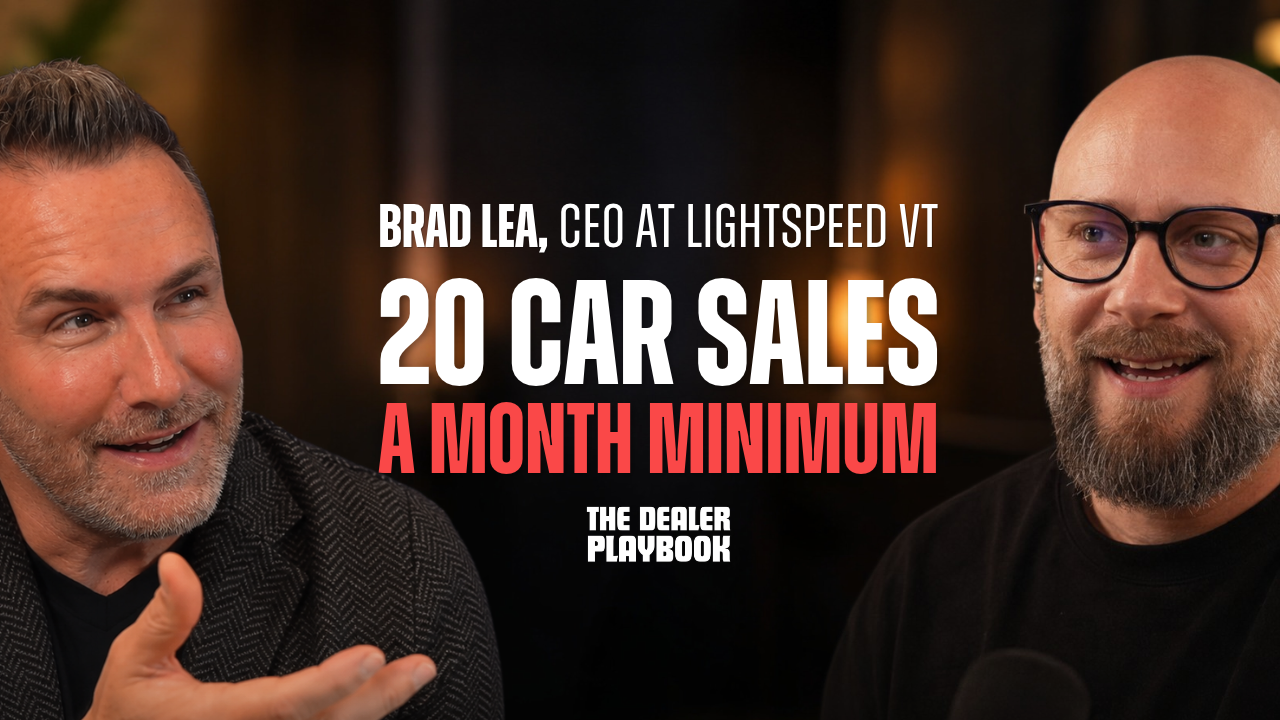
What if your salespeople could generate additional car sales every month without waiting for more showroom traffic or another increase in the advertising budget?
Brad Lea figured out a way to do exactly that.
Before founding LightSpeed VT, Brad developed an unconventional prospecting approach that generated at least 20 car sales a month. He found a way to reach people who weren't actively shopping, create conversations around their existing vehicles, and turn those conversations into buying opportunities.
And the way he did it challenges how many dealerships think about finding their next customer.
In this conversation with Michael Cirillo, Brad breaks down the approach, including the question that opened doors traditional referral requests couldn't.
But the discussion goes deeper into what actually drives dealership sales performance.
Brad explains why dealerships continue spending heavily on advertising while overlooking the training their employees need to convert those opportunities. He shares what separates effective training from ordinary sales meetings, why consistent practice and accountability matter, and how AI can help dealers develop more capable sales teams.
Michael's takeaway: If the only way your dealership can sell more cars is by spending more money to bring people through the door, there's an opportunity worth examining. Brad shows what can happen when salespeople are trained to create business for themselves.
Timestamps
(00:00) Intro
(00:49) Sponsor Break Ether
(01:44) Episode Begins
(08:18) Giving and Gratitude Mindset
(17:23) Free Will Over Victimhood
(20:20) Car Business as Boot Camp
(21:29) Building Real Training Systems
(26:25) Dealership Basics and Personal Brand
(30:08) Marketing and Training for Campaigns
(34:18) Stop Overspending Ads
(40:48) Accountability With Systems
(51:41) Inventory Buying Referral Hack
(57:05) Service Drive Opportunities
(57:38) Final Thanks and Wrap
Episode Brought To You By FlexDealer
Need Better Quality Leads? FLX helps car dealers generate better quality leads through localized organic search and highly-targeted digital ads that convert. Not only that, they work tirelessly to ensure car dealers integrate marketing and operations for a robust and functional growth strategy.
Watch The Full Episode
Prefer to watch episodes? Be sure to subscribe to our YouTube Channel and turn on notifications to get full access to our content.
Episode Transcript
[00:00] INTRO
[00:00] Brad Lea: I used to believe that to get the big houses and the fancy cars and the lifestyle, all you needed was to make a bunch of money. And so that's what I did. I made a bunch of money and I got the houses and the cars and the lifestyle. And then you realize, wait a minute, if the money doesn't keep coming, that stuff is more of a liability than a lifestyle.
[00:17] Michael Cirillo: I think maybe that's the paradigm shift I was trying to articulate, which is there's only so many ways you can talk about negotiating a car deal. There's something bigger to all of this. How do we make the best life we can while having working in the car business be a part of it?
[00:30] Brad Lea: I was hanging around Grant Cardone quite a bit in the early years, and he was trying to teach me. I just wasn't ready to be taught.
[00:36] Michael Cirillo: I mean, kudos to you, because I used your platform with Cardone Training. My earliest sales training came from that platform. What is the reason training is such a difficult topic for so many people to understand they've got to do every day?
[00:49] Brad Lea: Based on what I know...
[00:52] Sponsor: ÆTHR
[00:52] Michael Cirillo: Hey, before we hop into this episode, I need your help. Tell me if you've noticed this, because I see this problem all over the place. The vehicle sells on Tuesday, but it's still being advertised on Friday. Your website, your DMS and your IMS all tell different stories. Well, allow me to introduce you to the solution. It's ÆTHR. ÆTHR checks all three sources independently, then builds one clean record for every vehicle and streams that standard data feed everywhere it goes downstream. ÆTHR: trust what moves downstream. You can check it out at theaethr.ai. That's T-H-E-A-E-T-H-R dot A-I. Go check it out.
[01:30] Broke at Another Level: Brad's Biggest Money Lesson
[01:30] Michael Cirillo: OK, so I'm driving into the studio this morning, and I'm listening to the most recent episode of your podcast. You've got a wealth expert on, "The Wealth Trick the 1% Use to Avoid Taxes," and there's this one little exchange that had me cracking up. He says, "Hey, I don't know if you've ever been in a position where you're broke or you don't have money," and you come right through the center, Brad. You go, "Right now." And I was like, is that not the most perfect misconception about wealth, right there in two words? "Right now I'm worried about cash till the end of the month." So I want to ask you this question.
[02:24] Brad Lea: OK.
[02:25] Michael Cirillo: As you've grown your business and grown your family, what is the misconception or the lesson about money that has been most surprising to you?
[02:37] Brad Lea: I used to believe that to get the big houses and the fancy cars and the lifestyle, all you needed was to make a bunch of money. And so that's what I did. I made a bunch of money, and I got the houses and the cars and the lifestyle. And then you realize, wait a minute, if the money doesn't keep coming, that stuff is more of a liability than a lifestyle.
[02:53] So you learn that you don't get rich buying a lot of fancy things with earned income. What I should have been doing this whole time is making all this money, not having all the cars and the whatnot, and putting that money somewhere as if I didn't have it. Then that money would have accumulated over the last 30 years, and now I'd have the cars and the house and the lifestyle from money that was invested. And I'd still be making a lot of money, but I'd be investing it.
[03:30] So the lesson people need to understand is your passive income is not money to spend. It's not money to use. That is money to invest. You obviously have to live a little. But if you keep your desires and your lifestyle to a minimum, and you use that passive income not to live but to maintain, and then invest it for 20, 30 years, by the time you look where I seem to be right now, you would actually be where I look to be.
[04:08] So when he said, "You ever been in that position?" I'm still in that position. What are you talking about? Everybody thinks I'm a billionaire. On paper, maybe, if I sold companies and exited a few things. Well, not a billionaire, but you see my point. Right now I'm just thankful I learned it early enough that I'm still making money. I make a lot of money, but man, I've got a lot of obligations. I pay a million to a million and a half every month just in payroll. I've got to have a couple million a month coming in just to pay bills. So you get into a situation where you're just broke at another level.
[04:54] Michael Cirillo: It's funny. This morning I was going through some journal entries from years ago. I've always been a journaler. I'm LDS, and journaling is a huge part of that faith tradition. One of my journal entries from maybe 15 years ago, Brad, said, "Bring $200,000 a year into the business." And I caught myself this morning, because I'm like, holy crap, I well surpassed what that version of me thought. And I'm in the same boat you're in. That didn't erase any of the feeling of obligation I have to make sure I'm meeting payroll, covering expenses and all of that.
[05:35] And maybe it's because I'm getting older, but a lot of younger people coming into the workforce are hitting me up, saying, "Hey man, I'm just starting my career. What advice can you give me?" And I'm like, money's the least interesting aspect of this whole ordeal.
[05:50] Brad Lea: Yeah, I don't know if I'd agree with that.
[05:52] Michael Cirillo: Tell me.
[05:53] Brad Lea: Well, I mean, it's very interesting. I just wish I'd known. Nobody teaches you this in school. I was hanging around Grant Cardone quite a bit in the early years, and he was trying to teach me. I just wasn't ready to be taught.
[06:05] But at the end of the day, young people, pay attention. The money you're earning, your earned income, don't use it to live the lifestyle: the watches, the clothes, the belts, the cars. That money should be a tool to make money that you can buy that stuff with. Let's say you get fortunate and end up making a couple million dollars a year, and your lifestyle rises with it. Well, you'd better keep making that 2 million a year, or it's going to be a painful situation.
[06:36] But if you bring in that 2 million a year and you don't do that, well, now you have it. You stay broke. You stay financially broke, where everybody says, "I thought you were making millions of dollars. How come you're driving a Camry?" Because the money you're earning should be invested where it's earning more money without you. You do that for 10, 15, 20, 30 years, and by the time you're 50, the money that comes in is from the money you put away. And you can buy those things, because it doesn't end. It just keeps going.
[07:11] The stress people have about money, or at least me, I'll speak for myself, is based on "if I stop, it stops." Not completely. I'm not that big of an idiot, but I've been quite a bit of an idiot, so now I'm playing catch-up. I could live a much more extravagant lifestyle, but now I'm trying to act like I don't have it. Build more businesses, increase the valuation of the business, whatever the case may be. Buy some assets, is what I'm saying.
[07:54] Giving, Gratitude and the Value of One More Day
[07:54] Michael Cirillo: I think maybe that's the paradigm shift I was trying to articulate. When you don't have money, it's the most consuming thought. That's what I had building the business. But building the business was an interesting and exciting journey for me. It wasn't the pursuit of money that got me up. It was building the thing and knowing people wanted it, that I was doing the right thing. Then you get to the point where, to your point, off earned income, you can walk into any dealership and say, "That one." And once you've experienced that feeling, it's kind of like, now what?
[08:29] I loved the premise of your last episode on your pod, talking about charity and giving, maybe this concept of the tithe, if you will, and how that compounds. Talk to me about the takeaway you had from that episode that was an eye-opener for you, where you're at in your life.
[08:49] Brad Lea: Well, believe it or not, I do so many episodes, it's hard for me to remember every one.
[08:55] Michael Cirillo: I'll tell you right now. I'm going to pull it up.
[08:57] Brad Lea: And by the way, just because it dropped yesterday doesn't mean I didn't tape it three months ago.
[09:04] Michael Cirillo: I know better. I know what you're talking about. The episode was "How the Richest 1% Avoid Lawsuits and Massive Taxes," with Keith Singer. He was talking about how, any time he's been in a rough spot in his business, he looks to who he can give money to, and how that compounds for him. Have you found that to ring true for you?
[09:29] Brad Lea: In a way, yes, but I've never really done it to that degree. Apparently what he's saying is he only had a certain amount of money, and he said, "Let me give it away," and when he did, it worked. Well, if that's all anyone ever had to do, I'd be different, because I've given the last of my dollars away charitably before, not necessarily with any expectation of return.
[10:02] But I'm a fortunate man. Every time I catch myself talking about what I could have, I remember I'm fortunate, brother. I'm healthy. I don't have any pain. My kids are healthy. I wake up every day understanding that the value of life is life itself. The ability to get one more day is more valuable than anything you can create in the day.
[10:20] Think about this. If I said, "Hey brother, I'm going to wire you 10 million cash right now," and it was real and I did it, you'd get off this podcast and be like, "Wow, man, this is unbelievable." You'd feel this overwhelming excitement and enthusiasm and relief, all positive. But if I said, "I'll do it, but you're done. Tomorrow you won't wake up," of course you wouldn't take it. So what you really mean is that waking up is worth more than 10 million.
[10:54] So why don't people understand that, and feel the same every single day they wake up? Because it's more valuable than 10 million or 100 million. Yet we wake up and don't realize the gift itself is the day. You get a gift every single day if you're fortunate. If every single day we woke up and realized the gift is the day, everything else is a bonus. So when people say, "I had a bad day today," I don't think there's such a thing as a bad day. If you got the day, it wasn't bad. A bad day is when you don't wake up.
[11:33] Heavenly Energy vs. Earthly Energy
[11:33] Brad Lea: To me, opportunities are disguised as risks, problems and challenges. Whenever I face a problem and most people ask, "How are you handling this?" I see it as an opportunity to develop and grow, challenge myself, solve something and get better at problem solving.
[11:49] I've trained my mind to be what I call heavenly. I have two beliefs. Heavenly energy is confidence, enthusiasm, excitement, joy, love, generosity, kindness, everything you'd think heaven would be like. And then there's the opposite, which I call earthly energy, because the earth, if you read Scripture, apparently is Satan's. This domain we live in is Satan's domain. So earthly energy is the fear, the greed, the envy, the doubt, the worry, the opposite of heavenly.
[12:34] And what's crazy is we were given free will so we could accept Him or reject Him freely. Well, that same power can be used to accept or reject wealth, accept or reject health, accept or reject beautiful relationships. It all boils down to the choices we make, the free will, the agency we were given.
[13:13] So when I wake up, I've trained my brain to understand I've got a choice to operate in earthly energy or heavenly energy. Everything is frequency, and what you frequently see becomes your frequency. If I get to choose my frequency, and I do, and so do you, why are we choosing to be doubtful and fearful and scarce? It's just a choice. It's like music on the radio. You jump in a car and you don't like the music, man, turn the damn station.
[13:36] Why don't we do that as human beings? How come you don't see everybody positive and happy and courageous and joyful and grateful and enthusiastic and optimistic? Most people aren't that. They're the opposite, because most people don't realize they're choosing to operate that way. They have free will. They can choose to look at things differently. I choose to look at the bright side, and I'd recommend everybody does, because I used to be the earthly energy guy. Once you make a decision to shift your perspective, the whole world brightens up.
[14:13] You ever think that nobody sees the world through your eyes except you? You ever look at the sky and think, "Man, what a beautiful day"? Some people might be looking at that same sky and seeing gray, and you're like, "How could you be upset? Look at it. It's beautiful." You start to get deep in these internal thoughts, and ultimately it reveals mindset.
[14:50] I don't know where I was going with that, but I think it's valuable for people to understand, especially in the car business, because you go from hero to zero every single month. You're on cloud nine on the 30th, and then come the first, you're brand new. You've got no money coming, and you start all over. So it's imperative that people choose the right way to look at things, so when they wake up in the morning, they instantly choose to operate with heavenly energy. Then the frequency of gratitude starts to emanate from them. And believe it or not, frequency is attracted to like frequency.
[15:29] I used to sell a bunch of cars, make a bunch of money, and blow it all, because I wasn't educated in money. So if this podcast goes mainly to people in the car business: you can make a killing in the car business, but if you raise your lifestyle instead of using that money as a tool, you'll be in the car business forever.
[16:02] Michael's Mindset Shift and Brad's Turning Point
[16:02] Michael Cirillo: Yeah, man, this resonates with me on a variety of levels. This is our 12th year doing the show. Somewhere around year three, I was like, dude, there's only so many ways you can talk about negotiating a car deal. There's something bigger to all of this. How do we make the best life we can while having working in the car business be a part of it? So everything you just said resonates deeply, right up to and including how you look at the sky.
[16:30] A lot of people who know my story know I went a solid decade being suicidal and depressed, doom and gloom, subject to the earthly energy, as you'd say. And it was one choice in one moment. I remember waking up one day and being like, "You know what? I'm so grateful I have a bed to sleep in." I did mission work in the Philippines, and I've seen the way most people in this world live, and I've got a warm bed. Something happened in that moment. Then at the end of the day, I'm looking up at the sky like, "Holy crap, what a beautiful sky," and it was stimulating me and making me feel invigorated. That mindset shift did so much for me. And then this acceptance of remembering who I am and whose I am was big.
[17:23] So I want to ask you, can you remember the moment or the experience that made you really lean into the heavenly identity you're expressing?
[17:35] Brad Lea: It wasn't really a moment. It was more of a realization over time. Evidence. Reading. I didn't read very much when I was younger, so I started reading, and I found most successful people say the same things in their own way. Then I started to realize, man, if I want to be successful, why don't I try to do what they're talking about? And over time, through evidence, I realized this is true.
[18:00] More recently, I put it the way I put it because of free will. I think that's the power everybody has within them that a lot of people don't realize. The power of free will was given so we can accept or reject. Well, that same power is the power you can do anything with. I can accept or reject failure. I can accept or reject health and wealth.
[18:41] Victim Mentality and the Number One Car Salesman
[18:41] Brad Lea: People say, "Well, Brad, you can't choose whether or not you get cancer." That may be true, but I can choose how I react to getting cancer. I can choose things, and that's my point. You have the ability to choose. And once you realize you're the one who makes your choice, you're no longer a victim. I believe most people's problem in the world today is victim mentality. They're a victim, so they have no control.
[19:03] "Why aren't you succeeding?" "Dude, the dealership I'm working for has no people coming in the door. China's holding the chips," and blah, blah, blah. They just want to blame everything and everybody else, when in reality, I know a car salesman who sells more cars than any person in the whole world. You ever hear of that kid, Cody?
[19:29] Michael Cirillo: Yeah, yeah.
[19:31] Brad Lea: We just built a training system for him. So literally, I've got the number one car salesman in the world on demand, 24/7, to teach any dealership exactly what he's doing every day. And I'm like, how come every dealership in the world doesn't have this? This guy sells more cars than anybody. If you own a dealership, why wouldn't you want that guy teaching all your people exactly what he does every day? Because it exists.
[20:04] It's all mindset. "Oh yeah, well, that's probably not going to work for us. We're out in Toledo, and people in Toledo don't think like that." Come on.
[20:19] The Car Business as Boot Camp, and How LightSpeed Started
[20:19] Brad Lea: At the end of the day, man, the car business is an unbelievable business. I personally think it's more of a boot camp opportunity. I'd recommend every kid who graduates high school go sell cars for a couple of years. Then you've got two choices: go up the ranks and eventually own a dealership, which is beautiful, or use the car business to learn the skills, apply them out in the real world and get out of the car business.
[20:50] I don't think people should be car salesmen their whole lives. And unfortunately, I went and got a Ferrari the other day, and there are car salesmen there who were car salesmen when I was a car salesman. Guys, they think they've got 30 years of experience. They've got one year of experience 30 different times. They're not learning anything. It's crazy.
[21:17] Michael Cirillo: Comfort zone. Beautiful place, but nothing new ever grows there. That's what I'm hearing.
[21:22] Brad Lea: It's frustrating for me, because my goal is to get the knowledge from the people who have it to the people who need it. I don't know if you know the story of what set me off when I got out of the car business. In the car business, I got very good at teaching people how to sell, close and manage. I was able to snatch people out of Burger King windows, hire them at the dealership and teach them to sell cars, and they'd go from minimum wage to 10, 20 grand a month. I watched the impact that it had. Money can have a beautiful impact on someone's life. So I thought, I'm going to quit and go do this for a living.
[22:05] So I quit and went out there trying to change lives, thinking it was simply my information. In reality, it didn't work when I first did it. That's because real training takes good content, repetition, practice and accountability. Most dealerships are hardly training at all. And even the ones that are aren't delivering repetition, practice and accountability on a regular basis. They might think they are, but they're not.
[22:32] Once I discovered that, I built this technology, LightSpeed, put my content in it, and it started working. Then I ran into people who wanted Grant Cardone and Joe Verde and Tom Stuker and all these bigger names. So I asked the dealer, "If this was Grant Cardone's system, you'd buy it?" He goes, "Oh yeah, if this was Grant's, man, we'd buy it." And I'd go, "OK, hold on." So I went and closed Grant on using it, then Tom Stuker and all the people in the car business. Then they started selling it to all the dealerships they worked with, it started to work, and it was great.
[23:03] That's the only reason I'm outside the car business. I built that system for car dealerships to train salespeople because of the turnover and everything. We have thousands of dealerships that use it through those guys. But every dealership should have its own training system because of the industry they're in. Then they'd have people stay longer and travel up the ranks. If I'd stayed in the car business, I guarantee you my goal was at least general manager, but more than likely dealer. And I think that's the goal, isn't it? I want my own dealership. I don't want to be working at a dealership for 20 years. I want to own the dealership eventually.
[23:53] How AI Is Changing Dealership Training
[23:53] Michael Cirillo: Yeah. I mean, kudos to you, because I used your platform with Cardone Training. My earliest sales training came from that platform, and I'm very well-versed in what happens when you don't pass the test at the end of the module and you've got to watch it again. I think it's a brilliant platform.
[24:13] Brad Lea: You should see it now, dude. We embedded AI all throughout it.
[24:17] Michael Cirillo: OK, I was going to ask you, because sometimes people get rage-baited by this question. In the training segment, people are getting the crappiest information from their AI bot. What's your take on where AI is taking training?
[24:31] Brad Lea: Well, the AI we use doesn't invent the information. It speeds it up. You could take a videotape of your favorite sales trainer that you have on your shelf, I call that shelf help, and drop it into LightSpeed, and LightSpeed will build an entire curriculum based on the information. You can drop in an owner's manual, a product brochure, and LightSpeed will create a full-motion interactive video based on the source content.
[25:05] So it doesn't invent the content. It takes source content, the expertise, and turns it into high-level, instructionally designed, full-motion interactive video that also lets you role-play. If I'm teaching somebody how to handle "I'm just looking," we'll have a simulated AI person come on the lot and say, "I'm just looking." Now this person has to actually use the training and say it right, and it gives them coaching afterward. So we use AI to create training from what you have in a document, a book, a manual or on the shelf.
[25:45] A lot of these dealerships have training. You go in there and see it all on the shelf with dust on it. Somebody has to be able to deliver, track and measure that with repetition, practice and accountability. And quite frankly, a lot of these sales managers you think are training your employees are giving them some information and throwing it out there. Not all of them. Some actually train. But training takes a lot of time to do right. If you have a full-time trainer in your organization and you have one store, you're probably a higher-performing store. Why? Because you take training seriously.
[26:22] The Basics Brad Checks First in Any Dealership
[26:22] Brad Lea: If somebody from a dealership called me right now and said, "Brad, how do I improve my dealership?" the first thing I'm looking at is the basics. Are you turning every customer? Are you calling the logs? Are you sourcing every customer? Are you working the service drive? It's the same stuff. How many salespeople do you have who understand marketing? How many salespeople do you have with a personal brand? If I went to a car dealership right now and started selling cars again, I'd use my millions of followers to be one of the top salespeople in the nation.
[26:56] Personal brand. Every one of your salespeople should have a personal brand. But these car dealerships don't know how to build a personal brand, and they're not training their teams how to build one, so they've just got a bunch of car salesmen. Then you've got a guy like Cody who's selling so many cars as an individual it sounds unbelievable, and he's got a training system built on LightSpeed, no less, that any dealership can deploy to its entire organization. It'll teach them how this guy is selling so many cars. And it's not off lot traffic, guys.
[27:31] Your ad budget. You ever notice that a dealership with a higher ad budget generally sells more cars? Some dealerships are way out in the middle of nowhere, advertising doesn't work, their market's small. Dude, you've got to get online. I forget the name of the Dodge dealership that sells more Dodges than anyone, and they're out in the middle of nowhere, because they're online. They have people who understand online marketing. Cars.com, lead source. Carfax, lead source. You get your whole team properly trained and hungry, and you start dominating your market. You can't necessarily train hungry, but you can train people who are hungry.
[28:09] And then you tell a dealer, "Hey, it's $1,200 a month," and he says, "$1,200 a month? Are you crazy?" Dude, you pay $1,200 to put balloons on your lot on Saturday. Why would you spend $100,000 on ads but nothing to train the team that's going to handle that traffic? I don't know if it's changed, but that's what it was like.
[28:44] Michael Cirillo: It hasn't changed.
[28:45] Brad Lea: So every dealer or salesperson listening to this who wants to learn how to sell cars at a career level, there's, I think it's called Sell Like Cody. Cody's the number one car salesman in the world, month in, month out. He's not doing anything you can't do. You just don't know what he's doing. So if you're going to take it seriously and make a lot of money, man, go learn what you're doing.
[29:07] Reading Every Day and Growing as a Boss
[29:07] Brad Lea: That's another thing I learned, bro. I never used to realize there are people out there with the information. You're just not seeking it. So you have to seek that information. And to go back to what you originally asked, what was the moment for me? Believe it or not, it wasn't a moment. It was a realization, and it came after I started reading. Do you read every day?
[29:41] Michael Cirillo: Yeah, I do.
[29:42] Brad Lea: I'm a little bit weak at leadership. I used to think that was just a big corporate word that didn't really mean anything. I'm the boss, so I'm a leader. Not necessarily. Leadership has skill to it. So now I'm reading a lot of leadership books. Why? Because you've got to have a team. You've got to be able to lead, delegate and develop people. So to me, I almost want to go back into the car business, because I loved it. It was fun. You're not still in it, are you?
[30:17] Michael Cirillo: I'm not in it, no. I've got two agencies and a media company that support it, but not in retail.
[30:25] Training Your Team on Every Ad Campaign
[30:25] Brad Lea: Do you do advertising for them?
[30:26] Michael Cirillo: I do, yeah.
[30:27] Brad Lea: OK, so here's my question for you. Have you ever prepped a team on what the ad's going to be and found that you sold more cars than if you just ran the ads and hoped they understood what was going on?
[30:41] Michael Cirillo: 100%.
[30:42] Brad Lea: So if I were you, in your media business, I'd say, "I need to figure out a way to train on every single campaign I'm running for these dealerships." And you'd say you can't do it if you have a lot of dealerships. Well, now you create the interactive training for all the campaigns you're running with AI. It's so easy. You could drop your ad into LightSpeed and say, "Create a two-hour course prepping people at this dealership for this make and model."
[31:05] It would take your ad and make sure everybody in the dealership who talks to customers, the receptionist, everybody, fully understands the ad and what they're supposed to do. How do you switch the car? How do you give away the free gift or check the key, or whatever campaign you're running? Everybody's completely up to speed on the campaign. If somebody was paying you 100 grand a month to advertise, I'd suggest they give you 99,000 a month, pay the 1,000 to train the team, and watch the difference in results.
[31:47] Why Salespeople Don't Run the Dealership Anymore
[31:47] Michael Cirillo: Well, you're going to know when this episode drops, because my CRO, Emer, a 20-year retired Marine combat veteran who's huge on this stuff, is going to be like, "Hey, give me Brad's number."
[31:59] Brad Lea: Listen, any dealer who wants a LightSpeed system, we can customize. I didn't jump on here to plug it, but I like to help people. If you're a dealer, a general manager or a sales manager and you want a world-class interactive training system way beyond what Cardone had... There have been a lot of people on Cardone who aren't with him any longer, because they didn't like the content after a while or it doesn't apply anymore. Let's face it, he hasn't sold cars in forever.
[32:29] So at the end of the day, we do have the best of the best already in the system, but a lot of these dealers need their own system. They need their own system. Then if you want Cody's training, you just activate it. But you create your own training system where you can screen, onboard, hire and train applicants like this.
[32:50] I don't know if it's still the same, but a lot of dealerships have been kind of held hostage by their salespeople, because salespeople are hard to come by. Well, when you have an actual training system, salespeople don't run the dealership anymore. You do. Any dealer who wants a LightSpeed system, go to lightspeedvt.com. We'll show you in 10 minutes, and boom, you'll have one up and running so fast. We can drop in all your shelf help, your manuals and your product guides, and you can have the most amazing impact ever.
[33:25] And if you're just a salesperson who's like, "Hey, I want to take my own initiative and get good," well, dude, we've got people for you. So there's no excuse. If you're in the car business and you want to dominate your market, you can't do it just by sitting around waiting for customers to show up. There might be a few of those dealerships still left. I worked at one called Longo Toyota a long time ago.
[33:51] Michael Cirillo: Oh, dang. OK.
[33:53] Brad Lea: They had traffic like you wouldn't believe. You didn't have to call anybody. You didn't have to do anything except go to work. But I'll bet that's not the same at most dealerships. If I'm the dealer, the principal, I want my guys with personal brands. I want all my salespeople having followings. I want them all making millions of dollars with me and for me. And so I've got to train them.
[34:17] Spend $49,000 on Ads and $1,000 on Training
[34:17] Michael Cirillo: Yeah. And think of the operational inefficiency that still exists. My team doesn't get trained, so I set ad budgets so high, trying to outspend my operational and training inefficiency, which just perpetuates this cycle of nothingness. Overspending, not selling enough cars. It's the same old story.
[34:42] Brad Lea: Yeah, that's why, if I were you as a media company or an ad agency, I'd make sure I'm preparing training for every campaign, because it's not even expensive. You can train an entire dealership on a Thursday for the ad that's running Friday and Saturday, or whatever promotion you're running. You can put together a library of all the promotions you run and make them specific to the brand, the location, the state, whatever, in maybe an hour of somebody's time customizing the system for that particular campaign.
[35:17] So this Chevy store is running the 911 sale. Issue usernames and passwords to every salesperson taking leads or taking ups that weekend, and you know they know everything about the ad and what's supposed to go down. Watch the difference. I used to run these dealerships, and we were spending probably between $50,000 and $100,000 a week. A week. And when I forgot to prep the team on the ad that was running, which I did on occasion, we didn't sell as many cars.
[35:59] But when we focused on the campaign, it was big. Remember the newspaper? There was a big double-page ad in the newspaper, and we spent a lot of time training all the salespeople and prepping for it. We got the receptionist to answer the phone a particular way, "this weekend only" type of thing. Everybody knew what was going on. Double the numbers. Double the numbers. And what does it cost to do that? 500 bucks? 1,000 bucks? So if I'm spending 50,000 on ads, why don't I just spend 49,000 on ads and 1,000 to train the team?
[36:36] Why Dealership Training Fails
[36:36] Michael Cirillo: Yeah, it makes sense. And I don't know what the big beef with training is in our industry. We like to say it. We don't like doing it. Here's an example. I was at the World Cup match here in Dallas, Spain versus Portugal. Had to show up and rep my Portuguese heritage. Here I am within arm's reach of Cristiano Ronaldo, the highest-paid athlete in the world, who trains more than anybody else even though he financially doesn't need to.
[37:09] And it's like, what are we missing in this industry? The top performers, Cody, I imagine Cody is still training at his level to stay sharp and learn new things he didn't know. Why do you think it's so difficult? Is it because we're afraid of accountability? Are we afraid of growth? What is the reason training is such a difficult topic for so many people to understand they've got to do every day?
[37:39] Brad Lea: Based on what I know, it's because, A, people don't think it works. They get a little bit of an uptick for a minute, and then it goes back to the same. That's because there's no repetition, practice or accountability. That's usually number one. Number two, they believe they're training. So when you say, "Why aren't you training?" they say, "We are." But they're not training. They're simply exposing people to information. They believe training is letting me come in and talk for the day. That is not training. That is exposing people to information.
[38:13] You can get a really good trainer to come in for a day, and that's not training. What about the guy you hired next month who didn't get to see him? Now someone's trying to regurgitate what the expert said and didn't even get it half right. So they believe training is giving information, but that's not training.
[38:34] Training is good content, the right way to do it in the first place. Repetition, which is very rarely delivered. Practice. They let them practice on the customers walking in the door. And then accountability. Somebody has to know what they're supposed to be doing. How do I want my customers greeted? Does everybody get turned? What do you say when you call the logs? What do you say when you follow up? How do you follow up?
[39:04] Are you following up with "Do you want to buy yet? Do you want to buy yet? Did you decide yet?" That's not follow-up. That's annoying. And now buyers are so educated. They're already shopping online. They already know everything. When they call you on the phone or come into your BDC department and your people aren't trained, you're basically driving them to another dealership. And dude, they called you. If they're calling you, it's probably because you're the nearest one or you've got the actual unit they're looking for. You've got the advantage if they're calling you. But people don't understand it. They think, "My people are trained because the sales manager talks to them every Friday."
[39:46] But there's no repetition with that. There's all this variation. There's no accountability, no testing, no practice. When you find these really good managers who believe in training, who are role-playing regularly and developing their sales teams, their closers, their sales managers and their F&I guys, training people with repetition like I used to do, it takes a lot of time and energy. That's why they don't do it.
[40:08] "I don't have time, brother. I've got to do this, I've got to do this, I've got to do this, and then you want me to sit with those two new green peas who may not even make it, and spend all that time teaching them something that's going to go in one ear and out the other, when they're probably going to quit anyway? No thanks." So when the owner walks in, or the GM says, "Are we training these guys?" what do you think the sales managers say?
[40:41] Michael Cirillo: Yeah.
[40:42] Brad Lea: "Yeah, we're training them." But there's no way to inspect what you expect. You just have to believe people. Well, that's why I built LightSpeed in the very first place, for car dealerships specifically. This system babysits everybody 24/7. You'll know who's training, who's not, who's dumb, who's smart, who's good, who's bad. You know everything. All you need to do is assign it. In other words, it has to come from the top. That's the problem, if the leadership of the dealership doesn't believe in training.
[41:19] Mindset, Skills and Habits
[41:19] Brad Lea: If I were a salesperson, I just wouldn't work at that dealership, especially a new one, because people don't realize how much money you can make in the car business. Car salesmen get a bad rap. Car salesmen can make a fortune. A fortune. And then the good ones get promoted and make even more of a fortune. Doctors and lawyers and dentists go to school for years. A salesperson could get a job and make as much as a doctor in their first year. But they'd better have some skills.
[41:54] It boils down to this. Number one, mindset. Then skills, then habits. Because if your mindset is positive and optimistic and you're operating with the right frequency, you're actually not even a salesperson anymore. You're a help person. When I teach sales, I always tell people, "Stop trying to sell. Just try to help." It changes the frequency. It changes the intent. "I'm not here to sell you a car, brother. I'm here to help you." And that little vibrational frequency shift, believe it or not, is felt. So like I say, stop selling, start helping. "I just want you to help my customers. Now I've got to train you how to help them, and then I train you how to respond and all that."
[42:33] But point being, if they're really positive and optimistic and they've got the mindset down, but they're not very good, they don't have answers, they're not savvy, well, then they're probably not going to be top sales guys. Then you get habits. I've seen a lot of sales guys with bad habits ruin their careers, whether it's cocaine, alcohol, procrastination, laziness. Whatever your habits are, they're going to matter. So if you can just focus on the mindset, focus on the skill set and then focus on the habits, those three areas, boom, you're going to be golden.
[43:15] Your Own Training System and Follow-Up That Builds Relationships
[43:15] Brad Lea: And then again, if I'm a dealership, first of all, I want my own training system. I don't want some expert's training system. I want his content in my training system, but I don't want anyone else's system, because I need it for everything I do: screening, onboarding, training, communication. So I'd get my own system, and then I'd figure out what areas in this dealership I want improved.
[43:51] You want your sales to improve? Train your salespeople. I guarantee you they'll improve. But you might not be training them on the new features of a Camry. People already know the features of a Camry. You've got to train them how to market, how to build a personal brand, how to build value, how to negotiate, how to follow up. And by the way, follow-up is the opportunity to keep building that relationship.
[44:11] When I used to follow up with people, I wasn't saying, "You ready to buy? Have you decided? Did you talk to your wife? Are you ready to buy?" That's a nuisance. I'd find an article or something relevant to the conversation we had or the product they were buying, and I'd shoot it over. I used the follow-up opportunity to build the relationship and stay top of mind. Obviously they know I want them to buy. I'm a salesperson. I don't need to remind them, "Did you make a decision? Did you make a decision?" I need to build the relationship, stay top of mind and build value.
[44:52] Because the difference between me and every other Chevy store in the world is that I come with this one. I work at this one, and you can't get me at that one. Yeah, you can go get another Silverado, but you can't get me. And if you're not building value in yourself, then you're missing the whole point, because at the end of the day, relationships are the game. Relationships over money. Believe it or not, every dollar you'll ever receive comes from a relationship. And if you value the money over the relationship, soon you're going to have neither.
[45:25] Training Is Something You Do Every Day
[45:25] Brad Lea: So if I were a dealer, I would get my own training system. I'd pick and choose from the experts that are available and populate their content in it. I'd create my own proprietary local training. I'd have a training system, I would inspect what I expect, and I wouldn't allow anyone at my organization to not train. And training isn't something you did. It's something you do. Does that make sense?
[45:59] Michael Cirillo: Yep. It's a right-now thing.
[46:03] Brad Lea: Yeah. People think, "Oh, I trained." Dude, it's not something you did. It's something you do. It's an everyday thing. Like you said, Ronaldo is still training.
[46:14] Michael Cirillo: Every day.
[46:15] Brad Lea: So if you look at athletes, if you look at the military, if you look at people who are truly trained, it becomes reactive, second nature, instinctual. When someone says, "I'm just looking," you'd better have 15 ways to respond without stumbling and without thinking, because it's just natural. And that's where experience comes in. I could go back to the car business right now and probably be the top sales guy in the first month.
[46:42] Michael Cirillo: I believe it.
[46:43] Brad Lea: I'd probably be the best sales manager in the first month. I could run a dealership. "Well, Brad, you haven't done it in a long time. Things have changed." Yeah, maybe things have changed. I believe that. But guess what? It would take me a month to figure out what's changed, adapt to it and outproduce most people. And the reason for it is because I'm trained.
[47:06] Human Connection in an AI World
[47:06] Michael Cirillo: This conversation has come up a lot, and what you're saying feeds so deeply into it for me. As technology evolves and expands and moves, and the more connected technology becomes, I'm even seeing it in my life. I was born into this world with the innate desire to have a meaningful, trusting connection with another human being. Therefore, the soft skills, the relationship building, those real, genuine human inputs that only I can do are going to increase in value, especially in this next phase.
[47:42] Look at the pandemic, and I'm even annoyed that I'm bringing up the pandemic, but anyway. The kids went to Zoom school. They all had to homeschool. And I never thought I'd see a time when teenagers were like, "Can we just go back and be in person with our friends?" That's the validator for me that people desire to be connected in a meaningful way with other humans. And everything you're talking about is, dude, upping your game so that you're the one they want to have that meaningful connection with.
[48:16] Brad Lea: Yep.
[48:16] Michael Cirillo: You're the differentiator. You always will be. It's not going to be about your chatbot, because to your point, the customer already knows what they want. If I grabbed a six-year-old on the side of the street and said, "Hey kid, what does a car dealership do?" they'd be like, "Bro, I don't know who you are, but don't ask stupid questions." Everybody knows. What they don't know is what makes you unique. That's what I'm picking up from you, and I'm getting passionate about it, because that is it. How do I improve myself to the degree that I'm the one they build a meaningful connection with, instead of some Joe Blow down the street who has the same car as me but no value to my life?
[49:03] Brad Lea: That's because most car salespeople aren't trained to build value in themselves. They're trained to say what they think they need to say to sell the car. In reality, if you develop your salespeople to just be better human beings and understand ethics and integrity, and then the game, you're going to have a much higher-producing sales team because of that.
[49:29] Shoppers vs. Buyers You Create
[49:29] Brad Lea: And at the end of the day, man, it boils down to trust. I'll go to a dealership and buy a car because it's a killer price, knowing I'm never going to that car dealership again. So price matters, of course. But now price is already figured out before I even talk to a sales guy. So when a customer calls you, or you get an internet lead, you think you're selling them? No, dude. You might have the model they're looking for. You might have the price they found. You might have the promotion that's going on. They might be next to you. And now it's your deal to blow, because everybody knows a Silverado's a Silverado.
[50:03] Now, if I've got to pay 29,000 over there and I can get one for 21 over here, I'm going to the $21,000 dealership. That's why advertising's important. But when the customer walks into the $21,000 dealership, and I got the guy to come to me because of my ads, now how do I build value so I can get them to pay a little bit more, switch them to a nicer model or switch them to a lease, and make a little gross profit?
[50:37] But better than that, a lot of people who are shoppers are already in the market. Those are the people you don't necessarily want to talk to, if you can help it. People say, "What does that mean?" The way to build gross is to find people who weren't necessarily looking for a car. They're not educated yet. They haven't been to all the dealerships yet. They haven't searched all the websites yet, because you convinced them to get a car. So again, how do you create a buyer? That's marketing. That's prospecting. That's development of pipelines.
[51:16] I want to go out and get people to buy cars, not just help people who are already looking. Now, if I had to choose, I'd choose that one, but obviously I'd do both. You come to me, I'm going to help you. If there's not enough coming to me, I'm going to go create the market.
[51:35] The Referral Script That Sold 20 Cars a Month
[51:35] Brad Lea: I used to have a program I'd run, and it was so unbelievably successful. I'll share it with your audience, just because they're in the business. I used to ask people for referrals all the time, but a lot of people didn't want to give me referrals. They'd say they didn't know anybody. Let's face it, they didn't want to get bitched out by their friends for giving a car salesman their phone number. If we know somebody actively looking and we like you, yeah, we'll give you the referral. But referrals are not just freely given out.
[52:09] So I was smarter than the average bear. I thought to myself, "Well, if they don't want me to sell their friend a car, maybe they'd want me to buy the car." So every customer I sold or ran into, whether they bought from me or not, I'd say, "Listen, I'm trying to get the used car manager position at this dealership, and I need to buy inventory," which was true. "Write down five people you know and tell me what they're driving, and I'm going to call and offer them top dollar for their vehicle. And if I buy their vehicle, I'll send you a couple hundred bucks as a thank you." And every time, dude, they'd write down five of their friends and family and what they drove, because I wasn't a seller. I was a buyer. I flipped the script on them.
[52:55] So they'd give me these five names, and then I'd call them. I'd say, "Hey, your friend just told me you drive a 2011 Honda Accord. Is that right?" "Yeah." "Well, out of curiosity, would you be willing to sell that? I've got a buyer wanting a 2011 Accord. How many miles does it have?" "I don't know, about 30, 40 grand." I'm not calling going, "Do you want to buy a car? Do you want to buy a car?"
[53:21] Michael Cirillo: Yeah, right.
[53:22] Brad Lea: "I don't want to buy a car. Who gave you my number?"
[53:24] Michael Cirillo: Take a letter. Yeah.
[53:25] Brad Lea: Yeah. But when I said, "Can I buy your car?" now I'm giving them money, dude. They'd talk to me. They'd come down to the dealership and show me their car. And before they wasted their time coming down, I'd ask them, "If I happen to purchase your vehicle from you, are you going to need a ride home? Are you going to replace the vehicle with something newer? What would you be doing?" A lot of times they'd say, "Well, I'd probably get a new one." And I'd say, "Would that be a new Honda, or would that be something else?" And all of a sudden, I just created a buyer.
[53:58] They weren't in the market. They hadn't shopped all the prices. They're a little bit blind to all the rebates and incentives, and now, boom. That's why my gross was higher than most, because a lot of times I created a buyer. I didn't wait for the buyers to come into my dealership. I took those too, but I created buyers. Do you think a dealer wants a team of people creating more than what the dealership is driving in, or just taking and handling the ones it's driving in?
[54:32] Michael Cirillo: Yeah, no. It's a night-and-day difference, and it's an easier promise to fulfill, because it perpetuates. We're all looking for something to talk about at dinner tonight, and it's like, "Guys, I got a call. They're buying my car for top dollar. You guys got a car?" It just travels.
[54:51] Brad Lea: Yeah. And by the way, whether that person bought a new car or sold me their car was irrelevant. I'd say, "Hey, by the way, I'm trying to get the used car manager job. If you could write down five people and what they drive, and I buy it, I'll give you a couple hundred bucks." Even people who came in and didn't make a deal would still give me five names and numbers of people who drove cars. "You know my friend Bob? He drives a Ford pickup truck, not sure what year it is. My wife, she drives an old Cadillac, if you're interested in Cadillacs." And they'd just start giving you these referrals. Then you call them with the right script. Boom. I was selling 20 cars a month minimum that way.
[55:30] And all these other salesmen who were just sitting back waiting for customers, every time people would get out of their car and say, "Is Brad Lea here?" they'd be like, "Damn, how's he getting all these people to come in?" It's just like when I waited tables. I used to sell more dessert than anybody, and all I did was ask for the dessert order when they were hungry, rather than waiting until they're full like most waiters do.
[55:52] Lose Your Victim Mentality and Work the Service Drive
[55:52] Brad Lea: There are just certain things people don't understand, and then they want to blame the market, they want to blame the leads, they want to blame the advertising, when in reality, dude, that's victim mentality. So the overarching message I'd give anyone in any business, let alone the car business: lose your victim mentality, folks. You've got the power right in your body. Actually, it's the mind, because a lot of people think the body controls the mind. The mind controls the body.
[56:12] So it's what you do every day. How much time you put in, what you eat, what you listen to, what you read, whether you're practicing or playing a video game. Whether you're out on the lot smoking a cigarette, talking about the night before that's already gone, or you're in the dealership studying the product so you can be the best guy, and everybody turns the deals to you because you know the product better than anybody else. Whether you're walking your inventory to see what came in the night before, studying the bank rates and the incentives that are out there, or sitting out on the front line waiting for a customer when there's not enough coming in anyway.
[56:57] So at the end of the day, isn't that the same choice everybody has at the whole dealership? Work the service drive. I've pulled my car into the service drive many times, and I've never been greeted by a salesperson in the service drive. I used to pull five, six deals every month out of the service drive.
[57:18] Michael Cirillo: Wild. It's wild.
[57:21] Brad Lea: I almost want to get back in the training game.
[57:24] Michael Cirillo: Dude, you might have to. You might have to.
[57:27] Wrap-Up
[57:27] Brad Lea: No, I'm past that. But I can help people with the training system, and I know people who are currently in the game, killing it, who can train every single one of your people.
[57:37] Michael Cirillo: You're the man. Thanks so much for joining me on The Dealer Playbook podcast. It means a lot.
[57:41] Brad Lea: It turned out to be a big old commercial for us, but that wasn't intentional, by the way.
[57:46] Michael Cirillo: I thought it was great. Well, hey, if it had nothing to do with what we were talking about, it would feel like a commercial. It didn't feel like one to me. It feels relevant. It's needed. It's timely, more so now in this expansion of technology than any other time. Everything you shared with us today, Brad, are things that have always worked since the dawn of time, and they're more important now than ever. So I want to thank you so much for joining me on the show.
[58:13] Brad Lea: You're welcome. Thanks for having me, man.
[58:15] Michael Cirillo: Hey, thanks for listening to The Dealer Playbook podcast. If you enjoyed tuning in, please subscribe, share and hit that like button. You can also join us and the DPB community on social media. Check back next week for a new Dealer Playbook episode. Thanks so much for joining.