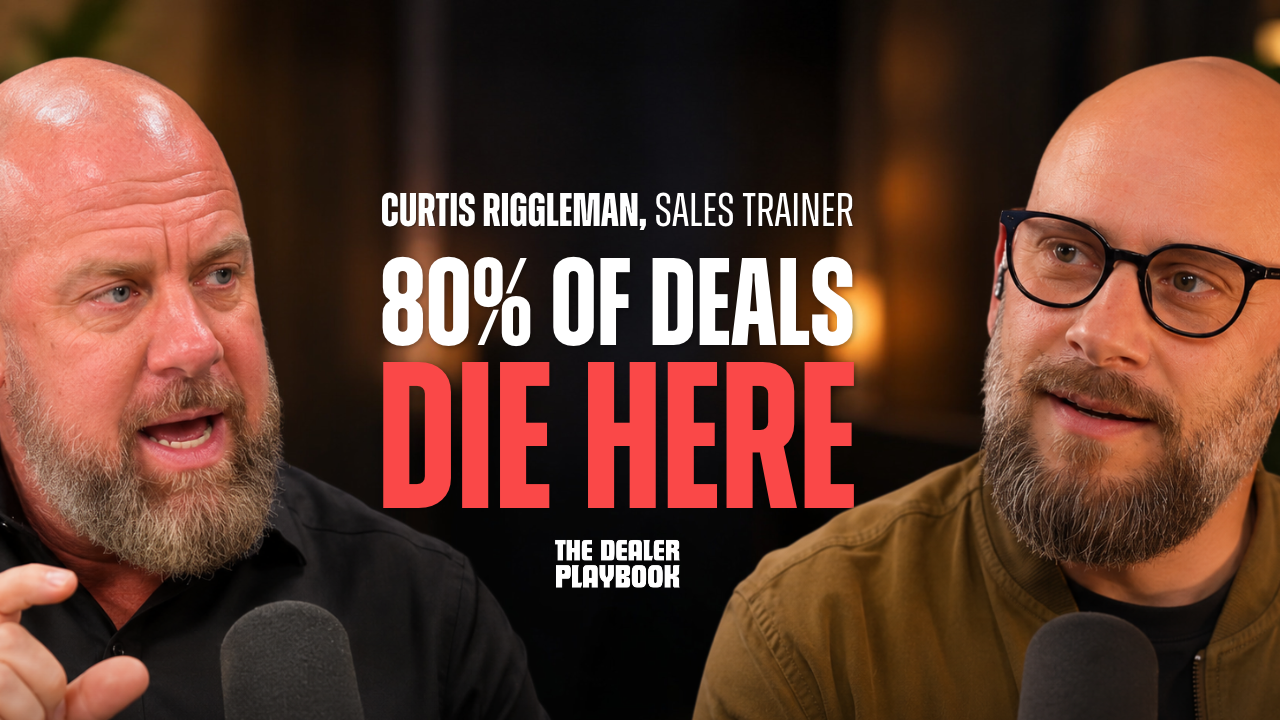
Curtis Riggleman believes dealerships are losing deals they should be closing, often because salespeople misunderstand what's happening in the customer's mind.
And he's got a pretty remarkable story behind that perspective.
Curtis grew up homeless, became a millionaire through the car business and real estate, then lost everything during the financial crisis. With roughly $2 million in debt, he returned to selling cars in the middle of a recession.
In his first month back, he sold 28 cars and made $17,000. Four months later, he'd sold 100 vehicles. Within six months, the store was moving 250 cars a month.
Today, Curtis operates 10 dealerships and trains salespeople through Riggleman University, using methods he continues to test on real showroom floors.
Michael Cirillo digs into what Curtis learned from that comeback and how those lessons translate into running dealerships today.
They discuss why Curtis believes 80% of lost deals fall apart before reaching the desk, how to recognize the difference between a genuine objection and a customer's hesitation, and why rushing to close can make a salesperson lose control of the conversation.
Curtis also shares how he approaches today's better-informed car buyers, why his managers are expected to train harder than their salespeople, and what he's discovering while testing AI-powered follow-up in two of his stores.
Michael’s takeaway: Your salespeople don’t need better rebuttals. They need to know when they’re hearing a stall. Get the customer inside, let the nerves settle, and the deal is still there.
Timestamps
(00:00) Intro
(01:06) Sponsor Message Aethr
(01:58) Origin Story From Homelessness
(05:29) Psychology Based Selling
(08:44) 100 Cars In Four Months
(11:33) Why pre-COVID training is obsolete
(15:55) Training While In The Grind
(20:11) “I need to think about it” is a stall
(24:32) Rapport Without Small Talk
(28:50) Where to find Curtis
Episode Brought To You By FlexDealer
Need Better Quality Leads? FLX helps car dealers generate better quality leads through localized organic search and highly-targeted digital ads that convert. Not only that, they work tirelessly to ensure car dealers integrate marketing and operations for a robust and functional growth strategy.
Watch The Full Episode
Prefer to watch episodes? Be sure to subscribe to our YouTube Channel and turn on notifications to get full access to our content.
Episode Transcript
Cold Open [00:00]
[00:00] Curtis Riggleman: Just understanding that will double somebody's income overnight. Very first month back in there, in that recession, I sold 28 cars and made 17,000 bucks. That was more than the GM at that time. In four months, I sold exactly 100 cars, and it changed the dynamic of that entire store.
[00:15] Michael Cirillo: You've got the benefit of being a rarity in that you are, yes, a trainer and a consultant, but also actively operating in a dealership. How do you feel that gives what you do a different perspective?
[00:28] Curtis Riggleman: What makes me different is being in the grind. I'm experiencing the same things that they're dealing with right now, so nothing's dated. And I went through every training in the book, and sometimes if they haven't been in the trenches in 10, 12 years, the stuff they're talking about is really dated, especially pre- and post-COVID.
[00:46] Michael Cirillo: I can see it. One question I have as a follow-up: what do you see with your team now? When they buy into the accountability and that championship mindset, do you find there's a spillover effect where they hold each other accountable and appreciate it? Or can that also cause some rifts?
[01:01] Curtis Riggleman: In my 10 stores, we have an accountability that's unheard of.
Sponsor: Aethr [01:06]
[01:06] Michael Cirillo: Hey, before we hop into this episode, I need your help. Tell me if you've noticed this, because I see this problem all over the place. First, the vehicle sells on Tuesday, but it's still being advertised on Friday. Your website, your DMS, and your IMS all tell different stories.
Well, allow me to introduce you to the solution. It's Aethr. Aethr checks all three sources independently, then builds one clean record for every vehicle and streams that standard data feed everywhere it goes downstream. Aethr: trust what moves downstream. You can check it out at theaethr.ai. That's T-H-E-A-E-T-H-R dot A-I. Go check it out.
Sleeping in Stolen Cars [01:58]
[01:58] Michael Cirillo: Okay, there's so much I need to dig into with you. We have limited time, but I don't want us to feel like we've got to talk like the Micro Machines guy from those commercials back in the late '80s and '90s, where he had to speed talk. There's so much about your story that's compelling to me.
[02:16] Michael Cirillo: I want to talk about you going back to the sales floor in '08, '09. For the youngsters listening in, not a great time in the economy. But before that, tell me a little bit about your origin story. I have a note here that says you were sleeping in stolen cars as a kid.
[02:33] Curtis Riggleman: Well, that's going all the way back to my childhood. And the reason I even tell that part of the story, Michael, is to relate with people who may have come from that type of rough background. I don't want people to think that success is limited to only a certain type of people.
[02:50] Curtis Riggleman: So that's why I go deep into that part of the story. Growing up, I had drug addict parents, and anybody who's lived that life knows how difficult it is. We were homeless my entire childhood. We never really had our own place, and we slept wherever we could.
[03:06] Curtis Riggleman: When my parents had dope, primarily my dad, we got to live with somebody. But that ran out in a week or two. From there, we had to find somewhere to stay until the welfare kicked in again and you could buy more drugs, and then somebody would let you sleep on their floor. That was the cycle.
[03:22] Curtis Riggleman: So in between, we're living in stolen cars. We would break into empty apartments and empty houses. When I say we, I mean primarily my dad, but we would all go. It was a family of four: my brother, my mom, and my dad. We lived in U-Hauls several times, because they would rent them and just keep them until the cops eventually took them.
[03:43] Curtis Riggleman: Tents, parks. We slept outside of what's called the Poverello House here locally. It's a homeless shelter, but they give you two meals a day, and people set up tents all around it. That was my whole childhood. We lived in all of those.
[03:58] Michael Cirillo: What has that done for who you are today?
[04:00] Curtis Riggleman: It's good and it's bad. It has made me a very driven individual. I'm extremely driven. It's taken a lot of the fear out of me, because there's really not much worse I can experience than what I already have. But on the bad side, it's made my empathy meter very low.
[04:19] Curtis Riggleman: So that's something I've had to adjust to. I accept almost zero excuses, and what seem like big problems to a lot of people are so minute to me that it's hard for me to relate sometimes. I have to really take my empathy meter down as low as possible to relate with them, because it just doesn't relate to me.
[04:40] Michael Cirillo: Yeah, I get that. In my early 20s, I did mission work in the Philippines, which was an eye-opening experience: to see how the majority of the rest of the world lives and to be in it. I can relate to what you're saying.
[04:56] Michael Cirillo: Not to suggest I'm comparing experiences at all, but I understand that feeling of, wait, you're complaining? All of you have the latest iPhone and you're still finding a rainy day?
[05:13] Michael Cirillo: Do you even understand?
[05:16] Curtis Riggleman: Exactly. That's the troubling part, particularly in relationships. I've had to learn how to be more sympathetic in that area, because my mind just doesn't work that way.
Selling With Psychology [05:29]
[05:29] Michael Cirillo: How does that feed into your training curriculum, where so much of the rhetoric is empathy, or getting to understand the other person's point of view?
[05:44] Michael Cirillo: How does that shape how you navigate that for the individuals you train?
[05:50] Curtis Riggleman: When you grow up in that environment, living that lifestyle and around people like that, you learn a lot about human psychology. You don't realize you're learning it in the moment. You're just living. But you're learning a lot about human behavior: how people talk, how they think, and what they really mean when they're saying one thing but have a different motive.
[06:10] Curtis Riggleman: You learn how to read all these things. So a lot of what I teach is the psychology. You've got to learn how to be a chameleon in every situation. I just learned how to do that over the years: how to relate with any type of customer and find a way to communicate with them. And that's how I train.
From Millionaire to $2 Million in Debt [06:32]
[06:32] Michael Cirillo: What happened in 2008 that caused you to go back to selling in 2009? And what did 2009 teach you about selling?
[06:45] Curtis Riggleman: I'd have to back up just a little bit. I got into the car business in 2001. I had just turned 21 and got into the car business broke. I lived in the motels, all those things. I got my first check and realized that was my way out, and I became obsessed with learning the car business.
[07:04] Curtis Riggleman: And this is from somebody who did not like school. I never went to high school. I'm not a guy who likes studying, but I became obsessed with the car business. From 2001 to 2006, I became a millionaire. I did it through real estate.
[07:20] Curtis Riggleman: I was buying one or two homes every year. Then I opened a billiard and poker store on Blackstone, the main vein here in Fresno, when that was a big thing in '04, '05. Then I went partners with somebody, and we bought a car lot in 2006. So I went from the dealership I was working at to running our own thing. 2006 was good. In 2007, someone turned the lights off, and it was fast.
[07:47] Curtis Riggleman: You know this. You were around at that time.
[07:49] Michael Cirillo: Yeah.
[07:50] Curtis Riggleman: It was like you were falling downhill and you couldn't stop yourself. Once I lost everything, lost the car lot, lost my other business, lost all my homes, I had no choice but to grab a pen and go back to work. And that's the one beautiful thing about this business. As long as you don't lose the courage, and you stay sharp enough to get out there on the line and make your money, you can do it at any time.
[08:14] Curtis Riggleman: That's exactly what I knew I needed to do. So in 2008, I grabbed a pen and went back to where I started. Went back to the line in the depression. I try to say this humbly, but I changed the culture of the entire store, because I went in there so driven.
[08:32] Curtis Riggleman: I lost everything I had. I wanted it all back. I was $2 million in debt between the IRS, the flooring company, and my homes. So I wanted it all back really bad.
100 Cars in Four Months [08:44]
[08:44] Curtis Riggleman: Everybody told me when I went back, "Hey Curtis, there's no money right now. The top guy made $3,500. Sales managers are on a $5,000 guarantee. There's no point in getting in here." I'm like, "We're in two different places right now." Very first month back, in that recession, I sold 28 cars and made 17,000 bucks.
[09:02] Curtis Riggleman: That was more than the GM at that time. GMs were on $10,000 guarantees. And in four months, I sold exactly 100 cars, and it changed the dynamic of that entire store.
[09:17] Curtis Riggleman: People were talking about it everywhere. All of a sudden, the best players from all over town were knocking on the door, wanting in. Six months later, we were doing 250 cars. We were right in the middle of the depression, but our store was doing 250 cars.
[09:35] Curtis Riggleman: It was unheard of.
[09:37] Michael Cirillo: What did that experience teach you about selling that a good year would never teach somebody?
[09:43] Curtis Riggleman: The whole experience taught me to really appreciate the car business. Going out there and trying to do it on your own, with your money on the line and your stress, was so stressful for me. Losing the business and losing my homes was near-heart-attack stressful.
[10:01] Curtis Riggleman: So when I got to go back to work on someone else's dime, and all I had to bring was a pen and I got a piece of the profit, it changed my mindset. I didn't appreciate it nearly as much the first time around. Once I went through that experience and went back in '08, '09, it was so simple.
[10:22] Curtis Riggleman: Everything I thought was hard before, Michael, was nothing. It was so simple, because nothing compared to the amount of stress I had just gone through. So it gave me a whole new appreciation for the car business, to answer your question.
Hardship and Soft Salespeople [10:34]
[10:34] Michael Cirillo: You're bringing up something I talk about with my wife often, and I think it applies to what we call the COVID babies: the guys who came into the business during COVID.
[10:45] Curtis Riggleman: They're almost all gone now.
[10:48] Michael Cirillo: That's fair. But I'm curious about your take. I think sometimes we forget the power and the drive that come from an experience you have in hardship.
[11:04] Michael Cirillo: I sometimes think about this with my kids. My kids are not experiencing anything remotely close to what I had, and I'm worried that's going to make them soft. My wife and I talk about how we can fabricate hardship for them.
[11:21] Michael Cirillo: How do you do that from your vantage point, as a leader and as a consultant and trainer? How do you say, "Hey, you can make what you want in this business," and make it believable for that individual?
[11:33] Curtis Riggleman: I can tell you, as a parent, I made the same mistake. I have a 30-year-old son. I had him when I was 17, and when he was born, we came home to the motel. I made it my mission: I'm going to be rich. My son's never going to experience any of this lifestyle I had to deal with.
[11:51] Curtis Riggleman: I gave him everything I never had, and it did backfire on me. It did make him too soft.
[11:57] Curtis Riggleman: I'm trying to repair that now, but it actually did backfire. As far as my staff, I'm much harder on them. We drill. We're like an army here. We drill, we train, we drill, we train.
[12:12] Curtis Riggleman: I demand the same thing out of my managers. My managers have to drill, and they have to train. If my managers are not willing to train harder than my sales guys, I get rid of them. In my 10 stores, we have an accountability that's unheard of. It really is.
[12:28] Curtis Riggleman: I have good people who come here and flop. They're not ready for the type of accountability we have here, and they end up leaving. It's like you have to be born into this or it doesn't work. So that's how we deal with that.
Why High Performers Keep Training [12:43]
[12:43] Michael Cirillo: What's inspiring about it is that it says, "You're coming into a standard that will not be fallen below." I actually picked you up on Brad Lea's show. I just had Brad on the show last week, and we were talking about this a little bit, because obviously he's big into training.
[13:02] Michael Cirillo: What baffles me, and I shared this with him, is this. I'm here in Dallas. We go to the World Cup, Portugal versus Spain. I'm sitting an arm's length away from Cristiano Ronaldo, arguably one of the highest-level athletes in the world and one of the wealthiest. For all intents and purposes, he's made it, and he shows up every single day and out-trains every other athlete.
[13:32] Michael Cirillo: What is it about our business where those who haven't made it yet think they don't need to train and maintain a standard of accountability?
[13:40] Curtis Riggleman: I don't think that's just our business. That's human nature, human psychology. Performers want to get better, and I've never met a high-level performer who doesn't enjoy bringing somebody else up.
[13:56] Curtis Riggleman: But low performers don't want to train or get better. They want to do just enough to get by. And if they do learn something, they want to keep it to themselves. That's one of the things I actually look for when I'm interviewing people. If they're one of those individuals who wants to keep things to themselves, I know there's an insecurity there, and I'm going to have trouble with them down the road.
[14:16] Curtis Riggleman: But high performers want to get better. High performers want to give it back. I've always found that with high performers. So I don't think that's just our business. I think that's people in general.
Keeping Politics Off the Floor [14:27]
[14:27] Michael Cirillo: I agree with that. What do you see with your team now? When they buy into the accountability and that championship mindset, is there a spillover effect where they hold each other accountable and appreciate it? Or can that cause some rifts?
[14:50] Curtis Riggleman: We don't have too many rifts. I keep politics out of the store. I keep a close eye on that, because that destroys dealerships when you let politics come into play. So I think we do a good job keeping that out. We have a team camaraderie where everybody wants to help each other win, and that's our goal here.
[15:08] Curtis Riggleman: There's enough winning available that everyone can win. You don't have to suppress somebody else to get yours. I can help this guy and get mine at the same time, and that's the attitude we carry. Like I say, we put all the success into a bowl, and at the end of the month, we all get pieces of it.
[15:27] Curtis Riggleman: We all get our share of it, but you don't have to try to hurt somebody for your own gain. We all try to help each other. I've got sales guys who will go in and close each other's deals all the time, and they don't ask for anything in return. They just know they can close the deal, so they're happy to help each other out.
[15:43] Curtis Riggleman: That's the type of camaraderie we have here. And if I get somebody in who doesn't fit that mold, even if they're a high performer, I'll weed them out, because it hurts the team.
Training While Still Operating [15:55]
[15:55] Michael Cirillo: You've got the benefit of being a rarity in that you are, yes, a trainer and a consultant, but also actively operating in a dealership. How do you feel that gives what you do a different perspective than those who had success in the business, then moved on and built training platforms?
[16:19] Curtis Riggleman: It's huge, Michael. I think that's one of the things that separates me from everybody else. I started training because I love training. I've been training for 20 years. I started putting it out on social media just to pay it forward, and I asked my crew to start putting out customer advocate content. I've never asked my team to do something I'm not willing to do.
[16:36] Curtis Riggleman: So I said, "You guys are going to put out customer advocate content. I'm going to put out sales advocate content. I'm going to give back to my sales guys." That's what started the whole thing. It was organic. Then people started reaching out to me on social media like crazy to train their stores. They thought I was a trainer, and I'm like, "I'm flattered, but I have 10 stores."
[16:53] Curtis Riggleman: "I really don't have time to go out." But that created Riggleman University, which is my online platform. So I've been training for a long time, but what makes me different is being in the grind. I'm experiencing the same things they're dealing with right now, so nothing's dated. And I went to every training in the book.
[17:12] Curtis Riggleman: Sometimes, if trainers haven't been in the trenches in 10, 12 years, the stuff they're talking about is really dated, especially pre- and post-COVID. Everything's changed. If you're teaching techniques from before COVID, those are obsolete now.
[17:28] Curtis Riggleman: They just are. It's the way our minds have been conditioned now. We want value immediately. We don't want small talk. Small talk will blow a customer off now. So if you think you're going to make small talk for the first five minutes, you're not. That's dated.
[17:43] Curtis Riggleman: That doesn't work today. They want instant value. They want what they came for, and then you can build rapport. If you haven't adapted your training that way, you're behind.
AI Follow-Up in the CRM [17:54]
[17:54] Michael Cirillo: Do you think this is where the conversation about AI comes in? People want immediacy, and AI can give them that. If so, where does AI win now, and where does it lose?
[18:06] Curtis Riggleman: I'm still playing with a lot of AI. The nice thing about having 10 stores is that I can experiment with things in one store and test different things. I'm testing AI right now in two of my stores, in the CRM, for instant follow-up. I'm seeing good results, because it's instant and it can follow up with everybody at the same time.
[18:29] Curtis Riggleman: It still follows up while others are sleeping or you're working a deal. You don't miss opportunities, and as soon as there's engagement, it serves the customer up to a live person anyway. So far, what I've found is that it cuts a lot of the dead time. It cuts a lot of the fishing.
[18:44] Curtis Riggleman: People can spend hours just trying to get responses. The AI only serves you up people who responded. So I'm still playing with AI. I'm still figuring out what works best and what doesn't. At some point, people want to talk to a real person.
[19:02] Curtis Riggleman: So if it serves them up to me and cuts out all the fishing time, I'm having success with that. But I haven't perfected it yet. I'm still working on it too.
[19:13] Michael Cirillo: To me, this becomes a validating point for what we were just talking about: "Hey, I'm in it. I've got 10 stores, and my curriculum is evolving as I'm actually testing it. I'm not working on hypotheticals." I think sometimes that's a challenge.
[19:30] Michael Cirillo: That's a gap for those who had some success. Now, with AI, the game is changing. The playing field is broadening, or becoming...
[19:39] Curtis Riggleman: More...
[19:40] Michael Cirillo: ...focused. So having real in-store experience is where I think there's a ton of value.
[19:47] Curtis Riggleman: That's something I actually talk about, Michael. I don't train anything in theory. If you're not actively in the business, you have to train in theory. You're learning new things that sound like they work, and they should work, but you're not positive they're going to work.
[20:03] Curtis Riggleman: I don't train anything that's not tested and tried in my stores. I just don't practice on students.
"I Need to Think About It" Is a Stall [20:11]
[20:11] Michael Cirillo: All these years in the car business, one major objection has always been talked about: "I've got to think about it." Does that objection still exist? And if so, how has the way you handle it changed, given all the access to information people have now?
[20:32] Curtis Riggleman: It still exists. I have a book named Objections Aren't Real.
[20:37] Michael Cirillo: Yep.
[20:37] Curtis Riggleman: "I need to think about it" is not a real objection. It depends on where in the process they're saying it. If it's toward the end of the process, that's a stall tactic. That's fear. That's anxiety building up. That's human nature.
[20:53] Curtis Riggleman: We want to procrastinate. Even when we're doing something that's good for us, we still want to procrastinate, because we fear taking action. So as they get closer to the end of the process and "I need to think about it" comes up, that's fear. I just have to get them over that hump.
[21:09] Curtis Riggleman: I don't need to fix "I need to think about it." I just need to get past that hump. Once I get them past that mental block, we can continue moving forward. So if we're toward the end of the process and I know it's a stall, I would say, "Michael, I know it's a big decision. I get that. Let's do this. While you're here, let me get you all the information you need to think about it.
[21:27] Curtis Riggleman: "And hopefully, when you're ready to make a decision, you'll make that decision with me. Is that fair enough?" And I just get them past that hump, and we move forward. Once I'm past the stall, I don't bring it back up again.
[21:43] Curtis Riggleman: I don't keep saying, "So what do you need to think about?" No. I know it's a stall. Let's get past the stall. Let's get them out of that anxiety mode. Let's get them into the building, get them calm again, and then move forward.
[21:59] Curtis Riggleman: If you know what you're really being told, it's so much easier to handle. But if you bite on everything like it's a real objection, and your mind goes into fix-it mode, you're losing more than you're winning. It's not something that needs to be fixed.
Back Doors vs. Stalls [22:14]
[22:14] Michael Cirillo: What I love about this is that it applies in so many different facets. It's like emotional intelligence. You might be feeling like you've got to do something, but you haven't named what's actually happening yet.
[22:31] Michael Cirillo: Until you name what's actually happening inside yourself, you can't get past it. So I love how you broke that down and said, "This isn't the objection. This is just a little hurdle we've got to get past." Do you think what screws people up in this situation is transactional thinking?
[22:48] Michael Cirillo: "How do I get them to the close?" Instead of what you just did, where you're saying, "I'm not worried about the close yet. I'm worried about..."
[22:54] Curtis Riggleman: The close is the last step. I've got to get over this hurdle, get them into the building, get them comfortable, let that anxiety pass, and then move forward. The problem is that everybody goes into close mode right away. It's funny, because I just did a webinar on this last night. 80% of the deals that are lost are lost outside, because salespeople bite on what they're being told instead of understanding what the customer is really feeling.
[23:19] Curtis Riggleman: That same objection, if it comes 60 seconds after hello, is not a stall. That's what I call a back door. That's the customer setting up an early way out if they don't like the way the transaction is going. So I handle that differently. I give them what they asked for. I give them a way out so they're comfortable moving forward, and then we can move past it.
[23:40] Curtis Riggleman: If it comes up later in the process, generally after the test drive and before going into the building, which is where it usually comes up, that's a stall. That's anxiety building up. That's fear of coming inside. That's, "Oh s***, I'm actually getting close to making a decision.
[23:56] Curtis Riggleman: "Do I want to do this, or do I just hold off a little bit?" And they throw out a stall. So I don't need to fix whatever comes out of their mouth. It doesn't matter. "I need to talk to my wife." "I need to think about it." "I need to sleep on it." "I don't do anything on a first date." It's all the same. It's all fake.
[24:11] Curtis Riggleman: Just get over the stall, move them past it, calm the nerves, and then move forward again. But don't try to close the deal outside. Don't try to fix the problem. It doesn't need to be fixed. Just understanding that alone will double somebody's income overnight.
[24:29] Michael Cirillo: Oh, wow. I can see it.
Rapport Without Small Talk [24:32]
[24:32] Michael Cirillo: One follow-up question, touching on something we brought up earlier: the speed people want to go at. They don't want the small talk. You've unlocked something I hadn't thought about. Up until you said that, my brain had internalized small talk as relationship building, and as the way to get past these hurdles.
[24:59] Michael Cirillo: But there's got to be a sense of relationship. How are you building the relationship so that you can do this effectively, and so it doesn't feel transactional?
[25:09] Curtis Riggleman: What you do is different. People plan on coming on your podcast, and this is a relationship talk we've already planned for. But when they step on the lot today, post-COVID, the average consumer has spent 15 hours researching your vehicle on their phone.
[25:26] Curtis Riggleman: The average consumer goes to 1.5 lots to buy a car. 70% of the people who buy a car buy at the very first place they go. So today's customer, when they come on your lot, has intent. I don't care what comes out of their mouth. They have intent. We're all extremely busy.
[25:42] Curtis Riggleman: Social media has conditioned us, post-COVID, so that if we don't get value, if we don't get what we want to see right away, we swipe. That's conditioned the way we think. We want value right now. So someone comes on my lot and says, "Yeah, I looked online and saw you guys have this.
[26:00] Curtis Riggleman: "Do you still have this?" And I'm like, "Yeah, that's right over here. By the way, what type of work do you do? Do you have a family?" If I start going that route like I did 10 years ago, they're like, "What does that have to do with anything? I came to see this. This is what I want to see." They'll blow you off.
[26:15] Curtis Riggleman: They won't say that. They'll say stuff like, "Is it okay if I just look by myself? Can I call you if I need you?" That's a swipe. So I've got to give them the content they want to see, and then I build rapport as I go. I have a series of questions to do that. As I start walking and talking, I say, "Michael, by the way, who's the lucky one getting a new car today?"
[26:35] Curtis Riggleman: I want some emotion. I want them to raise their hand and say, "Oh, it's for me." Whether they can control it or not, that creates emotion. The second thing it does is eliminate the third party who's going to be missing later. My second question is always the same: "By the way, how long have you been thinking about getting a new car?"
[26:51] Curtis Riggleman: This comes with stories. They start talking. "Oh, I've been looking for a couple of weeks." They tell you about the place they went to that didn't have what they said they had, and how they drove all the way down there and wasted their time. You can bite on these little things to start talking and building rapport. My third question: "Well, you picked out a nice car.
[27:08] Curtis Riggleman: "What is it about this one in particular that jumped out at you? What made you decide to look at this one?" Those questions open up stories I can tag onto. "Oh, well, it's this, it's this. It's 4x4." "Okay, great. You mentioned 4x4. Why is 4x4 so important?" "Well, I like to take my family camping, and the places we go require 4x4."
[27:26] Curtis Riggleman: "Really? Where do you guys camp?" So I build rapport during my discovery process, but I don't lead with trying to build rapport, because it's patronizing and people don't want that. They want value. As I'm delivering value, I can slip in rapport.
[27:42] Curtis Riggleman: By the time I get through my discovery, I'll know a lot about this customer that they didn't even realize I got out of them. But we train that. We train, train, train. It's efficiency. I'm doing two things at once as I move through the process, and I'm not annoying the customer by slowing things down or asking questions that aren't relevant to why they're there.
[28:05] Curtis Riggleman: Does that make sense?
Where to Find Curtis [28:07]
[28:07] Michael Cirillo: Yeah. That's a powerful reframe on how this can be done in a natural, organic way while still advancing the purpose of why they came to you. I love that reframe. As we wind down, Curtis, how can those listening and watching connect with you, and where do we get a copy of your book?
[28:26] Curtis Riggleman: All my stuff is at officialcurtisriggleman.com. My Instagram is officialcurtisriggleman. My Facebook is officialcurtisriggleman. Everything's officialcurtisriggleman. Or you can just Google Curtis Riggleman, and everything will pop up. It's not hard to find.
[28:41] Michael Cirillo: That's great. We're going to link to all of that in the show notes over at thedealerplaybook.com. For now, man, thanks so much for joining me on The Dealer Playbook podcast.
[28:49] Curtis Riggleman: Thanks, Michael. Appreciate it, bro.
[28:50] Michael Cirillo: Hey, thanks for listening to The Dealer Playbook podcast. If you enjoyed tuning in, please subscribe, share, and hit that like button. You can also join us and the DPB community on social media. Check back next week for a new Dealer Playbook episode. Thanks so much for joining.