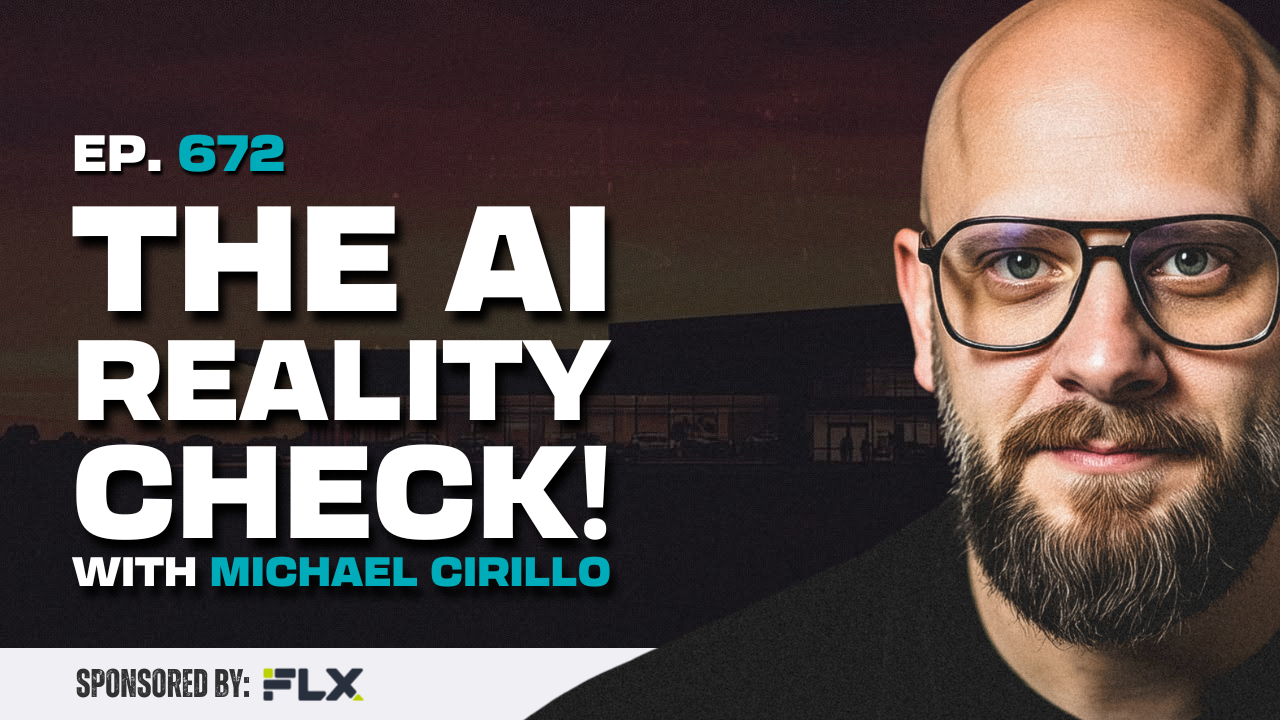
Ep. 672 - Will AI Replace Your Job? Or Will You Replace Yourself?
Let’s just be real.
The ground has shifted—and it’s not just a ripple. It’s a full-blown seismic shift under every industry, every role, every business model. In this episode, I’m unpacking what that actually means for those of us in the retail auto world and beyond as we navigate artificial intelligence.
You’ve seen the AI overviews show up before Google search results. You’ve heard the noise "AI is coming for your job." But here’s the kicker: whether you believe it will or won’t, you’re probably right.
What we explore in this episode is the why behind that statement, and more importantly, what you can do about it.
If you’re someone who’s wondering how to adapt, how to lead, how to stay relevant—or heck, even how to start thinking about AI in a way that serves you and your team—this one’s for you.
Episode Brought To You By FlexDealer
Need Better Quality Leads? FLX helps car dealers generate better quality leads through localized organic search and highly-targeted digital ads that convert. Not only that, they work tirelessly to ensure car dealers integrate marketing and operations for a robust and functional growth strategy.
Watch The Full Episode
Prefer to watch episodes? Be sure to subscribe to our YouTube Channel and turn on notifications to get full access to our content.
Episode Transcript
MC: 0:00
(Episode Sponsor)This episode is brought to you by FlexDealer.
Hey auto industry. Welcome to this episode of the Dealer Playbook Podcast. Today, we are going to be talking about as many thoughts as I can come up with around artificial intelligence. More important, where you should be thinking about it. Stay tuned, guys. What can I say? The world beneath us, the very ground beneath us, has shifted, and here we are. It's at time of recording August 2025.
MC: 0:46
You can't go more than a swipe or two without hearing about artificial intelligence in some way, shape or form. You've probably noticed when you go to Google, there's now a button that says AI mode. You probably noticed when you do a Google search, you see the AI overviews before any of the organic, traditional, organic listings. And I can't even believe I'm using the word traditional with something that's digital, because traditional used to meant well, traditional print and billboards and TV and radio. But it's kind of an indication at how quickly things move if you're not paying attention, or maybe you're unwilling to pay attention. Either way, things are on the move and I think it's only important here, in a very dealer playbook-esque fashion, that we dig into artificial intelligence. And boy, there are a million and one different places that we could start. Actually, chatgpt would probably correct me on that number and tell me there's trillions of places that we could start, but I think here's where I want to go.
MC: 1:48
First, let's set the table. Artificial intelligence is not going anywhere and we are experiencing it at its worst. Today is the worst that AI platforms will ever be. We see governments around the world making massive investments. We see companies like Nvidia creating chipsets that are more powerful than they've ever been. We are seeing power and energy companies boldly anticipating the future, because the energy consumption for where we're going with AI is going to be otherworldly, something we've never seen. You were worried about EV vehicle charging infrastructure and whether the power grid could help work with that. Wait till we talk about the power consumption estimates of artificial intelligence just in a minute. But what's exciting about this is it's the first time in the last what? 35, 40 years that quite literally, the playing field in every industry has been leveled, completely leveled, and that's kind of an exciting notion, and I think we'll talk about that in just a little bit as well and why I see it that way.
MC: 3:08
But there's a lot of conversation out there. You can't go more than one or two scrolls on any social platform without hearing some AI or technologist expert talking about the implications of artificial intelligence. You see founders of the different AI chat companies, like OpenAI, sam Altman, out there giving fireside discussions about AI and the things they're thinking about. And, of course, if you go to LinkedIn, which is where I hang out the most, love to connect with you there wink, wink, nudge, nudge. You're seeing a lot of us in the retail auto industry trying to reconcile our thoughts based on where we're seeing things today and where, based on all of this information that we have, we think things are going to go tomorrow.
MC: 3:59
Well, I think one of the biggest challenges that we're facing right now is this idea of being replaced by AI, and there's two sides to this coin. There are those out there whose voices are quite loud, saying AI is going to replace your job, and then there's those that say, well, it's going to augment your job, it's going to make your job more efficient. Well, I think it's important that we kind of look at both sides of that, because the reality of it is and I think this is where we should start, because it's probably the most pressing topic when it comes to AI and AI adoption is that, if you believe AI is going to replace your job and if you believe AI will not replace your job in both instances, I believe you are correct. Here's what I mean by that If you are going into job preservation mode and you're going to hang on so tightly to the way that your job is performed today, you're replaced, but because of the level playing field, because none of us really know what we don't know yet. If your idea of job preservation is to say, wait a minute, I am going to learn and study and implement and test and fail and succeed with AI to augment the work that I do today, I believe you'll be in a position in your organization, one of the few who will be able to create the new version of your job. Again, if you're so dependent on hanging on tight to the way things are currently being done out, if you take what you are currently doing and run it through AI tools and put yourself in a position of innovation and experimentation, I believe you now create the new version of your job that your organization is going to look to you for as the subject matter expert.
MC: 6:14
And that is the way I am thinking about job preservation. That's the way I'm thinking about how to continue to grow in an AI augmented slash driven world. I choose not to be afraid of it. I choose to embrace it in the best way that I know how, having a measure of faith that my efforts, my movement, my leaning in will provide me the clarity that is required in order for me to go to the next level. I want to try and draw this now to why AI is not going anywhere and why I believe it's incumbent upon us to lean in and to start asking questions, to sign up for a GPT account at 20 bucks a month and say, hey, look, I'm really interested in learning about artificial intelligence and all of the possibilities.
MC: 7:05
Granted, there are things I don't know to ask. What questions should I be asking, as a beginner, to start learning about the implications of AI and how I can apply it to my current workflow? Here's what I do for a living, here's the nuance of my job, et cetera, et cetera. And boy, wouldn't that be just a great starting place to start picking up the reins and learning what you don't know. You don't know yet, but because all of us don't know what we don't know and some of us think we know what we know that's one of the reasons why the playing field is so level. I don't believe it's been this level for 35 years, like I was saying, let me explain.
MC: 7:43
35 years ago the intercom in the Cirillo household chirps and it's my dad and he says guys, come down to the office. And so we, myself and my siblings, we make our way down to the office. There's my dad sitting at his computer. He's like Dr Claw from inspector gadget. His back is to the door. We walk in and he says watch this. And he connects to the internet. This is around 1993. The home internet is this new thing. At least where I was living we had never seen anything like it.
MC: 8:20
My dad connects to the internet, goes to the Encyclopedia Britannica website and slowly turns around to us as the website's loading and says this is going to kill the encyclopedia salesperson. And I remember gosh, 1993, I'm what? 10, 11 years old. I remember thinking whoa, you know what? Because at that time, for you youngins, at that time, encyclopedia salespeople would come to your house once or twice a year to sell you an updated volume A through Z or Zed of every edition of the Encyclopedia Britannica. Similarly, vacuum salespeople, ointment salespeople, I mean people were coming to the door like crazy, trying to sell stuff. I mean gosh, now that I've lived in Texas for a little while, I realize that door-to-door soliciting is alive and well. There's a salesperson for everything here. But you know what my dad was so right, I was more enamored by this thing called the internet and the access it gave.
MC: 9:36
But what my dad understood 35 years ago is yeah, this, this thing called the internet, is going to make way to level the playing field. It will absolutely get rid of jobs done the way that they had been performed up to that point. But, as we all know, looking back over the last 35 years, the internet provided and created millions upon millions more jobs. Well, you know what? At this time, our family business was publishing phone books. If you want to talk about job preservation, if you want to talk about a proof point to the thesis that you need to lean into the future, we published phone books. That's what we did, and back then it took all of about eight years for us to get out of that business before we realized the impending extinction. Do phone books still exist? Yeah, what are they doing? They're holding up computer monitors. You know, you're using it as a makeshift booster seat when you go camping what was once a really profitable business.
MC: 10:51
My dad saw the writing on the wall in 1993 and said wait a minute, this is going to change everything. This is going to kill the old way of doing things. This is going to usher in a new era of business, of commerce, transaction, relationship building, so on and so forth. And, like I said, I think we can all agree looking back over the last 35 years, that's exactly what happened. Well, here we are again in a very critical moment in our human existence, in our human history, where the playing field once again has been leveled, where I now, like my father, look into this camera and I say, hey, ai is. And to build your life in ways that you don't even know yet and not knowing yet is okay. Doing nothing about it forever is not okay, and I think you know, for those of you that are joining me that are listening to this, we need to really pay attention.
MC: 12:15
Ai is not going anywhere and in fact, it's not going anywhere to this degree. You've got governments investing billions of dollars into it. You have power and energy companies anticipating the consumption needs alone of America's consumption of AI alone. You have companies like NVIDIA who are fabricating new chips, more powerful chips, faster chips to accommodate the processing power alone. Speaking of energy consumption, to just really drive this point home that it's not going anywhere they anticipate that in the next five years, the energy consumption alone of AI's needs is going to be somewhere around 98 gigawatt hours. A 98 gigawatt power facility will be required in order to power America's consumption of AI. Guys, a 98 gigawatt power facility would be the size of the city of Dallas, and by the city of Dallas I mean the Dallas Metroplex, and by the Dallas Metroplex I mean from concrete on the west to concrete on the east. We're talking about like 80 miles.
MC: 13:29
Hey, does your marketing agency suck? Listen, before we hop back into this episode. I know you know me as the host of the Dealer Playbook, but did you also know that I'm the CEO of FlexDealer, an agency that's helping dealers capture better quality leads from local SEO and hyper-targeted ads that convert? So if you want to sell more cars and finally have a partner that's in it with you, that doesn't suck, visit flexdealercom. Let's hop back into this episode Now.
MC: 13:57
You might be skeptical. You might say no way, that sounds way too big. Well, mark Zuckerberg, if you go to his posts on Facebook, you'll see him speaking not just about AI, but artificial superintelligence, and you'll see a post that he put out a couple of weeks ago. So we're talking about early July 2025, where he speaks of the one gigawatt hour power facility that they're building for AI, for their AI super intelligence, for their Lama model, and they superimpose the square footage of this building over the island of manhattan. This is where you do the tim the tool, man taylor, you go a power facility the size of manhattan, one gigawatt hour and they're saying 98 gigawatt hours.
MC: 14:49
Ai is not going anywhere. This is it. It. It's here and it's incumbent upon each of us to be thinking to the future. What don't I know that I should know. Well, you can ask GPT what are the possibilities inside of what I currently do? Get the answer and start moving. Get the answer and start moving, start taking action, start experimenting, start failing, start moving forward with it because it's here.
MC: 15:26
But all of this, while kind of scary right, I mean, you're telling me that AI models now are creating their own code, set to never be able to shut down, to never be able to self-destruct or to be prompted to destruct. No, no, no, no, no, no, no, no, no, no. What Are you serious? What happens when these models fully integrate with a 98 gigawatt power facility that can just like become its own Tony Stark or Iron man or whatever? It's kind of scary.
MC: 16:00
There's been moments through all of this, as I've been learning more and more about it and where things are going, and the worries of Sam Altman talking about his worries about misuse and fraud and bad actors and just people getting their hands on such powerful technology, that I'm like, wait, if we can't shut this down, if this creates its own non-self-destruct code, if people are going to be using it bad, how do you unplug it? How do you unplug something that can't be unplugged? And this is where the opening credits of the Terminator start. But but okay, are you listening? Are you leaning in? Are you wondering where I'm going with this? I'm going to hedge my bet on something I'm open to being wrong. I'm open to this podcast episode playing in the future, with AI robots walking around everywhere being like what an idiot. But I'm going to hedge my bets here.
MC: 16:51
I'm going to make a prediction that, as technology becomes an even deeper part of our lives, of our society, of what drives the economy of governments, of quite literally everything we do that our desire will be for human connection. There's something innate in each of our DNA, whether we want to admit it or not, whether we're extroverted or introverted, where, given enough loneliness, surrounded by too much of the unnatural, our human desire is to connect with another human. And there's reasons for that. And there's reasons for that Humans can trust one another. We not only desire to trust, we desire to be trusted. We not only desire to love, we desire to see. But we desire to be seen, to have empathy one for another, to make somebody else feel good, to be of service and to be useful.
MC: 18:14
And it's not really productive for us to go down the wormhole and say we're all going to be replaced, none of us are going to have to work, none of us are going to have to exist. The robots are going to take over, they're going to take all of our jobs, they're going to do all these things. There's just no sense in doing that. What we should be doing is saying what don't I know that I should know, what questions haven't I asked that I should ask what can I learn that I need to learn? What can I do to create the next version of the work that I do and, most importantly, how can I utilize the technology to do what I think is going to be the most important thing here in the future Speed up human connection. Speed it up. Let's get from technology to handshake, to warm embrace, to community, to collaboration, to connection, as quickly as possible, because the thing that we are going to desire then, that we desire now, is to connect in a meaningful way with another human being. So maybe you're a dealership of the future. What are human beings in the future going to want? Connection Newsflash. What are human beings of 2025, of 2000, of 1950, of 1900 want? They want connection. And so, if we look historically and also to the future, if we look inward as well as outward, what we realize is that, even in a technology dominated or augmented or driven world, as long as human beings exist here, we need to place our chips on human connection, human experience, human love, human trust, empathy, idea exchanges and so forth.
MC: 20:14
My prediction is that we will go through phases where we're like I love AI. It makes me feel like a magician. I can do things that I never could do. I can code. I know Kung Fu Right, then we're going to kind of push back on it. We're going to be like wait a minute, who's regulating this? I don't, maybe I don't like that. It's integrated into everything and knows everything about me. I know we joke about Facebook and all these companies knowing everything about us, but like, like, maybe I don't like that anymore because it knows me better than I know myself, and that's kind of creepy.
MC: 20:52
And then we're going to accept and we're going to be like, actually, maybe I do, like that it knows everything about me. And before you know it, we're going to be walking down the street. Robots are going to be delivering our amazon packages like humanoid robots. It's going to weird us out at first, and then we're going to be walking down the street. Robots are going to be delivering our Amazon packages like humanoid robots. It's going to weird us out at first, and then we're going to be like, oh, it's kind of convenient. And then we're going to accept it. And before you know it, we're all in the opening credits of the Jetsons, right, but even in the Jetsons there were families, there were communities, there were businesses and there was humanity. And so I guess where I want to get us to is just that, If I had to place my bets on the playbook here, it's to learn as much as we can, to not be afraid to move forward boldly, excitedlyly, with the purpose of helping other people connect in more meaningful ways.
MC: 21:53
Well, listen, there's so many different places we could have gone. Like I said, gpt could tell us the trillion other ways that this episode could have gone, but I really wanted it to be a conversation opener, not an ender, not a closer. There's too many people out there that want to close the conversation. Be the smartest person in the room. I'm not the smartest person in the room. If if I were, I wouldn't still be hosting this podcast and taking ferocious notes like the way I do. But listen, I so, so deeply appreciate that you've been here this whole time. Are we going on? 14 years, no Eleven? How many years are we at? We're at so many years You've been here.
MC: 22:32
I'd like to say thank you to all of the new listeners and subscribers. It means the world to me. I want you to remember to keep the playbook open. We're going to be having more conversations about artificial intelligence, its implications, where things are going, how they're moving and shaking, and, obviously, the reality that human connection matters most.
(Outro) Hey, thanks for listening to the Dealer Playbook Podcast. If you enjoyed tuning in, please subscribe, share and hit that like button. You can also join us and the DPB community on social media. Check back next week for a new Dealer Playbook episode. Thanks so much for joining.