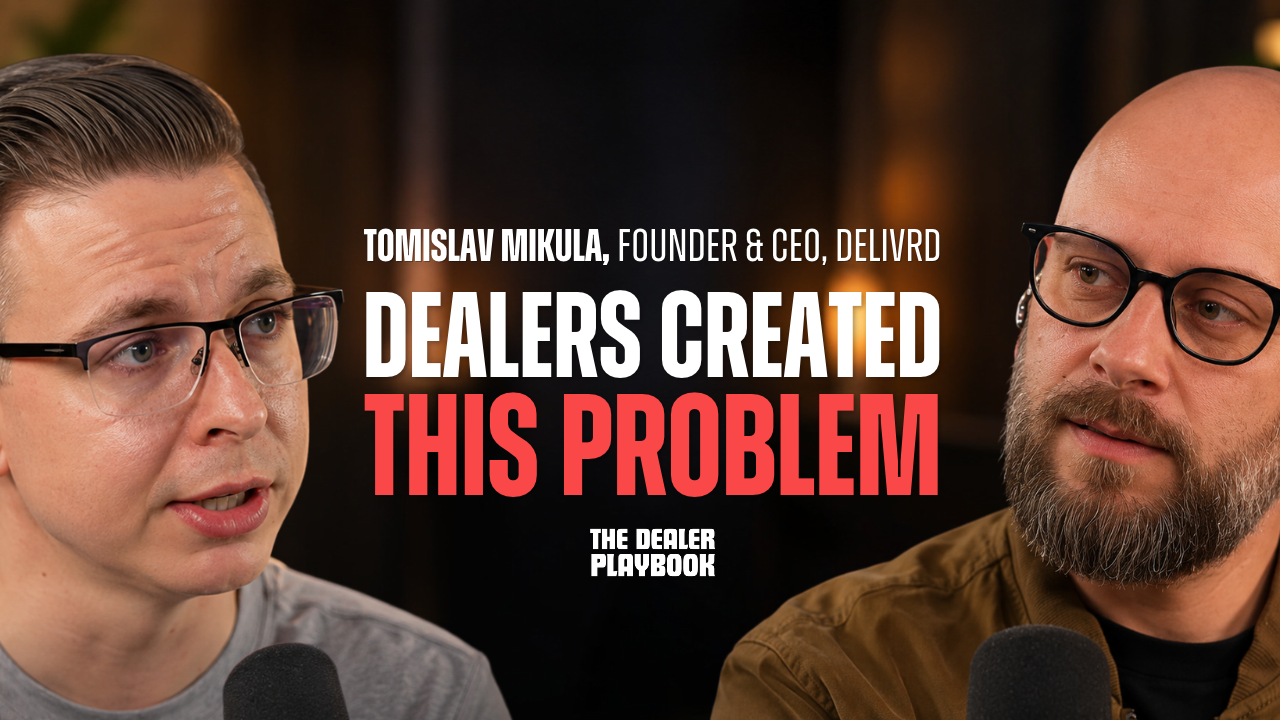
Tomislav charges car buyers $1,000 so they never have to deal with a dealership. A lot of dealers see him as the enemy. Tomislav sees it differently. He says dealers created the problem he's solving, and he'd love for them to fix it.
Tomislav is the founder of Delivrd, a car buying advocacy service that's four years in and profitable. Before that, he was a top finance manager running $3,000 a copy. Then eight customers in a row turned him down and told him the same thing: "I hate buying cars." That was the day he decided he couldn't fix it from inside the store.
Michael and Tomislav talk through what he learned from negotiating 100 deals for free (saving money ranked fifth for buyers), what he hears in the first 60 seconds of a dealership phone call, why hiding price and piling on add-ons sends people his way, and how his team keeps deals so quick that some dealers are happy to take them. He also makes the case that direct-to-consumer competition would push the best stores to sell a premium experience and make more money doing it.
Plus the $50 golf reimbursement that ended his dealership career, and how he runs his own team today.
Connect with Tomislav and Delivrd on YouTube, Instagram, TikTok, and Twitch by searching Delivrd, or visit delivrd.com.
Michael's takeaway: "Tomislav says he shouldn't have to exist. So if buyers are paying someone to avoid your process, go fix your process."
Timestamps
(00:00) Why DTC Helps Dealers
(01:05) Sponsor Ether
(04:53) Dealers Need Competition
(09:03) Good Dealers Vs Bad Tactics
(11:00) Customer Service Lessons Abroad
(14:33) Phone Call Red Flags
(15:50) Toxic Dealership Culture
(21:28) Learning What Customers Want
(23:21) Making Deals Fast For Dealers
(29:39) Wrap Up
Episode Brought To You By FlexDealer
Need Better Quality Leads? FLX helps car dealers generate better quality leads through localized organic search and highly-targeted digital ads that convert. Not only that, they work tirelessly to ensure car dealers integrate marketing and operations for a robust and functional growth strategy.
Watch The Full Episode
Prefer to watch episodes? Be sure to subscribe to our YouTube Channel and turn on notifications to get full access to our content.
Episode Transcript
Intro
Tomislav Mikula (0:00): The reason why I want direct-to-consumer to exist is I actually don't think it hurts dealerships. I think it makes the best dealerships thrive and make more money, and I believe people will pay a premium for that. But the only way I believe that happens is with true competition.
Michael Cirillo (0:11): I think your approach is fresh. Was there a moment in time at the beginning where you're like, "I'm onto something, and I'm going to take a lot of heat for this"?
Tomislav Mikula (0:20): Yeah. I just watched a video of some guy in a Hawaiian shirt saying I'm an idiot for charging 1,000 bucks and consumers are so dumb to go through this. I just think if you take off your car salesman glasses for a minute, you realize people trade their money for time all of the time. That's not a new concept. There's somebody mowing my lawn as we speak. I'm trading my money for time. That is exactly what this is with a car buying service, and we shouldn't judge people because they don't want to have to do a task. And if you're in that business, you should be saying, "Why in the world are people paying to avoid my experience? I should make my experience better."
Michael Cirillo (0:48): Boy, is there a lot of rage bait, I will say, and I don't even know if it's your doing. I think sometimes you just show up and it happens on these calls. But what do you think? Are people misunderstanding? Is there advocacy for the dealer in that mix somewhere?
Sponsor message: Aethr (1:05)
Michael Cirillo (1:05): Hey, before we hop into this episode, I need your help. Tell me if you've noticed this, because I see this problem all over the place. The vehicle sells on Tuesday, but it's still being advertised on Friday. Your website, your DMS and your IMS all tell different stories. Well, allow me to introduce you to the solution. It's Aethr. Aethr checks all three sources independently, then builds one clean record for every vehicle and streams that standard data feed everywhere it goes downstream. Aethr: trust what moves downstream. You can check it out at theaethr.ai. That's T-H-E-A-E-T-H-R dot A-I. Go check it out.
How growing up with nothing shapes the business (1:57)
Michael Cirillo (1:57): I have this thing I usually tell guests pre-show, where I say, "You might hear me say something like 'controversial opinion of the day,' and then I don't ask anything controversial." It's like an attention reset. But here I have you now, probably, dare I say, one of the most controversial characters in the auto industry. I'm like, controversial guest of the year. But I'm excited to have you on.
I guess I want to start here. I know you worked in a dealership. I loved the episode you did with Paul and Kyle from More Than Cars, just learning about your upbringing and some of those things. I want to start the framing with this: how does that upbringing shape how you maneuver through your business today?
Tomislav Mikula (2:50): Not everything is a given. I think a lot of people get to a certain phase, they start making enough money, and they go into coast mode. They just start coasting. There are obviously different phases people go through with their business. There's that founder, beginner mode where you have a get-s***-done mentality and you're grinding every single day. Then there's a certain point where you start making money, things are good, and you're almost afraid to change things.
My upbringing told me that tomorrow isn't a given. You could have food one day, and you might not have food the next. So you always have to be fighting. You always have to be scrappy. You always have to be innovative. And we push the envelope every single day.
I love the phrase "you grow or you die." I live and breathe by that. Funny enough, I learned it at my dealership. That phrase was one of our core values, it stuck with me, and we talk about it all the time as a team. If you do not grow as a company, you die, and our company sees that every single day. Every team member understands that concept, and we're always trying to find different ways to innovate and improve, to make our customer experience that much better.
Michael Cirillo (3:56): It makes me think about this. If I could try to articulate how I think about what you do, the content you put out and the service you deliver, and there's a plot line here I'll get to: when you first landed on my radar, I was like, "Dude, I've built my whole life being an advocate for the dealer body. Who's this clown?" And then I realized, wait a minute, he might not actually be doing the opposite of what I'm trying to do.
So tell me if I'm tracking here, because boy, is there a lot of rage bait, I will say. And I don't even know if it's your doing. I think sometimes you just show up and it happens on these calls. But what do you think? Are people misunderstanding? Is there advocacy for the dealer in that mix somewhere?
Why dealers need real competition (4:53)
Tomislav Mikula (4:53): Yeah, absolutely. Like I said, and this is truly my belief, a business is only successful if you know who your ideal customer is and can take care of them to the utmost degree. If I ask anybody who runs a dealership, "What is a dealership's ideal customer?" their answer has to be everybody, right? Anybody who's buying a car. That's way too broad in any other business sense.
The reason I want direct-to-consumer to exist is that I actually don't think it hurts dealerships. I think it makes the best dealerships thrive and make more money. Because now, with your ideal customer, you're going to have somebody who wants to buy their car the way they buy their phone, in 10 clicks. They're never going to want to talk to anybody. They're not going to negotiate. They're going to call it a day.
But there's going to be a group of people still out there who want that hands-on experience, a VIP buying experience, and want somebody who advocates for them and goes through it with them. And I believe people will pay a premium for that. Right now, I don't believe dealerships deliver that option, because they don't have to. But if they have competition from the manufacturer, they have to do something better than the manufacturer, and what they can do is give that premium experience. That's what I want dealerships to do. But the only way I believe that happens is with true competition.
Pitting dealers against each other at scale (6:05)
Michael Cirillo (6:05): Yeah. And like any front runner, you have to be willing to take the heat. It's not like brokerages or things of that nature are a net new concept we've never heard of. There are other people out there who love to compare themselves to you, by the way, and I'm sure you already know that. They're like, "Yeah, we're like Tommy." However, I think your approach is fresh. Was there a moment in time at the beginning where you're like, "I'm onto something, and I'm going to take a lot of heat for this"?
Tomislav Mikula (6:41): Yeah. Obviously I looked at the broker model. I wasn't dumb enough to think, "OK, I created this thing." I really did value my competition. And what I realized about most brokers is that they were really buddy-buddy with dealerships. They were advocates for dealerships, and they did that to get deals for consumers.
But when I looked at the people who got the best possible deals in the market as consumers, it was, quote unquote, "that a**hole." I always call him the engineer who comes in with a clipboard and pits 20 different dealerships against each other. Every car salesman cringes at that person. But at the end of the day, that person always got the best deal. They got crazy deals. They took emotions out of it. And I knew that had to be the approach at scale. We have to do what the best consumers do, which is pit dealers against each other.
Now, did I realize it would get the hate that it did? Some days I did, and other days I just think it's silly. I just watched a video of some guy in a Hawaiian shirt saying I'm an idiot for charging 1,000 bucks and consumers are so dumb to go through this. I just think if you take off your car salesman glasses for a minute, you realize people trade their money for time all of the time. That's not a new concept. People trade it to go to restaurants, to have lawyers. There's somebody mowing my lawn as we speak. I'm trading my money for time. That is exactly what this is with a car buying service, and we shouldn't judge people because they don't want to have to do a task. And if you're in that business, you should be saying, "Why in the world are people paying to avoid my experience? I should make my experience better."
Michael Cirillo (8:09): And I think this ties into where I was going, which is that you often attack what you don't understand. People are doing this with AI right now: "Holy crap, AI's going to take my job." And you're kind of like the AI they can touch. They're like, "That's a real person, and I'm going to attack him because he could take my job."
As I've grown closer to your content and what you're about, listening and leaning in, I don't think you're here to take their job. I think you're actually providing a service. See, now I'm thinking in my head, how much heat am I going to take for what I'm saying? People will be like, "Did haters become allies?" And it's like, yeah, actually, in a way. Because correct me if I'm wrong: yes, there are a ton of dealers who absolutely hate this, because it's uncomfortable and maybe they don't understand it. But then there are dealers you're referring a ton of business to as well.
Good dealers vs. bad tactics (9:03)
Tomislav Mikula (9:04): Yeah, absolutely. Obviously, there's a balance. I always say the dealers who don't like us are generally dealers doing a lot of the tactics I advocate against: charging add-ons or fees, not being transparent, or using "presence is power" because they don't want to give numbers over the phone.
Then there are volume dealerships, or dealerships that are honest. I use Doug from Beds and Bow Ties as an example. I think he's a great example. He's never had heat with me. We've had great conversations. He loves my content, and he shows it to his team, because for him it's a learning opportunity on how to be on the phone and what not to do as a dealership. Those are the dealers we really attract: dealers that make it honest and easy. There's a large portion that don't, but there are dealers that are good.
Michael Cirillo (9:47): I've heard you say several times, in different forms, "Honestly, what I'm doing shouldn't have to exist. But the fact that it does exist is an indicator of where we need to lean in."
Tomislav Mikula (10:01): It pisses me off when I think about it. Some people say I get angry, and I get angry because I think it's so stupid that a middleman has to exist to fix a middleman's issues. It is the least efficient way for the economy. People say, "Hey, Tommy, you're costing consumers." I know, and it pisses me off.
But right now, we won't allow manufacturers to step in, so the only way we can do this is to build this car buying advocacy program. Car buying advocacy basically acts as the manufacturer, but at an additional $1,000 cost. It's absurd. It's stupid. It's idiotic that this has to exist.
And again, I go back to franchise laws. Franchise laws have made it so there isn't true competition. When there isn't true competition, companies don't have to innovate. If you really think about buying a car today at a traditional franchise dealership versus 25 years ago, it really hasn't changed that much. Some dealers will let you do some paperwork online or on an iPad, but that's the extent of it. If you think about Amazon 25 years ago versus Amazon today, it's night and day.
Lessons from dealerships in Kazakhstan (11:00)
Michael Cirillo (11:00): Yeah. I've said this a few times. Paul, Kyle and I found ourselves touring about 30 dealerships in Kazakhstan, which, hey, don't hate me, but it's a developing country. Great people, all that kind of stuff. But what blows my mind, to what you're saying here, is how come every dealership we went to in Kazakhstan had a Ritz-Carlton experience? We're talking you walk into a Kia store, and it's blouses, pencil skirts, black pants. There were no polos and some dude wearing cargo shorts.
Tomislav Mikula (11:34): Yeah. I don't know how many dealer principals are watching this, but money does get funneled to the top quite a bit, and that's not only dealer principals. Management gets a lot of money. That money doesn't get funneled down to the salespeople. We're on a 100% commission sales structure where you'll hire anybody and everybody, and it's really just a bodies game. Get as many bodies in there as possible, because worst case, I can get somebody to T.O. and save the deal, and best case, I get some car sales out of it. It's absolutely insane.
This is the second-biggest purchase of people's lives. And the biggest purchase, real estate, has a similar problem. It's not perfect in that regard either. But I would say people are not respecting how big of a purchase this is. I've been to Kazakhstan too, and my belief is that sometimes, here, we don't really appreciate what we have when it comes down to money. Because of that, when somebody's spending $50,000 or $60,000, a car salesman can say, "If you don't like it, suck it up." But in Kazakhstan, if somebody's spending $20,000, $30,000, $40,000, all of a sudden it's "Holy moly, this is your life's work. We should treat that with the utmost respect." That's generally how I think other countries look at it, but in the United States, unfortunately, that isn't how it is.
Michael Cirillo (12:50): Side tangent here, because you're keying in on something I think about frequently. In my early 20s, I did mission work in the Philippines. Living in that environment and gaining an appreciation for how the rest of the world lives may be similar to the vantage point you've gained from how you came up in life. I think it's fundamentally missing. We all joke, "Ha ha, first world problems," but I don't think we realize how that perspective makes us a little soft.
Tomislav Mikula (13:24): Yeah, absolutely. It makes us not appreciate what we're spending. Like I said, I think it's insane. I'm looking a lot into real estate right now, and at how bad that market is, and how bad RVs and boats are. I was looking at the boat market, and even on the manufacturer side, I can't figure out what the MSRP of a boat is. It's a whole different problem. I want to figure out the cost of a boat, I go to build one, and I can't even get the general MSRP without waiting for somebody to call me and explain all the options. It's insane. But that's a whole different tangent.
Again, capitalism is great. It's why I built my business. I love the free market. But we have first world problems. We don't have that appreciation for money anymore, and sometimes it takes a reality check. I have to do that too, with my life now. I obviously have much more money than I did when I was a kid, and sometimes I have to go back and say, "Look at what I'm grateful for," really go back to gratitude and what I appreciate, think about the smaller things, and understand that this all could be gone tomorrow.
Red flags in the first 60 seconds of a phone call (14:32)
Michael Cirillo (14:32): I love that. It's the first 60 seconds of a phone call. I'm sure, because I can see it in your eyes on these videos, you know which way it's going to go in that first 60 seconds. What are the things you're picking up on in those first 50 seconds that happen way too often and are just big mistakes?
Tomislav Mikula (14:56): First off is your tone on the phone. If somebody just answers with "Hey, thank you," or "Sales." The number of times I hear "Sales," and I make a joke and people call me condescending: "Hi, Sales, my name's Tommy." When I was selling cars and when I was in finance, I would do the same thing to my team when they did it. "This is stupid. Your name's not Sales. Your name is Tommy." It's something small like that. I can always pick up on people who just don't want to be there.
And what I've realized, which is even funnier, is when people recognize my voice. It'll go from "Sales" to, "Hi, is this Tommy? Oh my God, so excited to talk to you," because they realize they're being filmed. That's one of the reasons I don't reveal who I am. Once you realize the camera's on you, everybody changes. When your boss is watching you make a phone call versus when you're on your own, everybody's phone calls are going to be different. I really think the tone sets the tone.
The alpha mentality on the sales floor (15:50)
Michael Cirillo (15:50): Do you think the anger comes from misunderstanding your position? Or does it come from the guilty taking the truth to be hard?
Tomislav Mikula (16:04): I think it's a mixture of both. Actually, I lied. I think it's a culture issue. Not every dealership, but a lot of dealerships run an alpha mentality. People always call me a nerd, so I'll dive into that. It's like all the jocks in high school, all trying to vie to be the best. If you're not the best car salesman, you're the worst car salesman. There's jealousy between the mid car salespeople and the top car salesman. There's this alpha mentality where it becomes so toxic at work. There isn't enough positivity, there isn't enough teamwork, and if you're not the one being successful, then everybody else is to blame.
I remember when I sold cars and when I was in finance, I was the number one finance guy. The number one salesperson was Kevin Carter, and I'll give him a shout-out. If you know him, you know him. He was a top car salesman. He sold over 30 cars every single month. The guy had more drive than anyone I've ever seen. He was in his 50s, and people couldn't keep up with him because he walked so fast. But every car salesman who sold fewer cars than him would always judge him. They'd say, "Oh my gosh, Kevin's so lucky to do X, Y and Z." They never attributed it to his work ethic. And I think that's just the culture in the car industry. You always want to blame or make excuses for absolutely everything instead of being excited for somebody, excited for your team.
And again, when it comes down to Delivrd, we're fixing a problem for consumers. This is a problem the dealerships created. I didn't create the problem. If I created the problem, that'd be a whole different issue. But I didn't create this problem; I'm fixing it. There should be more excitement about saying, "OK, look, this person's looking out for consumers. We actually have the roadmap now. We see what Delivrd's doing. How can we take parts of his model and build them into the dealership so we can put him out of business?" Because that would be great. I would love to be put out of business, because there are so many problems I can fix tomorrow. There are so many other industries I could fix that I'm not worried about losing my business. I'll find another business. I'll find another job. But it's insane that people aren't looking at it that way. They're looking at it the opposite way, which is, "Oh my God, he's screwing over..." I hear I'm a scam to consumers.
Why Tomislav walked out of the dealership (18:10)
Michael Cirillo (18:10): I've got a two-parter, but I'm going to ask the first part this way. You mentioned the car business and finance. Bring me into the moment where you're like, "Today, I'm done. I'm done with this life, and I'm going to move on." What's happening in the store? What's happening in your life, in your mind, that you're like, "I'm out"?
Tomislav Mikula (18:30): Two things happened. I'll give the full story here, so it'll be a little long-winded. My brother came into my life. We'd been separated. I told you I grew up poor. He was a little older when that happened, and he was able to leave. I was not able to leave. We reconnected about 20 years later. It's been great. He's been my best friend ever since. He builds businesses for a living, so he inspired me to start thinking with that mindset.
My owner was great at certain times, but at the end of my career there, I don't know what happened. I was making about $3 million of profit for my owner every single year. I did the math. I knew it. When you look at all the numbers as a finance manager, it's really easy to see.
We had this health program, and it was really simple. He gave you $50 a month to go do something for your health, to enjoy life, because we all work too hard. That was great. So I went to the owner's daughter at the time and said, "Hey, I'd like to use this $50 on my golf club membership. There's a gym there. I don't use a gym. I'd like to do that." She said, "That's great." I signed up for the golf club membership, and I got denied my first reimbursement.
I went over to my owner and said, "Hey, what happened?" If you've ever been chewed out in this industry, you know. I got chewed out for 15 minutes. "How dare you f***ing take my money? You think you're going to f***ing use my health money for golf?" And I realized very quickly, as an employee, I was making $3 million a year for this guy. I was running $3,000 a copy. I was doing great. But over something so small, 50 bucks, he just lost it. And I thought, "I don't want to work for somebody ever again. I don't ever want to be that boss. I don't ever want to be that owner."
It flipped a switch. I started looking for an opportunity to get out, a way to build my own business, and I thought about a lot of different things. I thought about training finance managers: "I'm good at this. I know how to do this. I've figured out every objection. I can start trainings."
Then January 3rd, 2023, I'll never forget the day. Eight deals in a row all lined up, eight deliveries all set up for finance. I was like, "This is going to be bank. I'm going to make so much money." Every single customer said no to me. I could not convert a single one, and they all ended with the same statement: "I hate buying cars." Again, I ran $3,000 a copy. I had great CSI. But I kept hearing that over and over and over again, and it just clicked that most consumers hate buying a car, and I'll never be able to fix this problem from within. If I can make it easier for consumers, I've got a pretty darn good business.
Michael Cirillo (21:03): And you walked out.
Tomislav Mikula (21:05): I walked out. I told my boss that same day. They actually changed their tune very quickly and asked me to stay a little longer because they couldn't replace me. I stayed for a few months while I worked on the business on the side and helped them out, because they gave me my life, and I didn't want to leave them completely hanging. But I put my notice in that day, left a few months later, and moved to Florida so I could be completely disconnected from the dealership and start Delivrd.
What car buyers actually want (21:28)
Michael Cirillo (21:28): Dang. What were the first moments like? You don't have to give away the farm, but I am curious. You go from that, and obviously you can sell, you can present, you can read the room, you can do all these things. Did you just start calling people on Craigslist and Marketplace saying, "Hey, I can help you buy"? How does that even materialize?
Tomislav Mikula (21:49): Step one, I realized that I understood the dealership side, but I didn't actually understand consumers. I thought I did. But one of the things my brother taught me very early on is that you need to understand your customer better than anybody else. When I really sat down and asked, "What do customers want?" I kept saying the same thing every car salesman says: "They want to save money. They want to save money."
So I said, OK, let's challenge that a little bit. I ended up doing this for free for 100 deals. I reached out to people on Reddit, Facebook, friends, family, anybody who would let me. I wanted to do it for free, and my only requirement was that a third party would come in and do a one- to two-hour survey. I paid them $100 for that survey. So: you're going to let me negotiate your car deal for free, I'm going to pay you 100 bucks for two hours of your time, and I'm just going to ask you questions.
I think that's what made Delivrd what it is today and why it's so successful, because we learned very quickly that when we asked what the most important things about buying a car were, saving money was number five on that list. It was never number one. It was the time, the energy, the anxiety. That's why I lead with that right now. That's why I led with it from the start, and it's why a lot of people have copied it. If you look at brokers five years ago, and really still to this day, they always advertise money savings: "This is the lowest possible payment." But consumers are driven by how easy it is to buy something, not always by how much money they save. There are consumers who are money-driven, but they're a small pool.
And for me, as I told you earlier, I want to find my ideal customer. I want to find the people who value their time, energy and anxiety, and make the best possible buying experience for them. I'm not trying to make Delivrd perfect for every single consumer on the market. I want to change this industry. I want to force other businesses to change. But I know Delivrd can't serve everybody.
How Delivrd makes deals fast for dealers (23:29)
Michael Cirillo (23:29): When somebody comes to you and pays you, and you're helping the customer, and that deal happens to be with, say, ABC Motors, the most famous dealership in the world: aside from the deal, is there anything happening between you and the dealership that makes them want to do more, other than just selling more cars? Or is that it? I think some people go, "Oh yeah, the dealers he keeps referring to, there's something else there."
Tomislav Mikula (24:03): There were two things I realized when I started Delivrd, and I think this is really important. First, I now understand consumers better than anybody else, but I also understood dealerships better than anybody else. And what I realized is that if I'm going to lose money on a car deal, and every car salesman can relate to this, if I'm going to get a spoon deal from my manager, I want it to be something I spend five minutes on. I don't want a four-hour spoon deal where I have to go through every single feature under the sun. If I can get spoon deals where I'm getting minis but doing five to 10 minutes of work, I'll take those all day.
So my goal was: how do I make this as fast and efficient as possible, so dealerships are just signing and going? They're not making money, but the deals are quick and efficient, and they can help with stair-step programs. Dealerships loved that idea, because I trained my clients and said, "Hey, this is how we're going to do this. This is what's going to happen in finance. I'm going to present everything for you," because I already know how to present.
So my team presents all of the options ahead of time. Then we go through and say, "OK, these are the ones you want," and we negotiate those up front. We handle it all, so it's such a smooth process. The average salesperson spends about 15 to 20 minutes on our car deal. The average consumer spends 15 minutes with the dealership. So it's a win every way across, and we're just doing all the middle work. But really, quick and efficient deals are why people want to do more and more business with us, more than anything else.
How Tomislav runs his own team (25:22)
Michael Cirillo (25:22): I want to shift gears slightly as we wind down. We touched a little on your upbringing. I didn't get into the details, because you can go check that out with Paul and Kyle on the More Than Cars episode you did with them if you're really curious. You shared an experience with the owner you'd made crap tons of money for. That's the actual quantity; you can fact-check me on it. Crap tons of cash. Now, having your own business and your own team, what has your life and career experience up to this point taught you about leading people? And what's something you think about more often than not when it comes to leading your team?
Tomislav Mikula (26:05): I think a lot of leaders look at people as a means to an end: "I want to work these people." In the car industry, you want them to work as many hours as humanly possible. Some people care about people, but in reality, their job is to make me as much money as possible so I make as much money as possible.
I went with a different approach, which was, "I want to make everybody who works at Delivrd the best possible version of themselves." So we try to do a great work-life balance. We try to do work from home. We send people to seminars or events to help them improve. I tell every person at Delivrd that my goal is for every team member at Delivrd to be the most sought-after employee in the world. I want people offering you $500,000 because they know you work at Delivrd.
When we teach skill sets, we teach skill sets that are valuable to them as a whole. We're doing a lot of AI training right now. We're not teaching them how to use AI to make negotiations better. We're teaching them fundamentally how to use AI so they can use it in every aspect of their life and potentially their next career. We're not afraid when somebody says, "Hey, my end goal isn't Delivrd." That's great. Awesome. Let's help you build toward your next goal. Plenty of people have said, "Hey, Tommy, Delivrd's probably a one- or two-year plan for me." That's great. Awesome. Let's figure out how we can grow you into your next job. I don't take it as a stab when somebody says they're going to leave.
Yes, I'm investing time and energy. But every person who chose to work at Delivrd understood two things. First, my entire mission with this company is to put myself out of business, because I don't believe we should exist. So it takes a little bit of a lunatic to take a job like that. Second, we're still a young company. We're four years in and very profitable, but it's a risk to join a startup, and I want to show my appreciation for every person who took that risk on me.
I call it chosen family. Those are the people behind it all, and I would go to war for each and every one of them. I truly have such an appreciation for the people who chose to work at Delivrd and chose to help me with my dream and my mission. These are people who are just as passionate as I am, and I don't ever want to take that for granted.
Delivrd Eats and the human side (28:10)
Michael Cirillo (28:10): That's amazing. One final question. Some people go, "OK, so now we've got all these cooking and baking videos. Is this just to soften his image, or does he actually enjoy baking?"
Tomislav Mikula (28:26): Oh my God, that's actually funny. It's twofold, and I'll be transparent here. Part of it is because I get so much heat, and I'm like, "Dude, people need to realize I'm a human." I do love to cook and bake. That's the real me. That's why I have my house and my kitchen. But part of it was, "You know what? We need people to see the real me, and that's not going to work on Delivrd." So Delivrd Eats is meant to show the personal side of me. It's not even always about cooking; it's just the more personal side. So yes, it softens the blow, but I am the person you see on Delivrd Eats.
Michael Cirillo (28:59): Dude, I love it. Our new social media director is a 23-year-old, fresh out of college, big into social, does everything on her phone. I'm like, OK, I am getting old. That is a fact. "What are you doing on your phone? It's so much easier on a computer." And she says, "You know what you need to do? You need to start posting videos of just your life." And I'm like, "How does that bring any value? I've been talking to dealers for so long." Sure enough, I post a video of me putting in my wife's hair extensions the other night, and it blows up. I'm like, I've been doing content for how many years, and it's me putting in hair extensions that people want to see? Get out of here.
Wrap up and where to find Delivrd (29:39)
Michael Cirillo (29:39): But I love it, man. I love everything you've shared with us today. I'm really, really grateful you could share your time with us. And my invitation to those listening, the DPB gang, you know I love you: lean in. Pay attention. You heard Tommy say several times, "I shouldn't be in business." We've got to lean into that, and we need to examine it. That is the call to action. Anyway, I can't thank you enough for joining me here on The Dealer Playbook. For those listening who are like, "OK, Michael, we want to lean in," where do we go? How can we learn more about Tommy?
Tomislav Mikula (30:13): We're on all the socials: YouTube, Instagram, TikTok, Twitch. You can just type in Delivrd. It'll probably be in the description. Otherwise, go to delivrd.com to learn more about what we're doing.
Michael Cirillo (30:25): Thanks so much for joining me on The Dealer Playbook.
Tomislav Mikula (30:27): Thank you so much for having me.
Michael Cirillo (30:29): Hey, thanks for listening to The Dealer Playbook podcast. If you enjoyed tuning in, please subscribe, share and hit that like button. You can also join us and the DPB community on social media. Check back next week for a new Dealer Playbook episode. Thanks so much for joining.