"Sold 300+ Used Cars" - This ford store cracked the used car game | Rob Ruth, President - Bob Ruth Ford
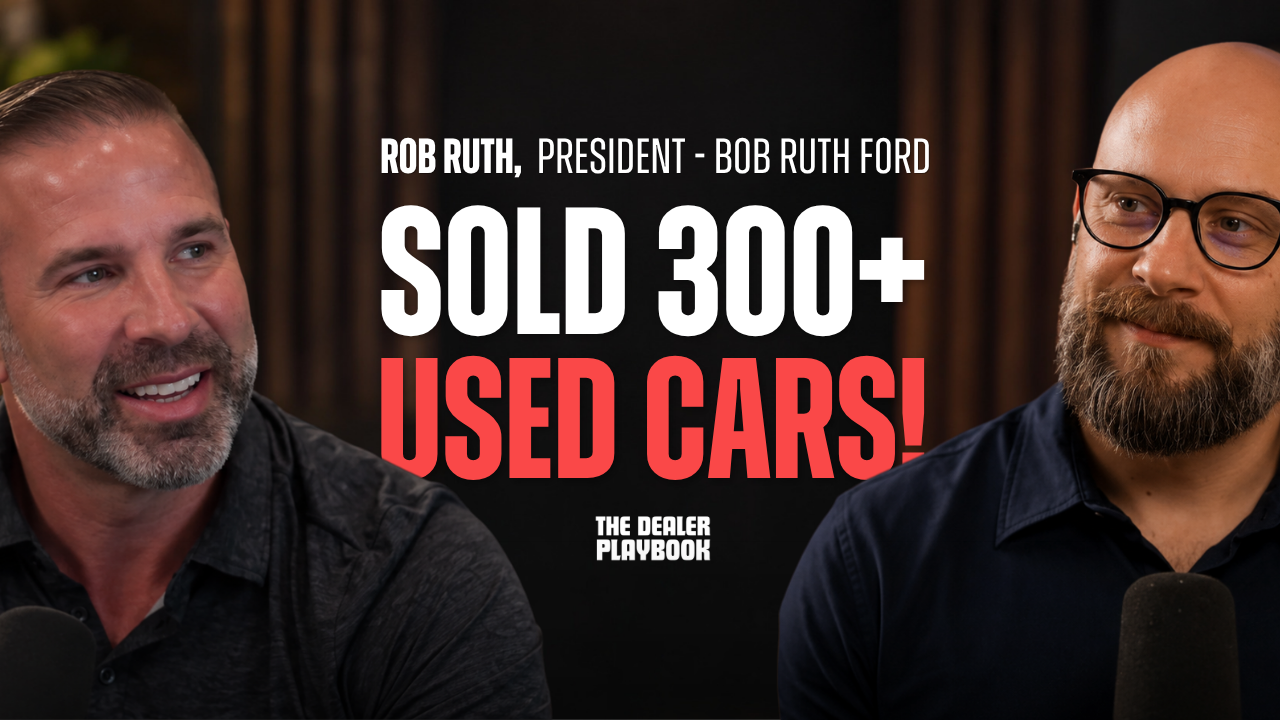
How do you sell 300+ used cars a month in a town of 2,900 people, and buy 240 vehicles off the street without relying on auctions?
In this episode, Rob Ruth the President / Owner of Bob Ruth Ford, Dillsburg PA breaks down the real playbook behind scaling a pre-owned-first dealership inside a franchise system, and why a startup mindset, disciplined acquisition, and a culture built on partnership can outperform “bigger market” excuses.
Rob shares exactly how they pivoted during COVID when inventory vanished, how they built a team-based buying machine (starting with Facebook Marketplace outreach), and why used cars drive the whole store: service, parts, profitability, and growth.
What you’ll learn:
Why used cars are the real growth lever (40M used vs ~16M new) and how to differentiate
The acquisition-first framework: buying center, street buys, and scaling a sourcing team
How to sell 8 used for every 1 new while keeping the OEM satisfied
What’s working now: $25K-and-under sweet spot, pricing discipline, and recon strategy
Leadership and culture: treating employees like partners, creating career paths, and recruiting in a small market
The recession-proof logic of building a pre-owned engine when markets shift
If you’re a dealer, operator, or leader who feels boxed in by OEM pressure, market size, or “the way it’s always been done,” this episode will challenge you to rethink what’s possible and remind you why you got into this business in the first place.
Timestamps
00:00 Introduction to the Used Car Mindset
00:36 The Story Behind Bob Ruth Ford
01:02 Key Elements of a Successful Pre-Owned Operation
01:13 Flex Dealer and the Dealer Playbook
02:35 Rob Ruth's Journey and Mindset
03:46 Challenges and Strategies in the Used Car Market
06:05 The Startup Mentality in a Family Business
15:20 Acquisition and Inventory Management
26:20 Community Impact and Leadership
33:29 Conclusion and How to Connect
Episode Brought To You By FlexDealer
Need Better Quality Leads? FLX helps car dealers generate better quality leads through localized organic search and highly-targeted digital ads that convert. Not only that, they work tirelessly to ensure car dealers integrate marketing and operations for a robust and functional growth strategy.
Watch The Full Episode
Prefer to watch episodes? Be sure to subscribe to our YouTube Channel and turn on notifications to get full access to our content.
Episode Transcript
Open [00:00]
Michael Cirillo: The first thing I want to get into, that I think a lot of people are curious about, is: what does your mindset have to be to think used cars? It almost seems like you made the decision — no, we're going all in here. What led to that? How does that look in the day-to-day?
Rob Ruth: I think it's common sense, honestly. The used car market in the US is 40-plus million, and the new car market is 16 million.
Michael Cirillo: You're in a small suburb. Talk to me about positioning yourselves to do what you're doing, volume-wise, in a small market — without leaning on the excuses a lot of dealers use.
Rob Ruth: I think you're right, those are excuses, and for us that's part of our story. I think it's great that we operate the way we do — it tells the story. You don't have to have the Taj Mahal, and you don't have to be in a metro area. We sold 300-plus used cars last month in Dillsburg, PA, a town of 2,900 people. So you can do it if you believe you can, and you put the right processes and the right people together.
Michael Cirillo: Maybe people are catching on, Rob, and they're thinking, well, where do I even start? What are some key things you've learned need to be in place to run a successful pre-owned operation?
Rob Ruth: To me it's a simple game.
Sponsor Break [01:13]
Michael Cirillo: One of the things I enjoy most about producing The Dealer Playbook is hearing from you — the messages I get from people who are getting so much value out of the podcast and applying it to their day-to-day workflows, finding a thriving career right here in the retail auto industry. It means the world to me.
One of the ways I make doing this possible is through my agency, FlexDealer. In the spirit of providing value, head over to flexdealer.com to show even further support for you, my beloved DPB gang. Right now, if you go to my website, you can get a full, free PDF of my #1 best-selling book, Don't Wait, Dominate. A lot of the topics in that book are even more relevant today than ever, with AI becoming more popular and people wondering, "What can I do next? How can I have a competitive advantage?" That's all covered in the book, and I'd love to offer you a free copy at flexdealer.com. It would mean the world to me, because that's how we continue to produce this show for you.
Introduction [02:35]
Michael Cirillo: We're going to get into all of it — the mindset, the operational shifts, everything. Rob, thanks so much for joining me on The Dealer Playbook.
Rob Ruth: Thanks for having me, Michael. Appreciate it.
Michael Cirillo: I want to get into all of it, because I've heard you talk about this on other interviews and in articles. The first thing I want to ask is: what does your mindset have to be to think used cars, when so many people go into franchises with all the impositions from the OEM saying "you have to sell this many new vehicles, you have to do all these things"? It almost seems like you made the decision — no, we're going all in here. What led to that, and how does it look in the day-to-day?
Challenges and Strategies in the Used Car Market [03:37]
Rob Ruth: I think it's common sense, honestly. The used car market in the US is 40-plus million, and the new car market is 16 million. We're one brand of that 16 million — say it's a 10% market share, that's 1.6 million versus 40 million. And we're competing on the same product with so many other dealerships in that same market.
For us, used cars were where we could differentiate ourselves. We have more control as an operator — we can be an entrepreneur and do things the way we want to. And obviously, used car profitability runs through the whole company: the more used cars you sell, the more cars you service, the more parts you sell. It didn't take me long to figure out we had to keep ramping up our used car department. And honestly, it's fun — I like these cars, and I don't like being told what to do.
Michael Cirillo: I was going to ask about that. How do you navigate the franchise, new-car implications of running a Ford store?
Rob Ruth: I don't want to say we don't sell new cars, because we actually do really well with new cars in our market — we outsell our market every year. But it's just so small. If we wanted to stay small, we'd just be a new car dealer. We wanted to grow, and used cars was the way to do it.
Michael Cirillo: There are some environmental factors here that I think a lot of people use as an excuse. I've heard you talk about how your building isn't one of these new, modern signature Ford stores with the coffee shop built in — you're in a small suburb. Talk to me about positioning yourselves to do the volume you're doing, in a small market, without those excuses.
Rob Ruth: I think you're right, those are excuses, and for us that's part of our story. We're a 43-year-old company, but we act like a startup.
The Startup Mentality in a Family Business [06:07]
Rob Ruth: My father and I were partners for 17 years. He passed away, unfortunately, almost eight years ago, and I bought the company from my family. So we're technically a startup. After he passed, there was about a two-year transition, and that was tough. Right after we finally got through the purchase, COVID happened and we got shut down.
I'd have loved to say, "Let's go build the Taj Mahal," but we just haven't been in that position — we're getting there, but at that point I didn't have the capital to do it. So I think it's great that we operate the way we do. It tells a story: you don't have to have the Taj Mahal, and you don't have to be in a metro area. We sold 300-plus used cars last month in Dillsburg, PA, with 2,900 people. You can do it if you believe you can, and you put the right processes and the right people together.
Michael Cirillo: I love what you're saying about the startup mindset, because it's a different way of thinking than what people expect from a franchise store. So many people hide behind "I'm a franchise store, so that means big corporate this and that." But there's something very real that happens with a startup mindset. Talk to me about that mindset shift, and its implications on your operation.
Rob Ruth: I was a general manager for 15 years, and a minority partner — I had stock in the company. But once it came time to buy the company, I had to go all in and put everything on the line. It's a completely different mindset. I didn't really know what fear of failure was until that point, and I have so much more respect for business owners who go through this. Even for my father — we were great partners, but I have so much more respect for him now than I did then.
Michael Cirillo: What are some lessons you learned from your dad that you carry into the way you lead today?
Rob Ruth: He was always great with people. He loved his customers, he loved his employees, he was a hard-working guy. My parents split up when I was very young, and I lived with my father — he bought the store in 1983, and he and I lived at the dealership for six years. I grew up there. We painted, we cleaned — I've had a job there since I was very young.
One thing he made me appreciate: there were never any handouts. I was never given a position because of who I was. It was, "You're going to earn it, you're going to learn this, and you'll keep moving forward if you do the work."
Michael Cirillo: That resonates with me. It's a car business thing, but it's also a life thing — that's what The Dealer Playbook is all about, creating a thriving life while working in the car business. Your dad making you work for things deepens your appreciation. I think about my own dad the same way. Not long ago I was on a plane, and I opened the notes app on my phone — I have a running document of things my dad taught me, just bullet points. I felt so deeply grateful to my parents for the sacrifices they made and the lessons they taught, to set me and my siblings up for a better life. But there was struggle, too — we saw them struggle and thrive, saw the seasons, and they weren't shy about it. I know what it's like to eat rehydrated camping food because we were digging into food storage. I think that built a level of grit in me that wasn't handed to me — I worked for it. And then I look at my own kids, and I almost feel like I have to fabricate hardship for them, which feels inauthentic in one way, and also like I want to push them harder, because they're not getting the same tests I got.
Rob Ruth: Your parents had it worse than we did, and just like you, I saw my father struggle. He was uneducated — he started in the car business, worked his way up, found an opportunity, and made it. I felt like there was a great opportunity in front of me, and I never wanted to feel like I took the easy road. My job was to take it to the next level. He laid the foundation, and by the time I came in full-time, in 2000, he was tired — it had been hard work to get where he got.
At that time, the internet was coming, and dealers thought it was going to wipe out their franchises. I saw it as an opportunity to grow with it, and the timing was perfect. My dad never even had an email address — I don't think he ever opened a computer. That wasn't his thing; he was a people person, a hard worker, but technology wasn't for him. So for the next generation, it's our job not to just keep things the way they are — to take them to another level.
Sponsor Break [13:13]
Michael Cirillo: Hey, does your marketing agency suck? Before we hop back into this episode — I know you know me as the host of The Dealer Playbook, but did you know I'm also the CEO of FlexDealer, an agency helping dealers capture better-quality leads through local SEO and hyper-targeted ads that convert? If you want to sell more cars and finally have a partner who's actually in it with you, visit flexdealer.com. Let's hop back into the episode.
Michael Cirillo: That's so good. There's the challenge of building it and laying the foundation, and then there's a whole new challenge with the pressure of not screwing up the foundation, alongside the pressure of forward growth and movement.
Rob Ruth: Second-generation — the statistics aren't good for second-generation business owners, and I always used that as a driving force not to become a statistic.
Michael Cirillo: There's always that negative connotation — we joke about "PhD," Papa had a dealership. But that's not mutually exclusive. Maybe Papa did have a dealership, but you also earned your own PhD.
I want to talk about the used car operation. You said earlier it's fun, but it's also a different discipline — it's not baseball anymore. When you decided to grow this thing, where do you start? A lot of dealers are so focused on new that they don't realize they should have become a pre-owned dealership a long time ago. Maybe they're catching on, Rob, and thinking, "Where do I even start?" What are some key things you've learned need to be in place for a successful pre-owned operation?
Acquisition and Inventory Management [15:20]
Rob Ruth: It starts with acquisition. You have to have the right inventory — you have to know your market, know what sells in your market. And that's changed so much. It used to be easy: we'd go to the auction, pick up 20 or 30 cars at a clip, bring them back, service them, and sell them. But that game has changed — the auction is so competitive now, you're not competing locally anymore, you're competing globally. So that's not really the way to go anymore.
Now we've created a buying center, and we buy cars from the public. I like to say it's a service we provide to people selling their car — we make it simple for them, and that's been a huge part of what we do. Once you acquire the vehicles, you have to merchandise your inventory, recondition it, and stay on top of pricing. There's a lot of discipline involved in being good at the used car business.
If all you're doing is going back to the auction, you're paying full price against everybody else, plus high auction fees and transportation fees. By the time you get the car to the store, there's no margin — you're just hoping for a trade-in or finance income. That only works for so long. You have to be creative and find other ways to get more inventory.
Michael Cirillo: Can you bring me inside your acquisition process a little further? I'm thinking there are probably some tools you need, people who know cars inside and out, maybe some consulting from technicians. What does that look like for you, to mitigate the risk of buying a bad car?
Rob Ruth: It started as, "Go to the auction, buy a lot of cars, bring them back, merchandise them, sell them." Then COVID happened, and all of a sudden we had no new car inventory, and used cars were going up in value wholesale faster than retail. We'd just gotten through COVID, where we had to lay off half our staff. We brought people back, and then suddenly we had no inventory, and we were built on volume. So it was: figure this out now, or go through the same pain you never wanted to go through again.
Honestly, it started with me in desperate mode. I went on Marketplace, found people selling their cars, reached out, and started making offers sight unseen. The first day I bought five or six cars. The second day, another five or six. Then it didn't take long to realize I wasn't going to be able to do this forever — I needed to scale it. Now we have a team of five or six people whose only job, every day, is looking for inventory, people who want to sell. We bought 240 cars off the street last month, as a franchise dealer in Dillsburg, PA.
Michael Cirillo: Holy cow.
Rob Ruth: We want to scale that further — that's where it starts, and where we have to keep growing to sell more.
Michael Cirillo: What kind of training, and what are you looking for in the people who are out searching the market and making those offers?
Rob Ruth: Service-minded, customer-focused people. We're providing a service, taking the pain of selling a car away from people. Would you rather sell to us, with 40-plus years of experience and money that's good, or take your chances with someone you found online, not knowing their finances, and having to deal with the DMV yourself? We take care of all of that, seamlessly, every day.
Michael Cirillo: What's the reaction been like from your market, given you're in a small, outlying suburb?
Rob Ruth: People love it. We're providing a great service, and the feedback is fantastic. About 75% of the time, we actually go to them — we do the deal in their driveway with a check. We do a quick inspection, and we just try to make it easy and take the friction away, whether we're buying from you or you're buying from us. Everything else in people's lives is pretty simple, and then they get to the car business and think, "God, I don't want to deal with a car dealer." That's the perception we're trying to change.
Michael Cirillo: Are you rolling in with something like an OBD reader, a quick diagnostic check in the driveway?
Rob Ruth: It depends on the car — the older it is, or the higher the mileage, the deeper the inspection we do. But you'd be surprised: 90 to 95% of the time, we're getting accurate descriptions from people.
Michael Cirillo: Because at the end of the day, they don't want an issue either — they don't want you coming back, now that you know where they live.
Rob Ruth: Right, there's really no going back once the deal is done. But there's no warranty when you buy from the public, either.
Michael Cirillo: What's the ratio you mentioned — used to new?
Rob Ruth: Eight used to one new.
Michael Cirillo: That volume must be building a reputation of its own — traveling by word of mouth. People probably don't even bother with Facebook Marketplace anymore; they just think of you first.
Rob Ruth: We do get a lot of repeat business, and there's still opportunity for us — we don't even really market for it at this point, it's mostly an outbound approach. But word does get out, and we're going to keep growing that.
Michael Cirillo: How do you satisfy the OEM when they start breathing down your neck?
Rob Ruth: To me, it's a simple game. They look at your sales expectancy for your market — how many of your brand were sold in that market versus how many you sold. If we outsell our market, they're pretty happy. If your customer satisfaction numbers are good, which ours are, they're pretty happy. There's a game to play to keep them off your back, and we've gotten pretty good at it.
Michael Cirillo: You mentioned there's a real mix of things that need to be right on used vehicles, and a lot of dealers thinking about being more intentional with their pre-owned operation are worried about the risk — especially coming out of the pandemic, when used cars were sometimes even more expensive than new. What are you seeing in the market now, and are there any pivots you're considering over the next six months?
Rob Ruth: It was crazy — the first time in history that vehicle values went up so fast during the pandemic, and then came down just as fast on the back side. You had to play a different game for each scenario. I think it's stabilized more now, and with interest rates coming down, I'm hoping to see a bit more demand over the next six months. I'm optimistic about the market going forward. There's always risk, but if you know your market — right now there's a sweet spot in used cars in the $25,000-and-under range. We're not trying to sell new cars, we're trying to sell used cars, and price is very relevant. You need inventory in the right price ranges to satisfy that market.
Michael Cirillo: Are there vehicles you just won't touch?
Rob Ruth: Not necessarily — we buy almost anything, and we may end up wholesaling some of it, but we're trying to brand ourselves as, "We'll buy any car." We don't do as well with foreign or premium inventory. We're serving everyday people, not the high end — that's our market.
Michael Cirillo: There's something genius here that I'm working through. It's November 4th, 2025, and there's a lot of talk in the news from pundits and economists about a possible recession, with all these headwinds. What I'm seeing is that you're so well positioned for that — if there's a recession and people still need to buy cars, their minds are going to go straight back to pre-owned.
Given that, is $25,000 still the ceiling, or does it go down to $18,000?
Rob Ruth: We try to keep some of that cheaper inventory, but I think the majority of people still need good, reliable transportation, and I don't see cars falling much further in value than they already have.
Community Impact and Leadership [26:24]
Michael Cirillo: What kind of conversations do you have from a leadership perspective, setting the tone for your team? You have a well-equipped management team — some coming from within the industry, some from outside, some who've been with you a while. Is there a mindset shift required for people to wrap their heads around, "We're a used car operation with a Ford logo on the building"? And if so, how do you help them see the vision?
Rob Ruth: It's tough for people coming from outside the car business. It's usually a good 90 days before they understand how it all works. They hear about us, get intrigued, want to come work for us — and then they get here and think, "Wow, what's happening?" We're different, but it's not a bad different, it's just different, and I think that's a good thing.
I think dealers need to change. I want to be aligned with my people, and I'm transparent with our team about just about everything. When the company wins, I want our people to win — I look at our team as partners, not employees. That hasn't always been the case in the car business — you've got a head-honcho GM or dealer calling all the shots. I've tried operating that way, and it'll wear you out; it doesn't last. So we're big on teamwork, developing people, and showing them career paths within the organization. As we grow, there will be more opportunities for everybody, and that creates the culture.
Michael Cirillo: I wish culture were a more prevalent conversation, because when I get to sit with leaders like you who talk about the real implications of culture, it's a growing group, but there's still resistance — it can sound too "kumbaya." Talk to me about ways you're seeing culture turn into a real, tangible driver of the business.
Rob Ruth: We have a lot of young people, which is good for the future, though it's sometimes difficult developing people who don't yet have the experience. But as we're growing, and things are happening that we said would happen, and they've been part of it, I think that's what people are really looking for these days — they want to be part of something, not just go get a job. Especially younger people — they want more mentoring, they want career paths. For us, it used to be sink or swim: if you made it, you made it, and if you didn't, sorry about your luck. Having a younger group that we're training and developing all the time, and working them toward the next level, helps our culture significantly.
Michael Cirillo: This resonates for me too, especially factoring in a population of 2,900. I hear the excuse a lot: "The gene pool here is thin, people don't want to live or work here." But here you are saying no — this is a place people want to work, where they're part of something, where even in a town of 2,900 there's a real opportunity to feel connected at a deeper level.
Rob Ruth: And to be successful at the same time — there are great opportunities in the car business if you stick with it and gain experience. People who maybe didn't have the education or opportunities others had can start in the car business, whether as a technician — technicians are in high demand and low supply, and ours absolutely kill it — or in sales, where the same opportunities exist.
Michael Cirillo: I'm hyper-focused on this. Recently I was in Kazakhstan doing some consulting and training for their auto industry association — their version of NADA, only two or three years old. We met one of the dealer group owners, thirty-plus dealerships, and they're now assembling vehicles in Kazakhstan. What inspired me there resembles what I'm feeling inspired by right now: he doesn't look at the car business only through the lens of sales and profit. To him, success is the real idea that in a young country like Kazakhstan, the auto industry provides great-paying jobs and opportunities for growth he hasn't seen in any other industry — a chance for anybody, from any walk of life, to build something. And there's this ripple effect: cars need steel production, infrastructure needs steel and manufacturing, and on and on. You're building a nation.
I think about your community the same way — we always say dealers are the backbone, but really, Bob Ruth Ford is building this region. How many people are on your team now?
Rob Ruth: One-seventy.
Michael Cirillo: One hundred seventy people who go home to their families, seeing growth and opportunity, feeling the culture. Say the average family is three or four people — that's 170 times three or four people hearing positive things about Bob Ruth, who then become advocates. It's a pedigree of influence that builds and shapes a community and people's lifestyles. I'm genuinely inspired by it. I look at the 30 people on my own team and feel that way — I can't imagine how you must feel with 170.
Rob Ruth: Thank you.
Conclusion and How to Connect [33:27]
Michael Cirillo: As we wind down, we've covered a lot of ground — the pre-owned operation, how you play the game with the OEM, culture, acquisition. How can everyone listening and watching connect with you?
Rob Ruth: I'm on LinkedIn, Facebook, and Instagram — those are the big three for me.
Michael Cirillo: I love it. I'm so glad we could connect. Thank you so much for joining me on The Dealer Playbook.
Rob Ruth: Appreciate it.
Michael Cirillo: Thanks for listening to The Dealer Playbook podcast. If you enjoyed tuning in, please subscribe, share, and hit that like button. You can also join us in the DPB community on social media. Check back next week for a new episode of The Dealer Playbook. Thanks so much for joining.