"1.8% Of Clicks Are Paid" - The Traffic Every Dealer Is Leaving On The Table | Matt Copley, Co-Founder & CRO of Hrizn
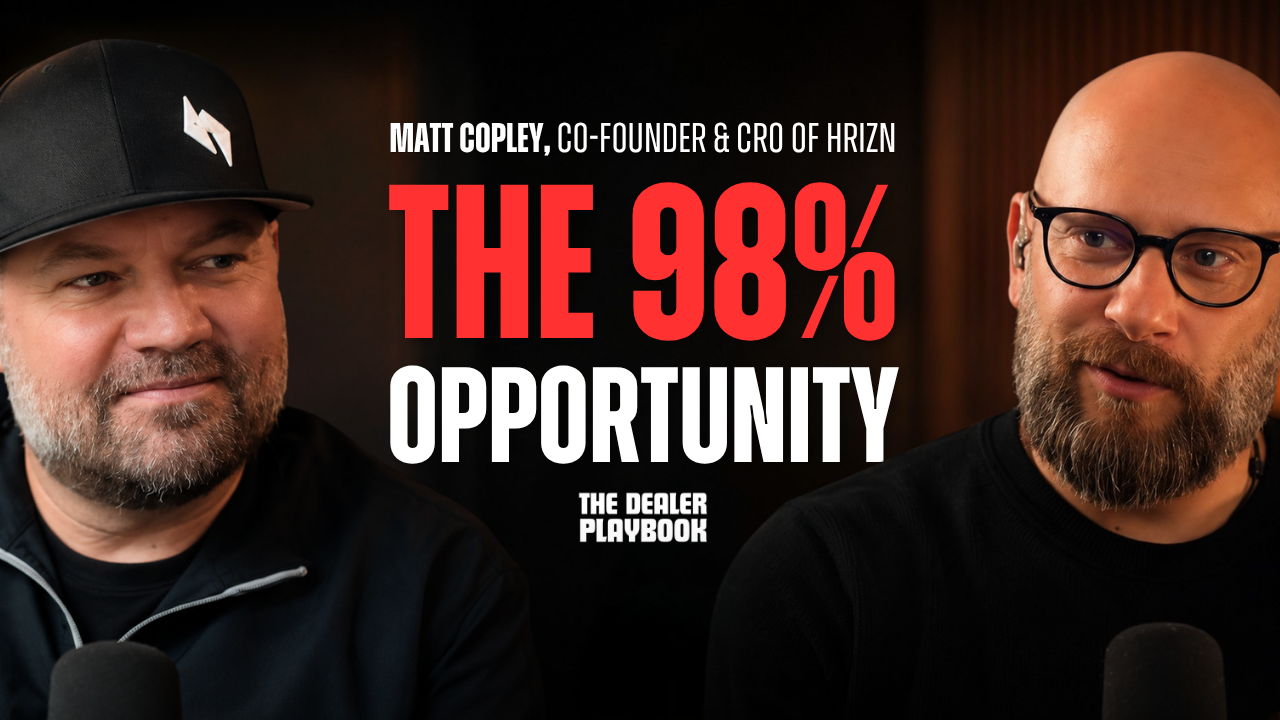
Most dealers are fighting over a sliver of traffic while the majority goes unclaimed. Matt Copley, Co-Founder, Chairman, and Chief Revenue Officer of Hrizn, joins Michael to unpack it. With over 25 years across media, adtech, and martech, including a decade working inside retail automotive itself, Matt's built a career watching how dealers show up online, and now builds the platform to fix it.
They dig into a number pulled from SparkToro, Datos, and Semrush: paid clicks only account for 1.8 to 4.9% of all clicks after a search. The rest is organic, and it's where the real opportunity sits. They get into why chasing hundreds of keywords through an outside SEO vendor is a losing fight, how a simple wearable AI note taker can capture a service writer's or product specialist's knowledge with zero extra work, and a mistake already live on plenty of dealer sites right now: unchecked AI-generated vehicle descriptions.
Connect with Matt Copley on LinkedIn, or head to Hrizn.io for their resource library on content and search, open to anyone whether they're a customer or not.
Michael's takeaway: stop fighting for the 2%. The 98% is already there, and it's free.
Timestamps
(00:00) Stop Chasing Keywords
(01:13) Sponsor Message FlexDealer
(02:38) Content Lives In Store
(03:30) Outsourced Content Problem
(07:12) Capture Expertise With AI
(09:10) Search Everywhere Strategy
(14:48) Paid Vs Organic Flip
(20:08) Social As Infrastructure
(23:09) People Over Brands
(28:54) Fight AI Content Slop
(35:38) Podcast Outro
Episode Brought To You By FlexDealer
Need Better Quality Leads? FLX helps car dealers generate better quality leads through localized organic search and highly-targeted digital ads that convert. Not only that, they work tirelessly to ensure car dealers integrate marketing and operations for a robust and functional growth strategy.
Watch The Full Episode
Prefer to watch episodes? Be sure to subscribe to our YouTube Channel and turn on notifications to get full access to our content.
Episode Transcript
0:00 | Intro Hook (What’s Coming)
Matt Copley:
We used to tell dealers, “Your SEO company says they are optimizing your website for 400, 500, or even 1,000 keywords. They are fighting a losing battle.”
They were never going to optimize effectively for all those terms. We recommended focusing on the top 20 to 50 keywords and allowing paid media to handle the other ways people search.
Today, I eat those words every single day.
Michael Cirillo:
What you are saying makes me think about quality, especially in an AI environment where we can generate an infinite amount of content that is simply good enough.
When good enough becomes unlimited, what actually becomes valuable?
Matt Copley:
When you build this content infrastructure, you create fertile ground for your paid advertising to deliver better experiences.
You can also earn significantly more organic traffic, reach people at the right point in their journey, establish trust, and guide them toward the next logical action.
Michael Cirillo:
In that vein, when content becomes infrastructure rather than a temporary campaign, what did you get wrong earlier in your career that you now understand differently?
Matt Copley:
I think….
1:13 | A Message From FlexDealer
Michael Cirillo:
One of the things I enjoy most about producing The Dealer Playbook is hearing from you.
I receive messages from people who are finding value in the podcast, applying these ideas to their daily work, and building thriving careers in retail automotive. That means the world to me.
One of the ways we make this show possible is through my agency, FlexDealer.
In the spirit of continuing to provide value, head over to [www.flexdealer.com](http://www.flexdealer.com). You can download a free PDF copy of my number-one bestselling book, Don’t Wait, Dominate.
Many of the principles discussed in the book are even more relevant now, particularly with the rapid rise of AI and people asking, “What can I do next? How can I maintain a competitive advantage?”
You will find those answers inside the book.
I would love to provide you with a free copy. Your support helps us continue producing The Dealer Playbook for you.
2:38 | The Best Content Already Lives Inside the Dealership
Michael Cirillo:
You are doing something highly innovative in a space that has needed innovation for a long time.
You have said that the best content for a dealership already exists inside the dealership.
If that is true, what is preventing dealers from using it?
Are dealers failing to recognize and capture that knowledge? Is it a technology problem, a human problem, or something else?
How do we recognize that the best content already exists inside the dealership and begin using it?
Matt Copley:
It is a great question, and some historical context helps.
I have been in the automotive industry for roughly 26 years. I was managing dealership websites in the early 2000s, so this is not a new problem.
Historically, most dealers outsourced their content, their public-facing expertise, or some version of it to third-party agencies.
There would be a monthly meeting where the agency asked the dealer what they wanted to write about. The agency would then disappear for two or three weeks and produce a couple of pieces of content.
As SEO evolved and automotive agencies became increasingly commoditized, content production often became a puppy-mill environment.
Agencies created templated content and applied it across hundreds of dealerships.
Through that process, the content became diluted, thin, and watered down. It stopped reflecting the dealership, its expertise, its people, and the environment it had built inside the store.
But dealers can see genuine expertise happening inside their stores every day.
A service advisor may explain preventative maintenance in a way that helps a customer understand its importance and make a decision based on trust rather than pressure.
A product specialist may explain the updated features on a new model to someone who has owned their current vehicle for two years. That specialist helps the customer understand the practical value of upgrading.
If operators pause and watch their best people working throughout the day, they will find an extraordinary amount of expertise inside the dealership.
Those moments are simply locked inside the store’s walls.
Strong operators already use the knowledge of their best people to improve the rest of the team.
But when a customer visits the dealership’s website, they often find a digital brochure that looks almost identical to the websites of 350 other same-brand stores.
None of the dealership’s expertise, local knowledge, community connection, or depth of experience reaches the customer.
The website fails to communicate why someone should do business with that particular store.
It does not show the value of its people, its relationship with the community, its understanding of the local market, or its knowledge of local driving conditions.
Those are the things that can make one dealership stand out.
---
## 7:01 | Capturing Store Expertise With AI
Michael Cirillo:
This is blowing my mind.
I am wearing a device from a company called Plaud. It is a note-taking device that hangs around my neck and creates AI summaries of meetings and real-world conversations.
It has even helped me in my marriage because it reminds me about conversations my wife and I have had.
As you were speaking, I started thinking about the opportunity for a salesperson or general manager.
The device costs approximately $150. If I am a dealership professional asking, “How do I extract all this information easily?” this may be a worthwhile investment.
When you are in the zone and sharing knowledge naturally, it can be difficult to recreate the same energy afterward.
A person could activate the device while explaining something, record the conversation without disclosing customer information, and then send the summary to the dealership’s marketing team.
A platform such as Hrizn could then add that information to the dealership’s context graph and develop an entire tree of relevant content topics for the website.
We have finally reached a point where “I do not know how to capture my knowledge” or “I do not have time” is becoming a weaker excuse.
There are countless note-taking tools available. It does not have to be this particular one.
You press a button and begin capturing the expertise.
If we cannot push a button, we may be in trouble.
Matt Copley:
Amen.
---
## 9:10 | Search Everywhere Optimization
Matt Copley:
We are introducing transformational functionality around that exact opportunity.
We want to enable experts inside the dealership to carry what they know into rich, authoritative, and helpful content experiences across the dealer’s digital properties.
I say digital properties because every dealer needs to understand how customer behavior has changed.
Five years ago, a dealership website was often a destination. It was where people went to find contact information, pricing, inventory, and other details.
That is no longer the case.
Human behavior has fragmented across countless surfaces. People decide where and how they want to consume information and navigate their customer journey.
Every dealership now has a responsibility to make its website worth visiting.
A dealership website needs to provide something unique, useful, and valuable.
And I am speaking more broadly than generating leads from low-funnel shoppers.
How do we create a resource-rich environment for every part of the customer journey?
That includes pre-purchase and post-purchase questions, vehicle ownership, maintenance, collision repair, finance and insurance, trade evaluations, and selling a vehicle.
The dealership’s expertise should also exist across every other surface where the customer may consume information or make decisions.
Social platforms are extremely important. Rich content and meaningful customer experiences need to be distributed across all these surfaces.
This is where the shift is happening.
Everyone has heard the acronym soup appearing on LinkedIn. People say SEO is dead, SaaS is dead, and then introduce AEO, GEO, and countless other terms.
Fundamentally, dealers need to carry their expertise into a search-everywhere environment.
When my teenager becomes interested in something, his first search often happens on TikTok or YouTube Shorts.
His second step, when he wants more detail or documentation, may happen on Google.
Generative search and short-form social feeds are retraining how all of us learn and explore ideas.
We increasingly want to see something, hear it, and have it explained before diving deeper into our own research.
Our job is to empower dealers without requiring them to understand every technical detail of SEO and content distribution.
How do we give the dealer a simple place to operate, capture the expertise, and distribute it across all the surfaces where it needs to live?
---
## 13:41 | Content Is Infrastructure
Michael Cirillo:
What I am hearing is that everything is content.
Slack messages, text messages, TikTok videos, social posts, videos, and FaceTime conversations are all forms of content.
When you recognize that, content becomes infrastructure. It becomes a knowledge graph.
That is very different from the way many people have historically viewed content as a temporary marketing initiative.
They say, “We are going to run a content campaign.”
But if content is infrastructure rather than a campaign, what have you learned throughout your career that changed how you approach it?
---
## 14:48 | Reversing the Paid and Organic Model
Matt Copley:
How much time do we have?
The most practical example for dealers comes from my former role at one of the top three highest-volume, technology-enabled digital advertising agencies.
If we go back to a period when everyone at NADA was talking about AI, most of what they were describing was conditional logic or Markov chain modelling.
Dynamic advertising was a major topic.
We would demonstrate how a customer could search for something and the advertisement would automatically change to match the query.
It appeared to deliver an extremely relevant experience.
At the time, we told dealers, “Your SEO provider says it is optimizing your website for 400, 500, or 1,000 keywords. That is a losing battle.”
We recommended focusing organic efforts on the top 20 to 50 terms and allowing paid media to handle all the other search variations.
Today, I eat those words every day.
With the technology now available, dealers can perform the opposite exercise.
They can focus paid search on highly competitive keywords with the strongest conversion rates. They can eliminate waste and use a disciplined, prescriptive content approach to answer the many other ways customers search.
That creates more relevant and helpful customer experiences.
Google has also released AI Max.
AI Max is effectively saying, “We will take a relevant advertisement and match it with the most relevant content on your website.”
But what does Google have to work with if your website contains only an About Us page, a few finance pages, a few service pages, inventory, offers, specials, and coupons?
There is very little content available to help Google deliver an intuitive and immersive experience to shoppers at different stages of the journey.
Customers have different motivations, demographics, psychographics, and reasons for purchasing a vehicle.
When we treat content as infrastructure, we begin building a rich knowledge graph across the dealership’s digital properties.
Google is also indexing content from platforms such as Instagram and Facebook.
When you build this content infrastructure, you create fertile ground for paid advertising to deliver better experiences.
You can also earn substantially more organic traffic by providing the right information to the right person at the right time.
That allows the dealership to establish trust and guide the customer toward the next logical step.
This shift is transformational, and dealers need to understand its significance.
At the Tier 3 level, the automotive industry spends approximately $5 billion annually competing against local, in-market competitors for paid clicks.
According to SparkToro, Datos, and Semrush, paid clicks represent approximately 1.8% to 4.9% of the total clicks that occur after a search.
When you build strong content infrastructure, you open the dealership to the remaining blue-ocean opportunity.
That opportunity has often been overlooked during the past 20 years of intense focus on programmatic advertising.
---
## 20:06 | Social Media as Infrastructure
Michael Cirillo:
That makes me think about the way many dealerships approach social media.
A dealer may say, “I am going to invest all this effort into posting, but I am not receiving many views.”
Pause for a moment.
If you evaluate social media entirely through the lens of going viral, you will become discouraged.
But if you view it as infrastructure that supports the entire dealership, sends stronger signals, and creates visibility among people engaged in shopping activity, the picture changes.
We still discuss social media primarily as a way to build a personal brand.
That is a valuable practice, but many people become inconsistent because they think, “I will never become Russ Flips Whips.”
There will only be one Russ Flips Whips. The chances of capturing that same lightning in a bottle are slim.
But dealerships should not tie financial growth directly to becoming a nationally recognized creator.
A dealership can still grow financially by using Instagram, TikTok, YouTube Shorts, and other platforms to provide relevant information to its local market.
I do not necessarily care about going viral.
I care about generating business.
Matt Copley:
It is about being present at the right moment for the right person at the right stage of discovery.
If only five people engage with a piece of content, but all five become lifetime customers, fantastic.
The content has done its job.
MrBeast once said that your first post will probably be bad and will not perform. The next hundred may not perform either.
Building this capability requires discipline. It is an operating discipline.
We are not saying that everybody inside the dealership should become an influencer.
But every dealership has people with the expertise, personalities, and authoritative answers worth carrying into the market.
Those people can become visible representatives of the store and its brand.
---
## 23:09 | People Trust People
Matt Copley:
The future we used to discuss is already here.
People trust people more than they trust brands.
A significant differentiator is putting real people in front of the dealership’s brand.
That will continue to affect market share and competitive position.
It is also important to understand that each content asset is more than a temporary campaign expense.
It is an investment in compounding equity that can produce returns for years.
The content creates visibility for the dealership, supports institutional learning inside the store, and becomes a shareable resource for customers.
It can show customers that the dealership cares about more than completing the next transaction.
Michael Cirillo:
Even if someone is not an influencer according to the social-media definition, they can still be a person of influence.
They can influence customer behaviour and shopping decisions.
This may sound strange, and somebody will probably disagree with me, but a portion of the market would prefer that you are not a traditional influencer.
When customers discover your video, you may feel more approachable because you appear like a real person from their community.
Years ago, people would ask me, “How did you get Grant Cardone, Gary Vaynerchuk, John Lee Dumas, or Guy Kawasaki on your show?”
My answer was simple: I asked.
But as some people become increasingly famous, they may feel less accessible.
The same principle applies to a local business.
Going viral in a local market might mean consistently receiving 50 or 100 relevant views.
Matt Copley:
Regardless of our perception, every person has a circle of influence.
Hopefully, dealerships have hired people for the right reasons and feel confident about how those employees represent the store.
If they do not, those people probably should not be there.
Every employee has friends, family members, contacts, and community connections.
When employees can articulate their knowledge clearly, they become the right messenger for a particular segment of the local community.
That opportunity is significant.
It also matters within the changing compliance environment.
Every dealer has influencers inside the store, whether the dealer recognizes them or not.
Many employees are already posting on social media, personally or professionally. Every dealership probably has several people creating TikToks or posting on another platform.
With recent FTC developments, dealerships may be responsible for what employees say online.
We have looked at that challenge and asked how we can give dealership teams the freedom to create in their preferred way while providing the compliance infrastructure needed to reduce risk.
The goal is to help employees create content without putting the dealership in trouble with the FTC, state attorneys general, or other regulators.
---
28:53 | Fighting AI Content Slop
Michael Cirillo:
That leads into my final question.
What I am hearing is an emphasis on quality.
We do not want content slop.
You have been outspoken about this, particularly in an AI environment where anybody can ask a tool to write a 1,500-word article and receive something immediately.
When we can generate an infinite amount of acceptable content, what becomes genuinely valuable?
Matt Copley:
The standard is already much higher.
We encounter this issue almost every day, and dealer principals may not realize it is happening.
A used-car manager may begin using Gemini to write vehicle descriptions.
Then somebody opens the vehicle detail pages and discovers that no one reviewed the output.
The description may still say, “Insert one of these four transmissions here,” or list three possible engine sizes.
That is mindless copying and pasting.
AI may produce more content, but it can also separate people from the thinking process that should accompany AI-assisted work.
More broadly, every dealership has significant data infrastructure that can inform much better content.
As a platform, we invest heavily in underlying data infrastructure for each dealer.
We incorporate build data, OEM data, package information, and vehicle configuration details.
That prevents content from using five-year-old specifications for a brand-new vehicle without anyone noticing.
Those details matter.
But the larger question is this: when everybody is sending default robotic content to customers, what will allow your dealership to stand on its own merits?
What will create a valuable market position and provide genuine help to the customer instead of becoming another piece of robotic slop?
We incorporate deep learning into every dealership instance so the store can carry its operating principles, community connection, people, background, history, and unique characteristics into its public content.
We then layer in enterprise-grade brand-voice management.
Dealers can develop voices that speak directly to deeply researched segments of their local communities, allowing the content to be properly informed.
We also provide connectors that help the dealership understand performance.
It is not enough to ask whether the content sounds good.
How is it performing?
What signals reveal gaps that competitors have not filled? What are customers searching for but failing to find in the market?
We take a research-first approach.
We begin by understanding customer behaviour and then create content that responds to that behaviour.
That is much more effective than playing pin the tail on the donkey every month and asking, “What should we write about?”
There are many additional layers.
We continue releasing one or two major product updates each month as we sharpen the platform.
With the launch of Hrizn 6, we will also release Hrizn Creator in the iOS App Store and Google Play Store.
It will be a frontline mobile application that brings dealership content creators directly into the content operating system.
It will support video distribution, content workflows, and other capabilities in a powerful way.
---
33:39 | How to Connect With Matt Copley
Michael Cirillo:
That seems like the perfect place to wrap up.
How can listeners and viewers connect with you, learn more, and follow what you are building at Hrizn?
Matt Copley:
We try to practise what we preach.
We do not do a tremendous amount of advertising. Instead, we consistently publish helpful content for our builder community.
People can connect with me personally on LinkedIn or subscribe to our weekly newsletter.
Hrizn.io is a resource-rich environment.
Whether a dealer works with us or not, we have built a significant resource library to democratize information about content marketing and challenge some of the misinformation circulating in the market.
We work hard to ensure every resource can help someone, whether that person uses our platform or not.
People can visit Hrizn.io or connect with me directly through LinkedIn.
I am grateful for every opportunity to speak with dealers and agencies.
We are a pure software platform.
We are not an SEO service, an SEO agency, or a traditional vendor.
Anybody can use the platform.
We earn the customer’s business each month through a straightforward software subscription. Customers can upgrade, downgrade, or cancel at any time.
So far, we have retained an incredible percentage of our subscribers.
Michael Cirillo:
We will include all those links in the show notes at [www.thedealerplaybook.com](http://www.thedealerplaybook.com).
You will also find a summary of everything we discussed.
Matt, thank you for joining me on The Dealer Playbook.
Matt Copley:
Michael, it is always a pleasure. Have a great one.
---
35:38 | Podcast Outro
Michael Cirillo:
Thanks for listening to The Dealer Playbook Podcast.
If you enjoyed the episode, please subscribe, share it, and hit the like button.
You can also connect with us and the DPB community on social media.
Check back next week for another episode of The Dealer Playbook.
Thank you for joining us.
Source transcript: