“Ten Cars Does Not Work” - The Habits Behind Higher Car Sales | Raul Tomsa, Client Advisor at Motor Werks
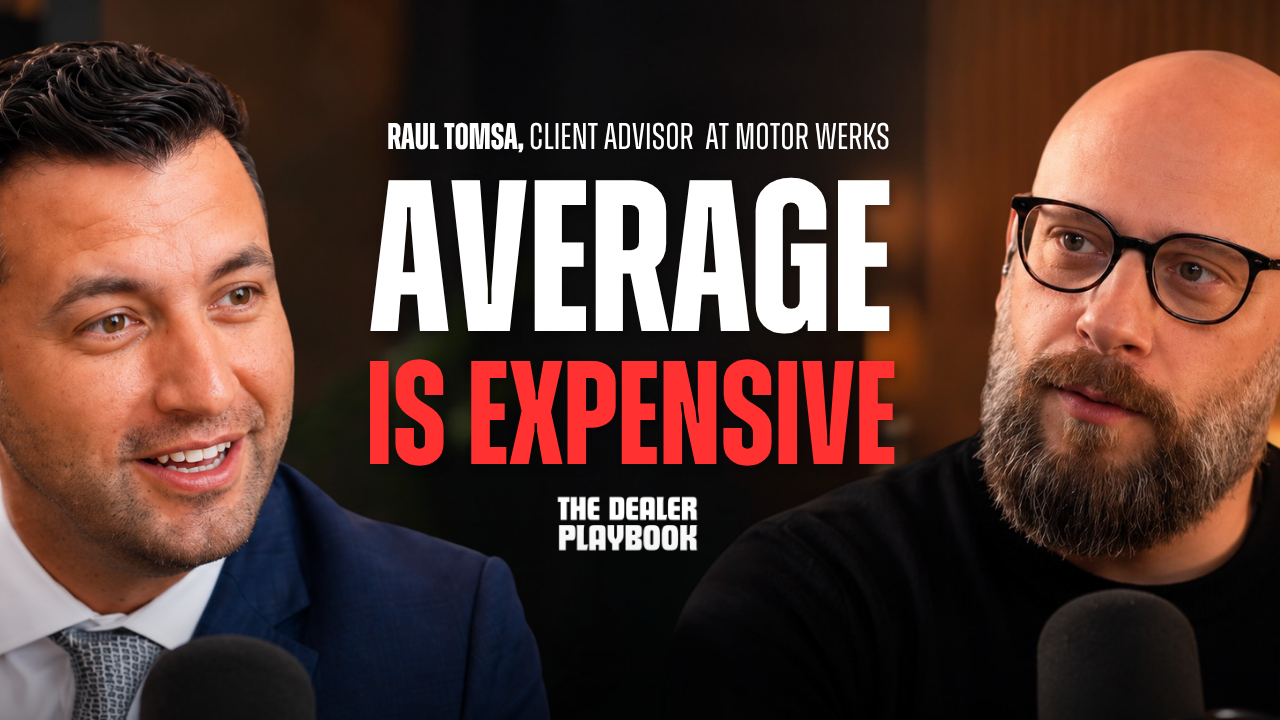
Average production has a cost, and it usually shows up long before someone notices it in their paycheck.
After 18 years in automotive retail, Raul stepped away from the general sales manager position and returned to the showroom floor as a client advisor. He wanted to reconnect with the customer experience and find out what separates someone selling ten cars a month from someone consistently producing 20 or more.
Raul explains why average producers often wait for perfect deals, avoid low-gross opportunities, and talk themselves out of transactions before the customer ever does. High performers keep stacking deals, serve every customer well, and understand that one additional sale can unlock thousands of dollars in volume bonuses.
He also shares why personal presentation matters, how helping coworkers strengthens the entire store, and why operating like an owner can make you more valuable regardless of your title.
The conversation moves into social media, where Raul breaks down how educational content creates real business. One video about the G-Wagon market led to a factory order, an interim lease, and a referral who purchased another vehicle.
Raul is a client advisor with 18 years of dealership experience and the creator behind Vincierge. Connect with him on Instagram, TikTok, and Facebook at @vincierge
Michael’s takeaway: Average is expensive. Stop waiting for better opportunities and become better at serving the opportunities already in front of you.
Timestamps
00:00 Intro
00:48 Dealer Playbook Support
02:10 Why He Returned
08:41 Can Connection Be Taught
15:37 Play by the Rules
19:39 Leadership Advantage
26:52 Money Versus Meaning
29:03 From 10 to 40 Cars
35:00 Service First Selling
40:56 Social Media Reality
42:06 Content That Sells
49:29 Authenticity Over AI
51:48 Right People Not Viral
55:25 Wrap Up and Connect
Episode Brought To You By FlexDealer
Need Better Quality Leads? FLX helps car dealers generate better quality leads through localized organic search and highly-targeted digital ads that convert. Not only that, they work tirelessly to ensure car dealers integrate marketing and operations for a robust and functional growth strategy.
Watch The Full Episode
Prefer to watch episodes? Be sure to subscribe to our YouTube Channel and turn on notifications to get full access to our content.
Episode Transcript
[0:00] Intro
Raul Tomsa: About close to 100% of every new vehicle ever produced has been sold. Did you know that? It's going to sell one way or another. I say close because there are a few million sitting on the lots, but they'll go too. So it's 99.999% of every vehicle ever produced that has been retailed. Who are they buying from?
Michael Cirillo: And that's the difference. They bought from somebody they either just needed to deal with, or they bought from somebody like you who they had a genuine connection with, who they're going to continue to lean on as the expert, the authority, somebody they trust, which pays back dividends.
Michael Cirillo: What's something that a 20-car-a-month guy knows that a 10-car-a-month guy does not yet know?
Raul Tomsa: 10-car guys talk themselves out of car deals.
---
Dealer Playbook Support
Michael Cirillo: One of the things that I enjoy most about producing the Dealer Playbook is hearing from you, the messages I get from people who are getting so much value out of the podcast, applying it to their day-to-day workflows, and finding a thriving career right here in the retail auto industry. It means the world to me.
One of the ways we make doing this possible is through my agency, FlexDealer. And in the spirit of providing value, I think this is a perfect time to head over to www.flexdealer.com. To show even further support for you, my beloved DPB gang, right now if you go to my website, flexdealer.com, you can get a full free PDF of my #1 best-selling book, Don't Wait, Dominate.
The reason I think it's so special is that a lot of the topics discussed in this book are even more relevant today than ever, with this surge in popularized AI and people wondering, "What can I do next? How can I have a competitive advantage?" Well, that's all here in this book, and I'd love to be able to offer you a free copy if you go to flexdealer.com. It would mean the world to me, because that is how we continue to produce this show for you.
---
[2:10] Why He Returned
Michael Cirillo: I've been thinking about where I want to start this conversation, Raul, and I think I want to start with the punchline and then work our way backwards. The punchline for me is, you've been in the industry for a while, right? Over what, 15 years-ish?
Raul Tomsa: 18.
Michael Cirillo: 18 years, okay. And you start out like everybody — I call it the trust fall, like you did the backwards trust fall into the industry. And here you are 18 years later. You work your way up the ladder. This is the journey that, when new car guys reach out to the show and ask, "What do I have to do to climb the ladder?" — you've done it. You went sales, finance, sales manager, general sales manager, and then inevitably made a decision: "I'm going to go back to the floor." What motivated that decision for you? Because nobody else really does it.
Raul Tomsa: I've always been a little bit of a contrarian. Almost — the World Cup just ended. Almost everybody I know is a huge Messi fan. I've never been a Messi fan, because everybody is a Messi fan. So when it came to sort of going backwards, quote-unquote "backwards," I thought, nobody does this. Maybe there's something to it. Can I re-climb the ladder anytime I want? Yes. I've got the résumé for it. But what am I missing, having been disconnected from the sales floor for over a decade? What am I not getting about what a client advisor goes through every single day? What am I losing that, who knows, maybe the future brings me back? I don't want to go back, but what am I missing? So I wanted to find out what I was missing.
Michael Cirillo: And what are some of the things that stood out to you going... and I'm even trying to refrain myself from saying "going back," because every visual cue I'm getting from you, following you on social, TikTok, Instagram — there's no "going back" concept here. This isn't like you climbed the ladder and went back down. This, to me, feels like a lateral move. What are some of the things you noticed returning to client advisor after having gone all the way to general sales manager?
Raul Tomsa: Connection is maybe something some client advisors struggle with. I work at a dealership out in the Chicago suburbs, and let's just say the clients are of a certain vintage, age-wise. Do you know who I connect with most? People in their 60s and 70s. I don't know if they look at me like I'm their son or grandson, but I connect with these people on a level where they seem surprised that we're actually connecting.
That's something I couldn't teach. That was just who I was. I've always been, if you want to call it, an old soul. I would always rather hang out with my dad and his friends because their conversations were way more interesting than what the 10 and 12-year-old kids my age were talking about. I'd be that kid in the midst of the adults, trying to listen to what they were talking about.
So when it comes to that connection, I don't think it's teachable. I think it's experience-based, based on who you are. I'm a deacon in my church. I deal with people of all ages. I'm 38 years old, but I'll give you a quick example. About two years ago, a friend of my mother's passed away. They had moved to Arizona over 30 years ago, and I'd known her since I was a child. I went to her funeral, and I thought about it this way: over the last 30 years, every time I saw her it was "Hey, how are you? How's life?" And I came to this realization sitting in that church during the funeral — am I at my mom's friend's funeral, or am I at my friend's funeral?
I've been telling young people since then this concept: be friends with your parents' friends. I deal with young people at our church, and I ask them, "You might be 18, you might be 20 — do you have your dad's buddy's phone number for anything?" So again, that connection — and you might ask, what does this have to do with sales? Absolutely everything, because I don't see ABC as "always be closing" anymore. I see it as "always be connecting." That's what I've uncovered. It's very easy for me to sell a car.
Michael Cirillo: I love it, because it's a transition of a conversation that everyone's having — "How do I sell more cars?" You're asking the right question from the wrong angle, in my estimation. It's not about selling the car. The car is actually going to sell itself. I often joke: "You see that chair right there? That chair is going to sell six cars this month just because it exists, because somebody already knew what they wanted."
Raul Tomsa: Close to 100% of every new vehicle ever produced has been sold. Did you know that? It's going to sell one way or another. I say close because there are a few million sitting on lots, but they'll go too. So it's 99.999% of every vehicle ever produced that's been retailed. Who are they buying from?
Michael Cirillo: And that's the difference — the connection. They bought from somebody they either just needed to deal with, or they bought from somebody like you who they had a genuine connection with, who they're going to continue to lean on as the expert, the authority, somebody they trust — which pays back dividends.
---
[8:41] Can Connection Be Taught?
Michael Cirillo: You said this can't be taught. You've observed things in your nature, from your lived experience, that can't be taught. Why does that become so challenging? I look over the last 12-plus years doing this show, over 700 interviews, and this is one of those throughlines in every successful person I've talked to — there's the connection way of doing things, the human, real, caring, service-minded way, and then there's the transactional way. Why is it so difficult to teach people this?
Raul Tomsa: I don't know. There's a large swath of the population that wants to learn it. It's one of those things — was I always this way? Maybe yes, maybe no. I started selling cars when I was 20 years old. I was legally an adult, but dealing with businesspeople and people with careers, I was new to life. So it was a lot of learning, a lot of reps — if you want to liken it to working out, it takes reps.
I've made this connection to my time in the F&I office. On average, an F&I manager touches 60 deals a month. In the course of a year, that's quite a few people served — and at a level where, in the first 15 minutes you're creating rapport, the next half hour you're doing your selling, and the last 15 minutes you're printing paperwork. So you have about an hour to really strike up a real conversation. It's about reps.
I've had younger client advisors watch how I talk to a client on a TO and ask, "How do you do that?" I tell them, it's life experience, it's learned experience. You can do it too — you can listen to how I do it and internalize it. Some say, "I can't do it like that." Well, I don't know what to tell you then. But you can — you have to believe you can.
Michael Cirillo: This ties into something I think is so important. This is going to be a statement, a question, and a compliment. When I was coming up in my career, every mentor told me: nice shoes, clean appearance, if you're going to have a beard make sure it's clean and groomed. And here you are, very well put together — that's the compliment. White shirt, tie. Here's the question: we live in a society that says, "No, just be you, that's all old school." Some might say, "That's just because Raul works for a highline brand." But what have you observed? I was in Kazakhstan — I went to 30 dealerships in 72 hours. It didn't matter if it was a Kia store, a gray import, or a highline brand — they all had professional white shirts, ties, clean and groomed staff. You walk into some dealerships in North America and you can tell the kid just rolled out of bed, and he's the one wondering how he's going to make more money. Have you observed that the way you carry yourself actually translates — can be quantified — into the business case for how you operate and generate income?
Raul Tomsa: Absolutely. Societal norms exist for a reason. When I was young, I didn't know what I wanted to be when I grew up. I just knew I wanted to wear a suit and tie and work downtown. I'm in Chicago — downtown Chicago, as a kid, you see a man with a briefcase, a lady in business attire, and you think, "That's it, they figured out life." I believe societal norms are important, and in sales you kind of have to be all things for all people — as unoffensive as you can be. There's a reason for dress codes, a reason societal norms exist: if you act a certain way in society, you get a certain result.
Now, the people in the world who draw outside the lines, the artists — they're the special ones who exist to entertain us, keep things a little spicy. No problem with those people. But when that starts trickling down into "everybody just be who you are," and I'm in an area where gauges, piercings, and neck tattoos don't fit — plus it's not who I am — that's different. This idea of "just be yourself" — well, sometimes yourself is not the right person for the moment. I had to come back in line. I'm a very religious person. I believe the scriptures exist to give you a guidebook to make life, which is already hard, slightly easier. Complicating life further, in the name of being "interesting" — good luck. You have free will. You do you, man. But then you cannot rebel against society when society says, "We're not about that."
---
[15:38] Play by the Rules
Michael Cirillo: I love what you just said. You do you — nobody's judging you. However, if you're going to walk onto this playing field and complain that things aren't working in your favor, perhaps it's time to start playing the game that the universe around you is playing. There are universal truths. You and I believe in the same things, so we can name it. But even if you don't believe that, just look at how the universe operates — there's definitely an operating system to the universe. It rewards certain actions and does not reward certain actions. Because we operate in society with a base, foundational moral framework — it's cause and effect. When you operate inside of that, you get the intended results. When you don't, you get an unfavorable outcome. Nobody's judging you — we're just saying, don't be mad about the results of a game you refused to play by the rules of.
Raul Tomsa: And here, we think we're programmed to rebel against the rules, because that makes it more interesting, makes life more fun. But no one wants to play a game with no rules. Think of a video game — if you play basketball and turn fouls off and score 400 points, or in real life, who's playing chess or checkers with you if you just say, "I'm going to take this piece and put it there and win in one move"? That's not how it works — "but those are my rules." I think the rules make things interesting. The rules make things fair. Following the rules isn't a bad thing — it's meant to help, not hurt.
Michael Cirillo: Here's a practical way I'm thinking about this. If I'm a movie star and I want to make my character believable, I immerse myself into that character's identity so that within the environment created for the character, it's believable. Now take that same context to the suburbs of Chicago. If you don't want to accept that you have to change yourself, then get into character. Guys — go to the U.S. Census website, look up the demographics of your area, figure out what environment you're operating in, and play your role. If the demographics of your market and brand suggest you need to be a certain way, then be that way. Now, for guys like you and me — there's no "role." What you see is what you get. I'm the same at home, at church, at play, at work. It's a much easier way to live — hint, hint, nudge, nudge.
Raul Tomsa: Absolutely.
Michael Cirillo: But if you want to bring it down to its lowest common denominator — if you're a sales guy sitting there thinking, "How come I don't have more? How come Raul is soaking up all the deals?" — guys, listen between the lines here, because he's revealing what I believe are eternal truths about how the universe, and people, operate.
---
[19:39] Leadership Advantage
Michael Cirillo: What competitive advantage, if any, have you gained from having the perspective of operational leadership, now that you've moved back to the sales floor as a client advisor?
Raul Tomsa: I let a lot slide. If another client advisor sells a vehicle ahead of me, I say, "Good job." I didn't get to it first — there are 300, 400 other vehicles here. Go. Whereas when you're fresh in the business, it's, "Oh man, he took my deal." I'm on a higher plane now, so to speak — I don't let the little things bother me like they once did. I think, "Okay, the store wins."
Here's one thing I do: anytime somebody takes a deposit on an out-of-state deal or closes something and sends it to the entire sales floor, I reply to that person specifically and say, "Great work." After doing this two or three times to one particular guy, he came up to me and asked, "Why are you congratulating me for selling that car?" I said, "Because I'm proud of you, man. The more cars you sell, the more money you'll make, the happier you'll be, and the better a coworker you'll be. I'll get mine. But I'm proud of you." You could've knocked him over with a feather, because everybody else on a sales floor is more likely to think, "I had somebody on that, now I have to call my guy and tell him he missed out" — that awkward conversation. I'm not speaking about this specific store, I'm speaking in general — we know what sales floors can be like coast to coast.
I look at it like the saying: the best employees act like owners, and the best owners act like employees. I like to think I'm the GM, even if I'm just a client advisor.
Michael Cirillo: It resonates with me. What I'm picking up on is: just because you're not the owner of the store doesn't mean you can't be the owner of you — the leader of you — and operate like an executive. If you are your own executive, why would you not present yourself in a way that's encouraging to your team?
The other thing coming to me, which is probably a bigger problem than we can solve in this episode —
Raul Tomsa: That's Part 2.
Michael Cirillo: There's always a Part 2, and this might need Parts 3 through 10. We're either a team, or we're not. And what makes it not a team — we say we're a team, we do our team meetings, the rah-rah — but then in application, many people are operating for themselves. They're not operating like a team. You brought up the World Cup — do you think Lamine Yamal is upset he didn't score the final goal, or is he excited his team won the World Cup?
Raul Tomsa: He's excited to be a World Cup winner. Nineteen years old.
Michael Cirillo: Nineteen years old, and he's a World Cup winner. No one, for the rest of history, can take that away from him. He earned it, he contributed. Is he a star? Yes. What you're really bringing to the forefront is: what makes you a star in your ecosystem is that you're a team player. You're not out for yourself all the time. You're playing the infinite game, and so many people are trapped in the myopic —
Raul Tomsa: Oh my gosh — think about it: a guy is six months into selling cars, and the place floods the floor with leads. I've seen guys, 18 years ago, six months in, flooded — and then they're gone. So I had this concept: stop. Again, you do you. There's a part of this business where, as a sales manager, you're building a business but relying on people to execute it. Coming back to the sales floor, there's a "business within a business" feel — I help somebody get a car, I help sign somebody up. We're an A-to-Z store. So if my buddy is off that day and a deal is 95% done, I'll do that last 5% for him.
A few months ago, I test-drove, negotiated, did our F&I menu, and brought a deal all the way up to the literal signing of paperwork — for someone else, because I had nothing else going on that evening. The guy said, "I kind of need the unit, can I just—" and I said, "Cool, give me a hundred bucks." He said, "That's not fair, I did 95% of the work, you'll get the whole deal." I said, "If you really want to pay me back, give me a hundred bucks — pays for lunch this week." He said, "I can't believe you'd do that." I said, "I wasn't doing anything else, it was 45 minutes of my day, and you gave me a hundred bucks cash for it — that's fine." It's about doing everything you can, at the same time, to make your environment a better place for the people around you.
Michael Cirillo: What I'm hearing is the law of reciprocity in full effect. You're pouring value into your business, with the faith that it will find its way back to you — probably to a greater degree. I think of the value that creates in the relationship between you and your coworkers, building a team atmosphere — that old Zig Ziglar quote: "Help enough other people achieve success, and you'll have success."
---
[26:56] Money Versus Meaning
Michael Cirillo: So many people get trapped in "I need to make more, more, more." Climbing the ladder is supposedly the way you make more — general sales managers probably make way more. But what I'm hearing is there's a potential trade-off of money versus meaning — you've found a greater meaning, a greater operating level, in all of this. So for those wondering, has this cost you anything financially? And what's the positive side that others aren't considering? Have you gotten your life back?
Raul Tomsa: I'm working harder. I set this year aside — I didn't go into this as a "let's see what happens." I work open to close, which I didn't do as a sales manager. So I'm working more hours, seeing my kids less. However, it's for the greater good. I've got a plan that's getting closer to fruition every day. Because I work at a special place with six brands under one roof, something unique — I probably wouldn't have done this anywhere else. How great is it to represent a brand while also having its greatest competitor under the same roof, and to be able to sell both? To the client it's, "Here are the great features of both, you choose — I'm just here to facilitate the deal for you." So the monetary impact hasn't been negative, thankfully. I've got four kids at home, so that's something a lot of people worry about.
---
[29:03] From 10 to 40 Cars
Raul Tomsa: But they also worry because, ever since the '80s, the industry average has been 10 cars per client advisor — "I need 200 units, I need 20 salespeople." I knew from the start that 10 cars wasn't going to cut it. I said, "I'm going back to the sales floor to be a 20-plus guy, or this doesn't work." Ten cars a month doesn't work unless you're selling Lamborghinis or brand-new Porsches with huge margin that holds on the front end. So 10 cars doesn't cut it.
When I got to 20, I said, "What's next?" Thirty. Then forty. In my mind, 40 cars a month was the number. Then I started talking to people doing 100. I said, "What?" Someone told me, "I sold 120 cars last month and didn't work 40 hours a week." And I thought, there it is. Is that for everybody? Absolutely not — it takes a special kind of person to hit that production. But I said, why not me? Can I give a year of my life to doing something at such a high level that — here, almost every store has a GSM, a GM, sales managers, F&I managers, but not every store has a guy doing tens and tens of cars every single month. If I could figure that out, I think that's more special. If you're one of these people who wants to climb the ladder to be "the guy" or "the gal," I think this is actually a bigger achievement — another way of writing your own paycheck and your future. Because a guy like that — if the store sells, if a new owner comes in — they're probably not messing with that person. GMs can change, GSMs can change, it doesn't matter. That's a rock of Gibraltar in that place. So I said, why not me?
Michael Cirillo: What's something a 20-car-a-month guy knows that a 10-car-a-month guy does not yet know?
Raul Tomsa: Ten-car guys talk themselves out of car deals — especially because a lot of our comp plans in this industry are based on front-end gross, on margin. Some have talked themselves into thinking zero equals more than a mini. I don't know where that math maps out, but I've had client advisors who worked with me — I'll give you an example. We were at a JLR store doing very well in margin, and I had a client advisor who was an amazing salesman but could never get to 10 cars — he was doing 9 cars very well. I sat down with him and said, "Bro, your year-to-date is bigger than mine, and I'm not mad at you, keep going. But here's where you're missing out: at 10 cars, we're paying an extra 5%." If he had a lead on one of our "bagels" on the lot, he couldn't be bothered — he had to sell brand-new Range Rovers or nothing. I told him, "If you'd sold one more bagel, you would've unlocked thousands waiting for you — but it was a $200 mini, and you couldn't be bothered."
That's the difference: a 20-car guy or gal is just stacking deals, and it all comes out in the wash. They understand that the more cars they sell — mini or not — they'll be fine at the end of the day. But the 10-car guy is searching for the fresh pre-owned units, the G-Wagon customers — at a Mercedes store you might get one or two G-Wagons a month, and you think you're going to be the guy who sells every one of them.
Michael Cirillo: You're going to be the G-Wagon guy wearing khakis that are too tight and too short, golf shoes, and a white polo with a ketchup stain on the sleeve. I get a little salty over that one. But the visual that comes to mind, Raul, is millionaires who still stop to pick up a dime on the sidewalk. We have it backwards — we think once we get the bigger money, we can devalue the smaller money. It's like tripping over dollars to get to pennies, and it changes the psyche. What's something else that separates a 10-car guy from a 20-car guy?
---
[35:00] Service-First Selling
Raul Tomsa: Service. Being at the service of the client, no matter what they're there for. It's the guy who walks the person to service or the parts department instead of saying, "Oh, it's over there." It's the person who picks up trash on the lot instead of calling the porter. It's the person who cares about people — coworkers, managers, clients. As a GSM for a short time, I had a client advisor at a store that wasn't performing well ask me, "What books do you read? What sales tactics? How are you the way that you are?" I told him: the Bible.
If we want to talk about the elephant in the room — the "car advocates" out there, that content becoming more and more prevalent — every dealer who goes up against one of these car advocates will tell you the reason we exist and do what we do is because of the experience. But I'd ask: if you polled the American public, would they say they had a positive or negative experience shopping for a car? There are good dealers — I work for one, I like to think I am one, and I give a good experience. But I think I'm in the minority, not the majority.
That's the other thing — just being a good human. You've got to be the kind of person who draws other people to you, who they want to spend time with. One of my first deals back on the sales floor — we have this thing on our website, "one person, one price, one hour." When I got the lead, the guy said, "I read the whole thing — you can really sell me a car in an hour?" I said, "I'll take it a step forward — if I can sell you a car in half an hour, there's something wrong with you, not me." We were together for three or four hours, not even doing the car deal — talking about getting sushi afterward. He'd been in the oil and gas business; I'm Romanian, and he'd spent time in Romania. We talked about everything but the vehicle. And yes, he transacted. There's this dichotomy — do you want transactional or relational sales? I think you can do both, but it's the relational sales that make it fun, make it worthwhile, and draw people to you.
---
[40:56] Social Media Reality
Michael Cirillo: For those wondering what separates a 20, 30, or 100-plus car guy or gal from those stuck at 6 to 10, this is a roadmap. Now let's talk about where you're building toward, which is where you first popped up on my radar: social media. Even in 2026, at time of recording, we get stuck reconciling — is it all social media, or is it hand-to-hand relationship building? My best guess is it's probably a majority of who you are in real life, amplified by social — where a lot of people think, "If I just do social, do the worm on the showroom floor, get attention, that's going to help me sell more cars." What has your lived experience been with social media? How are you leaning into it, and what motivates you to stay consistent?
---
[42:06] Content That Sells
Raul Tomsa: There are two masters you have to serve in social media. Doing "the worm" gets views — it will never get you a car sale. Early on, I was doing skits a lot, and I'll return to them because my fans have been asking for them — they appreciated the humor and creativity. But those skits will never get me a car deal. All they got me was followers, and you kind of have to feed the algorithm to get videos in front of eyeballs. What's really paid dividends is educational content — being the expert.
Quick example: I was at Manheim trying to buy cars, and I saw 2026 G-Wagons with delivery miles selling for $20,000 over MSRP at auction. I grabbed my camera, walked out the door, and filmed a video with the hook "the G-Wagon market is exploding" — which I can say factually because I'd just seen one go for $20,000 over. That video led to a local customer who'd had a hard time connecting with someone at my store, who understood the G-Wagon market. He came in, put an order in for a G-Wagon, leased a GLE while he waited (since he had a Grand Cherokee he wanted to get rid of), and brought in one of his best buddies, telling him, "You're leasing a GLE like I did, and you're doing it from Raul." That's three car deals, for those counting at home.
What you want to do with social media — if you're a good person putting out the right content, being careful not to embarrass yourself or your store — is make it a good thing for people to know you before they need you. I didn't coin that term, but that's the concept. I made a video clip that said, "If you're not buying a car today, hit follow. If you're not buying a car for six months or six years, hit follow" — because I've decided I'm here for the long haul. I've got brands for everybody, vehicles for everybody. Social media is my follow-up tool. Client advisors hate the "happy birthday" call or the "it's been a year" call — but if someone is following you and you're always in front of their radar, when it's time for their spouse or their kid to get a vehicle, or they're on the golf course and someone says, "You're shopping? You've got to see this guy" —
I had a client build a car through our trade-in tool last year. I didn't know he was one of my followers. When I reached out, I said, "I don't know if you remember me, but I helped you get this car." He said, "Of course I remember you — I've been following you for months, you're the greatest thing I've ever seen." I said, "Oh, stop it." He said, "Bro, you've got it — I kind of want to invest in you." I said, "I don't even know what the business is yet, but when I figure it out, can I take you to lunch?" He said, "You better." Did I help that guy get an AMG GT last year? Sure. But now he's a fan of mine — which is such a weird thing to hear. I've got supporters now telling me, "Dude, you're the guy, we're so glad you're doing this." That's a high level of the social media game — I don't know if everybody can attain it, but everybody should strive for it.
I think the realness of it — putting out who you actually are, why your process is better, how you can serve the customer more efficiently — is what matters. In my emails, every time I get a lead or a text or a call: "I'm Raul, I'm here to serve you. How can I serve you?" If you can put that out there, I think it's a huge success.
Michael Cirillo: Was there any fear starting out on social media? What would you say to those worried they'll only get two views, or a hundred views?
Raul Tomsa: The last thing I wanted to do, as a man in his late 30s pushing 40, was become an influencer. I thought I'd missed the boat. I used to care a lot about what people thought of me. Then I had a realization — yes, there are some comments, but I'm sarcastic by nature and I love to troll the trolls back. It became part of the fun. As long as I'm not embarrassed by what I put out — meaning it's factual, clean, the right thing — I shouldn't be so scared. There's a hurdle to get over, and then the supporters start coming in, which softens some of the blows. It's tough, because we're in a field where people love to hate on car salesmen — it's like you're in sainthood if you don't get hate.
If you have low self-esteem and can't handle it, I always come back to this: if I shut it all off tomorrow, what's left? I have an amazing wife, amazing children, an amazing spiritual life, church life, community life — and I can still sell cars. My foundation cannot be shaken. So as long as you're the kind of person whose foundation can't be shaken, do it, and do it well. There are growing pains, but I'm so glad I did it. I only regret not starting sooner.
---
[49:40] Authenticity Over AI
Michael Cirillo: I love how this has built up to this point. Understanding your journey, your psyche, your mindset, how you carry yourself — these are all reasons the social is working. In an increasingly tech-enabled world, with AI avatars and everything else, it could be really easy to create video — but authenticity, the human aspect, is what's going to shine through.
Raul Tomsa: Somebody told me, "Just get ChatGPT Premium, load up a couple of videos, and it'll make videos for you, save you so much time." I just stared at them. I said, "Never. Are you crazy?" I take videography pretty seriously — it's one of my hobbies, and I shoot on a Sony. People ask, "This must take you all day," and I say, no — it takes me maybe 5 minutes to film and 7 minutes to edit, so 15 minutes total for a one-minute video clip. If somebody tells you they don't have time to do this, it's because they don't want to make the time, don't want to learn how. That's fine — you'll just stay where you're at. There's going to be more room for the rest of us.
It's like when I was new on the sales floor — "Oh, here comes another creator." No — there's plenty of room for anybody who wants to join, but do it right. I don't want to do anything that makes other creators look bad, and I hope they don't do anything that makes me look bad. We're kind of rowing the boat together. He might have 100,000 or 200,000 followers, I'm stuck at around 11,000. That's fine.
---
[51:49] Right People, Not Viral
Raul Tomsa: Here's something I've found: don't get disappointed that you're not going super viral. In my study of this algorithm, I don't think there will ever be another "Ross Flips Whips" — the algorithm just isn't pushing car content out like it used to. However, the 2,000, 3,000, or 4,000 views you might get instead of 400,000 — those are going to the right people. The algorithm right now is really finding the person — it could be the one person that video finds, the one person who needed to see it, and that results in a car deal. So don't get discouraged by not going viral.
Michael Cirillo: I really want to talk to you for the rest of the day.
Raul Tomsa: Let's do it — I have an appointment at 1:30, so I've got a little bit of time.
Michael Cirillo: Me too, in six minutes actually. Here's the point I want to emphasize: you brought up "Ross Flips Whips" — look at other content creators who seemingly came out of nowhere. I've been podcasting for 14 years, I've ridden all the waves you could ride, had all the guests you could think of on this show. Then a car dealer guy comes through the mix and — lightning in a bottle. People immediately want my take, and I say, congratulations — how fantastic that somebody found an angle that works for them, true to the context of their circumstances.
But here's the part I want to really emphasize: if you went to the Dealer Playbook's TikTok right now, which we've only recently started being intentional about, you might think, "This dude only has a thousand-something followers." But here's the secret — because of this show, because of the consistency, showing up, being authentic, pouring in value — it's created an inbound engine. My agency, my tech company, has no sales department. We don't have a single salesperson. I guess you could say I sell, but everything is inbound and referral. We've never had a sales team, and yet we're privately owned, debt-free, never borrowed any money, self-sustaining, and have a waitlist of people who want to do business with us.
The 300 views here, the 2,000 there, the 4,000 here — I don't need all 4,000. I need the right one person with the right one problem I can solve. And it's created a beautiful life. I've traveled the world speaking on stage because of a podcast — from Australia to Kazakhstan, South Africa to Canada, and everywhere in between. I've brought my wife all over the world. Some might say that's because I went viral. No — I did that because I reached the right group of people. That's the real emphasis.
---
[55:25] Wrap-Up and Connect
Michael Cirillo: Raul, this has been so enlightening and fun. My hope for those tuning in is that you pay attention to what we've talked about today. This is a playbook — you said it a few times — and it's available to everyone. For those willing, who have the desire to do something with it, greatness in life and career is possible. Thank you for joining me. How can those listening or watching connect with you?
Raul Tomsa: On socials, my handle is @vincierge — that's "Vin Concierge." A lot of people think my name is Vince — it's not, it's Raul. V-I-N-C-I-E-R-G-E. You can find me on Instagram, TikTok, and Facebook.
Michael Cirillo: You're the man. Thanks so much for joining me on the Dealer Playbook Podcast.
Raul Tomsa: Thank you.
Michael Cirillo: Hey, thanks for listening to the Dealer Playbook Podcast. If you enjoyed tuning in, please subscribe, share, and hit that like button. You can also join us and the DPB community on social media. Check back next week for a new Dealer Playbook episode. Thanks so much for joining.