"Choose hard" — Finding Your Edge in Automotive Retail | David Spisak, Founder and CEO of DGS
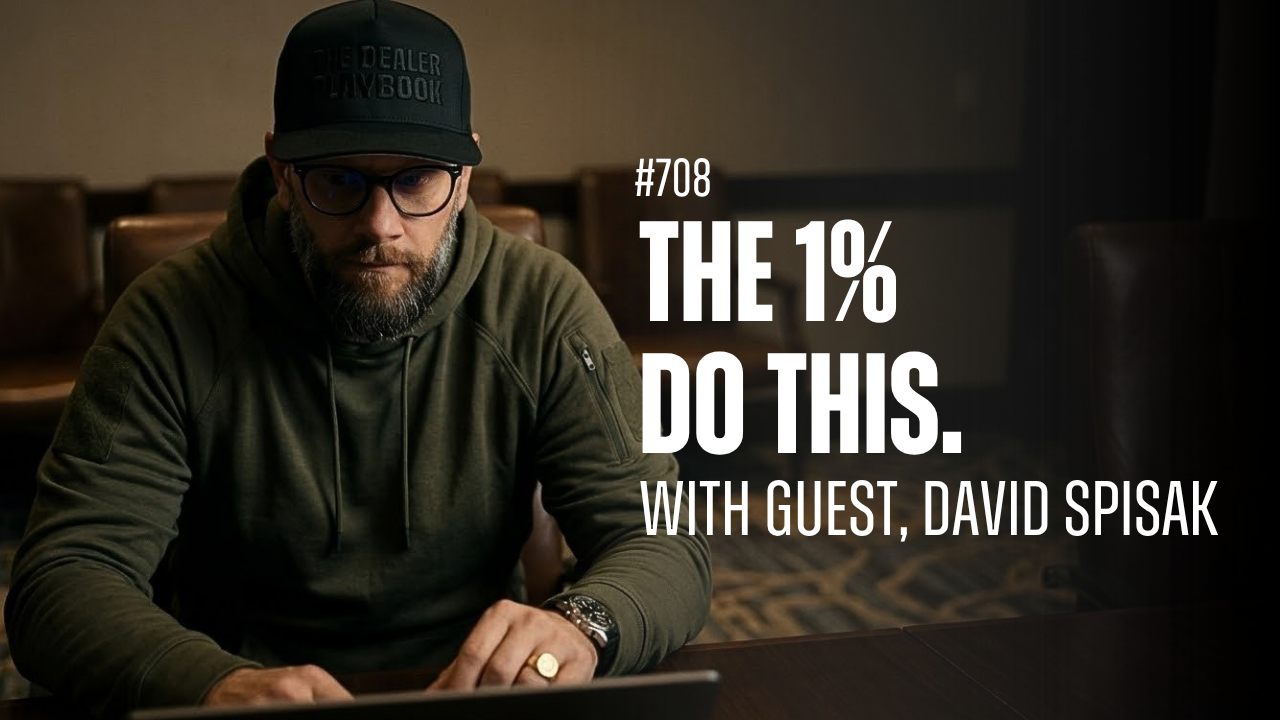
Are you tired of hearing the same old talk about how "hard" automotive retail is? Everyone acknowledges the challenges, but few are willing to roll up their sleeves and actually do the hard work that creates real, sustainable dealer growth. This isn't about avoiding difficulty; it's about making deliberate choices that set your dealership apart.
Here's what you'll get from this episode:
Reframe how you view challenges in automotive retail, understanding they are opportunities for real differentiation.
Discover why investing in people and fostering internal talent development isn't just "nice to have," but essential for dealer growth.
Learn why embracing "unreasonable hospitality" can elevate your car dealership above the competition.
Identify immediate, actionable steps to transition your team from just "talking the talk" to "walking the walk" on internal development.
Understand why the inevitable changes, like new regulations, are ultimately beneficial for high-integrity car dealers.
David Spisak, automotive consultant, President and CEO of Disruptive Growth Solutions and host of The David Spisak Show, brings decades of experience leading top-performing dealerships and developing industry talent.
Timestamps
00:00 Keynote Skepticism Setup
02:08 ASOTUCON Keynote Preview
05:18 Circuit City to COO Story
09:03 Bill Walsh Coaching Tree
11:23 Dealers Resilience Through Change
21:14 Develop Talent Like Techs
26:17 Unreasonable Hospitality Standard
28:17 FTC Rules and Choosing Hard
38:44 Year of the Human Close
43:18 Final Thanks and Outro
Follow The Dealer Playbook so you never miss an episode.
Episode Brought To You By FlexDealer
Need Better Quality Leads? FLX helps car dealers generate better quality leads through localized organic search and highly-targeted digital ads that convert. Not only that, they work tirelessly to ensure car dealers integrate marketing and operations for a robust and functional growth strategy.
Watch The Full Episode
Prefer to watch episodes? Be sure to subscribe to our YouTube Channel and turn on notifications to get full access to our content.
Episode Transcript
[0:00] [Hook] Michael Cirillo: You’re a keynote at ASOTUCON, which is coming up here shortly — I posted about this on LinkedIn. Somebody commented and said, "To do what David did in his store with all of the achievements, highest net profit dealer, 20 years, no attrition, all these sorts of things, is one thing. To be able to teach other people to do the same thing is quite another." I want to turn it over to you and say, what can we expect in your keynote, and what would you say as a retort to someone who has maybe a skeptical comment like that?
[0:37] Michael Cirillo: One of the things that I enjoy most about producing the Dealer Playbook is hearing from you — the messages that I get of people who are getting so much value out of the podcast, applying it to their day-to-day workflows, and finding a thriving career right here in the retail auto industry. It means the world to me.
And one of the ways that we make doing this possible is through my agency, Flex Dealer. In the spirit of providing value, I think this is a perfect time to head over to flexdealer.com. Right now, if you go to my website, you can get a full free PDF of my number one best-selling book, Don't Wait, Dominate. A lot of the topics discussed in this book are even more relevant today than ever with this surge in popularized AI, and people wondering, "What can I do next? How can I have a competitive advantage?" It's all in this book, and I'd love to offer you a free copy at flexdealer.com.
[1:58] Michael Cirillo: I'm here with David Spisak, alumnus of the Dealer Playbook. So glad to have you back. I want to get right into it. I'm so excited. Your keynote at ASOTUCON is coming up shortly. I posted about this on LinkedIn and said I'm so excited — I've gotten to know David over the years. The breadth of experience and wisdom, you never cease to amaze me with what you have locked in that will come out so casually. I really believe you know what you know, and you can tell when people are faking it.
Somebody commented and said, "To do what David did in his store with all of the achievements, highest net profit dealer, 20 years, no attrition, all these sorts of things, is one thing. To be able to teach other people to do the same thing is quite another." What can we expect in your keynote, and what would you say as a retort to someone with a skeptical comment like that?
[3:08] David Spisak: Well, first of all, color me a bit of an optimist or a positive human, but I kind of looked at that comment and I thank you for your post. It's very humbling to be asked to be a keynote, because this event is different from the inside out. This company is different. Their intentionality is different. This isn't just another industry event. This isn't nuts and bolts with a bunch of exhibitors showing off the typical stuff. There's a lot of unique innovation and things that touch on areas of dealership operations that we don't often see. There are conversations that happen at ASOTUCON that you don't hear at any industry event.
So perhaps I'm overly positive, but when I read that comment, I thought he was saying, "Hey, it's one thing for you to do it, it's another thing if you could teach it." And I was kind of hoping maybe he's somebody I've run across, and maybe I've helped him, and I have taught it to him or to somebody.
Honestly, Michael, from the outside, for as maybe staggering or impressive as some of those things were about what was accomplished by my team at that store — who cares? I mean, honestly, who cares? I think anytime anybody talks about anything we've done, who cares, if it doesn't impact somebody? If we can't take what we've learned, what we feel like we've mastered, and pass it forward, pay it forward — whether you do it for money or altruistically, and I prefer the latter in most cases — that's really ultimately what matters.
[4:48] David Spisak: The things I'm proudest of in my 46, 47 years in this business are not genuinely anything that I've accomplished. It's what I've been able to teach people to accomplish.
It's finding a guy who was helping me at a Circuit City. I walked in, I needed batteries — my kids had gotten a remote control toy. I'm wandering up and down looking for batteries, and there's this young kid there, name tag: Ben.
He says, "Hey, what are you looking for? I can help you." I said, "I just need some AAA or AA batteries." He says, "Wait a minute. Do you have kids?" I said, "Yeah." He says, "Is this for a remote control toy?" I said, "Yeah." He says, "Come with me. Have you ever looked at rechargeable batteries?" I said I hadn't. He says, "You're going to go through these batteries like nobody's business. They're going to leave the toy on, come back and it'll be dead, and you'll just replace and replace them."
He says, "You see this charger? You plug it in the wall, you buy four rechargeables, put them in the toy. Then you buy a second set, recharge those, and when the first set dies, you swap them out. You just rotate. You never buy batteries again." And he takes me through the whole thing, Michael. I was frankly astonished.
[6:30] David Spisak: It was such a surprise. So much so that at my Wednesday morning meeting at my Mercedes store, I told my guys — and I didn't do it in a negative way. I said, "Guys, I have to share something with you. I was at Circuit City looking for batteries. This young guy gave me a better presentation on rechargeable batteries that cost twenty dollars than I sometimes hear us delivering on a fifty-thousand-dollar car." And it mattered. It really mattered.
I went back to make sure it wasn't a fluke. This time I thought, "I'm going to buy something far more exciting, Michael. I'm going to go for toner." So I hang out in the toner section. I see him there. He comes over and says, "Hey, I helped you with the batteries." I said, "You did. It was fantastic, thank you." He says, "What are you looking for today?" I said, "Toner." And he takes me through the same level of process.
I stopped him. I said, "I've got to ask you something. I apologize for asking, but how much do you make an hour?" He said, "About eight dollars an hour." I said, "Well, I have to tell you, you're remarkable. You're very uncommon, and I believe that with your skill set and your personality, you ought to be selling cars. Have you ever considered it? You'd make a lot more money and have a lot more fun." He said no. I said, "Listen, we have a Ford store right over there, literally a five-minute drive." So I invited him over, we interviewed him, we hired him.
[8:10] David Spisak: Shocking Disney movie. Salesperson of the year. Following year, salesperson of the year. Moved him to Finance and Insurance — top F&I manager. Moved him to sales manager — top sales manager. All the way up, Michael. And I got to watch him move from position to position. Not one time was he ungrateful. Not one time did he feel like he had arrived. Not one time did he take his foot off the gas. Not one time did he forget to do what he was doing with kindness, respect, and consideration.
You know what? That guy retired before he hit 50. He retired in his 40s as the Chief Operating Officer of one of the best automotive organizations in the country — Norm Reeves Honda. No offense to my friend Brian Benstock at Paragon, who is number one — and they are number one, let's be honest, kings of the world at a different level. But come on. To go from selling batteries to that — how does that not make you feel greater than anything else?
[9:03] David Spisak: When I was involved with the 49ers for those twelve years on the board, I felt like Forrest Gump — a fly on the wall. I first met Bill Walsh and got to spend time with Bill, got to see a little bit of training camp, and from the inside out, what made Bill, Bill. Why did people respond and react to him?
As great as he was, legendary Hall of Fame coach, I think what's far more impressive — and nobody talks about it — is how many coaches, how many head coaches, how many Super Bowl coaches came from the tree of Bill Walsh. When you think about Pete Carroll, Bill Belichick, Sam Wyche, Mike Holmgren — I could go on and on. It's a who's who of coaching. They all came up through him.
And I guarantee you, as much as Bill had pride in what was accomplished with the 49ers, his best days and best thoughts were, "Man, to see that happen — what's better than that, Michael?" Whether it's our kids, people we bring into the business, or people we're fortunate enough to mentor.
[10:22] David Spisak: And even people like you. You've been doing this longer than anybody with the Dealer Playbook. You do a fantastic job, you always have, and I appreciate what you do for the industry. But what people don't see — we see your posts, and they always have humanity in them, always have a desire to learn from somebody else. I don't have to ever be on a call with you or with a client that does business with you to know it's the very same thing. It's not about selling a product, it's not about selling tech, it's not about more client acquisition. It's about — my God, I get an opportunity. Somebody's literally paying me to help make their life better. What's better than that?
[11:20] David Spisak: I can tell you this business — I've seen it since 1981 go through so much. I've seen a million times people say we're going to go the way of the dinosaurs. I've seen people calling out dealers as charlatans and crooks, never once pointing out the dealers that for years, for decades, have a reputation and a legacy and a commitment to their communities like no other business in those communities.
I've seen our manufacturers try to replace us. Ford at one time had the Ford Retailer Network. General Motors did something similar. They were going to get into our business.
[12:24] David Spisak: Think back to when you would buy a cell phone from a mom-and-pop shop. We had one called Parrot Cellular out here for years — ten, twelve, fifteen locations, super successful. You could walk in and buy any phone, any model, hook it up with any carrier.
One day, the guys at Parrot Cellular look across the street, and there's a new store going in. It's AT&T. It's Sprint. It's Verizon. Wait a minute. These are the guys whose product I've been selling, making them money, bringing them customers — and now the manufacturer set up shop across the street, knowing full well I don't have their bank account, their advertising budget, their processes. I'm a small business.
Well, we know how that movie ends. The Parrot Cellulars of the world — it didn't matter that they served customers, that they gave many options, that it was a one-stop shop. Gone. Unceremoniously gone.
[14:02] David Spisak: When that happened, there was actually a prediction from some incredibly well-known, seriously respected people that literally put out what the new retail landscape was going to look like. Dealers were going to own fifteen percent of all the stores in the country. Large groups — this was before AutoNation came along — were going to own a big chunk, and then the other massive chunk was going to be the OEMs.
How did that work out? We're still here. The large groups did come along and do some really good things, but we still represent over eighty percent. It's still people like Liza Borsius, Brian Benstock, the Bachmans over at Galpin, Stan Pack, the McLartys, and others who have been in business for over a hundred years. Seen it all, survived it all.
Black Monday, 1987 — that was going to do it. Uber coming out — that was the end of new cars. Autonomous vehicles were going to be everywhere by 2020. A biblical plague. A poor OEM decision to buy chips on three-month contracts instead of long-term agreements. And yet that chip shortage ended up creating the greatest profitability rewards in the history of being a dealer.
[15:47] David Spisak: This industry is like no other. Resilient like no other. It allows people with no money down, no college education, possibly not even a high school degree, to become a dealer. It allows people who didn't speak the language — like Alex Flores — to turn around and own stores. It's like no other. So I hope to do something at ASOTUCON that reminds everybody in that room who we are and why we matter. That's really what I hope to impart.
[16:25] Michael Cirillo: Everything you've shared resonates deeply because it's rooted in the things that truly matter — the contribution of people in a meaningful and strategic way. I love the word velocity because it implies speed with focus, not sporadic, chaotic speed, but with intense direction.
In all of these 47 years — and all the youth out there just heard "67" in that, by the way —
[17:12] David Spisak: You know how old I'm going to be this November? Sixty-seven.
[17:16] Michael Cirillo: No kidding. You need a trophy. There's a meme in there somewhere.
The first time you were on the show, we talked about how you did things in an unorthodox way — internal scholarships, redirecting marketing dollars. But it's always been rooted in community and in people. Now here we are in a moment of uncertainty with advancements in technology and artificial intelligence. Where most people would have started with that conversation, you still started with being deeply rooted in the human experience.
What are the topics that you think the industry should actually be talking about, outside of all the polarizing headlines?
[18:37] David Spisak: There are some great organizations out there like WOCAN, Women in Automotive — Veronica Dunford, Carrie Wise with WOCAN, and Patricia and others who have put together great organizations. We've had NAMAD around for years. Do you know that as it pertains to minority-owned dealerships, we're at roughly the same percentage now as we were twenty years ago? Damon Lester has been lugging that rock like Sisyphus up the hill year after year. It's a pretty thankless but incredibly worthy and noble cause. Why would we not want our dealerships to be reflective of the communities they serve?
When I've gone to Paragon Honda — and I've been there more times than I could ever count — one of the things that hit you in the face was why they were the number one CPO Honda and Acura store in the world year after year. You're in a community in Queens that is such a cultural melting pot, and you could be from any background, any socioeconomic situation, and you're going to find yourself reflected in Paragon Honda. Every language spoken. That wasn't systems. That was people.
[20:40] David Spisak: I remember at Smythe when we started moving up from one million to three, to six, to eight, to twelve, to sixteen, to twenty-four million — people would ask, "What kind of lights did you put in your lot? What system did you put in?" It's not the system. It's not the technology. It's the people. It's always been the people.
Here's the thing: AI is not AH. It's not artificial humanity, it's artificial intelligence. And by my measure, I think sometimes it comes up a little short on the intelligence. Plenty of artificial, not a lot of intelligence sometimes.
[21:20] David Spisak: We have to stop just talking about developing people and actually do it. Our people went to Disney to learn from Disney — and by God, who does it better than Disney? They're bringing people on at minimum wage, wearing a hot Winnie the Pooh head, sweating, and they couldn't be more proud. I had a young woman named Laura Tanaka who worked in my parts department. You know what her part-time job was? She was Mickey Mouse at Disney — and she was so prideful of that. Why would you not be? Why would you not learn from those people?
Why do we have to have salespeople come in and actually wonder why this person wouldn't want to be a salesperson for the next twenty years? I don't know a single leader who wants to be in their current position one year from now, much less five or ten. Why would we think our people are different?
[22:49] David Spisak: Why can't we take an approach like we do with technicians? We have an entry-level tech, a level two, level three, level four, and a master tech. Why can't we do that with salespeople? Why can't we give them a path that provides a source of pride, accomplishment, and movement? Who doesn't want velocity in their income?
Can we please stop talking about how hard it is to find people? Because it sounds an awful lot like, "It's so hard to find used cars." Yeah, it is — using the approach you're using today. And yet we have Rob Roos in a town of 2,600 people selling 400 cars at nine or ten used to new, buying 250 cars or more off the street. And look at Beaver Toyota's website right now — 450 used cars. Bozard Ford Lincoln hasn't looked for a technician in years. They've gone from 30 bays to over 90 bays, and there's a two-year waiting list for an entry-level job. They have a Bozard University Development Center and childcare on site.
[24:47] David Spisak: We have to go from talking the talk to walking the walk when it comes to development. We've talked for decades about how sixty percent of our cars are purchased by women, and yet less than ten percent of leadership executives in dealerships are women.
I'm getting up towards seventy. I would love to see all of the humanity and the good things we do in communities — the meaningful jobs we create — elevated. Despite the fact that autonomous vehicles, EVs, and now AI dominate the conversation, I'd love for us to go from great intentions to making it actionable, holding ourselves accountable, and figuring out how to measure whether we're going down the right path.
The greatest organizations on the planet — Will Guidara from Eleven Madison Park, the number one restaurant in the world — it wasn't the food that made it number one. Every Michelin star restaurant has world-class food. What made it number one was the people and the experience they created. We need unreasonable hospitality in this industry. We need to make a real commitment to attract great talent and then develop those people. If we do that, we don't just survive. We become more successful, more sustainably successful, and more impervious to anything external that could possibly damage this industry.
[27:55] Michael Cirillo: The takeaway for me is: stop talking about the hard and do the hard. Hard is the difference. We spend so much time saying, "Oh, new regulation, it's going to be so hard. Oh, AI is too hard. Hospitality is too hard."
[28:18] David Spisak: Do you know about these new FTC regulations, Michael? They're going to make us do the right thing. And people say it's so hard. I've been working so hard at remembering everything I told somebody.
Listen, I'm not talking about the eighty or ninety percent of great, honest, transparent dealers. I'm talking about those who've hidden behind the fine print. "That price is only if you finance, otherwise it's a grand more." "That's if you have a trade, otherwise it's two grand more." "That price didn't include these add-ons." I'm talking about you. You're going to have to put in the work, and the industry is going to be better for it, and every buyer is going to be better for it.
You know who else is going to be better for it? Every one of the honest, high-integrity, transparent dealers who have suffered. You've taken their business and their ability to work with people who were looking for dealers like them but never found them — because you hooked those customers with false advertising. That's over. The great dealers out there are not worried about the FTC. Not in the least. You don't have to be when you're on the right side.
[29:58] David Spisak: I have a nine-year-old, Jagger, and Jackson is going to be twelve later this year. If you ask them, they've heard from me more times than I can count: "Do what you need to do so you can do what you want to do. If you have a choice between choosing hard and choosing easy, choose hard. Hard now, easy later. Easy now, hard later."
Those things may sound like clichés, and maybe they are, but I've come to find in my nearly sixty-seven years on this earth that clichés are clichés for a reason. They're true. They've stood the test of time. So when Michael Cirillo says choose hard — let's choose hard. It's for the good of all of us.
[31:01] Michael Cirillo: I think one of the greatest gifts we have as human beings is our ability to choose — our agency. But agency means we are agents, and agents have a responsibility. To tie agency, the ability to choose, to being an agent with responsibility — I love what you're teaching your kids and what our industry needs to hear. If you have agency and you are an agent with responsibility, then choose hard.
[31:46] David Spisak: You want to hear some irony? What is the single most uttered word these days when it comes to AI?
[32:01] Michael Cirillo: Agents.
[32:02] David Spisak: Agents. Here's the difference. Those agents seek data, not opinion. Those agents are all in, all day, every day — not just the last week of the month. Those agents have a pure intention to complete every task and accomplish a goal, not to get noticed, not to get credit for doing what we should be doing anyway.
"Oh, I took care of that customer." Thank you. "I know their name." Thank you. I mean, the last three customers — when I saw how you treated them, I thought there was no hope for you. But now you're saying this time you respected their time, you took care of them, you were more concerned with their outcome than your income?
That is what we are supposed to do. We have to be more concerned with the customer's outcome than our own income. I coined a phrase back in the eighties that I used all the time in teaching my salespeople: commission breath. I wanted it to feel like a punch. "Have you ever had somebody come up to you with commission breath?" It reeked. All they cared about — they didn't see your face, they saw money. They wanted to convert you into a transaction, not an opportunity to help solve a problem.
[34:04] David Spisak: Here is something curious to me as a data fanatic with a terminal disease called curiosity: if you look back over the last twenty-plus years, you cannot find a successful new car sales period that was not enabled by external circumstances.
After the tragedy of 9/11, GMAC came out with the first zero percent interest rate of all time to jump-start the industry. It exploded. When 2008 came along and we learned it wasn't smart to sell houses to people with no jobs and no money down, the entire economy started to implode. We had Cash for Clunkers — it exploded new car sales. The chip shortage and pandemic created the best profitability results in the history of the industry.
[35:26] David Spisak: What happened on March second last year? Donald Trump stood up and said the word. There used to be a game show when I was a kid — Password, right? And the word is: tariffs.
Whether somebody likes Donald Trump or not, the man knows how to negotiate. He got people's attention. If that guy doesn't know how to throw a first pencil, I don't know who does — because he got entire countries to bounce off the ceiling.
So what happened? Everybody ran in to buy. Our SAAR was 15.8 in January, 15.8 in February. You know what it jumped to? 17.9 — thanks to Trump getting on camera. You know what happened when that wore off? We went back to being us. The clock struck twelve and everyone went back to normal.
The new car department has become too reliant on things on the outside, and we've forgotten the power we have on the inside. And yet there are people like Ali Reda, people like Frank Kranidi, selling thirty, fifty, sixty, even a hundred cars a month. Frank Kranidi works four days a week. Ali Reda goes home at six. Nothing interrupts their business because it is not reliant on an OEM, an incentive, advertising, or the economy. It relies on one thing: relationships.
[38:35] David Spisak: They've learned that being the internal force of nature crushes, supersedes, overrides, and outlives anything that is an external force of nature. External, my friends, is temporary. Internal — when you are the force of nature — that light does not go out.
[38:46] Michael Cirillo: This is the Year of the Human. That is the hashtag for ASOTUCON. You are the human. You are going to be our keynote speaker. We are so excited to have you. How can those listening connect with you and learn more about what you do?
[39:08] David Spisak: Come by my house. I'm kidding.
I believe I might be one of the most accessible people in this industry. When I give out my phone number, people think it is a burner phone — like I'm Jack Ryan. No. It is my number. I have had the same cell number for over forty years: 510-604-0308.
You can also reach me at david@dgsglobal.com or david@davidspisak.com. My website is davidspisak.com, or the DGS Global site. You can find me on LinkedIn at least three times a week, trying everything I can to give back to this industry that has given us so much. DM me there — a lot of people do. And by the way, someone asked me, "Who responds to all your DMs?" I do. "Who responds to all your comments?" I do. Not AI. I do not have an agent. I am the agent.
[40:45] David Spisak: If somebody is kind enough to like your post, that is the equivalent of a wave. If somebody comments, that is somebody saying, "You impacted me positively." I responded to a few over the weekend — someone who shared a ten-year anniversary, someone who lost their brother from the Grappone family. I didn't know Amanda, but I was really touched by that. There was another post from a guy whose daughter was heading off to college. I responded as earnestly as I could: "Thank you for putting this up. What a tremendous reminder of what a great privilege it is to be a dad — and how incredible it is to see everything you've poured in manifest into this incredible person." He said, "Thank you so much. It means a lot." What did that cost me? Nothing. It's humanity.
[42:28] David Spisak: Despite the fact that we are hearing about AI agents and humanoids — and yes, Walmart actually listed a twenty-thousand-dollar humanoid robot from China on their website before someone caught the mistake and pulled it — it is not AI. It is not humanoids. It is the Year of the Human. I only hope every year remains the Year of the Human. That is what makes us great and uniquely positioned to continue serving people doing what we love — hopefully from now until we have cars on Mars.
[43:18] Michael Cirillo: David Spisak, the one and only. Thank you so much for joining me on the Dealer Playbook.
[43:23] David Spisak: Pleasure. I genuinely appreciate you, Michael. I appreciate everything you do and who you are. I hope people seek you out, because to spend an afternoon with you — your calm, your patience, your consistent desire to serve — it reeks just like commission breath. But oh, is that breath magical, Michael. Looking forward to seeing you at ASOTUCON.
[44:06] Michael Cirillo: Thanks so much for joining me.
[44:08] David Spisak: Thank you. All the best.
[44:09] Michael Cirillo: Hey, thanks for listening to the Dealer Playbook Podcast. If you enjoyed tuning in, please subscribe, share, and hit that like button. You can also join us and the DPB community on social media. Check back next week for a new episode. Thanks so much for joining.