“50 More Cars a Month” - Why Every Franchise Dealer Needs a Subprime Department | Luke Godwin, Owner Godwin Motors
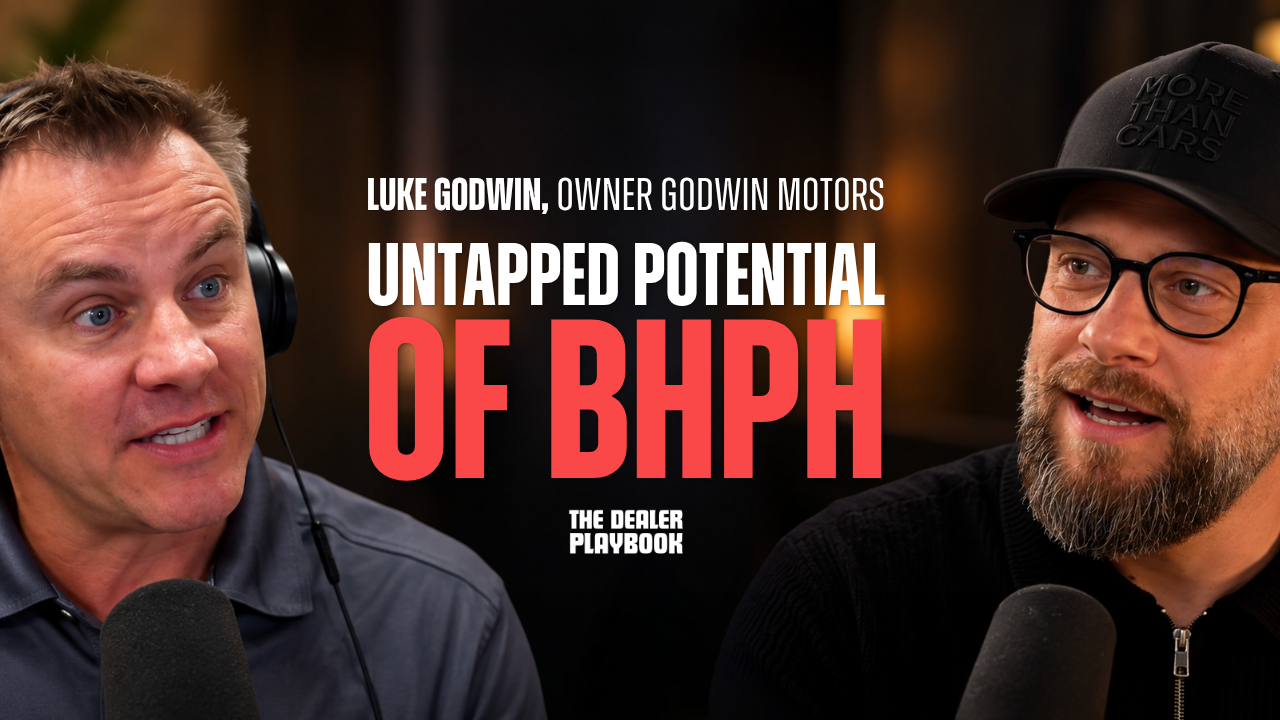
Could your dealership be missing out on 50 additional car sales every month?
Luke Godwin, a third-generation car dealer, founder of Godwin Consulting Group, and co-host of the Independent Dealer Podcast, believes many franchise dealers are overlooking an opportunity sitting right inside their existing operations.
Luke has managed a buy here, pay here business with over 900 customer accounts. And he's convinced that some of the customers franchise dealers turn away because of financing challenges could represent an entirely new source of business.
Think about it. Your dealership spends money attracting customers, works to get them approved, and sometimes loses the sale when traditional financing falls through.
What if you had another way to serve those buyers?
Michael Cirillo sits down with Luke to unpack why franchise dealers should consider a separate buy here, pay here operation, what it takes to make one profitable, and the expensive mistakes that can come with getting it wrong.
The takeaway: Before spending more money trying to bring new customers through your doors, take a closer look at the opportunities your dealership might already be letting walk away.
Connect with Luke Godwin: https://godwinconsultinggroup.com
Find him on LinkedIn and Facebook, or listen to the Independent Dealer Podcast.
Timestamps
(00:00) Who Can Run BHPH
(01:00) Show Support Plug
(03:39) Why Franchise Add BHPH
(06:58) Hiring The Right GM
(08:22) Three Gen Origin Story
(12:26) Hunker Down Strategy
(15:05) Community Marketing
(19:30) Collections And Repos
(21:59) Empathy Without Abuse
(23:45) Early Mistakes Fixes
(25:01) Ancillaries Reinsurance
(26:13) Consulting And Wrap Up
(26:46) Final Outro
Episode Brought To You By FlexDealer
Need Better Quality Leads? FLX helps car dealers generate better quality leads through localized organic search and highly-targeted digital ads that convert. Not only that, they work tirelessly to ensure car dealers integrate marketing and operations for a robust and functional growth strategy.
Watch The Full Episode
Prefer to watch episodes? Be sure to subscribe to our YouTube Channel and turn on notifications to get full access to our content.
Episode Transcript
(00:00) INTRO
[00:00] Luke Godwin: Your general manager at the new car store doesn't know how to do it. The used car manager at the new car store does not know how to do it. Your F&I guy does not know how to do it. You've got to build or hire someone to do it that doesn't really have any franchise experience, because if you do, you could run into trouble.
[00:15] Michael Cirillo: You know, you were well over 900 accounts. That's not luck either. That's you as an operator building a system that is working like a finely tuned machine. What are the first one or two, maybe three moves that you're recommending for somebody that's thinking in this direction?
[00:31] Luke Godwin: One thing I'd want to do first is, okay, do I have enough money to truly make this thing go? The second is finding someone with intimate knowledge of how a buy here, pay here dealership works, that's hired a general manager that's done it before.
[00:44] Michael Cirillo: And I'm curious about how, you know, we hear so much in our business about hospitality and customer care and empathy and all of these sorts of things, which I imagine you possess, but how do you do it in the segment of buy here, pay here so that you're not also being taken advantage of?
[01:00] Luke Godwin: Man, it's a fine line.
A word from FlexDealer
[01:03] Michael Cirillo: One of the things that I enjoy most about producing The Dealer Playbook is hearing from you. The messages I get from people who are getting so much value out of the podcast, applying it to their day-to-day workflows, and finding a thriving career right here in the retail auto industry. It means the world to me.
And one of the ways that we make doing this possible is through my agency, FlexDealer. In the spirit of providing value, I think this is a perfect time to head over to www.flexdealer.com to show even further support for you, my beloved DPB gang. Right now, if you go to flexdealer.com, you can get a full free PDF of my number one best-selling book, Don't Wait, Dominate.
The reason I think it's so special is that a lot of the topics discussed in this book are even more relevant today than ever, with this surge in popularized AI and people wondering, "Well, what can I do next? How can I have a competitive advantage?" That's all here in this book. So I'd love to offer you a free copy if you go to flexdealer.com. It would mean the world to me, because that is how we continue to produce this show for you.
Welcome
[02:25] Michael Cirillo: Okay, first of all, I've got to say, from one podcaster to another, congratulations. You're at 400-plus episodes, and I know better than most people how much work it actually takes to do one of these things.
[02:38] Luke Godwin: Yeah, it's crazy. And actually, I was telling my wife this morning, "I'm hopping on a podcast with Michael Cirillo today," and she's like, "Yeah, I remember his name." I said, "Man, he is the OG of independent dealer podcasts." I mean, or just dealer podcasts. You were the first, I think, right, Michael?
[02:58] Michael Cirillo: Well, I don't want to... I like that you're saying it. It's weird for me to be like, "Guys, I was the first," but it's been a while. 2012 really is when we started this whole experiment. And like we were just talking about beforehand, there's no exit strategy. I'm going to be the Johnny Carson of car dealer podcasts. I'm going to be 70 years old and still doing the show. But it's cool to watch what you've built with yours. It's definitely a show I think people should be checking out, especially from the vantage point of independent dealers.
Why franchise dealers should add buy here, pay here
[03:30] Michael Cirillo: So I want to talk to you specifically through that lens, and we're going to touch on some of the buy here, pay here stuff, because I know there's always a lot of intrigue around it. Where I want to start is something I've heard you say at some points: that franchise dealers should add buy here, pay here to their toolkit. Can you walk me through that? What's your reason for saying it, what kind of objections do you hear, and how would you overcome those for a franchise dealer?
[04:01] Luke Godwin: Okay, I'll try to put all those together. Number one, why should they? Because as you know, being in the advertising space, it costs so much money to get a lead to your showroom or to turn a lead into an application. And every time you lose one of those, it's just like throwing $100 out of the window, when you could take that lead that maybe you can't get qualified. Now, I would say probably eight out of ten times a franchise dealer is going to be able to get the really low credit score hung somewhere. But there's that two out of ten, or maybe three out of ten, where it just doesn't work.
If you had a standalone buy here, pay here store across the street, or a block away, or at that old location you can't sell, you could walk those customers to that store, and you'd probably sell 50 cars a month just doing that. Not to mention the inventory from trade-ins that you're sending to the auction that just isn't bringing what you think it should bring. So I really believe there are so many opportunities for the franchise dealer to make this work. That's number one.
[05:21] Michael Cirillo: What would their hesitancy be?
[05:23] Luke Godwin: It's messy. It's dirty. If we talk about the inventory side, they look at it from a franchise service recon situation. So they're going to send, let's call it that $5,500 car, to the service lane in their franchise store, and they're going to charge $285 an hour, and they're going to charge full-boat retail. Where most independent dealers see $1,500 to $2,000 in recon on that car, they're seeing $4,500. So immediately they go, "I don't want to do that," and they send the car to auction, when they could have their own standalone recon facility that charges normal rates, or send it to an outside shop that charges normal rates. That's a portion of why franchise dealers don't want to see it.
And the messy side is this. If you're a Toyota store, you're used to dealing with Toyota customers all day long. Then the buy here, pay here customer you've taken care of, who's done everything right, has a bad day, or their car gets repossessed, and they show up in the new car showroom and start raising Cain. It's not going to look good for your other customers, and I think it's hard to get over that. So it really needs to be a separate operation to cut down the messiness of it.
The first moves to make
[06:58] Michael Cirillo: Right. And obviously, at one point, you were well over 900 accounts. That's not luck either. That's you as an operator building a system that's working like a finely tuned machine. Walk me through somebody who's interested, and they're like, "Okay, I hear what you're saying. I understand that there's an opportunity there." What are the first one or two, maybe three moves you'd recommend for somebody thinking in this direction?
[07:27] Luke Godwin: Franchise dealers probably don't have to worry about securing the cash, but that's the one thing I'd want to do first: okay, do I have enough money to truly make this thing go? Most franchise dealers or dealer groups are probably going to have the cash available, or sitting around, so let's just take that off the board. The second is finding someone with intimate knowledge of how a buy here, pay here dealership works, that's hired a general manager that's done it before.
Your general manager at the new car store doesn't know how to do it. The used car manager at the new car store does not know how to do it. Your F&I guy does not know how to do it. You've got to build, hire, or develop someone to do it who doesn't really have any franchise experience, because if they do, you could run into trouble.
Three generations in the car business
[08:22] Michael Cirillo: Got it. You're a third-gen operator, correct?
[08:27] Luke Godwin: I am third gen.
[08:28] Michael Cirillo: Did the family business start as buy here, pay here, or did you transition into it?
[08:34] Luke Godwin: No. My grandfather was a Ford dealer. He was actually a rural agriculture teacher in South Carolina, and he just wasn't making enough money. So, I think in the late '50s or early '60s, he went to work selling new Fords and worked his way up to general manager. You know how some of those stores would give the general manager a portion of the dealership? Then in the mid-'70s, Ford noticed they kept winning awards, and they said, "This guy needs his own dealership." At that time, if a general manager had been to the right Ford schools, Ford would put them in business. It didn't cost you any money. They would take a poorly performing spot and place you there.
That's what they did. They placed him in Winnsboro, South Carolina, which at the time was a 5,000-person town just north of Columbia. The previous Ford owner there was terrible. Nobody would look at a Ford. Nobody would buy a Ford. And I don't know how I remember this, but I kind of do: they put me in a playpen on the showroom floor. I was born in '78, so this was probably '81 or '82. When it rained hard, the rain would come onto the showroom floor because the roof was leaking. It was a terrible spot. A terrible location.
Gas was really high back then, and you couldn't get any of it. The recession of the early '80s put a hammer on Ford in general. They told my grandfather, "Hey, you need to build this big, shiny new building." He started on it, and what he figured out was that it was going to cost a million dollars to build in 1982, with interest rates at 19%, in a town of 5,000 people. And he said, "Guys, I'm good." He just shut it down. At that point my dad, as a Ford dealer's son who'd been to every Ford training out there, was hired quickly by another Ford dealership. He worked there two or three years, opened our store in '85, and I took over in '01.
Reading today's market
[11:07] Michael Cirillo: You've seen some things, right? Three generations see some things. What are some aspects of the market you're paying attention to right now where, given your lived experience and your family's, you're like, "Oh, this is similar to that time period," that maybe gives you a competitive edge in the market we're in today?
[11:29] Luke Godwin: One thing I'm seeing, and it depends on how much longer gas and diesel prices stay as high as they are, is the gas guzzlers really starting to take a hit in the wholesale market. The last time I saw this, I'm pretty sure it was around Katrina, so '04 or '05. We got a real big gas shock, wholesale prices on those trucks just plummeted, and you were able to buy them. It looks like there's a little bit of that going on. The market's a little soft. But what scares me more than anything is margin compression like I've never seen. We had that margin expansion during COVID, and now we have margin compression. So I think that's something dealers really need to pay attention to.
Growth, arbitrage, and a people business
[12:26] Michael Cirillo: As a dealer, how are you navigating that? There's always this tension between the 30-day cycle and this insatiable appetite for growth, married against the market, and knowing these things are happening. Sometimes I lay my head on my pillow at night and I'm like, "Holy crap. How do I pull back from the micro and look at the macro of what's actually happening here, so I can make some wise decisions?" So I'm curious, from your dealer operator perspective, how are you thinking about it? How do we marry growth with a market contraction, or compression, as you've said?
[13:11] Luke Godwin: I think sometimes growth is just the wrong way to look at it, and sometimes you have to hunker down. We might be in a period where you need to hunker down. Now, that might not be what I'm doing right this second. We might be growing in different areas. And if you're looking to grow, then you need to find an arbitrage somewhere. I know this is going to sound wild, but I think the arbitrage is being in the lane buying cars, and not buying everything virtually. Finding things that CRs just aren't pointing out, the good and the bad. So I think it all goes back to availability of cash and availability of the right inventory.
[13:55] Michael Cirillo: Right.
[13:56] Luke Godwin: And that's really what's key right now, I think.
[13:59] Michael Cirillo: Yeah. I'm thinking about my experience. We've been a family business now for almost 50 years, and you're giving me déjà vu with the 19% interest rates, except we lived in Canada, and it was like 28%. All of these market cycles, and now everything happening with AI, which is the whole buzz, and it's going to solve the world's problems for you, and so on. It's got me thinking a lot about how a market that may be compressing a little doesn't mean people are going to stop buying cars. It just means the pool shrinks a little bit. So maybe, to your point, it's not about growth. It's about hunkering down and getting my unfair share of that smaller pool.
And marrying it to my earlier thought: when the market gets saturated with a certain opinion, what you said about finding an arbitrage, zagging when everyone else zigs, is really important, and I want to underscore it. I was talking to somebody else on a show and asked, "When's the last time you went to the mall parking lot and just blasted flyers on people's windshields?" There's a part of me that thinks, in a compressed market, those human inputs are actually going to increase in value. Someone who actually took the time to drop it on the windshield, to shake someone's hand, to introduce themselves at the restaurant: "I sell cars at..." or "We do buy here, pay here," whatever.
[15:37] Luke Godwin: Oh yeah, 100%. This is still a people business. No matter what you think, people buy from people they like. Don't get me wrong, price matters. They won't even show up at your dealership if you're not priced properly. But if you are priced properly, they're going to show up to the people they feel like they know. So it's being involved in your community, like you're talking about. And maybe billboards work again, who knows? It's getting your face out there and really engaging in your community.
The big franchise stores that work very well are the ones where people feel like they know the owners. Jim Hudson is huge here in South Carolina. He has the same saying he's been using for 25 years on every commercial. Every time you watch TV you'll see it, and people know it. I think that separates him a lot of times from the other dealers in town.
Consistency and the longevity play
[16:38] Michael Cirillo: There's something interesting there worth unpacking a little bit. The same message for 25 years. The consistency. Our human nature compels us to want to change every time we think something's not sticking. I guarantee that guy, at some point over the years, was like, "Do we need to change the message? Is it hitting? Is it landing?" But there's something so interesting about seeing it through and not diverting from the course, and the impact of that over the years. To your point, I wouldn't know who this guy was unless you brought him up, but he's stuck enough in your mind that you're going to shout him out. We've got to remind our team to send him an invoice for the free ad. No, I'm kidding.
But I'm curious now, from your perspective in the buy here, pay here space: is there a longevity play? Is there a case for, "Hey, they came here as buy here, pay here, but after a period of time we were able to graduate them into a more stable, consistent credit journey or buyer journey"? Have you seen that happen in your experience?
[17:55] Luke Godwin: We did that, and we did it by keeping the customer. We just started lowering rates. We had a sliding scale, and if you'd bought multiple cars from us, your rate just kept going down, because even if your credit was still poor, we could get you a better rate every time you bought another car from us. What we also did was move up in ACV on the vehicle. There are many really, really good buy here, pay here customers out there who, once they start doing business with you, will keep buying from you no matter what you're charging interest-wise. They trust you, they like you, and you've always done right by them. So you'll see many buy here, pay here stores that have been in business for 30-plus years. They may have started out with a super low ACV, but now they're selling $30,000 trucks, maybe $40,000 trucks, because that customer wants to stay loyal.
Now, can you do it a different way? Yeah. When our portfolio was the biggest, we'd probably get eight to nine payoffs a month at new car stores. You could see that customer graduating. Unfortunately, a lot of times when that customer graduates, they end up back to see you in a couple of years, because those lenders just can't collect the same way we collect. They have rigid rules that end up driving some of them back to buy here, pay here, which is unfortunate, but it happens.
Collections and repos
[19:30] Michael Cirillo: Right. And that brings up where I wanted to go, because I'm sure those listening or watching are going, "Okay, what is the collections process like?" Let's talk about repos. Do you have your own repo guy? What safety protocols do you have in place to make sure you're not getting screwed over?
[19:45] Luke Godwin: Yeah. You know, sales are easy in buy here, pay here, for the most part. Collections is where the money is made, though. You could sell 100 cars a month, and it looks like you're making $4,000 a copy. But if you don't collect that money, you didn't make anything, and you start losing. So you have to build a very good collections department. A lot of times it'll start with the owner, and then as they grow, they develop some staff. You typically need about one collector for every 300 to 350 accounts. They're making calls on day one that somebody's late, using AI or text messages, but they're getting communication going with that customer. The customers that succeed are the ones that communicate, and the customers that fail are the ones that don't.
Repos are tough. No matter what different agencies say out there, nobody wants a repossessed car. It's bad for us, it's bad for the consumer, and it's just a headache. There are a lot of dealers out there that probably repossess their own cars. It's super dangerous. Do not recommend it. We've done it before. We don't do it anymore. There are a lot of repossession companies out there, because there are a lot of repossessions happening. So you hire the right people, they do it the right way, and everybody's safe. What you see on TV is not really what happens when it comes to repossessions.
[21:22] Michael Cirillo: I'm glad you brought it around to hiring people who are qualified so they do it the right way and it's safe. For a minute there I was like, well, Luke basically just said all of us Italians should not get into buy here, pay here, because repo might be my favorite part of the job.
[21:38] Luke Godwin: I've probably physically repossessed 500-plus cars myself in my life, and that was really years ago. Man, you don't want to do that. It's just the worst thing to do. Customers get mad at you, and it's just not worth it. But unfortunately, it's part of the buy here, pay here business, and it's super expensive to repossess.
Empathy without getting taken advantage of
[21:59] Michael Cirillo: And I'm curious about how, you know, we hear so much in our business about hospitality and customer care and empathy and all of these sorts of things, which I imagine you possess, but how do you do it in the segment of buy here, pay here so that you're not also being taken advantage of?
[22:19] Luke Godwin: Man, it's a fine line. The dealers who do it best understand when empathy turns into being taken advantage of. But it's hard to separate. If you have a great collector, she or he has amazing empathy but also sternness, and they know when it's, "All right, we've given you this opportunity and that opportunity, and we just can't do it anymore. At that point there's only one thing we can do, and that's repossess your car." You have to be stern, and you have to make sure communication is done properly.
If you just tell a customer, "Michael, I'm coming to repossess your car because you didn't pay me the whole payment last month," and Michael goes, "Well, hey, buddy, I'm going to pay you next week," and you say, "I don't care, I'm coming to get it right now," that customer would just as soon hand you the keys and never talk to you again. So you've got to really know how to speak to people. You have to be a customer service rep more than a collector, because life happens to people. Life happens to people no matter their socioeconomic or credit standing. Life just happens. And if you can't bend your policies to help there, you're just going to repossess all your cars, and then you're not going to make any money.
The mistake that cost ten years
[23:45] Michael Cirillo: Let me ask you this as we start to wind down. What's a mistake you were making in the early days that you've learned from, or something you've tweaked since then because you realized it wasn't working, in this segment of the business?
[24:05] Luke Godwin: Cadence of collections was a big thing we didn't do early on. We didn't communicate with customers properly up front. It was harder to do back in the day, but the more you communicate with customers, the better off you are. But a bigger mistake than that was not selling customers ancillary products. It took us a while to get into reinsurance and really focus on how important it was to collections and to customer success. It took us years to develop that. But once we decided to lean into ancillary products in the buy here, pay here industry, which was really nonexistent at the time we started, man, account retention took off, the profit went up, and we started piling money into a reinsurance company. That's probably one of the things that, if I could have done it earlier, I would have.
[25:01] Michael Cirillo: What held you off so long from getting into reinsurance or adding ancillary products?
[25:06] Luke Godwin: I didn't know about them. I didn't know it was possible in the buy here, pay here space. I was talking with our friend Tracy Myers one day about starting my own warranty company, because it just kept being on my mind that we should be selling warranties to these customers. They need them. I said something to him, and he's like, "You don't need to set it up. There's this thing called reinsurance." I was like, "What's that?" He told me, and literally a month later we were set up and rolling. I think that was in 2011. No, it wasn't 2011. It was probably more like 2015. If I'd started it ten years earlier, the amount of money we could have made, on top of keeping customers' cars running, would have been life-changing.
Connect with Luke Godwin
[25:55] Michael Cirillo: Yeah. Wild. That's so cool, man. Congratulations on being able to do all of this and figure out the system. And now you've moved on to adding what I'd call an ancillary path in consulting, which is super awesome to watch. So as we wind down, how can those listening and watching connect with you and learn more about your consulting?
[26:19] Luke Godwin: Yeah, you can go to godwinconsultinggroup.com, and everything's there to get in touch with me. I'm on Facebook, I'm on LinkedIn, all those good spots. I'm speaking at conventions all the time, so I'm out there, and you can get a hold of me. And please watch or listen to the Independent Dealer Podcast. It drops every Thursday morning.
[26:43] Michael Cirillo: Love it, man. Thanks so much for joining me on The Dealer Playbook Podcast.
Hey, thanks for listening to The Dealer Playbook Podcast. If you enjoyed tuning in, please subscribe, share, and hit that like button. You can also join us and the DPB community on social media. Check back next week for a new Dealer Playbook episode. Thanks so much for joining.