“We Built an AI Department” - Why Dealers Need a Real AI Strategy Anyway | Jeff Swickard, President/CEO of Swickard Auto Group
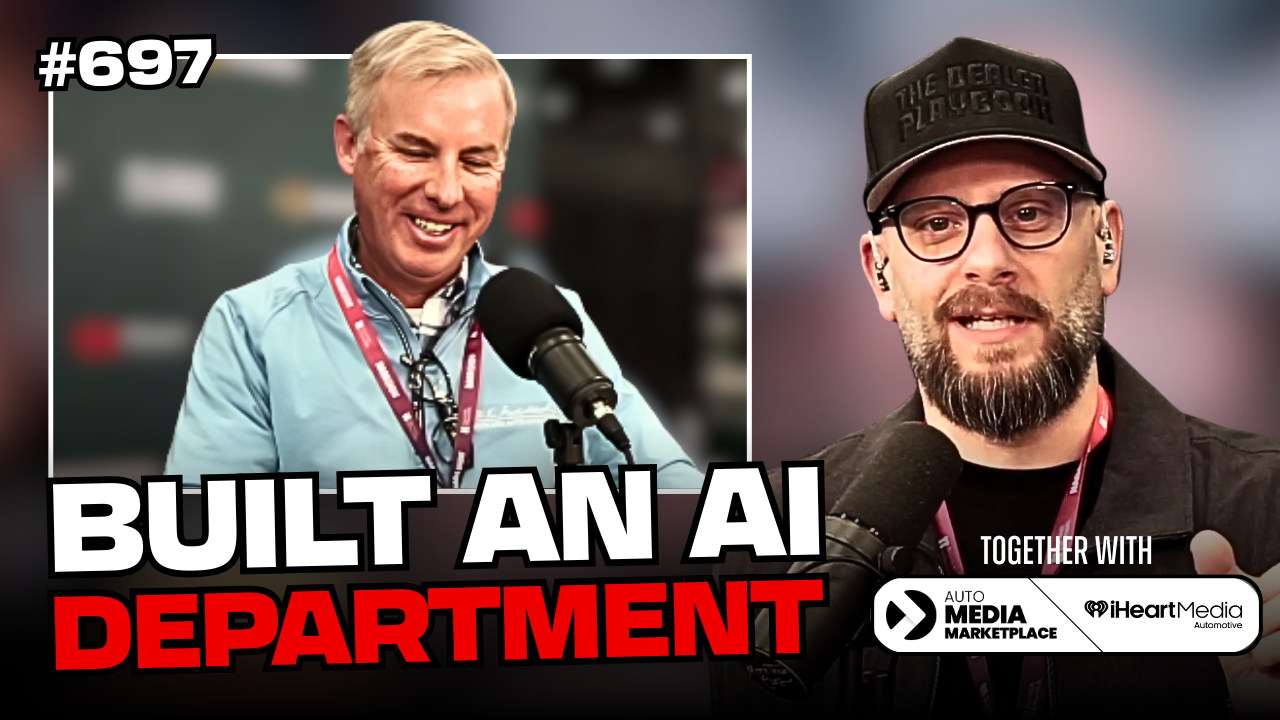
Most dealers are talking about AI. Jeff Swickard is building an AI department inside his auto group.
In this special episode of The Dealer Playbook, Michael Cerullo sits down with Jeff Swickard, President & CEO of Swickard Auto Group, to unpack what it actually takes to operationalize AI inside a dealership group—without breaking culture, customer experience, or your tech stack.
Jeff shares how they built an enterprise data warehouse in Microsoft Azure, why integration is the real battle, and how they’re using agentic AI + sentiment analysis to protect and improve the guest experience—especially in service.
What you’ll learn:
Why Swickard Auto Group created an internal AI department
How an enterprise data warehouse solves “nothing integrates” chaos
The role of APIs + bidirectional data feeds with the DMS and vendors
Using AI to measure call quality + customer sentiment in a high-volume service contact center
Why hospitality is the long-term differentiator (and how tech should support it)
How to drive buy-in from employees and avoid “here we go again” resistance
The real leadership skill: prioritization, iteration, and pivoting
“Buy vs. build” in automotive tech—and how to know when to switch
If you’re a dealer principal, GM, fixed ops leader, or marketing/ops exec trying to figure out what AI actually means for your stores, this is a blueprint for how the best groups are approaching it.
Timestamps
00:00 Welcome & Meet Jeff Swickard
00:29 Why They Built an AI Department in a Dealer Group
02:03 Taming the Tech Stack: Enterprise Data Warehouse on Azure
03:34 AI + Hospitality: Using Sentiment Analysis to Elevate Service
06:23 Building It In-House: 2.5 Years to Connect the Data Sources
07:39 Getting Buy-In: Involving Employees Early & Prioritizing ROI
10:33 Forward-Thinking (and Stumbling): Learning, Predictive Analytics & People
13:30 Leadership Urgency: Staying Focused, Pivoting Fast & Buy vs. Build
16:13 Wrap-Up, Thanks, and Podcast Outro
Episode Brought To You By FlexDealer
Need Better Quality Leads? FLX helps car dealers generate better quality leads through localized organic search and highly-targeted digital ads that convert. Not only that, they work tirelessly to ensure car dealers integrate marketing and operations for a robust and functional growth strategy.
Watch The Full Episode
Prefer to watch episodes? Be sure to subscribe to our YouTube Channel and turn on notifications to get full access to our content.
Episode Transcript
0:13
Welcome & Meet Jeff Swickard
All right, gang, welcome to this special episode of the Dealer Playbook podcast.
I'm here with the man, Mr. Jeff Swickard, the President and CEO of Swickard Auto Group.
We had a delightful conversation the other day and I'm so excited to dig into this.
Thank you so much for joining me on The Dealer Playbook.
0:27
*Jeff Swickard*
My pleasure.
Yeah, nice to See you.
0:29
Why They Built an AI Department in a Dealer Group
You and I chatted the other day briefly, and you said so many things that I need to dig into here because, well, first of all, you said that you have an AI department in your auto group.
Tell me, you know, one of the things that I'm so fascinated by are people that are looking around corners and it seems like machine learning, artificial intelligence and the likes of you're looking around corners at what's coming.
0:57
How did you develop that sense?
0:59
*Jeff Swickard*
Oh, geez, you know, I don't know that I'm, I'm not sure I'm looking around the corner quite yet.
I feel like sometimes the corner catches me before I'm ready.
But I think in terms of AI, you know, we, you know, we've been looking at other industries to try to figure out, you know, how are they incorporating AI into their businesses?
1:16
And so we decided to look at all the disciplines of our, our business.
So fixed operations, variable operations, used new and figure out OK, each, each kind of team, how we wanted to implement AI artificial intelligence into those, you know, those departments, if you will.
1:33
And so we came up with a list of ideas and we realized that it was going to be challenging for us to find a third party to be able to satisfy each of the needs of those departments.
So we hired an an expert who has been in the automotive sector who had kind of a running start, if you will.
1:50
And so we hired him as the director of artificial intelligence at our group.
And then he hired a small staff of people to support initiatives that we wanted to launch that were outside of what we could buy from third parties, so things that weren't readily available in the marketplace.
2:03
Taming the Tech Stack: Enterprise Data Warehouse on Azure
This is something that we we're challenged with in the industry is when you really pull back and you look at that spreadsheet, if you will, of the tech stack of most dealerships and dealer groups in this case.
And it's multiple pages on multiple pages.
And the frustration that we often hear is that things don't integrate or speak well to each other.
2:22
What's, what's your vantage point on that?
How are you looking to bring things together so that your systems are are operationally efficient?
2:30
*Jeff Swickard*
I mean, that's, that's the, that's the real challenge, right?
So our first project that we started 2 1/2 years ago was establishing an enterprise data warehouse.
So we have a common repository of data where all of our customer data is, is housed in Microsoft Azure, which is a hosted platform and it's managed through what we call an enterprise data warehouse.
2:51
So we have API hooks into this data so we can allow our teams to pull different things.
We started with like reporting and things that were easy for us to do.
And now we're doing bi directional integration with our, you know, all of the different parties that we have that use and where we transit data with.
3:08
So like an example would be our DMS.
You know, we take all the DMS data about our customers, their transactions, some of their habits, and we put it into our enterprise data warehouse.
And then we're able to use the data in that, you know, in the warehouse to figure out, you know, how we can implement new technologies.
3:25
And that's where a lot of the AI work is being done.
3:28
*Michael Cirillo*
I told you guys how much I love this type of conversation and I'll tell you why in my next question.
3:34
AI + Hospitality: Using Sentiment Analysis to Elevate Service
There's a real opportunity for dealers and any operation for that matter, to look deeper at the integration of technology, the intersection of technology and human connection.
And so this leads me to the next question I want to ask you, which is you're also very concerned in a positive way with the hospitality side of the business.
3:58
How are you thinking about the next phase of customer experience and or guest experience and what those people can expect once they once the promise has been made by you online, the fulfillment of that promise once they come into one of your stores?
4:12
*Jeff Swickard*
That's a really interesting question because you know, what we know is, is that the only thing that the only things that make other people happy are people, right?
And so we know that technology in and of itself cannot satisfy the needs of our customers.
So we have to find in ways of using technology to enable our hospitality.
4:31
So an example would be, you know, when a customer calls into our contact center to service an appoint to schedule an appointment, which we take about 5000 calls a day here in Las Vegas at our contact Center for our service team, we use agentic AI to actually score the call, to actually use sentiment analysis to figure out what is the sentiment of the customer, Is the customer happy?
4:55
Are they frustrated?
Are they using words that would cause us to worry?
Are we actually achieving the hospitality standards that we set for ourselves?
So we we use AI to enable our people to actually provide a higher level of care and service.
5:11
And that's really important to us because we think that's our differentiator long term is, you know, to provide this kind of memorable experience, the service level that they can't find elsewhere in the automotive space or it's harder to find.
So, you know, for us, hospitality is the core of who we are and who we want to be.
5:28
So we're looking at the using the technology to try to help us and help our people, you know, help customers faster, you know, increasing the speed of transactions, making sure that customers, there's a safety net for customers who may not have be having a good experience.
We can pick it up before they have to report it to us.
5:45
And then we can also rate our, you know, our staff on how they're doing in terms of hospitality using agentic AI.
So instead of just having the, you know, the, the AI actually take and process the call itself, because some customers might want that, some customers might want a fully automated experience, but many customers want to talk to someone.
6:02
And so we want to be able to understand their sentiment.
We want to understand what their experience is.
And AI is a great technology for that.
6:10
*Michael Cirillo*
I don't know if you guys heard that he didn't even finish what he was saying and the audience started clapping for him.
Did you hear that?
They were like, yes, thank you.
This brings up so many interesting things.
I mean, is, is this to suggest then that, you know, you mentioned your databases and your storage and all of those sorts of things, so you guys are building this for yourselves.
6:33
Building It In-House: 2.5 Years to Connect the Data Sources
Is that is that an accurate statement?
6:35
*Jeff Swickard*
Yes, that's right.
We are right and we've been working on it for 2 1/2 years.
And part of the part of the challenge is, is that you know, to capture all of the data sources and then correlate them properly so they can be retrieved easily later is a is a challenge.
6:50
And so we hired a third party and they've been working on it for, you know, I guess we as a company boring out for 2 1/2 years, but we've now finally reached the end point where it's established and we're actually retrieving data and doing bi directional feeds between the, you know, between different applications and our enterprise data warehouse.
7:09
*Michael Cirillo*
OK, you don't have to give me.
I know it's a.
7:10
*Jeff Swickard*
Conversation killer I'm.
7:11
*Michael Cirillo*
Sorry, no, it's it's not.
I'm like, you don't have to give me all the details on this part.
Yeah, because I do.
Actually, our audience really loves what you're talking about.
I know it because they're asking questions about this stuff.
I mean, this is the topic really of NADA right now.
People are wondering about AI.
7:28
Everybody's talking about AII actually joke Jeff that I was going to bring in a Gentek AI to talk to the other AIS to vet the AIS on AI.
7:39
Getting Buy-In: Involving Employees Early & Prioritizing ROI
But you said something that I think is really important 2 1/2 years.
My my thought process here is the time is going to pass anyways.
You might as well do something effective with that time as a leader from your vantage point in your experience.
7:55
What is that conversation?
I this is what I didn't want you to feel like you had to bear all the details on, which is bring me into how you present that to the people so that in an organization the size of Swickard auto Group, you're getting the buy in.
People aren't just going, oh, here we go AI, but they're actually seeing, seeing it from the the lens that you're seeing it.
8:17
*Jeff Swickard*
Well, I think people naturally want to do the best job they can.
So I think that when you introduce new technology that helps them do their job better, I think people respond favorably.
And also communicating very openly with what the future looks like, at least from our perspective, and getting their involvement early on so they can and evaluate the technology on their own.
8:40
They can touch it, feel it, be part of the development of it.
And then quite frankly, our best learnings come from our people.
So they'll tell us what is working, what's not, what customers will like, what they won't.
And so that's how we build our systems, our processes.
8:56
And you know, and most of these ideas are borne by our employees.
They want better, easier ways of doing things so they can satisfy customers faster, more efficiently, more accurately.
So I think the more involvement from our people has made our processes, our systems, our technology better.
9:15
And then they help us to prioritize, like what is the most important because we can't do everything at the same time.
So we have to prioritize what do they want?
What would help them do their jobs better and what, you know, what return on investment do they see?
So I mean, I think we bring our folks along early and it's kind of like, you know, it's some sometimes that you wonder like, OK, how efficient will we make it to the finish line?
9:38
Because, you know, I describe it like, you know, decorating your Christmas tree, like everybody has an ornament, right?
And so if you put every ornament on the tree, it may not look as good as if you just had, you know, standard decorations.
But I think, you know, what we have learned is the diversity of experience, the diversity of ideas, you know, actually makes our business better and actually enhances the technology faster.
10:01
We get, you know, we can kind of fail faster, if you will, which has been helpful for us.
So I mean, I think, you know, I mean, I don't think we're, I think we're an imperfect organization and we probably should, you know, learn, learn more and learn faster.
But we, you know, we tend to lean in on our, our people and we trying to learn from them.
10:19
Let them evaluate the technology, let them tell us how to, how to, and then from a customer's perspective, their feedback, what do they like about it?
What do they not like about it?
So we can make, you know, we can make improvements and enhance our capabilities.
10:33
Forward-Thinking (and Stumbling): Learning, Predictive Analytics & People
Has your auto group in its history, has it always been this forward thinking or is this kind of been a line upon line kind of thing for you guys?
10:43
*Jeff Swickard*
Well, I don't want to mislead anyone.
I mean, like we are struggling and stumbling through a lot of this ourselves right now.
You know, there isn't an easy playbook to follow.
So we're learning as we go.
I would say that, you know, many times we take two steps forward, one step back, and that one step back is painful.
11:00
So, you know, our team and our employees are incredibly dedicated and patient with us while we try to learn through this and stumble our way through it.
But you know, I mean, the most fun about the automotive business is satisfying our customers and delivering experience that they don't see coming.
11:19
And quite frankly, we need technology to be able to do that.
I mean, to think about what customers want before they've even expressed it to us sometimes requires like predictive analytics, things that maybe the customer isn't comfortable telling us, you know, and learning about the the customer and what what their expectations are.
11:37
And then the same with the employee, right?
So the employees unlikely to provide an exceptional experience unless we do the same for them.
So if our technology is broken, it's cumbersome, it's difficult to use, you know, employees get, you know, demotivated.
And so that's why, you know, we want to involve them.
11:54
We want to stay forward, you know, we want to stay forward thinking.
But there's a lot of auto groups, quite frankly, that are doing a lot of really amazing things when it comes to technology today.
And a lot of our learning is coming from, you know, our our competitors or other companies that we watch and see and learn from.
12:09
So, you know, it's, you know, it's a time when we can learn kind of from everybody, our competitors, the manufacturers, some of them have some really cool technology.
You know, our employees give us, you know, they're, they're, they're a source of, you know, a feedback loop that's really healthy for us customers.
12:27
So try to collect all that information and then assemble it in a way that's useful, you know, and then try to bake it into our technology is is kind of our goal.
But I don't know that we're that much ahead of anyone else.
I mean, but we are, you know, intently focused on it and it is something that, you know, drives us and we're, you know, we're excited about the future of this business.
12:48
And you know, in order to capitalize on the future, in order to continue to enhance our customer experience, which is our desire, we have to use technology because we need the speed of technology we need.
I mean, the human brain, as you know, can only process so much data, but a machine can process an infinite amount of data.
13:07
So how do we use the machine to process the data?
And then how do we use our people to deliver that in a way that's, you know, kind, considerate and, you know, customer focus.
That's the goal.
13:17
*Michael Cirillo*
What are the chances that my wife tuned into the live stream right when he said the human brain can only process so much data?
I think what she heard is Michael's brain only processes so much data.
You mentioned, but well, So what I'm picking up here too is we only have this opportunity once every, I don't know, 30 years where the, the playing field levels to a degree and all of us are in this position of, I don't know what you want to call it subconscious incompetence.
13:44
Leadership Urgency: Staying Focused, Pivoting Fast & Buy vs. Build
We don't know what we don't know yet.
You also mentioned the prioritization of this.
So at, from a leadership perspective, how are you or what would you say is the best way to manage the keeping the right level of urgency?
Like, hey guys, this is where we need to be going with the this iterative approach that you're talking about.
14:06
*Jeff Swickard*
Yeah.
I mean, it's a really complicated, you know, question.
I mean, I think, you know, focus is we have to continue to change our focus and evolve our focus as we learn, right?
And you know, and a key part of learning is listening.
So, you know, as we listen, as we learn from the marketplace, we have to pivot.
14:23
So, you know, what we might have thought was a good idea six months ago, a year ago, two years ago, may no longer be a good idea today.
And for that reason, we we have to be self reflective enough to figure out, OK, how do we pivot without abandoning, you know, some of our core principles that we want to move forward with.
14:43
And the other thing is as we're developing the technology, we're learning that others are too, and maybe their development is better than ours.
So then we might have thought we needed to develop this ourselves.
And then we learned that, you know, one of our partners is development and they have the, they're better equipped to do that than we are.
15:01
So we have to pivot and go, OK, we're instead of, you know, we're, you know, we're half kind of midstream here in our development and someone else has a better product.
So we have to be comfortable to abandon what we were doing, which is really hard on us and go with a third party product that might be better.
15:17
And then vice versa, we might try a third party product and think that it's going to accomplish all of our goals.
And once we install it, we realize that it's not.
And so then we have to pivot back to doing ourselves.
Our position is, is that we'd rather buy it than build it.
But if if what we want isn't is something that's in the marketplace because we're not a software development company, that's not who we are.
15:37
I mean, we're a automotive, you know, business that wants to be a hospitality provider.
So, you know, we tend to want to buy first, but if we can't get what we want, then we'll build it.
15:48
*Michael Cirillo*
Yeah, I love this.
I think I answered your question.
You did.
And I think it's incredibly inspiring for those that are watching this live or who will listen to this after it's published on our podcast platforms.
I want you to really be thinking about what Jeff just said.
It's an iterative approach.
16:04
There's things we don't know that we don't know yet.
And the the ability to foster enough resiliency to iterate, to accept what that means, you need to be looking through the context of your own circumstances.
16:16
Wrap-Up, Thanks, and Podcast Outro
As we wind down, Sir, I want to just thank you so much for joining me here on The Dealer Playbook.
16:21
*Jeff Swickard*
Thank you.
Nice to meet you.
Thank you.
Have a great show.
16:24
*Michael Cirillo*
(Outro) Hey, thanks for listening to the Dealer Playbook Podcast. If you enjoyed tuning in, please subscribe, share and hit that like button. You can also join us and the DPB community on social media. Check back next week for a new Dealer Playbook episode. Thanks so much for joining.