“The Great Train Wreck”: How Affordability and a Broken Process Are Costing Dealers the Sale | Matt Lasher, Streamline Auto
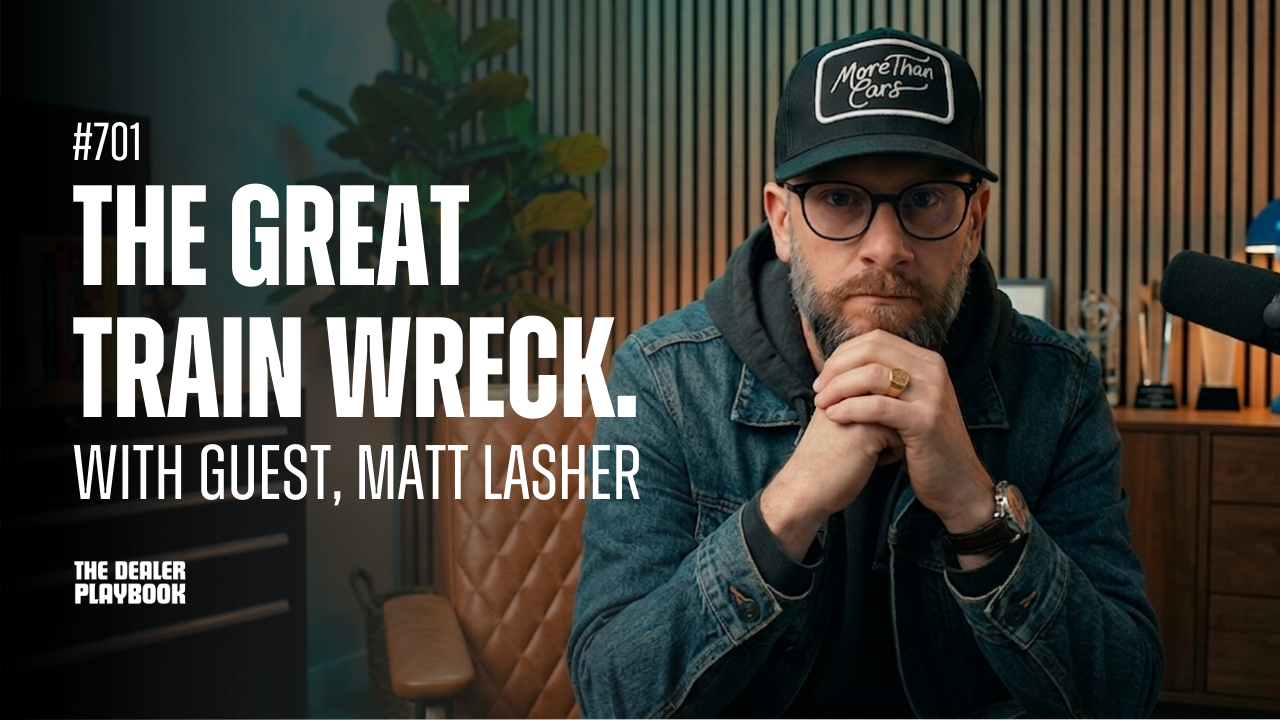
Matt Lasher pulls back the curtain on one of the most expensive and preventable problems in automotive retail. The moment a customer falls in love with a car, spends five hours at the dealership, and then the deal collapses in finance because nobody asked the right questions early enough.
In This Episode
What the great train wreck actually is and why it is happening at every dealership every single day
How the affordability crisis is creating a tidal wave that dealers need to start preparing for now
Why lenders and dealers are like Mars and Venus and what it costs everyone when that gap stays open
The hidden bias toward customers with credit challenges and why 40% of consumers have a credit score of 680 or less
Why empathy is not just a soft skill in automotive retail but a business strategy
How technology should be used to enhance human connection rather than skip over the people that make the deal happen
Matt's perspective on why dealers are resilient and why this crisis is no different from every other one they have survived
About Matt Lasher
Matt Lasher is President at Streamline Auto and a people first advocate in automotive retail. With a background rooted in dealership operations, Matt now sits at the intersection of auto fintech and the dealer lender relationship, working to make it easier for dealers to serve every customer that walks through their door.
Key Quotes
"The great train wreck happens not because we want it to but because sometimes there is just a lack of information at the point that they need it."
"40% of consumers have a credit score of 680 or less. If you are not thinking about the affordability problem you are just servicing the people that have buckets of cash."
"Dealers are resilient. There is just no stopping the dealer."
Resources and Links
Connect with Matt Lasher on LinkedIn
Learn more about Streamline at streamline.auto
Subscribe to The Dealer Playbook newsletter at thedealerplaybook.com
Join the Dealer Playbook community for more conversations that matter
Take Action
If this episode hit home, do two things. First, subscribe to The Dealer Playbook wherever you listen so you don't miss the next one. Second, leave a review. It helps other dealers find these conversations when they need them most.
Timestamps
00:00 Intro
00:48 Dealer to Vendor Shift
02:17 Affordability Train Wreck
04:26 Time Kills Deals
05:50 Lenders vs Dealers Gap
08:58 Tech With People First
11:32 Empathy for Buyers
15:21 Blind Spots in Credit
16:38 Connect and Wrap Up
17:22 Outro
Episode Brought To You By FlexDealer
Need Better Quality Leads? FLX helps car dealers generate better quality leads through localized organic search and highly-targeted digital ads that convert. Not only that, they work tirelessly to ensure car dealers integrate marketing and operations for a robust and functional growth strategy.
Watch The Full Episode
Prefer to watch episodes? Be sure to subscribe to our YouTube Channel and turn on notifications to get full access to our content.
Episode Transcript
INTRODUCTION
Michael Cirillo: Back to the show — Matt Lasher from Streamline Auto. Thanks so much for joining me.
Matt Lasher: Mr. Cirillo, it is an honor and a pleasure.
Michael Cirillo: I feel like you and I have more in common than the LinkedIn algorithm will ever let us discover.
Matt Lasher: Tell me more.
Michael Cirillo: Family men, for one. I mean, that could be said of a lot of people here — this feeling of not even having unpacked yet but already wanting to be home.
Matt Lasher: Listen, family first — you know what I mean? But it's great to see everyone here. NADA is kind of a second family, right? So it's the transition that's hard.
---
FROM DEALER TO VENDOR: HOW THE LENS SHIFTS AT NADA
Michael Cirillo: Can I ask you a sincere question? Going from dealer operations — working at the dealer group — to what you're doing now on what we all call the vendor side: how does the lens shift when you come to a NADA?
Matt Lasher: It's fascinating. I've attended so many NADAs with a dealer badge, and I have a lot of respect for dealers and for the overwhelming nature of what NADA is. I think the fascinating disconnect is that we all get really excited about our solution — the thing we do as vendors, the problems we solve. We care a lot about those things.
But a lot of times it's really disconnected from the dealer. The dealer themselves doesn't even feel it, understand it, or care about it. That's the riddle and the puzzle. Yet the industry is so great — it's such a relationship business. People do business with people they know and trust. People buy cars from people they know and trust. The industry is no different.
If you want to grow and have success as a vendor, as a dealer partner, or whatever, there are no shortcuts. You build relationships slowly, intentionally, over time. And I think that's what makes NADA so valuable — it's why we all have to have so much fun getting together.
Michael Cirillo: It's speed dating. Speed dating that smells like money. OK, I've got to talk to you about this — because you are sitting on what I believe is a tremendous amount of data with the work you're doing at Streamline.
---
THE AFFORDABILITY CRISIS AND THE GREAT TRAIN WRECK
Michael Cirillo: I want to get into the affordability crisis first. Let's talk about this thing you call "the great train wreck." I need to know what you're seeing. What corner are you looking around right now, and what's your sentiment?
Matt Lasher: Look, affordability is a topic you see in the headlines — $1,000 car payments, new cars continuing to rise in price, high interest rates. The affordability problem is becoming more and more well-known. But back in 2006, Greg Goebel — give credit where it's due — coined the phrase "the great train wreck." And it's a problem that still exists at every dealership, everywhere, every day. And it's getting worse.
The great train wreck goes like this: I spend five hours with you, Mike. I show you all these great cars your family could use — you need the third-row seat, everything looks perfect. We test drive a bunch of cars and you fall in love with the Cadillac Escalade. Let's write this deal up. But then we get to the finance office and I realize — I forgot to run your credit. I never asked how much you make per month. And now I don't have a deal that's financeable.
We've created the great train wreck. The customer's unhappy, the salesperson's unhappy, the sales manager's unhappy, the finance manager's unhappy, and the lender is upset because nobody has the opportunity to do any business. It happens not because we want it to, but because sometimes there's just a lack of information at the point when it's needed most.
Michael Cirillo: And that creates a ripple effect into the customer experience — or, as I like to call it, the guest experience, because customers should be treated like guests. This is a hospitality business at some level. When friction is created at so many points, it kills the excitement of car shopping — because buying a car can be exciting.
Matt Lasher: It can be exciting.
Michael Cirillo: Exactly. But when it isn't, it's almost like watching the train not just hit the obstacle and wreck, but also watching the rear end of the train implode on itself.
---
TIME KILLS DEALS
Matt Lasher: There's a phrase car dealers use a lot: time kills deals. If you work at a dealership, you understand it. It's a simpler way of describing the friction we're all aware of.
Time kills deals in all sorts of ways. If I spent five hours with you at the dealership and now you can't leave with that car — are you coming back to see me?
Michael Cirillo: I'd be a little bit upset.
Matt Lasher: Maybe not. And even beyond that — the speed and throughput of the transaction, the efficiency of the dealership — those are huge. We're talking about it everywhere here at NADA: all the ways AI and technology can help us be better, faster, smarter. That same thinking applies to the F&I office. Nobody wants to spend two hours going back and forth through paperwork and add-ons.
So we've got to juggle all of these complex things. Sometimes it's a financing issue, sometimes it's related to affordability. Sometimes it's just that the finance manager wants to add an extended service contract and extend the term from 72 to 84 months. There are practical things we can do to help speed up throughput at the dealership — addressing affordability, improving protection, and enhancing the consumer experience.
It's a layered problem, and it connects to the haves and have-nots — whether you have money or you don't, and the different problems different lenders are solving within the ecosystem.
---
THE GAP BETWEEN LENDERS AND DEALERS
Matt Lasher: Observationally, here's what I'm learning: lenders and dealers are like Mars and Venus. There's a Grand Canyon between them. We use different language. I go to all these lender events now with my dealer lens on, and I'm struck by how they seem to be skipping over the dealer entirely. And we're all about people — the power of people and the value that dealers add in the process.
Michael Cirillo: You mentioned that lenders are skipping over the dealer. Say more about that.
Matt Lasher: People in the lending world don't always appreciate the value that people are adding in automotive retail. Take the F&I role — it's often misunderstood even inside dealerships. General managers and principals sometimes don't pay close attention to F&I because it produces a lot of profit. But you've got people like Adam Marberger and others who are training F&I managers and growing leaders in the business. How do we sell warranties more effectively? How do we improve the customer experience? How do we provide real service to the people buying cars? There's so much opportunity for improvement, and that's what makes this work exciting.
Michael Cirillo: So being in the room where those conversations are happening — that's part of the opportunity you're seeing. It's that "don't waste a good crisis" mentality. There's a train wreck — let's make it not a train wreck.
Matt Lasher: Bro, I love that. Dealers are so resilient. Think about 2008 — Lehman Brothers, cash for clunkers — and then COVID. We came out smelling like roses. The affordability crisis that's coming, the tidal wave of people running out of cash, negative equity, high interest rates — all of these affordability constraints — dealers are going to figure this out too. There's no stopping the dealer. And that's the value that the people in auto retail bring.
---
TECHNOLOGY THAT PUTS PEOPLE FIRST
Michael Cirillo: From your vantage point at Streamline, you mentioned you're in the room with a lot of lenders now. What types of things are coming up where you think, man, I wish a dealer was in this room?
Matt Lasher: All the time. Take a simple question like: how can a lender help a dealership? Lenders provide the liquidity — somebody has to buy these contracts and loans. So how can a lender be better? One answer is dealer-facing technology that helps dealers navigate lender programs. That's a biased answer because Streamline helps do exactly that — but there are other providers in that space too.
A more nuanced answer came from Rob Cochran, who spoke at the NADA Chairman's event just the other day: it's about the relationship. Are you genuinely thinking about how to grow your relationship with your dealer in an increasingly digital world? How can you have practical, productive conversations that help dealers do more business?
Michael Cirillo: I've been wrestling with something — and I'm not sure I've fully figured it out yet, but I think you're the right person to help me work through it. On one side, there's this idea that technology will figure everything out for us. On the other side, humans deeply desire to have other humans help them figure things out. How do we reconcile that?
Matt Lasher: We share a people bias — and I think that's the key. It's about not taking for granted the skills you may not fully understand. A really talented F&I manager — if you've never sat in that seat, you may not appreciate the art of what they do. If you've never understood it, it's tempting to just skip over that person. That's no different from how some lenders think about dealers: I want the loan — why do I need the intermediary? But it's an indirect automotive lending model. You're not going to change that model, so you have to embrace it and respect the skills within it.
The same goes the other way. As a dealer, do you appreciate the underwriter who texts you back immediately on a tough application? Do you know their name? We can just be human about it. And I believe technology can help grow those relationships in productive ways. If there's a way to enhance what we already have and allow our businesses to grow together — that's where AI and efficiency can actually play a meaningful role.
Michael Cirillo: That seems to be the theme I've picked up on today. Four months ago, it was AI is killing everybody's jobs. Fast forward to now, and the conversation is: if we do this right, AI is going to speed up human connection.
Matt Lasher: If we do it right — exactly.
Michael Cirillo: Words like empathy, trust, discernment — these are all coming up when I think about a people-first approach.
---
EMPATHY FOR EVERY BUYER
Michael Cirillo: Can we talk about empathy as it relates to customers who have less money?
Matt Lasher: The world has a bias toward people based on how much money they have. In the car business, there can be a tendency to view someone with challenged credit, an affordability issue, or a lower income as a headache. It's going to be hard to sell this person a car. I might have to discount it, there's a bank fee, I'm not going to make money — it's not worth my time. That stigma exists. But I come at it from the point of view that we're all equals, regardless of what's in your bank account.
One of the underlying premises at Streamline is this: can we give dealers the information they need to serve that person more easily? Let's make the customer with a 580 credit score who just had a bankruptcy discharge your best opportunity of the day — one you can serve quickly, efficiently, and transparently — just like you would an 800-score customer who can buy whatever they want.
Michael Cirillo: This really resonates with me. I have a friend who is the head orthopedic surgeon at his hospital — making well over a million a year. He told me that one of his colleagues, another well-paid doctor, was going through a divorce. And he said a divorce is enough to break even the wealthiest person's finances. All of a sudden, that person couldn't get approved for things he would have taken for granted before.
And to your point — you just don't know people's situations. We hear the reverse of this all the time: the story of the kid who walks in looking casual and wants to buy a Lamborghini, and the dealer dismisses him. But it goes both ways.
Matt Lasher: Exactly — we put people into credit criminal buckets, but the reality is that the safety net just wasn't there for them. A divorce, a health issue, a job loss, owning a restaurant during COVID — life happens.
Michael Cirillo: Or someone who comes to a new country and doesn't realize they're starting over with no credit history, but still needs a vehicle. Those life circumstances don't eliminate the need for a car. And I'll be honest — I've personally sat in the seat of being told "we can't help you," and I had money. I felt that dismissal, and it stays with you.
Matt Lasher: This is a big financial purchase for people. It's an important decision. Finance managers, sales managers, GMs, salespeople — we have this opportunity to guide people through something genuinely stressful. But when you're at the dealership all day every day, it's easy to lose that perspective. Sign here, $1,000 a month, no big deal. But for some people, that payment is something they're choking on.
Michael Cirillo: And here's the thing — how many dealers have never actually bought a car themselves? They've never gone through their own process as a customer.
Matt Lasher: They haven't. Or they've gone through a completely different version of it.
Michael Cirillo: Right. We can speak so freely about things because we're inside them — and sometimes that removes a level of empathy that, if it were present, would completely change how we approach the problem.
---
THE BLIND SPOTS IN CREDIT
Matt Lasher: And there are real blind spots. I could talk to any luxury dealer in the country and they'd say, "Oh, we don't do subprime business." Then I could pull their credit applications in RouteOne or DealerTrack and show them that the more applications they put into the system, the closer they are to the national average: 40% of consumers have a credit score of 680 or below.
The more statistically significant the application volume, the clearer it becomes — yes, you do have customers with affordability challenges. Yes, you do have customers who just went through a bankruptcy, a divorce, a health scare, whatever else. And if you're not thinking about the affordability problem, you're not serving them. You're only serving the people with buckets of cash. That's K-shaped economy stuff — haves and have-nots.
Michael Cirillo: I love this conversation. Every now and again, especially at a NADA, you have a conversation that cuts through differently. Matt, I feel like you're coming at this from a genuinely different angle, and it's one we should all be thinking about.
---
CONNECT WITH MATT
Michael Cirillo: As we wind down — how can those listening or watching connect with you and learn more?
Matt Lasher: LinkedIn is the place. Send me a message and I'll find you — or just tag me in one of your pieces of content and I'll see it. We're all gluttons for attention out here.
And I should plug the company: streamline.auto. Check out the website. We'd genuinely love the feedback — even if you think we're nuts for what we're doing over here.
Michael Cirillo: We're here at the Auto Media Marketplace at NADA. Matt Lasher — thanks so much for joining me on The Dealer Playbook.
Matt Lasher: Brother, so good to see you. Thank you so much.
(Outro) Hey, thanks for listening to the Dealer Playbook Podcast. If you enjoyed tuning in, please subscribe, share and hit that like button. You can also join us and the DPB community on social media. Check back next week for a new Dealer Playbook episode. Thanks so much for joining.