"Absolutely Cancerous" - The Biggest Problem In Retail Auto and How To Solve It | Michael Cirillo, CEO at FlexDealer
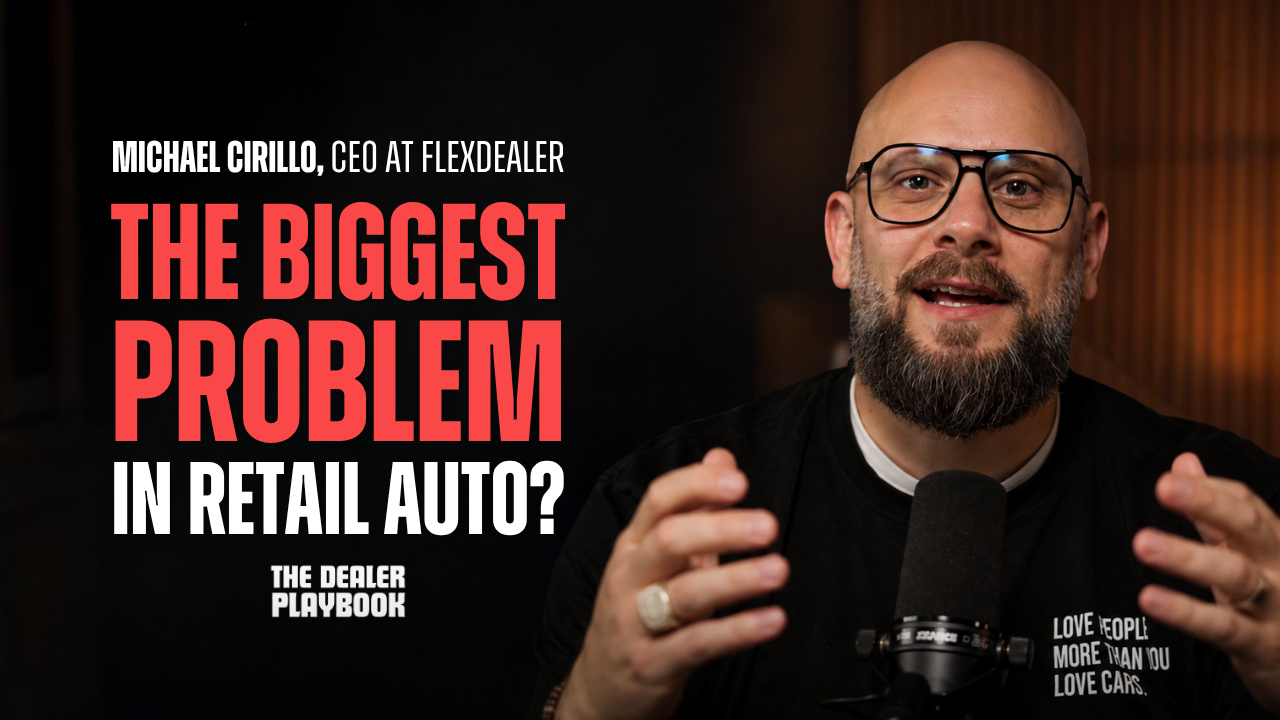
Most people assume the biggest problem in retail auto is inventory, rates, or competition.
But every time I walk into a dealership, I see something else at the core of the struggle. It isn’t obvious on the surface, but you can feel it in the turnover, the burnout, the “busy but not fulfilled” pace that too many teams are stuck in.
In this week’s solo episode, I share what I believe is the biggest problem holding retail auto back, and how you can solve it. It’s the same framework my team and I use in my companies, and it’s made all the difference in how we lead, how we serve, and even how I show up at home with my family.
I think you’ll find it both challenging and hopeful.
Timestamps
(00:00) Ethical Fading Warning
(00:35) Episode Sponsor: FlexDealer
(02:05) Legacy Matters
(06:46) Why Teams Feel Stuck
(10:25) Defining Ethical Fading
(13:14) Reset With Values
(16:30) Guiding Principles Exercise
(19:50) Six Genius Types Explained
(24:18) Action Steps And ROI
(27:18) Using GPT As Chief Of Staff
(30:24) Final Thanks And Subscribe
Episode Brought To You By FlexDealer
Need Better Quality Leads? FLX helps car dealers generate better quality leads through localized organic search and highly-targeted digital ads that convert. Not only that, they work tirelessly to ensure car dealers integrate marketing and operations for a robust and functional growth strategy.
Watch The Full Episode
Prefer to watch episodes? Be sure to subscribe to our YouTube Channel and turn on notifications to get full access to our content.
Episode Transcript
[0:00] Intro (What’s Coming Up)
Ethical fading runs rampant in the automotive industry.
Ethical fading happens when leaders prioritize short-term wins above anything else. Ethical fading happens when leaders prioritize a lack of accountability.
Keeping the top-performing salesperson because they generate a ton of revenue, but are absolutely cancerous, sends a clear message to the rest of the team: we are willing to give up on the things that we say matter most in lieu of monetary gain.
Think of that ripple effect. So ethical fading is something that should be avoided at all cost, and we'll get into how we can avoid it. But first….
---
Episode Sponsor: FlexDealer (0:35)
One of the things I enjoy most about producing the Dealer Playbook is hearing from you, the messages I get from people who are getting so much value out of the podcast, applying it to their day-to-day workflows, and finding a thriving career right here in the retail auto industry.
It means the world to me. And one of the ways we make doing this possible is through my agency, FlexDealer. In the spirit of providing value, I think this is a perfect time to invite you to visit www.flexdealer.com to show even further support for you, my beloved DPB gang.
Right now, if you go to my website, flexdealer.com, you can get a full, free PDF of my number one bestselling book, Don't Wait, Dominate. The reason I think it's so special is that a lot of the topics discussed in the book are even more relevant today than ever, with the surge in popularized AI and people wondering, "Well, what can I do next? How can I have a competitive advantage?" It's all in the book, and I'd love to offer you a free copy at flexdealer.com. It would mean the world to me, because that's how we continue to produce this show for you.
---
Legacy Matters (2:05)
Hey gang, welcome to this episode of the Dealer Playbook Podcast. I am so excited that you're here, because we're going to dig into a framework that I've observed has helped teams all over this great industry, my team at my companies included, dominate and perpetuate something I know we all care about: legacy.
Amplifying legacy. Building a legacy. Building something meaningful, that brings fulfillment, and shows up in the right way for our customers, for our team members, for our organization, our community, and so on.
This has been on my heart lately, because as I'm visiting dealerships, going in and out of stores, I'm seeing a common thread. My observation is that while there are marketing, regional, or sales-specific challenges each store faces, they all kind of boil down to the same issue. And I think it's high time we address it.
Our industry loves legacy. As a background, we just love it. Our industry has third and fourth-generation owners now, and the pictures are all over the wall of the forebearers, the people who paved the way. That means a lot to us in this industry.
My legacy, my family's history, means the world to me. I often find myself going down the wormhole considering: my grandfather on my dad's side fought on the front lines of World War II. He was a lone survivor, immigrated to Canada at the same time my mom's family immigrated to Canada from Portugal. Somehow they moved to the same city, somehow showed up to the same church festival, and somehow met each other. That's how my parents met.
I love thinking about that stuff. Then I get into the legacy side of it, which is the sacrifices I know my grandparents made, on both sides, to provide just a little bit better of a life for their children, my parents. And the sacrifices my parents made to build something special in our family, to give us an even better lifestyle and setup than they had.
And then I think about the work my wife and I are doing for our children, to carry that baton, to lift that torch, building something special, fulfilling, and satisfying.
Of course, legacy is tied to family most often. Yes, we do cool things in business, but it's tied to family. The family is the most precious unit, the most precious organization in the world. And when we come together as families to build something, create something, and teach our children to go out into the world as noble citizens, stalwart, service-oriented, God-fearing people, that's the stuff that brings us all fulfillment.
What we do for our career, what we're doing in the auto industry, is an extension of that. How we perform and function at work is a mirror of what's happening at home, most often. I'm a firm believer that no material success will ever compensate for failure at home. We talk a lot about leadership and legacy in this industry, and it's like, if I'm a crappy parent, and I'm sorry, that's harsh, but if I'm a crappy parent and I can't lead my family, or lead myself even, what does it matter if I have a leadership title at work? I don't believe that's legacy. That's not part of legacy.
We care about legacy. My buddy Glenn wrote a book called The Legacy Titles, which encapsulates how to grow a business while building on the foundation of legacy. I've had conversations with my dad where I've said, "Look, I am so grateful for what you and Mom have done for me, and as part of that legacy, the only way I can pay it back is to pay it forward."
I think that's something we all care about in this industry. We want to build something that lasts.
---
Why Teams Feel Stuck (6:46)
The men and women in this industry are showing up day in and day out, grinding it out. And sadly, from the conversations I have in and out of the dealerships we visit and work with, it seems there's a lack of fulfillment. There's an anxiety, because growth doesn't seem to be happening or pacing the way individuals think it should.
We have evidence of this. Look at the turnover that still exists in the automotive industry in 2025. It's still pretty abysmal, people jumping around like crazy. You don't believe me? Go on Facebook right now. Three scrolls and you're going to see people who just got hired here, who are no longer there, who now work there, who don't work there anymore, who moved on. It just happens.
I think the reason that happens is twofold, and it's not fair to just blame leadership. There's self-accountability in that equation too, based on what I've observed. While we like the idea of legacy, and we feel warm and fuzzy talking about it, we don't necessarily have a framework to create it, to show up every day with purpose, with a renewed sense of urgency around that purpose, with the focus required to fulfill it.
So we want to believe what somebody who's trying to get us to work for them says, what the organization is trying to sell us on. And six months go by, and we realize it's not that.
My hope for this episode is that I can leave you with something tangible, something I'm genuinely excited about: the beginning of a framework that, if you implement it, will create unlocks inside your organization, inside your existing team.
If you're a leader like me, you're constantly examining: what can I be doing differently? What ownership can I take to understand the circumstances better, help build the vision, and help deploy people in the right direction? Because we care that people are facing in the right direction, with the right level of accountability and understanding, moving at a pace that's equitable. They see growth, which inspires them to move with more rapid pace, and we see their growth, which fuels our desire as leaders to feed more into them.
I've discovered something I think is so powerful, something we utilize at my companies, that's brought tremendous understanding, so the legacy we all want to build comes to fruition in an organized, fulfilling way. So that stress levels decrease, focus increases, profitability increases, customer experience increases, and so on.
But before I get to it, I want to share this, because I talked about the common thread I see: lack of vision, lack of purpose, not knowing why we show up, lack of personal leadership and accountability.
---
Defining Ethical Fading (10:26)
There's something else that happens in our industry. It runs rampant. It's something Simon Sinek refers to as ethical fading. We see this in every industry, and I want to read this to you because I think it's important we understand it.
This is from Simon Sinek: "Ethical fading is a condition in culture that allows people to act in unethical ways in order to advance their own interests, often at the expense of others, while falsely believing that they have not compromised their own moral principles. Ethical fading often starts with small, seemingly innocuous transgressions that, when left unchecked, continue to grow and compound."
As I read that, are you thinking, "Yeah, yeah, I got it, that's a thing"? Ethical fading runs rampant in the automotive industry. It happens when leaders prioritize short-term wins above anything else. It happens when leaders prioritize a lack of accountability. We see it all the time. We talk about it all the time.
Keeping the top-performing salesperson, because they generate a ton of revenue but are absolutely cancerous, is ethical fading. Why? Because it sends a clear message to the rest of the team that we're willing to give up on the things we say matter most, in lieu of monetary gain.
So what happens is people start saying, "Well, if that's the case, then I'm going to cut corners. I'm not going to put my best effort in. Why would I? Why don't I just save time for me?" That's the ripple effect Sinek talks about: a condition in a culture that allows people to act in unethical ways to advance their own interests, often at the expense of others.
Think about that ripple effect. The corners you're willing to cut don't just impact the person working right next to you. They might impact an entirely different department, with team members you don't engage with day to day, who have no idea why they're feeling negatively impacted, and it was the ripple effect caused by your own ethical fading.
Ethical fading is something that should be avoided at all cost.
---
Reset With Values (13:18)
The way we avoid it is by setting clear values, adhering to them, building our team based on compatibility with those core values, having a clearly defined mission, and having the critical actions we'll take each day.
Paul Daly does this so well at More Than Cars. He reviews the critical actions, the core values, and the guiding principles regularly with the team, principles that should invigorate the team, but also, in a positive way, weed out individuals who aren't compatible with those beliefs, values, and mission.
Now, I know it's difficult. You might be thinking, "We're too far gone. This would be an awkward conversation." Please have it. Please have the difficult conversation. Please apologize. Please solve the resentments. Please seek to reset, whether you're the leader or a team member who's realized ethical fading in yourself, and say, "I'm done with this behavior, and I'm showing up not just for me anymore, for my family, for my legacy, for my ability to set up the next generation of automotive people so they have it a little bit better than I had it."
That's how we truly build legacy in the automotive industry. When we look at legacy and its impact, what do we often talk about? We talk about our forebearers, second-generation owners, first-generation owners, the people who started it all. We say they had accountability, they were hardworking, they had vision, they cared about people, they felt stewardship for the people. It wasn't just that they built a business. It wasn't just that they were good with money. There were guiding principles that laid the foundation of their legacy. That's largely why you're experiencing what you're experiencing today.
---
Episode Sponsor: FlexDealer (16:03)
Does your marketing agency suck? Before we hop back into this episode, I know you know me as the host of the Dealer Playbook. But did you also know I'm the CEO of FlexDealer, an agency helping dealers capture better-quality leads from local SEO and hyper-targeted ads that convert? If you want to sell more cars and finally have a partner that's in it with you, visit flexdealer.com.
---
Guiding Principles Exercise (16:38)
Let's hop back into the episode. Something you can do, whether you're a leader or a leader of one, is sit down and ask: what are my guiding principles? What are my critical actions? What's my mission? What's the reason I show up every day? Am I grinding it out just to pick up a paycheck? I doubt it. If you really boil it down, it's because you want to build something special, a life for your family that sets them up to have it a little bit better than you had it.
Now, when it comes to teams, you might say, "This is fine and dandy, but boy, are there annoying people on my team who get in the way and make it so difficult to show up and lead well." They're so annoying, they can't get out of their own way, the drama, right?
I have something for you. This is something I look at frequently, daily in fact, sometimes several times a day in my organization: an assessment you can do. Yes, you have to pay for it. Believe me, it's worth it. It's called the Six Types of Working Genius Assessment.
---
Six Genius Types Explained (19:50)
The Six Types of Working Genius Assessment is not a personality assessment. The best way to describe it is a mode of operation assessment. It helps you identify your zone of working genius, the competencies you have that are genius, that bring you joy. It helps you identify working competencies, things you're good at but that aren't quite your zone of genius. And then there are working frustrations, the things you can do, but you don't derive joy or happiness from doing.
Remember, we talked about fulfillment and building something meaningful earlier. I think it's incumbent on every organization to have everyone take the Six Types of Working Genius Assessment. Why? Because in this industry we often say, "They were the right person in the wrong spot, and I wasn't quite sure where to put them, so they're not here anymore." We hear that a lot.
If you understand your team's zone of working genius, working competency, and working frustrations, it gives you a visual map of who's most compatible working with one another, and a deeper understanding of how your people operate, so you can better unify your team.
I'll give you real examples from my own team, without naming names. The six types are: discernment, enablement, tenacity, invention, wonder, and galvanizing. Everyone has two working geniuses, two working competencies, and two working frustrations.
My own working zone of genius is discernment and enablement. Discernment is identifying whether an idea or project will work, understanding its viability. Enablement is demonstrating to my team that it will work, and enabling around that.
Invention is loving to create new ideas. Wonder is floating in the clouds, deriving joy from considering every last angle. Galvanizing is rallying the troops, bringing people together. Tenacity is "get it done:" you want me to run through that wall? I'm going to run through that wall, let's get the job done.
Wonder floats in the clouds and whispers, "Would you please rain?" Tenacity says, "I don't need rain, I'll make my own, I'm going to turn the soil, why are they up in the clouds whispering for rain when the task is to turn the soil?"
When your team takes this assessment, and you start to look at them, I promise you'll gain a greater understanding of the people you have stewardship over, if you're in a leadership position. Team members will also gain a better understanding of how they work with one another, and where the drama comes from.
Somebody with tenacity might genuinely clash with somebody who leads with wonder. But because these are modes of operation we naturally derive joy and fulfillment from, every team needs a mix of these individuals. A tenacious team without wonder will rot in the field. Tenacity says, "The task was to run through the wall, I'm going to run through it." Wonder says, "Yeah, but when you run through it, will you even be in the right room?" We need tenacity to run through walls, as much as we need wonder to determine whether we're headed the right way.
Emer, our chief revenue officer at Flex and LiftKit, is a 20-year retired Marine, and I love the parallels to military operations. I've learned so much from him. As a Marine, he talks about being the tip of the spear: go in, penetrate, tenacity. But I asked him once, "Would you ever deploy on a mission if there was no strategy?" He said, "No, never." I wonder if the person helping develop the strategy leads with wonder. There has to be somebody who wonders. There has to be invention, creating ideas, "what if we tried this?" There has to be discernment: "I'm looking at it, I think this is viable, or not." And enablement: "Yep, this is going to work."
---
Action Steps and ROI (24:18)
So what's the action item from this episode? Do a Six Types of Working Genius Assessment with your team. Pay for it. Budget it. It's critically important, because when you examine how your team operates, it becomes so much easier to understand them, and understanding is the pinnacle of knowledge.
When you understand, your actions, behaviors, and mindsets shift. You start to avoid some of the drama, because when you encounter it, you can look at the individuals at the heart of it and say, "They operate differently, and nobody has bridged understanding for them." But if we bridge that understanding, saying, "That individual's working genius leads with this, but it goes against that, and that's why you're feeling it," it creates room for empathy and lets team members find a resolution together.
This has been a game changer for my team. There are rarely conversations that happen from the seat I sit in as CEO where I don't say, "Let's look at the zone of working genius assessment for what you're experiencing, I think we'll find some answers there."
Again, it's not a personality assessment, it's a mode of operation assessment. You're setting your organization up in a way that brings everybody growth, gives them the right foundation and level of understanding, gives them the ability to unify, and gives you, as the leader, the ability to set a vision that matches their mode of operation. That creates an equitable relationship. And that, in my opinion, is how we build legacy.
---
## Using GPT as Chief of Staff (27:18)
You're probably wondering, has Michael done this for his own family? The answer is yes. My wife, my kids, we've all done zones of working genius assessments. What a game changer, as a parent, to understand my child a little bit better.
What I love about it is that it's not pointing out strengths and weaknesses. It's simply saying: you naturally derive joy from operating this way, you don't naturally derive joy from operating that way, and you're good at operating this other way. Imagine knowing what drains your team. Imagine knowing what empowers them. If you want to solve for building a legacy, solve for the attrition problem this industry has, solve for the drama, solve for having the right person in the wrong spot and not knowing where to put them, assess their zone of working genius.
Here's a little nugget. Take it or leave it. Once you have all your assessments completed, go into your GPT, create a project. Mine's called Chief of Staff. I have a Chief of Staff project in my GPT for FlexDealer, for ASOTU, for LiftKit. I put all of those zones of working genius in there, all the PDFs of all the assessments. Now I can use my GPT to help me draw connections, build training curriculums, run after-actions, or what we call practice sessions, and reframe or reposition things so we're getting the best out of each member of our team.
Because authenticity matters to me, I'm not going to sit here and convince you we're perfect. But we're striving to be one percent better every day. And what I can say authentically is that doing these assessments has been an absolute game changer.
---
Closing (28:39)
Holy smokes, what did we cover? So much. We talked about the importance of legacy, a general issue our industry has in not feeling like it's fulfilling that legacy or paying proper homage to the forebearers. We talked about why I think that issue exists. We talked about churn. We talked about ethical fading, and how we can avoid it.
Hopefully you felt the kickstart of a framework you can implement in your store, to get more from your people, for your people to get more from themselves, and to build a solid foundation to keep building on.
I believe it's our duty as stewards, not leaders, not managers, as stewards. Each of us has stewardship for ourselves, and for the people who've been trusted to work within our tender care and concern. This will help you do that.
If you got value from this episode, if you're excited about the working genius assessment, I'd love for you to message me once you've completed it and let me know where you're at. I love this stuff. I'd love to hear how it's going, and how it's impacting your team. You can message me at michael@thedealerplaybook.com. Please visit us on our socials. It would mean the world to me.
Thank you so much for being here, and until next time, God bless.
---
Final Thanks and Subscribe (30:24)
Hey, thanks for listening to the Dealer Playbook Podcast. If you enjoyed tuning in, please subscribe, share, and hit that like button. You can also join us and the DPB community on social media. Check back next week for a new Dealer Playbook episode. Thanks so much for joining.