"Human in the loop" — Why AI needs organic intelligence in your dealership | Mackenzie Wiltrout, Stream Companies
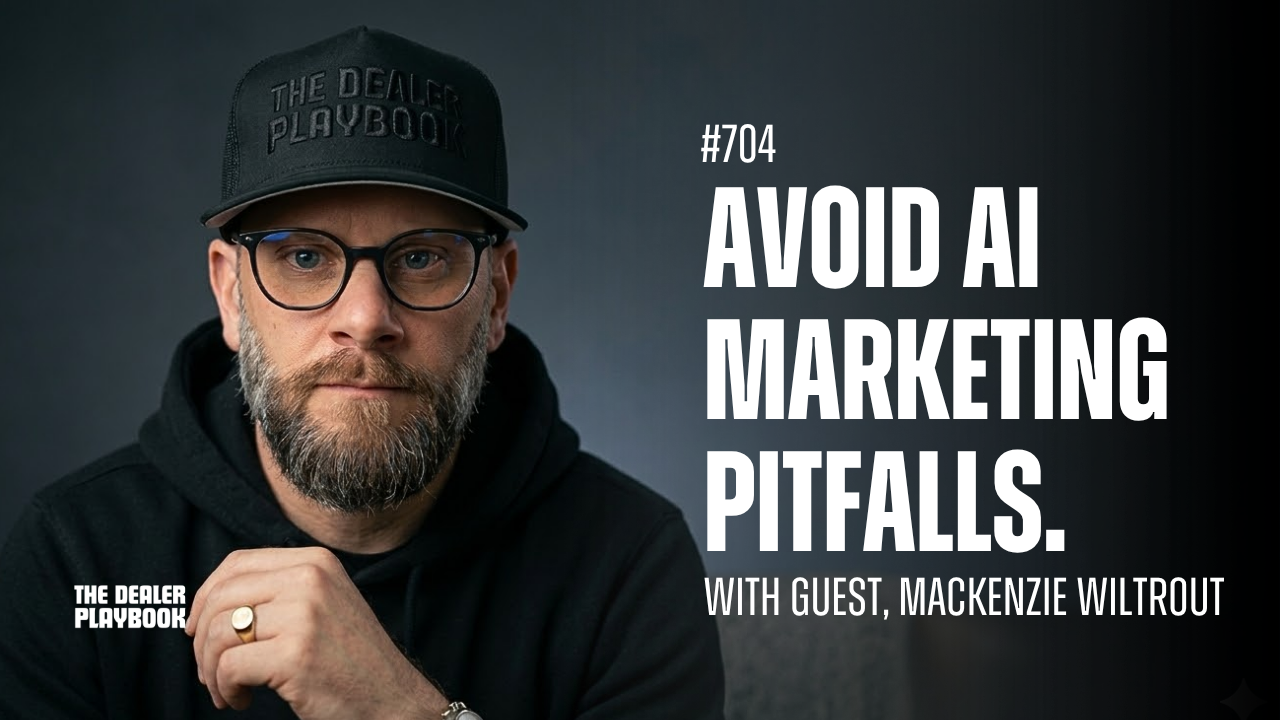
The AI hype is real, and every vendor at NADA claims to have the next big thing for your car dealership. But as you consider integrating new tools, are you truly solving problems or just inviting new ones? The promise of AI in automotive retail is vast, yet without a strategic approach and "human in the loop," the technology can quickly become a costly distraction.
In this episode, you’ll discover:
Why generic AI solutions often fail to deliver real ROI in a dealership setting.
How to identify and choose AI tools that provide actionable data instead of just affirming biases.
The critical role of "organic intelligence" in leveraging AI to move more metal and improve fixed ops.
Strategies for avoiding common technological pitfalls that lead to change management nightmares.
Mackenzie Wiltrout, VP of Innovation at Stream Companies, shares her expert perspective on finding impactful AI that genuinely drives dealer growth.
Follow The Dealer Playbook so you never miss an episode.
Timestamps:
00:00 Intro
01:11 AI Hype Versus Impact
03:14 Proof And ROI Data
05:59 Humans In The Loop
07:57 Bias And Obliging Chatbots
11:03 Stream Vision Orange OS
13:25 Data Vacuum Dangers
16:17 Outro
Episode Brought To You By FlexDealer
Need Better Quality Leads? FLX helps car dealers generate better quality leads through localized organic search and highly-targeted digital ads that convert. Not only that, they work tirelessly to ensure car dealers integrate marketing and operations for a robust and functional growth strategy.
Watch The Full Episode
Prefer to watch episodes? Be sure to subscribe to our YouTube Channel and turn on notifications to get full access to our content.
Episode Transcript
[0:13] Intro
Michael Cirillo: Alright gang, welcome back to this episode of the Dealer Playbook Podcast. I have my friend — and people don't know this, but we've had lots of conversations — my friend Mackenzie Wiltrout from Stream Companies. I'm so glad you're here. Thanks for joining me on the Dealer Playbook.
Mackenzie Wiltrout: Michael, thank you so much for having me. This is really an honor to be on your podcast.
Michael Cirillo: Oh shucks. Now, is this your first NADA?
Mackenzie Wiltrout: It really is!
Michael Cirillo: How's it going?
Mackenzie Wiltrout: This has been so exciting. I've been having a great time. The energy here this year has been amazing, and over at our booth we've had a lot of fun stuff that we're unveiling. Really just a banner couple of days.
Michael Cirillo: I just have to say, by the way, Stream always has some of the best swag at NADA. I'm just going to say it. Stream and its affiliates always bring the best swag — I had to run to registration to pick up one of the exhibitor backpacks because tomorrow is shopping day, friends.
[1:11] AI Hype Versus Impact
Michael Cirillo: Okay, I'm so excited to get into this. You have tremendous access to data, to innovation, to so many things you guys are building and working on — things you've seen work. So I'm curious: with the market flooding, and NADA flooding, with new AI tools in 2026, what does it truly mean to find impactful AI?
Mackenzie Wiltrout: This is a great question, because if you've walked the floor here at all — and I know that you have — every other booth, maybe even every booth, has AI listed somewhere. There is a flood of AI tools out there right now. But when it comes to impactful AI, I think what sets a tool apart, or a vendor apart, is not even the tool itself but their focus on the human element of it. Focusing on people, their pain points and problems, and how they're actually going to use it to solve real problems.
That is a question I have heard at our booth and floating around the floor: "How is this actually going to solve a problem?" I get that AI knows there are issues out there, it has access to data, and it can point at things — but we need a little bit more than pointing in 2026 for dealers to move metal off the lots with AI in their arsenal.
Michael Cirillo: What you're making me think of is back in the day when we introduced websites. It was pitched as a solution, but it actually created internal friction — because now we needed somebody to manage the website. Then we needed teams to manage websites. Then we needed a whole department. And my concern is, to your point, how do we navigate this to make sure we are actually solving a problem and not just creating a new one?
[3:16] Proof and ROI Data
Mackenzie Wiltrout: I have fielded that question quite a bit, and I always say the proof is in the pudding. You bring on a new tool, you're excited, everybody's telling you it's going to solve all your problems — help you sell more cars, service more vehicles, do your taxes, solve all your relationship issues. All of these things. But at the end of the day, if you have the tool and there is no reporting data after the fact showing the tool made a difference, there is no case study — then we have smoke and mirrors.
We always prize the data ahead of time, the data that underpins the AI before it goes to work. But I'm thinking about what comes after the flood — the data after the fact that shows a dealer was using this to build strategy, build campaigns, fill out their marketing funnel, and actually sell cars within their market. We need that reporting after the fact that shows a return on investment.
And to be honest, because we're still at that genesis point — these AI tools are still so young — we're still so early in understanding what AI can truly do for us. We don't have that full historical trail of data quite yet. But if you are working with a vendor who is educating you and taking the time to teach you how to use it, you should be able to see a return on investment. There should be numbers. There should be proof in the pudding.
Michael Cirillo: This is moving beyond technology in a vacuum. You know what it reminds me of? Getting blood work done by your doctor. You can work out, eat healthy, do all of the things — but it's the trailing data from three months of blood work that helps you understand the full picture. That loop back to the beginning is what informs what you do between now and your next blood test.
Mackenzie Wiltrout: Exactly right.
[5:59] Humans in the Loop
Michael Cirillo: So how do we encourage that shift in a way that's palpable and not a huge change management nightmare? How do we move beyond technology and start diagnosing the shifts we should actually make?
Mackenzie Wiltrout: I think it comes back to having people in the loop — in the process — working with you to understand what the AI is doing. Something I've seen quite a bit is vendors telling dealers that the AI is going to solve everything. So they hand it over under the misconception that it is self-driven — that it'll be able to answer your questions and figure everything out on its own.
Michael Cirillo: Going to lasso the sun, moon, and stars for you.
Mackenzie Wiltrout: Exactly. "It's an intelligence, so it's smart — it can tell you how to use it." That is such a misconception. Artificial intelligence needs organic intelligence in order to drive it correctly and to understand your specific use cases. That's another thing I see so much: general purpose, one-size-fits-all AI. Your standard, garden-variety chatbot — which is what most people think of when they think AI. They're smart and capable to an extent, but they're general purpose. They're trained on all the data, and when they have all the data to look at, they often don't know which specific data set to focus on for your particular problem.
[7:57] Bias and Obliging Chatbots
Mackenzie Wiltrout: My concern with general-purpose AI is that it tends to affirm your bias rather than challenge your thinking. It's seeking to understand your bias just so it can agree with it.
Michael Cirillo: That's exactly it. I've been in threads where I've given an AI all the information it needs and it still just affirms what I already thought. And when I push back, it apologizes — and then outputs the same thing anyway.
Mackenzie Wiltrout: Yes, because these are enterprise products. These companies are trying to make profit, and there is a sort of gamification to it. In the game world, systems are designed to make you want to keep playing — always dangling a carrot. AI being so agreeable is the same thing. It's saying, "Keep using me, you need me." Especially if you've already started offloading some of your cognitive work onto it.
Michael Cirillo: Right. We've even got a comment here on our live stream — Landon says he's had to handle a lot of this on his own because owners didn't think it was important to invest in technology or actual teams. And the reality is, we don't yet have a full understanding of what we truly need. A blanket AI is not the answer.
Mackenzie Wiltrout: Exactly. It's still dangling the carrot. It wants you to use it — but that doesn't mean it's solving your real problems.
[11:03] Stream's Vision and Orange OS
Michael Cirillo: This brings up something I want to ask as we wind toward our close: what is Stream's vision for helping dealers avoid these technological pitfalls while still taking advantage of what AI can do?
Mackenzie Wiltrout: At the end of the day, we are partners to our dealer clients — whether we're managing an account, driving strategy, or providing technology. We're creating a very purpose-driven AI within our Orange OS system, launching in 2026. It was built for dealers, by people who understand dealers. But this is not a scenario where we just say, "Have at it, go into the dashboard, let the AI solve your problems" — and wash our hands of it. Never.
We believe in people and relationships with people. Technology is part of that. We believe in educating our clients, helping them strategize, and empowering them to take that strategy into their own hands. We are partners in technology as much as we are partners in marketing strategy. There will always be a human in the loop to ensure you're using AI in a way that truly solves problems — not creating new ones, whether from an overloaded tech stack, inflated expectations, or bad data being consumed in isolation.
[13:25] The Danger of Data in a Vacuum
Michael Cirillo: Let's talk about that — data analysis in a vacuum. What are some of the things you've seen happen as a result?
Mackenzie Wiltrout: It always plays out the same way. A flashing red signal appears in the data. Everyone zooms in, blinders go on, and the team becomes so fixated on that one thing that they miss the holistic portrait. If I zoom in really close right now, I can only see your face, Michael. Zoom out, and I see this entire showroom floor — all these people, all these booths. The full picture.
When you're super zoomed in, you might be seeing something negative on one side while missing positive indicators right next to it that completely change the story. It's so important to zoom out and see the whole picture the data is actually telling you. And frankly, that's where AI is genuinely powerful — it can ingest all the data and surface the full picture very quickly. Put all the cards on the table. Give it to me straight. Good, bad, and ugly. And often, when you see the full picture, the bad and ugly doesn't look so bad after all.
Michael Cirillo: What stands out to me is the ability to see it all laid out in front of you, and then apply the human filter — factoring in the nuance of your specific circumstances, rather than just taking the AI's word for it. The AI handles the analysis quickly, but you are ultimately the filter.
Mackenzie Wiltrout: Absolutely. And remember, when those red signals flash, there's an emotional reaction too. It gets a little knee-jerk sometimes.
Michael Cirillo: I know — I'm Italian. It's unavoidable.
Mackenzie Wiltrout: So having that emotionally unbiased layer of technology in your arsenal is genuinely valuable. It steadies the room.
[16:15] Outro
Michael Cirillo: I love this conversation. There is a real opportunity here to partner with a company like Stream, whose vast data set becomes the layer on top of the AI that actually drives the diagnosis and helps dealers make better decisions. As we close out, Mac — how can those listening or watching connect with you?
Mackenzie Wiltrout: Connect with me on LinkedIn — Mackenzie Wiltrout. You can find me as VP of Innovation at Stream Companies, or connect through the Stream Companies website. Or you can send a carrier pigeon. I'm very open to meeting new friends.
Michael Cirillo: Old school. Only send the carrier pigeon when you're trying to avoid Skynet. Mackenzie Wiltrout, thank you so much for joining me on the Dealer Playbook Podcast.
Mackenzie Wiltrout: Michael, thank you so much for having me.
Michael Cirillo: Hey, thanks for listening to the Dealer Playbook Podcast. If you enjoyed tuning in, please subscribe, share, and hit that like button. You can also join us and the DPB community on social media. Check back next week for a new episode. Thanks so much for joining.