Ondar Tarlow: Sell More Cars With VIP Activation Events | Car Sales | Ep. 676
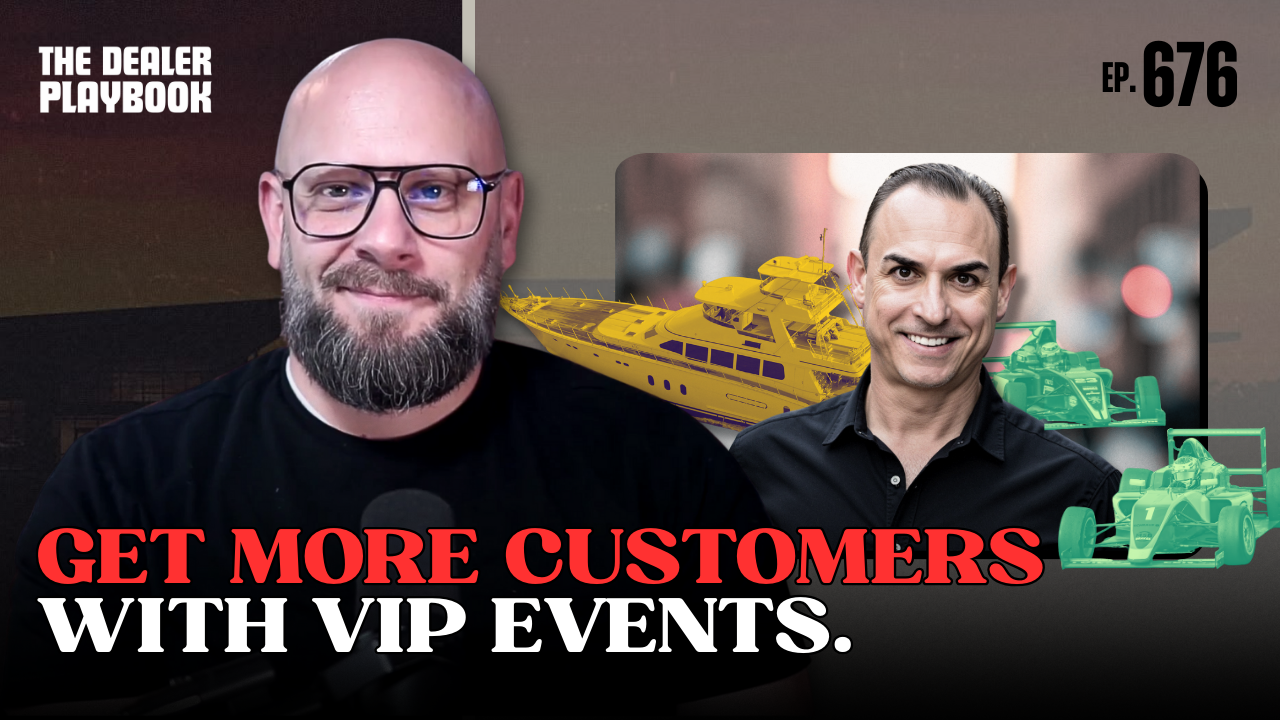
In this episode my guest is Ondar Tarlow, a marketing strategist with more than 20 years of experience working with brands like Fastlane Drive, Pacific Premier Bank, and the LA Chargers. He’s built a career on creating events and campaigns that actually move people—sometimes literally into showrooms.
We dig into the big question dealers wrestle with all the time: what actually makes an event memorable? Ondar breaks down why so many VIP activations fall flat, and what it takes to craft experiences that stand out in a world where everyone is competing for the same high-value customers.
You’ll hear insights on:
Knowing your audience beyond the surface level
Why cocktail tables and champagne won’t cut it anymore
How partnerships with other brands can elevate your dealership events
Lessons automotive retail can borrow from Formula One and pro sports
Where AI fits into the future of marketing without losing the human connection
If you’ve ever wondered how to make your dealership events more than just “another invite,” this conversation will get you thinking differently about experiences, community, and what customers really value.
Episode Brought To You By FlexDealer
Need Better Quality Leads? FLX helps car dealers generate better quality leads through localized organic search and highly-targeted digital ads that convert. Not only that, they work tirelessly to ensure car dealers integrate marketing and operations for a robust and functional growth strategy.
Watch The Full Episode
Prefer to watch episodes? Be sure to subscribe to our YouTube Channel and turn on notifications to get full access to our content.
Episode Transcript
MC: 0:00
So for the dealers listening in, what's a place that they can start after they have an understanding of their audience? Then what does it look like to make sure that an event they put on does not fall flat?
Ondar: 0:09
So I come from the marketing world and, of course, marketing and sales being deeply connected. So the first thing you need to know is….
MC: 0:13
One of the things that I enjoy most about producing the dealer playbook is hearing from you the messages that I get of people who are getting so much value out of the podcast, applying it to their day-to-day workflows and finding a thriving career right here in the retail auto industry. It means the world to me, and you know, one of the ways that we make doing this possible is through my agency, flexdealer, and, of course, in the spirit of providing value, I think this is a perfect time to head over to www.flexdealer.com to show even further support for you, my beloved DPB gang. Right now, if you go to my website, www.flexdealer.com, you can get a full, free PDF of my number one bestselling book, Don't Wait, Dominate. And the reason I think it's so special is that a lot of the topics that are discussed in this book are even more relevant today than ever, with this surge in popularized AI and people wondering, well, what can I do next? How can I have a competitive advantage? Well, that's all here in this book, and so I'd love to be able to offer you a free copy of this If you go to flexdealercom. It would mean the world to me, because that is how we continue to produce this show for you.
MC: 1:40
Ondar Tarlow is a marketing strategist with more than 20 years of experience leading award-winning campaigns. When he was the CMO at Connecta, Federal Credit Union and Pacific Premier Bank, his data-driven and creative storytelling delivered over $1.7 billion in product volume and tens of thousands of new customers. He's worked with brands like Fast Lane Drive, producing sponsorship activations for the LA Galaxy, Anaheim Ducks, Honda Center and Beach Life Festival, which I mean. Ever heard of any one of these brands? People, of course, you are known for leveraging AI to increase campaign performance five-fold. He's passionate about turning events into high-impact story-driven experiences. Passionate about turning events into high-impact, story-driven experiences.
MC: 2:26
The DPB gang knows a bio that invigorates me to ask questions and learn more is exactly what just happened, Ondar. I got to ask you this right out of the gates, especially in the context of automotive dealers. They love the idea of community activation. They love the idea of bringing more people into the dealership, getting more foot traffic. Some of them have tried cocktail parties and quote unquote VIP events. This idea of a VIP activation, I think, really stimulates a lot of desire in the dealer community. But I'm curious, from your perspective, from all the events you've worked on, what makes them underwhelming? What makes them great to be at and can you share an example of, maybe to start, a poorly conceived event that missed the mark?
Ondar: 3:19
Absolutely, and this is a great question, and I'm happy to be here today with you. What's interesting is you have dealers, of course, who are dealing in luxury and super luxury automobiles, exotic cars, hypercars, which I'm all very familiar with. And when you say VIP, I believe that VIP means different things to different people at different levels, and so the first thing you need to know is who is your audience, and that's key. So I come from the marketing world and, of course, marketing and sales being deeply connected, the first thing is who is your audience. You have to make sure that you have segmented your audience, you know exactly who you're going after. What is the demographic? What is the household income? What is the area or areas, from a geographic standpoint, that you're going after? What is the household income? What is the area or areas from a geographic standpoint that you're going after? What is it that you're looking for in terms of the cars that they're looking to purchase and, from there, really identifying something that is going to be unique to that segment, unique to that demographic. Because you have to remember, of course there's a lot of competitors out there dealers, et course there's a lot of competitors out there dealers, etc, manufacturers they're all vying for this small population, and so you have to differentiate yourself. And so if you're kind of leaning on kind of the same traditional things that you've done in the past, well you may be a little disappointed with the results, and so you have to focus on how to differentiate, to come up with something that's actually unique, that's different. So if your starting point is, hey, we're bringing in cocktail tables and we're bringing in champagne, and this is gonna be great because we have the cars on display, sometimes that can be a little flat, and I have seen that. I've experienced that many times. Folks who you're looking to contact and that you're looking to grow your network with and you're looking to sell vehicles with now and as well as into the future, have to be wowed. Today, everyone again is vying for that same population. So you have to rise above the fold in terms of what you're doing, and what I've seen most often in the marketplace is kind of the same population. So you have to rise above the fold in terms of what you're doing, and what I've seen most often in the marketplace is kind of the same thing. You receive an email looks good, you're invited to do a test drive. You're invited to go to a cocktail party and it's the same old thing again and again and again.
Ondar: 5:42
The way that you really stand out is to figure out what your audience is interested in. Are they also an audience, and is there a nearby body of water, as an example, where you could do something with respect to a yacht? So you're incorporating something that is at the level, or perhaps even a higher level, than your demographic, so that they're looking at this as something that they're interested in doing and it's an activity, as opposed to standing around a cocktail table and having the same basic conversations that they're going to do again and again and again. Right, most people will get bored by that very quickly and they're going to turn off to your dealership. They're going to turn off to your brand.
Ondar: 6:23
Oftentimes, you'll look at associations and marketing. If they're interested in a luxury or a high performance supercar, hypercar type of vehicle, they're probably interested in other things where that you can integrate other brands Watches are a natural fit. Anything to do with types of racing, of course, like F1, as an example, or IndyCar, that you can integrate into your event. Or maybe you're having an event at one of those locations, in a suite, at a booth, or perhaps you're bringing a vehicle, a driver or a combination thereof to your event to really spice things up.
MC: 7:00
Now, of course, I'm talking about various things at different budget levels but when you're focusing on this audience, you know that you're going to have to spend money to make money, and that's key. Do you even know your audience? And it sounds so crazy because I think to your point. You brought up the manufacturers earlier. They do a lot of that heavy lifting for us. They're doing the market research, they're figuring out what vehicles they should be building and who those vehicles are for. They're spending gazillions of dollars Don't fact check the number on marketing budgets and things of that nature.
MC: 7:44
But then I think when it delineates to the dealer body, some of that gets lost in translation. And to your point and to the question right, why do these fall flat? I love how you you bring it back to a foundational piece who's your audience? Who's your market? Who are you trying to activate? You brought up different budgets and I'm curious about this because it sounds like this is something whether you're super lux or a luxury brand and, by the way, love the watch reference because I'm not going to say I'm collector status yet, but I'm definitely a dial guy. My wife sometimes will come into our bedroom on dark. She'll be like what are you watching on your iPad? And I'll turn it around and that's some guy assembling a watch.
Ondar: 8:28
I've been there too.
MC: 8:30
It could be worse. It could be worse, but this sounds like I mean gosh. If you're a Jeep dealer to have some sort of off-road activity and I love that you use the word activity so for the dealers listening in, what's a place that they can start? Where do they need to be paying? After they have an understanding of their audience, then what does it look like to make sure that an event they put on does not fall flat?
Ondar: 8:57
Well, I think you said it. So, first, budget what is it that you have available as far as your budget is concerned? How many potential customers or existing customers are you looking to entertain? And then from there you've got to do research and really identify the types of events or activities that are available and that you can connect with other companies to support and help you, or are you creating something completely bespoke? One area to look at we mentioned watches, watches as well as beverage brands. Think about the brands that kind of revolve around automotive and then figure out if you can also align with those other brands to help support you in your needs, which also is a way to offset your budget, so that it's not completely set up to be supported by your individual dealership or dealership network Because those other brands this is the same audience we talked about watches or whether it is boating or whether it is hospitality.
Ondar: 9:53
You know, there's kind of the basic tenets if you think about this type of lifestyle. As far as cars are concerned and we'll get to the Jeep reference as well, but it makes sense is what are activities that this audience is interested in? So, are they interested in travel? Are they interested in adventure travel, and can you set something up so that you're taking that event and that activation to the next level? So we mentioned racing, we mentioned watches, we mentioned hospitality, luxury vacations. All of those things match up very, very well.
Ondar: 10:29
So in my time as I've been a member and also working to support Fast Lane Drive as far as brand partnerships are concerned, Fast Lane Drive is a 2000 member exclusive network across the world 23 chapters one in Monaco, one in Paris, Tokyo and 20 in the US. The reason that I bring that up is our audience is this luxury, super luxe, hyper car style audience, and what fits well for them is exactly that. It is experiences that are something that they cannot attain in their daily life. Because when we talk about competitors, it's not only the automotive brands that you're competing with, but you're also competing with other luxury brands that are also vying for the same audience. As time, it is a small population that has the wherewithal and the funds to be able to purchase these types of vehicles, and so, therefore, you have a lot of brands buying for that same timeframe and same uh, same mind space.
MC: 11:30
Hmm, I love that. It's not that. And tell me if I'm understanding this correctly. It's not that they can't attain these things because they're in that audience, it's that they can't attain it in their daily life. It's outside the norm, it's outside the routine. There's a measure of novelty to this experience.
Ondar: 11:53
That's exactly right because it's about access as well. So oftentimes if you are a high net worth or ultra high net worth individual, you have access, but you don't necessarily have the same type of access that can be achieved through dealer-dealer network as well as collaborating with other brands. As I mentioned, kind of the F1 reference, if you're bringing in someone from an F1 team which would really be at a top level, you know oftentimes an individual to have, that access is going to be difficult for them unless it revolves around a race. Or are you bringing in folks from the manufacturer? Those that are very interested in the automotive lifestyle find it fascinating to speak with engineers, to speak with designers face-to-face. That is something that is amiss in most events that I attend.
Ondar: 12:43
As far as automotive is, it's really left up to the dealer and the sales team, which have the best intentions, which is great, but at the same time, if they can call upon the engineers, the designers and others that can speak to the vehicle and how it was developed and how it was designed with authority and interest and charisma, then you're getting to that next level where again the average you know high net worth, ultra high net worth individual still does not have access to those folks, and that can be something that can raise the game, because if you're bringing in a let's say, you're an Aston Martin dealer and you're bringing in a designer from Aston Martin or an engineer or part of that core team, that's going to be of high interest to many of those that might be attending your event, and then you can use it to market.
Ondar: 13:30
Because let's go back to the foundation that we talked about a second ago you have to think about how are you marketing this? You might be marketing in your dealership, you might be marketing it via direct mail, you might be marketing it through email and you might be marketing it through social media, as long as you can target that audience. But then what is going to bring that audience to you? Beautiful cars, possibly, but it's also people and stories, because automotive, the automotive world, is sold on storytelling, and so you have to remember that as part of your marketing as well. So, bringing that audience in serving them well, so that when they see your brand, no matter where they see it, they're thinking about the experience that they had, that was truly unique of just how much the associations are in play in day-to-day life.
MC: 14:26
For example, my wife works at an all-women's gym. She's a fitness trainer there, but the owner of the gym also raises and trains horses. So horse racing, horses, and so of course now I'm paying attention to horse racing and I don't want to alienate this part of my audience, but I, I it's. I don't get it yet, but what I noticed is because I'm a watch guy, I immediately noticed my favorite watch brand which is associated with horse racing, which is long jeans, and I just love their watch. They're not the most expensive, they're not the cheapest, they're kind of they're in Michael territory, let's say they're in Michael territory and I love the way they look. And so I'm like, oh my gosh. And you know it's interesting what happened immediately? I was like, do I like horse racing? Now, like isn't this a thing? Because I already liked the thing I was familiar with.
MC: 15:31
And then I'm thinking about this you know there are some dealers who do fork out a lot of money to have maybe a celebrity affiliation, maybe it's the local sports team affiliation or something like that. But then, to your point, I was like you know if that's going to cost me like 100 grand. How cool would it be to put on an event, instead of having spending 100 grand on a celebrity, to say 14 words, to like dial in no pun intended to the watch crew and be like hey, at our event we are giving away long gene, like our guests at this thing will have, will get a long gene watch as a parting gift. Yeah, it's a hundred grand, but I get something to. Yeah, I don't know, you got my brain moving here.
Ondar: 16:20
Yeah, no, it's a great point because, again, it's that offer Some. You may have some folks that you know. When they show up to the dealership and the event, you know they think, great, I'm ready to buy a car. But usually it's not all of them, so there's got to be some connection point after that. Having some type of tangible and interesting offer to the audience is great.
Ondar: 16:39
It's also a great way to be able to collect additional data right, utilizing all the rules and regulations and transparency, so that you can continue that conversation with them. You know you may have their email address or their mailing address only, and that's how you contacted them to invite them to the event. But if they give you permission to be able to utilize their mobile number or other information that you can gather, you know, which is kind of fairly standard when you're doing offers, then that gives you additional data that you can use to market to them types of watches they like as an example. And so going back also to the experience aspect is to your point with watches is you know you bring in, you can collaborate with the watch company or a specific boutique that has multiple watch brands and they're bringing in. You know a master watchmaker which is going to help their business and obviously it's going to be interesting and intriguing to your guests as well as your customers.
MC: 17:37
This is. I love this. I love it because, especially in a such a tech focused world where it's like run Facebook ads, run Google ads, this sort of a thing, you can cut through the noise and be the one dealership who stands out, predicated on doing something that is out of the norm. And I think this day and age, from a human connection perspective, people want something to do. To your point about the experience rich people, poor people, middle class but it doesn't matter what your demographic is. We all want something to do and we want to connect with, with real human beings. That kind of sentiment, because you've brought up I've heard you bring up some unconventional venues on a yacht or you know, some sort of an experience or activity that would really stand out for that target audience, where dealers sadly still are challenged with this public perception of you know gimmicks and you know those sorts of things. What would your, what would you say to those that are considering doing something like this, so that it's met with the right intention from their audience?
Ondar: 18:54
Well, again, it starts with knowing your audience and being able to communicate and appeal to them on a level that's of interest to them, right. So it has to be a match. It has to be a match between the automotive brand or brands that you're representing and then the audience that you're looking to gather, whether, again, that's existing customers and you're looking potentially for additional sales or retention, or whether you're looking to bring in new customers. The buzzword, of course, is authentic. So it has to be something that aligns with their interests. If it aligns with their interests, they're not going to see it as a gimmick. They're going to see it as wow, this automotive dealership knows me and they know me enough to invite me to something that I have an interest in.
Ondar: 19:35
That's a key piece, because people are often proud of the vehicles that they drive and so they want things to be able to support that. You know themselves being proud and themselves looking at the brand as really part of that, because oftentimes, especially in your higher end vehicles, that persona that you have, the car that you have, sometimes blends together to a certain degree. If you have a sports car or you have a hyper car, you're obviously typically interested not only in more of a collectible style automobile, but then you're also maybe interested in racing and other things that go along with it. So being able to reinforce why they selected your brand or brands to begin with is something that people find important and they find interesting and they will activate with you.
MC: 20:33
Hey, does your marketing agency suck? Listen before we hop back into this episode. I know you know me as the host of the dealer playbook, but did you also know that I'm the CEO of FlexDealer, an agency that's helping dealers capture better quality leads from local SEO and hyper-targeted ads that convert? So if you want to sell more cars and finally have a partner that's in it with you, that doesn't suck visit FlexDealercom. Let's hop back into this episode. I don't think that we've and this is kind of ironic a car dealer podcast cars racing. I've never talked so much about or said the word racing as much as I have on this episode, and I want to ask you about that. It's poignantly placed. You brought up F1. You brought up IndyCar. Earlier You've said that sports sponsorships can galvanize new markets, and so I'm curious what some of the takeaways, let's say, from Formula One and pro sports activations translate directly to a show room when crafting a luxury client experience.
Ondar: 21:37
Yeah, absolutely so. It's about the imagery and it's about the experience. So if you're looking to align the two, you have to look at what are you bringing into the dealership or the dealership experience again digitally as well as physically, to be able to, you know, evoke that type of emotion. Or, as we talked about experiences, bringing, let's say, your top clientele to the track, or potentially even having a track day, which I do see some dealers doing, which I think is a great idea and works really well, Because, again, it's an activity you're getting people out into the mix and they're doing something again they can't typically do each day and is very exciting for them and, to a degree, that kind of runs itself.
Ondar: 22:26
One piece you have to obviously keep in mind of whether or not it is professional sports or F1 is part of professional sports is, you know, there's obviously budgets to that as well. So if you're expending dollars, you want dollars back. So the data capture piece and the follow-up is key and that's also where I see a lot of automotive manufacturers as well as dealerships fall down is that follow up. The follow up is key because you know as a dealership that oftentimes that sales cycle can be very long. So what are you doing on a consistent basis to communicate with that audience about something that they're interested in Not just sales, not just your latest lease deals, but different types of experiences, different types of subject matter that they're interested in, that you're branding as part of your email or as part of your website, or as part of direct mail or as part of any other marketing medium that you're doing is important to zero in on.
MC: 23:20
You talk about plan. Tell me if I got this quote right. Talk about plan.
Ondar: 23:27
Tell me if I got this quote right Plan, plan, plan, then data, data, data.
Ondar: 23:39
Yeah, that's from a previous show, but you're spot on there.
Ondar: 23:42
So if you don't have a plan, things, the things that you believe will work really well based on the research and based on the data that you have, and based on working either with the manufacturer or other dealerships but then also you need to have a test budget, and so that plan needs to incorporate both those that are kind of strongholds in terms of being able to bring in business and retention and those that you need to test with, and so that plan as well as that testing are key.
Ondar: 24:12
Testing nowadays is easier than it used to be in the past, but with additional data comes additional complexities. So the first thing is you have to make sure that you're trusting your data so that when you're planning and how you're going to utilize that data to market and then follow up and then obviously go down the entire funnel, it's very clear exactly what you're looking for as far as success metrics are concerned, and then, as you're testing what's working, what's not what's working, perhaps you double down on that as far as the budget is concerned, not what's working. Perhaps you double down on that as far as the budget is concerned, and perhaps you back off from what's not working. You look at it, revisit it, figure out what you need to tweak and then test again. This is, quite frankly, it's all. It is marketing. Obviously, the sales piece within marketing is all part of it, but you've got to start off with those basics.
MC: 25:02
I love that it's like you plan, but also acknowledging this thing that I don't think a lot of people who do marketing are comfortable with, which is account for failing in some degree, like what is the experiment, if not identifying the failure point and then trying again.
MC: 25:20
And so I love that you're approaching it from that angle, because it's like we can plan and plan and plan and plan and look at the data, but we do have to pass through this testing phase to really know how it's going to land. And then the data that comes out of that gives us so much more insight to work with. And, like you said, I love that you touch on this because I mean, gosh, this is the automotive industry, so that there's a positive ROI on the backside of this. Like nobody wants to really engage in anything now just to test or just to perpetuate brand if they can't track ROI. So I'm curious, when you're looking at all of this data, what are some of the key indicators you're looking for to understand? Yes, this worked. I mean, aside from money, because that's the easy thing. Oh, look, we met. But what are some milestone markers I guess along the way to know, yes, this test is going to bear fruit.
Ondar: 26:18
Sure, and these are the things that top brands who are successful do all the time.
Ondar: 26:25
But if you're a smaller brand, if you're an individual dealership or you're a group of dealerships, you can do this, you can do this same thing, and it starts off with it's a premortem.
Ondar: 26:33
So you have to identify what are the reasons that this campaign, that this activity, that this experience, that this event could fail.
Ondar: 26:42
That's important, not a postmortem. Sure, we could do that and figure it out, but let's do a premortem and identify all the reasons that something could go wrong, which typically there's a lot. If you're identifying them and then figure out how you're able to identify and figure out how to make sure that that doesn't happen as best as possible, you're going to probably eliminate a lot of those chances. So, and happen as best as possible, you're going to probably eliminate a lot of those chances. So, as opposed to kind of a hope and pray mentality, really is, you're planning it. And to the additional point that you made is one simple example is email marketing. So, with email marketing, there's some key pieces that you need to look at. So, first off, you need to make sure that you have clean data and you have to make sure that all the email addresses that you have are delivering. There are some relatively inexpensive tools that you can use in order to identify is your email list clean or is it a bunch of junk? Because if you've got a hundred thousand emails and 90,000 of them are not going through because they're old, outdated or whatever the case, the value of that list is dramatically less. So you have to look at we talked about data, data, data you have to look at that email address, that list of email addresses, figure out what are actually clean email addresses. Once you have that list, there's your audience. So let's say that you have a thousand email addresses and once you send out that first email, what is happening with that email? What is the actual open rate?
Ondar: 28:16
You need to be able to track open rate. I've seen this not too long ago in various businesses where they're having trouble even tracking the open rate, which is just inexcusable in today's world. With today's technology. That was maybe something 25 years ago.
Ondar: 28:29
You have to be able to track open rate and you also have to be able to track click to open rate. These are the basics. So how many opened and then how many clicked to perform an action. And if you don't have a click option within your email, you're missing out on a ton, because that's your first conversion action all the way through the funnel with, in this case, the email funnel. So, open rate, click to open rate.
Ondar: 28:53
And then what actually happened after they clicked? Did they land on a landing page? Can you track that landing page? Did they complete a form? Can you track the completion of that form to the thank you page? And then from there, is that information ingested in some type of CRM at your dealership to be able to then track it to an actual sale? So those are the basics, I would say, as far as data is concerned. But you see misses along the way in various companies and dealerships and this is what you cannot have happen. You have to have folks who understand marketing, you have to have folks who are comfortable with data. You need to have the right people in the right seats.
MC: 29:34
Speaking of people, we're in an AI crazed bubble right now and I want to talk to you a little bit about this. How are you seeing this impacting the ecosystem of what we're talking about now and where do you see it going in the future as the popularization of AI continues?
Ondar: 29:58
Sure. So let's talk about generative AI to begin with, and oftentimes that is used for content development, content ideation, as well as design. So, first off, if you've got a marketing team, even if it's a small marketing team, you need to identify what do you mean by AI? And then how can it fit into the workflow that you already have to not replace, but assist the team, that you have to be able to do more, be able to do more accurately and be able to do more quickly, so that you have to be able to do more, be able to do more accurately and be able to do more quickly, so that you have the efficiency gain. Fitting it into the workflow they have now, or adjusting the workflow so that it makes more sense in the AI world. And then, with Gen AI, utilizing tools and being able to test those tools so that you can come up with content content that's unique, that you check, that you fact check. It's not a copy and paste situation. You will make some very, very dire errors if you're doing copy and paste. As far as generative AI is concerned, whether utilizing a paid version of ChatGPT or Cloud or other tools, these tools are very handy, but you have to use them in the right way. If you're looking, one way to do that is ideation Ideation as far as campaign ideas but you have to give and you have to feed the AI engine a ton of information. If you're just simply looking for ideas that you can copy and paste, well likely you're going to have some other beginners on that level doing the same thing and you're going to come out with stuff that's very, very cookie cutter. I cannot emphasize that enough that it's AI has moved so quickly, especially the Gen AI side of content the written word, if you will as part of that content that people will spot content and be able to identify if it is generated by specific chatbots. So it's critical that you're if you're using it, you're using it in the right way and you're using it in your fact-checking and you're making sure that it is not copy and paste and you're coming up with original ideas that can be enhanced, as well as research by AI.
Ondar: 31:59
When you're doing research as far as AI is concerned and you're doing a prompt because really it's all about prompts as far as Gen AI is concerned one of those prompts should be providing you with the sources of the information that the prompt is gathering and so that AI is providing back to you the sources. You're asking for credible sources, and you're not only asking for sources, but you're asking for linked sources. Many of us, including myself, when you're doing research or content ideation and you're asking for those sources, the legitimate sources, et cetera find that when you receive links, sometimes they don't go anywhere or sometimes you end up with information that is completely incorrect, and those are what's called an AI hallucination, and this may not be new for some of your audience, and for some of your audience it may be new, but it's not just as simple as saying, hey, chad, gpt, I want to make reservations at a great Italian restaurant. This is much deeper. This is a way where you can actually use. You can utilize AI to help be a research assistant, help be an idea sounding board as well, and so doing the homework on AI. Taking courses online as far as generative AI will help tremendously.
Ondar: 33:19
One way to use AI in the past is being able to take a look and be able to create models, so propensity models in terms of how likely is person A versus person B going to purchase whatever it is, whether it is financial services and a loan, or whether it is an automobile, and I believe there are resources now available in the automotive industry to do just that. But when you're talking to various providers, one thing to always keep in mind is there's a lot of what I call vaporware. Right, there's a lot of promises made that cannot necessarily be fulfilled. So you've got to take everything with a grain of salt. But first and foremost is to understand the technology with a grain of salt.
MC: 34:09
But first and foremost is to understand the technology. I wrote down vaporware in all caps because I love.
MC: 34:13
I love that I didn't invent that word, but I I've used it many times I love it and and I mean this is so good, I mean some of the notes, right, that that I'm thinking about as, or writing as you're, as you're sharing your wisdom with us, is, yeah, you're right, most people are probably not understanding how much information you actually have to feed into a prompt to get a better response back and and it's actually quite tremendous, it's if you don't know how to write, you better start learning because you're gonna have to don't know how to write, you better start learning because you're gonna have to lengthen and deepen the the prompt that you're giving ai.
MC: 34:50
So I think that's a huge call out and I love you know bringing up the hallucinations, because I've even experienced it where you do get a link and it's a broken link, that goes to nothing. But. But what worries me about it is how many people, in a professional setting especially, are maybe planning on putting something, on utilizing it for ideation, or you know a first draft of something and they're asking for sources but they're not checking the work.
Ondar: 35:22
Yeah, that's a killer for sure. So I mean it starts off with understanding what exactly you're using, and if you're not understanding it, then I would not use it.
MC: 35:33
I got a bone to pick with GPT, though, because it single-handedly destroyed the M-Dash from my writing arsenal, and I love the M-Dash.
Ondar: 35:45
Yes, professional writers often utilize the M-Dash. Yes, professional writers right often utilize the M-Dash, but ChatGPT overuses it.
MC: 35:52
Like tremendously overuses it. Okay, I've got one final question for you. You've brought up, or we talked a little bit about Fastlane Drive and the expanse of that community. They have something correct me if I'm wrong the JA Fastlane to success kind of a philanthropic purpose to the community, and I know a lot of dealers we could go to any of their community pages are investing deeply in communities. But when we talk to them it's kind of like, yeah, we sponsored something and that's as far as it went. But we see this with brands like Tom's and whatnot. Tell me a little bit more about how we can be more intentional, more meaningful in the philanthropy, especially when many dealerships are the flagship business in the community that they live or reside.
Ondar: 36:50
Yeah, what an excellent question. And philanthropy is near and dear to my heart. So I'm on the board of Junior Achievement in my local area across a couple of counties in Southern California, and so what we did with Fast Lane Drive and specifically in Orange County, california, as part of that chapter, is we teamed up with Junior Achievement, which, if some of your listeners are not aware, junior Achievement is a national organization. It has 99 chapters. There's also an international portion as well, and it focuses, and has been focused for the last hundred years, on financial education, career readiness and entrepreneurship, and that matches up well, I believe, with many dealers and individuals those three things. So it's one of many. Obviously, nonprofits, it's something that I see as really helping students, which is a big piece in terms of my focus. To your point, there are a lot of businesses out there who do a great amount of work in terms of supporting monetarily a nonprofit and they get a logo or they get a write-up, but what you need to look at is again is how can you utilize those dollars better? So not only is it going to help the nonprofit more, but it's also going to be reflective of your stature in the community and what you're doing to help the community be on the logo. I talk a lot about this is that you can pay small or large dollars to get a logo on something, but if somebody just sees a logo, they're going to pass right by it. You have to have an entire plan and it doesn't need to be complicated about the purpose of you investing dollars into various types of sponsorships whether it is nonprofit or whether it is a sports sponsorship With a nonprofit piece to your point, with dealerships being an important part of the community is.
Ondar: 38:40
That's key is does the nonprofit align with what your values are? How is the nonprofit also going to help to market the support that you've given? I mean, it is a two-way street. You're obviously doing this for philanthropic purposes, but you're also trying to make sure that your name gets out there and that your name is associated with a nonprofit that is supportive of the community and of areas of the community that are important to the community as well.
Ondar: 39:10
And sometimes those are smaller nonprofits who sometimes are a little bit more nimble and can do more things, or those that have a local chapter, like a junior achievement. You have some nonprofits that are very national in nature and can help you on a national level but may not be able to help you as much as far as local is concerned. And that's where I see. The difference as far as dealerships are concerned is, you know, oftentimes they are very local or they're regional, and so focusing on things that can help them in those local or regional areas is key and then also, obviously, can reflect on them as best as possible across various types of marketing medium and communications on a regular basis.
MC: 39:46
That's powerful. I love it because, you're right, it's really a logo at this point for many, many dealerships, this idea of, okay, how can we integrate man? I feel like if I was in that position, I would somebody on my staff would be specifically responsible for, and have a stewardship for, the philanthropy side of it, because I mean to me and this is stuff we love talking about on the show what's the point in doing any of this if we can't elevate and lift and help somebody else? If it's true, I feel like if it's only about putting stash in, what are we going to do? We're going to stash wads of cash in the walls, like Pablo Escobar, like what are we actually doing any of this for? I think the greatest joy and fulfillment in life comes from first achieving one's goal and then, after its achievement, helping somebody else achieve their goal or helping them find clarity on their goal.
Ondar: 40:52
I couldn't agree more. And that's the student aspect is why that's so important to me because students, you know, they, they haven't yet become adults, right, they haven't yet experienced the world as many as many of us have, the world as many of us have. And so to be able to give them important information, share knowledge with them, and then also to receive knowledge from the students and share is very important. And so that's an aspect that we took in as Fast Lane Drive in Orange County, and so I'll tell you a little bit about how this worked and may help your audience as well. And so we combined efforts with not only Fast Lane Drive in Orange County, but we also did that with Junior Achievement and then also Marconi Auto Museum. So it was kind of a perfect blend, a perfect synergy. So we had students from three high schools, over a hundred students, come in and attend essentially a workshop at Marconi Auto Museum in Tustin, california.
Ondar: 41:49
The Marconi Auto Museum, if you could imagine, has probably over 100 cars Ferraris, lamborghinis, race cars, amazing motorcycles and they do this type of work to help their community.
Ondar: 42:01
And so we talked about what is the process of buying a car, leasing versus buying, financing, what are the things you need to understand when you're talking to a dealer. You're going into a dealership, and this is for high school students, some of which, and most of which, hadn't purchased their first car yet. Maybe some of them have, but this is the type of key information that's helpful for them to understand, for them to understand. And then we blended that with our Fast Lane Drive members, who are majority entrepreneurs successful entrepreneurs who have their own business or multiple businesses, oftentimes like dealers as well, and they talked about their own experience their own experience as far as education is concerned, their own experience as far as business is concerned and the audience were students. These were students anywhere between ninth grade and 12th grade, and they were super interested, and they were interested because the idea of cars, exotic cars, got them interested. But what held them there were the stories that our members and Marconi and Junior Achievement were able to share.
MC: 43:02
Wow, I've taken so many notes today. You've got my mind moving. I love it. That's what makes this all worth it, what makes it meaningful Seeing the shimmer of light in their eyes as they get it and they see the bigger picture of what's possible. I think it's such powerful stuff. I can't thank you enough for joining me on the show today. How can those listening or watching connect with you?
Ondar: 43:31
Absolutely, and it's been a wonderful show. So I really appreciate being invited to today's episode, and to find me, ideally, is on LinkedIn. So if you put in Ondar Tarlow, you will find me on LinkedIn. Feel free to DM me. I'm always available to answer questions, be able to ideate and share experiences with those that are interested.
MC: 43:52
Ondar Tarlow. Thanks for joining me on the Dealer Playbook Podcast. Thank you.
(Outro) Hey, thanks for listening to the Dealer Playbook Podcast. If you enjoyed tuning in, please subscribe, share and hit that like button. You can also join us and the DPB community on social media. Check back next week for a new Dealer Playbook episode. Thanks so much for joining.