Ep. 670 - GET OUT of the Customer's Way, for crying out loud! with Gary Graves
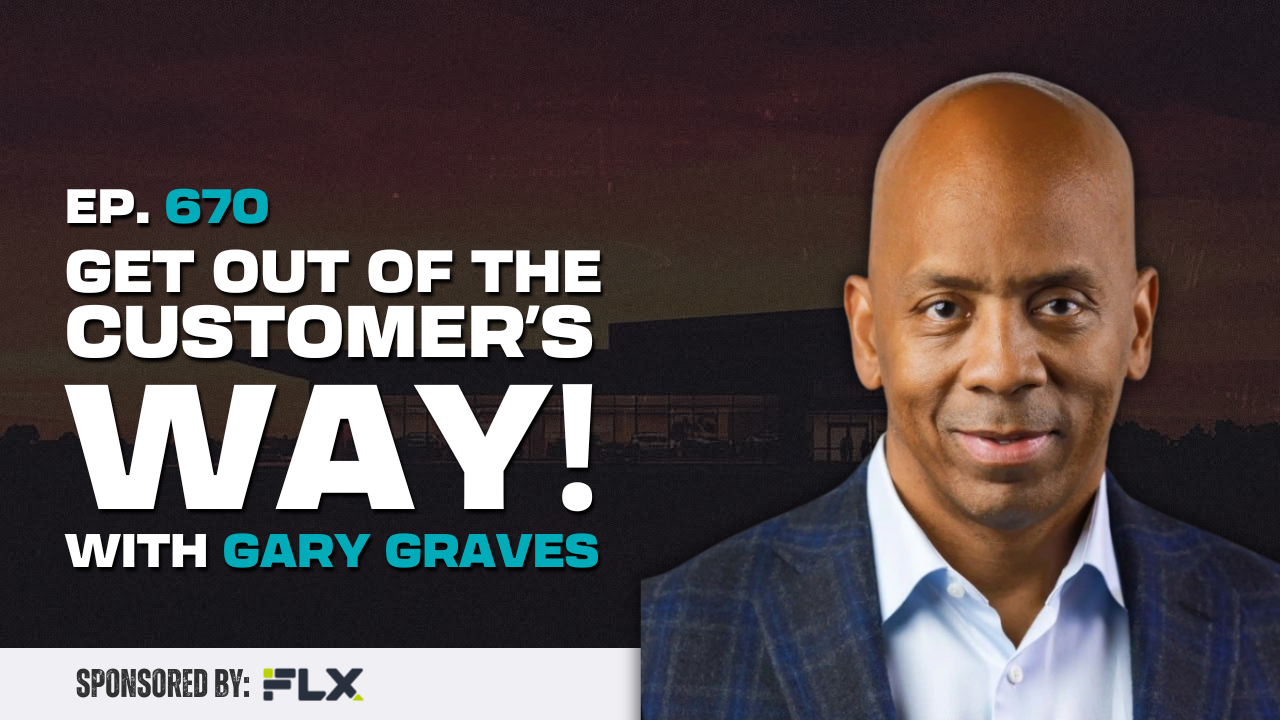
In this episode, my guest is Gary Graves, the kind of guy who can build a SaaS platform by day and grade a dirt road by night. One foot in the tech world, the other in the real one. Equal parts futurist and hands-on problem solver, he's spent years collecting and analyzing the conversations dealerships have with their customers—and the insights he’s uncovered are eye-opening.
We first aired this episode a while back, but honestly, it’s been aging so well we figured more people needed to hear it. The insights are still sharp, the stories still hit, and the timing feels just right.
Gary and I talk about what really happens on the other end of a dealership’s phone line—and what those conversations reveal about how we treat customers. You’ll hear why most CRMs still misunderstand the role of a phone call, how IVRs might be silently costing you business, and what dealers can do today to build actual loyalty—not just repeat transactions.
One of the things I love about this conversation is how practical it is. Gary doesn’t talk in circles. He breaks down what the data shows, what dealerships keep missing, and what it actually looks like to build a culture where customers want to come back.
If you’ve ever wondered why your customers don’t call back, or why some reviews sting more than others, this episode is worth your time.
Episode Brought To You By FlexDealer
Need Better Quality Leads? FLX helps car dealers generate better quality leads through localized organic search and highly-targeted digital ads that convert. Not only that, they work tirelessly to ensure car dealers integrate marketing and operations for a robust and functional growth strategy.
Watch The Full Episode
Prefer to watch episodes? Be sure to subscribe to our YouTube Channel and turn on notifications to get full access to our content.
Episode Transcript
MC: 0:00
(Episode Sponsor)This episode is brought to you by FlexDealer.
Gary, thanks so much for joining me on the Dealer Playbook Podcast. My pleasure to be here. So you said you've got a story and I got to know it. We'll get to the cellos and the stringed instruments in a minute, because I think that could be a whole different podcast. Oh for sure, but I'm curious what was your journey? Did you do a trust fall, like most of us, back into the auto industry? How did you get into doing this and then founding, being a co-founder of Total CX?
Gary: 0:41
Yeah, I made a wrong turn. It was a total accident. I was in the process of conceiving and building a real estate CRM. This is 18 years ago, so I mean never got back to it but effectively, my partner had started in telephony and at the time he had needed some help, and he found me and I was doing consulting to keep the lights on while building my real estate CRM, and I found what he was into is basically call tracking marketing lines really, really basic calls from customers that are calling in to purchase something. That's information CRM is supposed to contain.
Gary: 1:30
So I decided to build my own telephony platform and ultimately partnered with Jack BR, who's still my current partner, and we entered the automotive space with the likes of who's Calling, callsource and some of the other ones that are no longer here Very, very crowded space. We depreciated ourselves, though, by partnering with CRMs, that we're the first telephony company that brought Click to Call to automotive, with dealer ups back in and Sales Edge actually back in. I think it was like 2006. Everyone was scared to touch it at that time because of pending regulations with the FCC about federal communications and recording calls and all that, but we we dare to to do so.
MC: 2:26
Yeah, I mean, uh, I think it was Dr Willie Jolly, who's a Sirius XM radio host. He's like you, you've got to be willing to do something ridiculous if you want to go where you want to go. And certainly I hear you. I mean there and I love this about automotive, by the way cause, like anytime there's a regulation that comes down the pipe, we're all like what are we going to do? Is this going to change our entire business? You just forayed into it. You were like, screw that, I'm going. Yeah, head first.
Gary: 2:54
Yeah, absolutely, and it created an interesting dynamic, ultimately because my partner he has a long, long background in telephony, hosted and cellular PBX systems, and he came to me one day just with his knowledge of the industry. He said, gary, why can't we record every call? There's nice systems and these other companies and Fortune 500 that do this, why can't we do that? And I'm like, well, we can. I didn't know that that's something that we wanted to do this. Why can't we do that? And I'm like, well, we can, I didn't know that that's something that we wanted to do.
Gary: 3:27
So we ended up creating an appliance, total Track, that effectively taps the calls of a dealership, all of them inbound. Outbound Somebody picks a call up the phone to order a pizza. We got that call personal call service, parts sales, et cetera. Interesting problem, though, because now you have a quarter million minutes of audio. What are you going to do with that? Who's going to listen to that? Nobody. So we partnered with Google in 2017, because telephony data is low bandwidth, meaning low resolution audio. It's not like hey, siri or Google. There's probably a device in my house that's going to respond now, but that's high fidelity, and most models were trained by Google and Apple using high fidelity audio, whereas telephony audio is low bandwidth. So we partnered with Google and provided a lot of low bandwidth audio in order for them to train their models, got a really sweet deal, and it allowed us to now extract content from recordings, because we knew what was being said. And this is the trajectory of how we started with telephony and then redefined the purpose of our existence, since we have so much intimate data around the.
Gary: 4:43
You know, with the car dealership, how many times they call back when they're frustrated, upset, when they start cussing. You know it's. It's. My favorite, though, um is when the customer reminds the salespeople that they're a customer. It's like I'm the customer here. You hear that Like that's just like red lights, bells whistles, defcon one. For sure, but's just like red lights, bells whistles, def CON 1. For sure, but it happens way too often, entirely too often.
MC: 5:11
I was going to ask you about this because now you're opening up. Dare I say, probably at the time we felt like dang Gary he's opened up a can of worms. We didn't have metrics or data on any of this stuff. It was always there, but we just weren't collecting anything. Now, all of a sudden, to your point, you're collecting all of these data points. You know how many customers just woke up on the wrong side of the bed and they're swearing right out of the gates, versus the ones that had to be provoked to a point of cursing and flipping tables over and stuff. Let me ask you this when did you make this correlation Like? There's actual data to be seen here and I guess what are some of the common things you notice that cause us to get in the customer's way and maybe deter them from working with us?
Gary: 6:06
us to get in the customer's way and maybe deter them from working with us. So I'm going to speak to the data part first and I'm going to call it a problem. It's a data problem and the problem is that ignorance is bliss. And the other problem is that the CRM companies we all know who they are they were designed from the start with the wrong concept of a phone call. They designed their systems to think that a phone call is a lead and it's not. It can be but it's not. It can be but it's not.
Gary: 6:46
So now, when we came to market with our products, a lot of CRM, like we broke CRMs because we had too much data. We made their call buckets irrelevant because we had all the calls and they're like we don't want all the calls, we only want the calls where people are calling to buy a car. And I'm like CRM, right, customer? Hey, we'll do that, we'll do that and I mean they've gotten better. But the other problem is like on the dealership side is now you have all this information but you don't have number one, a role in the dealership, a person, a job description, who has the authority to police or champion the customer experience across departments, because the sales cycle for a consumer buying a car is longer than you think. It's not just you know, once the financing is done and they got the keys, no, it continues, service recalls, their kid buys a car, their mom, their cousin coworker, et cetera. So that's why you want relationship for all those branches that it'll create. But there's no one today enrolled, prescribed in a dealership that would use our system at its full capacity, because it's cross-departmental and it's kind of the equivalent of a game warden, meaning a game warden can go wherever a game animal can go without a warrant. So if the deer's in your backyard, a game warden can go in your backyard. So that's kind of like that.
Gary: 8:21
So the things that you notice are the things that are like the boil to the top. Like just blatantly obvious is when the customers complain to the dealership about the experience they had prior. So meaning, yeah, I've been on hold for 21 minutes. Then I hung up and called back. So now you have a customer who's called. The original intention of the call was to satisfy a need the oil change. I want a car, I want this car available. What's the price? How much will you give me for my trade? And it went from that to now. The first thing that they want to share with you is how bad they've been treated. So it's no longer about what the intent of the call was, it's about you know. You just totally ruined my day, like I have a life to live and I want to do this now. No-transcript.
MC: 9:17
Yeah, how often is this happening from?
Gary: 9:20
what you can see. It happens entirely too often. It happens so often in fact now. So I mean, we all know what happened during COVID and inventory, and customers were buying cars sight unseen. So the level of customer service that needed to be provided to generate a profit lowered extremely. Right. They fell back on their laurels. Now you know that time is over. It's time to get back to work.
Gary: 9:56
Dealerships coming to us, because it starts at the top but it's implemented at the bottom, meaning the way a dealership operates is a direct reflection of the mentality of its owners and leaders, the soldiers that are on the field taking the calls and scheduling appointments. Their directive is given to them by them. And if it's profit only if it's profit driven, that'll be reflected in how fast they try to move from person to person, deal to deal, et cetera. If it's quality driven, now you'll have a more hands-on white glove type service where they're actually catering to the relationship. But you see that and this is stuff that's able to be monitored, measured, reported upon, which is a prerequisite to actually having deliberate improvement in those areas.
MC: 10:52
(Sponsor Ad Mid-roll)Hey, does your marketing agency suck? Listen before we hop back into this episode. I know you know me as the host of the Dealer Playbook, but did you also know that I'm the CEO of FlexDealer, an agency that's helping dealers capture better quality leads from local SEO and hyper-targeted ads that convert? So if you want to sell more cars and finally have a partner that's in it with you that doesn't suck, visit FlexDealer.com. Let's hop back into this episode.
Have you ever tried to get help in a Home Depot lately? There is no, but I'm convinced nobody works there anymore. You stand in the aisle and it's not even for a small purchase. You're like I'm about to buy a whole appliance package. I'm going to buy, I'm about to drop five grand in this place, or 10 grand or whatever, and you can't. And so what do you start doing? You start walking around, you start looking for somebody. 10 minutes into this activity, you forgot why you even came to Home Depot, so you just leave. And, to your point, as I'm listening to you, this is exactly what we just did.
MC: 11:55
The pandemic made us soft. Because it was so easy. People were laying down on everything. Because it was so easy, people were laying down on everything and also to that, just to put a bow tie on my little rant here now that I'm enraged is you have, dare I call them COVID babies, covid the pandemic this last time period. That was their foray into the car business. They have no other reference point from before and they think this is the norm. And I'm telling you, dude, that freaks the crap out of me, because now we're moving into 2024 and nobody, you know we do what we always do. This is an indication that we're all getting old. We start to speculate about what's the new year going to bring Right. Start to speculate about what's the new year going to bring Right. But let's go back to what you're talking about here, which is how much effort right, tell me about this how much effort the customer actually has to put in now to get what they want? Seems like it's it's increasing significantly.
Gary: 12:59
You know it. It significantly it is. I'll tell you a story that's quite in the line with your Home Depot rant. I'll give you a little one of my own. I was in Lowe's. I'm a Lowe's guy. I don't do Home.
MC: 13:16
Depot. You're not the first one that's tried to convert me to that side of the aisle. I'm just saying.
Gary: 13:22
Hey, so I bought an air filter, right, and it was, like you know, $120. Air filter is like on sale for 80 bucks. Get to the self checkout lane, scan it, it rings up to 120 bucks. Lady's there, I'm like you know, this isn't ringing up right, it's like $89. She's like well, I can't just take your word for it. You need to go, get a picture and bring it back to me, and I use my favorite line. I'm the customer. You need to get on the phone and talk to somebody and to have them go, and I'll be right here. So she expected me to exert effort to spend money with the company and that's what you see here. So I'll see if you know this one. Thank you for calling ABC Motors. Please hold.
MC: 14:12
I start to gnash my teeth.
Gary: 14:14
So I didn't wait for acknowledgement or you to say actually yes, I didn't care. I mean, that might as well just be a recording for us, for that matter.
MC: 14:23
Sure.
Gary: 14:24
But at the gate effort. So now the effort that's required from you from the very first phone call is patience. So now you, you, you dial the number, phone rang, they answered, you spoke to someone, and they tell you look, you're not important, I'll be back with you when I, when I, when I have a moment. Now they hit an IVR Okay, one for sales, two for service, three for parts. Most people just hit the button that's going to give them a human, because if they hit service, they're going to be put on hold for a long time Right to sales, or I'm going to hit the zero and have the operator call and go that way. So now they're trying to game the system in order to get better, faster, responsive service, in order to spend money with the brand Again, effort. So every transfer, every hold, every time they have to repeat their intention of calling exerts effort If it's a callback, meaning they had to call back again.
Gary: 15:33
91% of people who have to make a second call for the same issue end up frustrated, upset, dissatisfied or they just abandon the process altogether and take their business elsewhere. And this is real data that we've extracted from the conversations that our dealers have with their customers. We were able to see this and we're able to advise them and say, hey look, you have a problem here. And some dealers are like, okay, tell me what to do, what do I do here? And those are the ones that we're able to help, but some just don't want to do it. That we're able to help, but some just don't want to do it. They just don't have an interest in having a person answer the phone that can help someone.
MC: 16:19
I don't figure. It's like right out of the gates. We don't even realize it, see, because we've been sold that this is going to make our systems and processes more streamlined. Right, the IVR is going to be able to help us handle more in the same amount of time, because it's going to handle the distribution of the call. We've been convinced that this is the case. Never once, though to your point, have we looked at it from the customer's perspective and said but what is the impact of putting these systems in place on the customer experience? What are you seeing? So patience, so, right out of the gates, we're asking them to be patient, even though they're already been patient, because they had to show up every day to go to work to earn the money that they're now willing to spend with you, and that took time. So we're already months into this process, but we don't think of it in that light. What is the other impacts that you've picked up on that you're noticing?
Gary: 17:19
I'm going to answer that, but I had to go back because you said something very, very important Customer perspective, looking at it from their perspective, and that's what we call the CX mindset. It's an inverted model. Most people, even software systems, model the way the business looks at the customer. That's not useful for the customer and it's not inherently useful for the business either, for that matter. For marketers I could see to a degree. But the inverted side how does the customer view the business and how do you measure and monitor that? And we can get into that later.
Gary: 18:04
But the biggest indicators that you know there are issues are you issues are abandoned calls, and these are things that can be detected by any call tracking company or phone system administrator who has a little bit of coding skills or write a query.
Gary: 18:26
You just look at how many people call me multiple times in a day and then you drill down into those situations and you'll find some issues that you need to resolve. The length of calls people who have calls that are 15, 20 minutes long. There's almost never any situation or any conversation that you need to have with a car dealership if you're not a bank or an insurance company that will last that long. So any calls that are exorbitant long 10, 15, 20 minutes, 20 plus minutes there's something going on there, probably a lot of hold time, because there's just not that much to talk about. It's not a personal call, there's not that much to talk about. So those are also things that you see. But ultimately the biggest indicators are when they go to the Better Business Bureau or the Attorney General's office or your Google, my Business page or some of the other social arenas where they're able to spout off and say, well, look, they didn't care about my business, they didn't care about me as a consumer, and that feeling is hard to overcome once it's ingrained.
MC: 19:41
What do we do about this? As you work with dealerships, what's the first thing you recommend Because it sounds like there's quite a bit of consistency across the board and how things currently work. When you come in and you say, okay, here's the new plan, here's the first thing I need you to do, what do you find that common recommendation is the first thing?
Gary: 20:02
is to lose the IVR. Thank you for calling. Please hold. Don't make your receptionist your receptionist or the person who's handling your phones, who's answering you know, that pot of gold that you spent to get the phone to ring Shouldn't be your lowest paid employee, should not like Now you're turning things on their head.
Gary: 20:28
So if you put something and it can't just be one person, especially if it's a very popular brand. I mean you have to look at call volume Now if you really want to get disruptive. And what I would do if I were a dealer principal, what I would do if I were a dealer principal, I would have my service advisors be cross-functional and I'll tell you why. The majority of calls to a dealership are to service. So, no matter what, even if you have the most charismatic, great bed manners, if you want to call it that on the phone, like who answers the phone, she's still going to have to transfer them because she can't help it. All she can do is feel their, understand what they're calling for and then direct them. So when she does that, that's already the first effort for them because now it's a break in their process of getting resolution. So now imagine if you would and I know service advisors are busy, I know that. So this is a pie in the sky. It could happen, but I know there's other considerations. So imagine this though calling the dealership and a service advisor answers the phone, this. So thank you for calling abc motors, I can help you. Yeah, I need to speak to somebody as service, my car, blah, blah, blah. Okay, what's the last eight of your event and you're into it.
Gary: 22:02
When has that happened ever where someone called a dealership and immediately got into the issue? That was the intent of their call. But it can. And when it comes to changing the paradigm and like Amazon and Hyundai are trying to do, if that process just becomes so seamless that the relationship doesn't matter anymore, or if dealer principals and subsequently the managers and subsequently the advisors and salespeople continue to treat people like numbers, then the relationship won't matter anymore, and that's when that type of transacting becomes desirable. If you want to return something at Amazon, you put it in the box and you take it back to the local Kohl's or whatever that's it. You don't talk to customer service. It's just purely transactional and there's no relationship necessary. And I'm not suggesting the cards would be done like that. My point is is that when the relationship is so bad that it doesn't matter, things like Amazon and Hyundai's deal become palatable.
MC: 23:13
Is this part of just rounding things out as we start to wind down? Is this part of what you're talking about, or what you call the CX mindset?
Gary: 23:22
It is. It is I, along with my colleagues, my business partner, all of my employees, our partners, are trying to change the minds of the people in automotive, to change the way they think about their customer.
MC: 23:39
What's the impact of that? So we know the impact of making customer wait. What's the impact of adopting the CX mindset, this empowerment relationship-based mindset?
Gary: 23:50
Well, the first thing is that you now have, I guess, the equivalent of biofeedback, meaning you have an instant understanding of your posture as it relates to the way your customers view you. That allows you to be responsive and deliberately develop that to the benefit of you both, because it needs to be a mutual benefit. The customer is happy and the deals are structured right and their experience was great. Long-term, that customer becomes loyal and what loyalty gives you is referrals, unsolicited reviews and all that makes you the most desirable selection.
Gary: 24:33
If there are competitors in the brand, the consumer process goes and compares the inventory. Because you have something you want and that store doesn't have it, you're not going to shop there. So you're locked in on the vehicle and people buy for different reasons. But if you have that that's the vehicle you want, that trim level, that feature set and that dealership has it, then it's the only one in the country. Yeah, you're probably going to buy there. But if you're just going for a Honda Accord or Hyundai Genesis and you can get it pretty much anywhere, it's going to come down to ratings to say hello, it's like what's their ratings, how are other consumers rating them? And then it'll go into their own personal experience. So by providing good experience and seeing how your customers are responding to it, it'll give every dealership the best chance at the best possible outcome, which would be to transact and to convert that customer into a loyal customer. I love it.
MC: 25:27
I love it, this conversation, I love this kind of stuff because this is like this doesn't cost you any extra money to change the way you build relationships and provide a customer experience. You know what I mean. Like everybody out there is the shiny, this and the. The guru over here said that it's like or, and hear me out care about people you know, care about the experience. I mean we could go down so many more tracks here. Certainly would love to have you back on the show, gary. How can those listening or watching connect with you?
Gary: 26:00
You can connect with us at TotalCXcom on any of the social channels you know LinkedIn, facebook, instagram, etc.
MC: 26:08
Gary Graves thanks so much for joining me on the Dealer Playbook Podcast. My pleasure. Take care, mike.
(Outro) Hey, thanks for listening to the Dealer Playbook Podcast. If you enjoyed tuning in, please subscribe, share and hit that like button. You can also join us and the DPB community on social media. Check back next week for a new Dealer Playbook episode. Thanks so much for joining.