"$400 A Transaction" — Boosting F&i Profit With Data-driven AI | Adam Marburger, CEO at Ascent Dealer Services
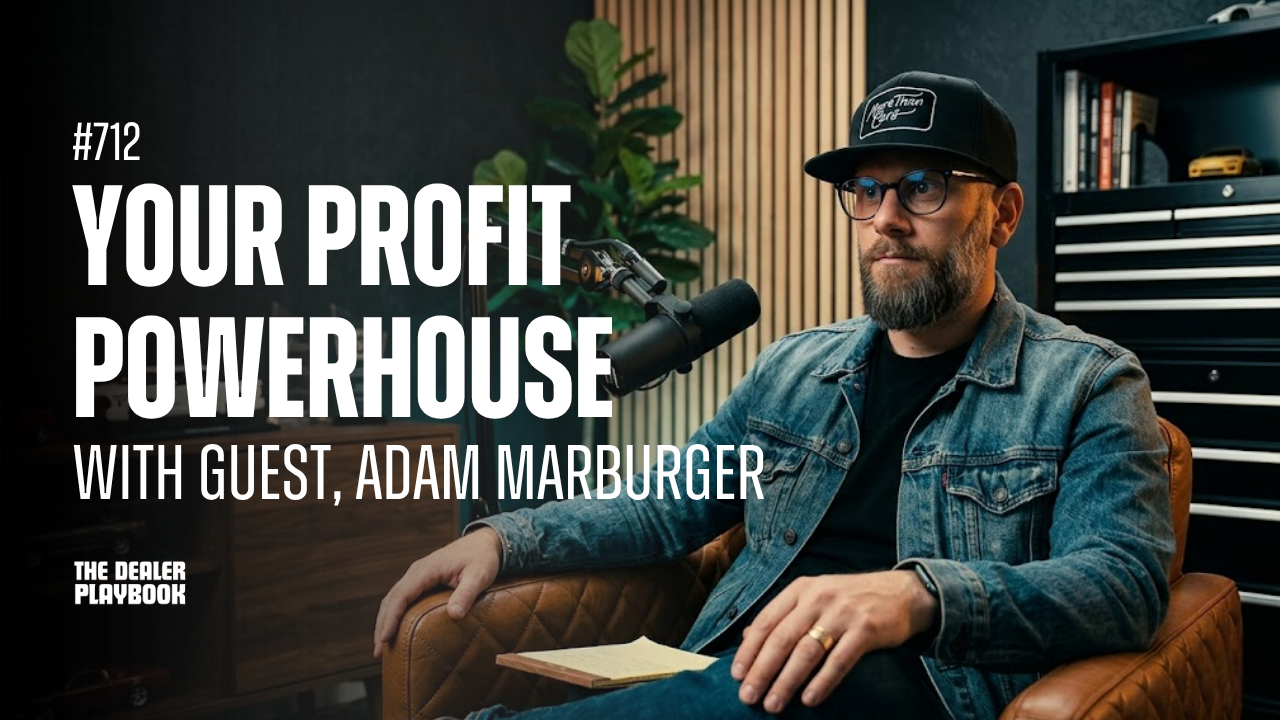
In this episode, automotive F&I expert Adam Marburger reveals how leveraging data and accountability is generating a nearly $400 lift in F&I PDR per transaction for dealerships. Discover how top-performing dealers aren't chasing the next shiny object, but instead focusing on human capital and systematic processes to protect and grow their bottom line.
What you will get from this episode:
Understand why F&I is now a retention and profit center for your dealership.
Learn how to identify and fix overlooked process gaps in your F&I department.
Discover how AI isn't just hype—it's a powerful tool for F&I accountability and coaching.
Strategies for investing in your team to drive consistent F&I performance and dealer growth.
Why accountability, even when it "stings," is the key to unlocking hidden revenue.
Adam Marburger, CEO at Ascent Dealer Services, brings years of experience in automotive retail and F&I training to help dealers optimize their profit centers.
Follow The Dealer Playbook so you never miss an episode.
Timestamps
00:00 Intro
01:08 Why F&I Matters Now
02:21 Retention Through Relationships
03:13 Scripts vs Real Connection
04:28 Process and Accountability
05:36 Why Accountability Hurts
07:53 Growth Mindset Over Time
11:27 Avoiding Work With Shiny Tools
11:54 AI That Enforces Process
13:42 One Shift Protect Margins
15:29 Connect and Wrap Up
15:45 Podcast Outro
Episode Brought To You By FlexDealer
Need Better Quality Leads? FLX helps car dealers generate better quality leads through localized organic search and highly-targeted digital ads that convert. Not only that, they work tirelessly to ensure car dealers integrate marketing and operations for a robust and functional growth strategy.
Watch The Full Episode
Prefer to watch episodes? Be sure to subscribe to our YouTube Channel and turn on notifications to get full access to our content.
Episode Transcript
[0:13] Michael Cirillo: All right gang, welcome back to this episode of the Dealer Playbook Podcast, here at the Auto Media Marketplace booth together with iHeartMedia Automotive. I have one of my favorite people — the one and only Adam Marburger. Thanks so much for coming back and joining me on the Dealer Playbook.
[0:28] Adam Marburger: Always like hanging out with you, my friend.
[0:30] Michael Cirillo: Dude, you know what I love about you? You have the ability to articulate what you do in a way that not many people can. It's not even the gift of gab, because I relate the gift of gab to people that just BS. You don't BS. You tell it how it is. And why it's inspiring for me — if I could just give you a genuine compliment — is because I love speaking with people who know what they know. And you know what you know, especially when it comes to finance and insurance, the whole process, dealership operations. That's what we're going to be talking about.
[1:08] Michael Cirillo: I want to kick it off with this first question. With margin compression across the store, why does F&I become more important now, not less?
[1:19] Adam Marburger: Because we need to maximize. The F&I department has two functions. First, it's a retention center. In the past we used to look at F&I as: stay compliant, do the transaction, maximize the gross profit. But the reality is, our job is to do those things while also getting our customers happily engaged in service so they come back and buy another car.
[1:52] Adam Marburger: Why is it more important because of margin compression? Because we've got to pick it up in F&I. And it's more important right now because Disneyland's over. We're way past the COVID era. We're competing at a high level and we've got to perform in F&I. Dealers are singing the same tune. Across the country, dealers are paying more attention to their F&I office now than I've ever seen.
[2:20] Michael Cirillo: This is a true story. The last time I bought a vehicle, I built a deeper relationship with the F&I manager than I did with the person who was supposed to sell me the car. The next time I went to buy a vehicle, I went right through the showroom floor and knocked on his window. I said, "I'm back. Do you still have all my information? I want that one." What I really appreciated is that he remembered who I was, despite being at a massive volume store selling 850 cars a month. He said, "Hey Michael, what's going on, bud?" The throughput of what I'm hearing you say is: yes, you can get them into service, but it's going to happen through relationship.
[3:13] Adam Marburger: Exactly. And another thing — back in the day we were given fancy word tracks and scripts. You say this, I say that, and you're just going to close. That doesn't work anymore. It's relational. People make decisions based on previous experience. People make decisions in the F&I office based on their previous transaction. What was that like? What was the F&I department like at their previous dealership?
[3:45] Adam Marburger: A lot of times F&I people just want to get the customer in and out. We need to slow down, get to know our customer. Objections are real, they come, but they're a lot easier to overcome when you build a relationship and you're selling based on what the customer truly needs and wants. It's about them, not about us. When we can be relational in the F&I office — which a lot of us are now — we're going to get higher CSI scores, retention goes up, and guess what else goes up? Profit. We make more money when we care.
[4:18] Michael Cirillo: It's the age-old thing. Money is the recognition that value has been received. You want more money? Provide more value.
[4:26] Adam Marburger: Right.
[4:27] Michael Cirillo: That's what I'm hearing. So let me ask you this. I know you're very involved in training, and I can only imagine the number of dealerships you go into that have similar challenges. What are you finding, through the lens of training, is something that is often overlooked and can't be ignored anymore?
[4:48] Adam Marburger: Wonderful question, and it's a very easy one for me to answer. When I see a performing F&I department — the ones that are getting it done — they have the culture, they have servant leadership throughout the house, and they have defined processes that are held accountable.
[5:05] Adam Marburger: Processes are not the sexiest thing to talk about, but they are the most critical piece of the equation. The dealers that are falling short do not have a written process, and what exists is not being held accountable. The stores that are winning right now are dialed in. Their processes are duplicatable, trainable, coached on, and held accountable. That is what is overlooked and missing in the stores that underperform.
[5:36] Michael Cirillo: Why are people afraid of accountability?
[5:37] Adam Marburger: I don't know, because it stings a little bit. I have a coach myself. I'm kind of afraid of her. You might know her — Danielle Delgado. I'm not afraid of her exactly, but I don't want to let her down. We have like-minded individuals that hold each other accountable. But it stings if you've never participated in that kind of accountability before.
[6:07] Adam Marburger: It's sometimes unnatural. It's unnatural for some people to be held highly accountable.
[6:22] Michael Cirillo: Do you think it stems from how we're raised? Some PTSD from being pushed too hard? I'm trying to get to the root cause. Are we afraid of change? Are we afraid of success?
[6:39] Adam Marburger: Change is uncomfortable for most people. And a lot of us have had bad experiences with managers — drill sergeants, mean-spirited leadership. That can rub people the wrong way. But then when you get the right one — I ran into my old GM recently. His name is John Aaronson. I pulled him aside and gave him what I consider the best compliment I've ever given anyone. I said, "John, I speak on accountability all the time. You held me accountable at the highest level when I was a rookie F&I manager, and without you on me constantly, I wouldn't be where I am today. I want to thank you for that."
[7:45] Adam Marburger: He was a micromanager, no question. But he loved me and he cared. He wanted what was best for me, and he made sure I did what I was supposed to do.
[7:53] Michael Cirillo: Is it one of those things where you either have the right mindset or you don't? What separated you at that time? Because I know your story, the things you've recovered from. What was it in you that said, "Despite being micromanaged, I'm not going to use that as an excuse"?
[8:15] Adam Marburger: In my 20s, I didn't like accountability. I didn't appreciate it and I didn't respect it. In my 30s, I grew up. Life events, having kids, getting a little older — you grow into appreciating accountability as you age. In my 20s I was too immature and wasn't ready. As I got older I started looking at things differently. And when you take on more responsibilities and manage more people, you understand. You look back and think, "Now I know why John was so hard on me. He saw something in me that not many people did at that time."
[9:07] Michael Cirillo: It was actually an act of love, not micromanaging. He saw something in you and knew what it was going to take. It's almost like trying to develop your teenage son — sometimes you have to be direct. And with accountability comes growth.
[9:45] Adam Marburger: Absolutely.
[9:45] Michael Cirillo: Acceptance of not liking your current circumstances is a motivator for change. I've been doing blood work. I've put a lot of work into getting in shape. It was the data that held me accountable. Because I was so unhappy with my current state, I paid attention to it. The accountability became a motivator for action. I had to take ownership — for 20 years I put effort into not taking care of myself. There's no way out of that other than owning it.
[11:03] Adam Marburger: There comes a time in your life where you get sick and tired of yourself. You get sick and tired of the BS you feed yourself. Because nobody can BS you like you can BS yourself. And it gets to a point where you say, "Something has to change."
[11:27] Michael Cirillo: This leads me to my next point. In an effort to avoid accountability and doing the things that truly matter, we start looking for new tools, new AI, new everything. So what are you seeing from an F&I perspective when it comes to new tools and AI? Is it avoidance? Is it looking for a shiny object to solve real problems?
[11:54] Adam Marburger: AI is a word we're all throwing around nonstop and honestly it's getting annoying. Now, I am an investor in an AI company in the automotive space. And I will tell you, this is not a shiny object. The big public dealer groups are embracing this tool. What makes it valuable — and I'm not going to over-endorse it, I'll just baseline it — is that it allows us to put our process into the AI tool. It records F&I transactions. It tells us when F&I managers skip steps. It catches situations like a cash deal five minutes before close where the manager skips the customer interview and the menu presentation. From a coaching standpoint, it gives us the ammunition to identify exactly where each F&I manager needs development.
[12:56] Adam Marburger: These AI tools also allow F&I managers to role play live in real world scenarios. I'm genuinely excited about it.
[13:18] Michael Cirillo: So you've moved from shiny object skeptic to impactful adopter.
[13:23] Adam Marburger: We are using it and we are getting almost a $400 lift in F&I PVR with the tool. Four hundred dollars a transaction. We have the data. So yes, I have adopted it, I have embraced it, and we are holding it accountable as an agency right now.
[13:41] Michael Cirillo: I love this. As we move into my last question — for the dealer principal, general manager, or sales manager listening right now, if they were going to make one adjustment to protect margins, what is that one shift they should be implementing in their store today?
[14:00] Adam Marburger: The shift to protect margins is to invest in the human capital within the four walls of your store. Protect your good people. Work to develop those who can be developed. It is all about your people. Coaching and mentorship on a never ending basis. I see a real lack of genuine coaching out there. The investment we make into our human capital is what is going to change everything.
[14:23] Michael Cirillo: This resonates deeply. Our CTO said one of the greatest misses in this industry would be failing to invest in human skill sets. You're saying the same thing — invest in your people.
[14:46] Adam Marburger: Because if you don't, someone else will. I wake up every single day with the mindset that somebody out there wants to take everything I have. I have wonderful partners and teammates, and there are people who want my team. I'm not allowing that to happen. So I pour into my team and love my team on a never ending basis. Not just through bonuses, gifts, and trips — but through real mentorship, guidance, and leadership.
[15:22] Michael Cirillo: You will be a better person as a result of investing in the right machine — your people — versus going through this alone. Adam Marburger, how can those listening and watching connect with you?
[15:33] Adam Marburger: Find me online — LinkedIn and Facebook. I'm pretty easy to find and I respond to everybody.
[15:40] Michael Cirillo: This is my pal. You see why I love this guy so much. Thanks so much for joining me on the Dealer Playbook. I appreciate you.
[15:44] Adam Marburger: Thank you. Good man.
[15:46] Michael Cirillo: Hey, thanks for listening to the Dealer Playbook Podcast. If you enjoyed tuning in, please subscribe, share, and hit that like button. You can also join us and the DPB community on social media. Check back next week for a new episode. Thanks so much for joining.