David Spisak Weighs In on How Amazon AutoS Move Is Reshaping the Future of Car Buying
For decades the car buying rhythm was predictable. Trade in, trade up, repeat. It felt like the ritual of progress.
But 2025 isn’t following the script. Something has shifted in the psychology of car buyers across North America. It’s not just interest rates or inventory levels. It’s something deeper — a quiet realization that “new” doesn’t always mean “better.”
Amazon’s Quiet Entrance into Automotive Retail
Right now you can visit Amazon, type “Hyundai,” and go through the full purchase process. The checkout feels no different than buying a blender or a TV. You click, confirm, then swing by a local dealership to pick up your car.
No haggling. No waiting for “manager approval.” No 3 to 6 hour Saturday ordeal.
This new experience doesn’t just make buying easier. It reshapes how customers think about the dealership.
Amazon’s initial rollout launched with Hyundai, listing new vehicles in 48 U.S. cities by late 2024. The company says this is only the beginning, with more brands and cities to come.
The Early Data Is Eye-Opening
Here’s where things get interesting for dealers. Amazon is bringing its data engine to the car buying process.
According to Amazon’s 2025 Automotive Report, EV purchasers spend an average of 241 days researching before buying. That’s just over eight months. It reinforces what Amazon leaders shared at the 2025 Presidio Auto Tech Summit — that the company can detect buying signals long before a customer ever walks into a dealership.
Amazon has also expanded its program to include used and certified pre-owned vehicles in major markets. Customers can browse, compare, and complete much of the process before visiting the store.
Amazon’s Perspective: A Win for Everyone
At the summit, Amazon leaders didn’t sound like conquerors. They sounded like collaborators.
They said their goal is to “partner with dealers and brands to redesign car shopping, making it more transparent, convenient, and customer-friendly.”
From their perspective, Amazon reduces friction, connects dealers with motivated buyers, and lowers selling costs. To them, that’s a win for everyone.
Of course, it’s easy to see why dealers still feel cautious.
Dealers Are Split
Some early adopters are already listing inventory on Amazon — both new and used. The expansion into used vehicles is especially interesting because it opens a much larger audience.
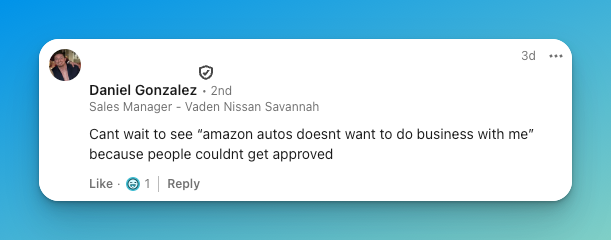
Others are waiting to see how it plays out. They worry that customers may begin to associate the buying experience more with Amazon than with the dealership itself.
Here’s where David Spisak’s perspective hits home:
“If you don’t have one authorized and approved process in your sales floor, you have twenty.” — David Spisak
He’s right. The dealers that win in this new environment are the ones who build consistent, trusted processes that meet the customer where they are — online or in-store.
Amazon isn’t hiding its ambitions. More brands and markets are already in the pipeline.
Why This Matters for Every Dealer
Amazon isn’t just competing for buyers. It’s reshaping expectations.
The typical car purchase still involves multiple showroom visits, long wait times, and F&I surprises. But research shows that one poor experience can erase years of loyalty.
Forty-five percent of automotive customers say they would switch brands after a single bad visit. That’s not an industry trend — that’s a warning.
Transparency, speed, and digital convenience aren’t optional anymore. They’re the new cost of entry.
For a dealership, this means the value proposition must evolve. It’s no longer about “we sell cars.” It’s about “we make buying cars easy and trustworthy.”
As Spisak puts it:
“You’ll find that most top-performing used car places never put more than two grand in a car. Why? They’ve figured out that if you want to maximise gross, you don’t do it one deal at a time. You do it by maximising turn.” — David Spisak
The same principle applies to customer experience. Dealers that increase the turn of trust and simplicity win more business over time.
A Wake-Up Call Disguised as Innovation
Amazon Autos isn’t just a new platform. It’s a mirror.
It shows dealers what customers have been craving all along — transparent pricing, quick transactions, and fewer surprises.
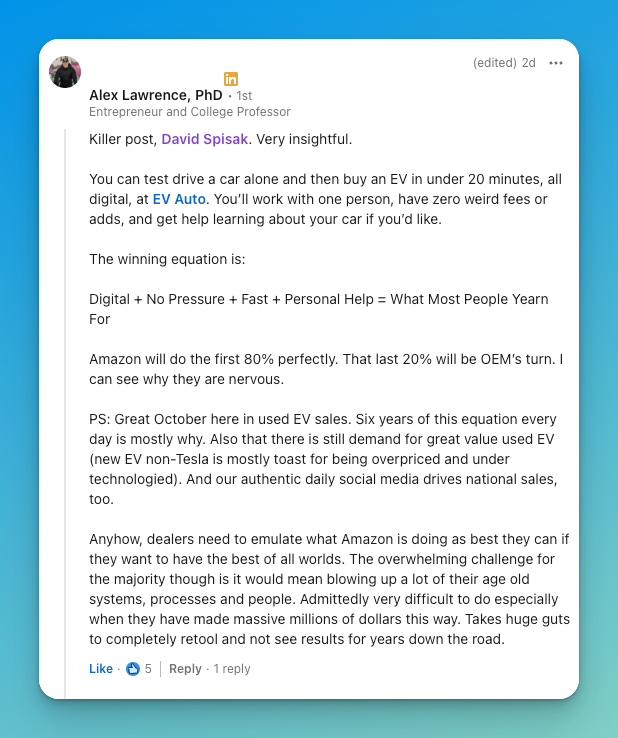
The trigger isn’t online shopping alone. It’s data and behaviour. The eight-month decision cycle proves that buyers want space, not pressure.
Dealers who embrace this shift will build digital retailing systems that feel effortless. Those who ignore it risk becoming little more than pickup points for cars purchased elsewhere.
The Bottom Line
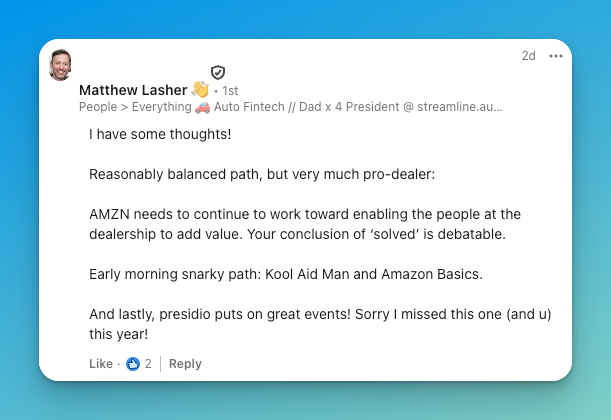
You can debate whether Amazon’s move is disruption or collaboration. But it’s happening.
And for millions of customers, it’s not a vision of the future. It’s an open tab in their browser right now.
Because Amazon has made buying a car feel as simple as buying anything else.
And that changes everything for dealers focused on value, trust, and the long game.